
The Measured Weight of Cold Iron: A Novel of True Sovereign Restraint

CHAPTER 1: THE FRICTION OF THE BLOCK

The industrial wash house smelled of stale bleach and the scorched, metallic heat of commercial ironers. It was a heavy, rusted scent that clung to the back of the throat like dried lime dust. John Vance did not look up from the folding table. His fingers, calloused and thick from thirty years of hard labor and older duties, smoothed the rough seam of a standard-issue orange jumpsuit. Every crease had to be precise. In the desaturated light filtering through the reinforced mesh windows, the fabric looked almost brown, stained by the iron-heavy well water that ran through the facility’s pipes.

To his left, the floorboards vibrated with the low, off-balance thudding of a heavy-duty extractor. It was a rhythm Vance calculated automatically—four beats of a mechanical skip followed by a long, scraping drag. He knew every loose bolt in the foundation. He knew exactly how much oil the main flywheel was losing by the distinct, burnt-sugar smell drifting from the motor housing. Survival in the tier did not belong to the loudest voice; it belonged to the man who measured the wear and tear of his surroundings before the metal finally snapped.

“He’s not hearing you, Ox,” a voice rasped from the dark corridor near the steam pipes. It was Marcus, his stocky frame silhouetted against the wet heat of the drying racks. He was leaning against a support pillar, his hands tucked deep into his pockets, eyes shifting toward the far end of the folding line where the air grew noticeably colder.

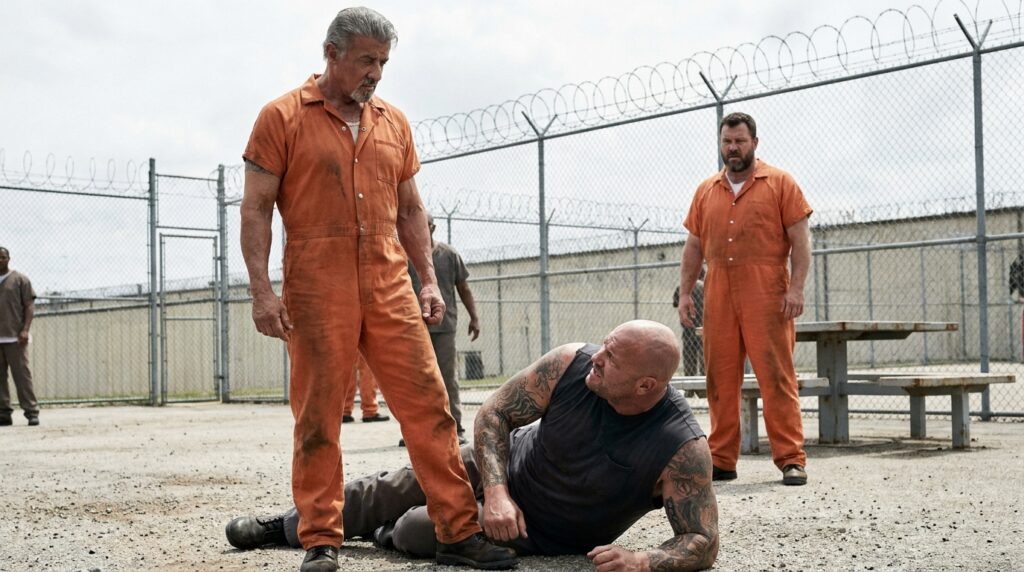
Brody Miller moved into the light of the single unshielded bulb. The skin of his bald head was slick with sweat, the massive ink-work on his forearms twisted into dark, illegible knots as he flexed his fingers. He didn’t walk; he crowded the lane, his heavy work boots dragging through the gray dust on the concrete. He stopped less than two feet from Vance’s table, his shadow blotting out the desaturated glare from the window.

“The old man hears fine,” Brody said. He slammed a heavy, rust-spotted iron flat down onto the neatly folded stack Vance had just finished. The impact sent a small cloud of dry lint into the air between them. “He just thinks if he keeps his eyes on the thread, the rest of the world goes away. I told you three days ago, Vance. Your crew doesn’t use the south tables anymore. You’re occupying space that belongs to people who actually have a purpose in this block.”

Vance stopped his hands. He did not pull away from the table, nor did he look into Brody’s eyes. Instead, his gaze remained fixed on the tattooed skin of Brody’s wrist—noting the slight tremor in the radial artery, the subtle tilt of the younger man’s weight toward his right heel. A classic brawler’s stance, overcompensated by raw mass. Underneath his own sleeve, the frayed remnant of the gray military bootlace pressed hard against Vance’s pulse point. He breathed in through his nose, holding the hot, chemical air for three seconds before letting it out.

“The tables belong to the state, Miller,” Vance said, his voice low and dry, like gravel turning over in a shallow stream. “And the state says everyone gets an hour of air. Go back to your tier.”

Brody leaned over the metal table, his chest nearly touching the iron. “The state isn’t down here on the concrete, old man. Your time out here is done.”

Vance reached out to pick up the next jumpsuit, his movement deliberate and slow. But as his fingers brushed the coarse cotton, his eye caught a small, bright glint tucked inside the collar of the garment Brody had just slammed down. It was a brass collar pin—not correctional issue, but a specific, dual-pronged military insignia from an active domestic infantry brigade. The metal was clean, completely devoid of the rust that coated everything else in the block.


CHAPTER 2: THE ANATOMY OF A LEVER

“You looking at my laundry, old man, or are you looking for a way out?”

Brody’s voice was too loud for the narrow corridor of the wash house. It bounced off the lime-encrusted boiler jackets, flat and heavy.

John Vance didn’t lift his fingers from the coarse cotton collar. His thumb pressed against the cold, crisp edge of the brass prongs hidden inside the hem. It was an infantryman’s pin—specifically the 10th Mountain division, crossed rifles over a stylized ridge. The plating wasn’t even tarnished by the sulfuric steam of the prison water. It had been slipped into the lining recently. Probably within the last two hours while the bins were stacked in the staging area outside Tier 3.

Vance didn’t look at the pin again. He didn’t need to. His mind mapped the weight of the metal, comparing it to the standard correctional stencils used on the uniforms. Someone was marking him. Or worse, someone was making sure Brody knew exactly who he was standing across from.

“I asked you a question, Vance.” Brody stepped closer, the thick rubber soles of his work boots grinding a stray piece of laundry soap into white powder against the gray concrete. He smelled of industrial grease and cheap tobacco, a sharp, unwashed odor that cut through the chemical fog of the steam extractors. “You got a lot of opinions about the south tables for a guy who doesn’t even talk to his own cell boss.”

Vance let his hands slide off the orange fabric, leaving the jumpsuit flat on the rusted iron plate of the folding table. He adjusted his posture by an inch, sinking his center of gravity back toward his left hip, away from the loose drainage grate near his heel. The rusted iron pipes running overhead dripped once every twelve seconds, a rhythmic tink against the tin shield of the light fixture.

“The laundry gets delivered at four, Miller,” Vance said. His voice stayed level, stripped of the gravelly heat Brody was trying to pull out of him. “If your boys don’t have their blues by lockup, Sergeant Harris is going to deduct the yard time for the whole tier. You want to explain that to the floor?”

Out of the corner of his eye, Vance watched Marcus shift his weight against the support pillar. Marcus wasn’t a fighter, but he was an accountant for the local block economy. He knew the exact value of an uninterrupted hour in the sun. Right now, Marcus’s eyes weren’t on Brody’s massive, tattooed forearms; they were fixed on the door behind Vance—the narrow entrance where the line guard usually sat with a wooden baton and a clipboard.

The guard wasn’t there. The stool was empty, the clipboard hooked over the wall thermostat. The absence felt like a deliberate space, cleared out like a ring before a bout.

Brody noticed the glance. A slow, ugly grin spread across his face, pulling the skin tight over his scarred jawline. “Harris is down in administration signing off on the commissary transfers. He’s going to be there for a while. We got all the time we need to settle where the grease goes in this block.”

Brody reached out, his massive hand coming down over Vance’s left shoulder—not a punch, but a heavy, controlling grasp meant to turn the older man toward the wall, to establish the physical boundary of the room. The fingers were thick, the nails split from the quarry detail, locking onto the orange cotton of Vance’s jumpsuit with the familiar arrogance of a man who had never met a joint he couldn’t break by leaning his weight into it.

Vance didn’t pull back. To pull back was to give the brawler the momentum he wanted, the space to swing that heavy right shoulder forward. Instead, Vance let his shoulder drop slightly, absorbing the initial press of Brody’s palm. His skin registered the friction of the coarse fabric against his old scar tissue—the small, raised line below his collarbone where a piece of mortar shell had settled thirty years ago in a ditch outside Mogadishu.

His internal monologue didn’t contain anger. It was a cold spreadsheet of mechanical leverage. Radius of the arm: twenty-two inches. Weight distribution: sixty percent on the leading toe. Guard intervention: zero.

“You’re crowded, son,” Vance murmured. His hand stayed down by his side, but his fingers uncurled, the hidden bootlace around his left wrist tightening against his skin as his forearm tensed.

“I’m exactly where I want to be,” Brody growled, his grip tightening until the seams of Vance’s jumpsuit began to pop with a dry, thread-snapping hiss. He began to twist his wrist, intending to force Vance down toward the low edge of the iron table, a standard compliance move used by the younger block enforcers to make an elder mark look small before the gallery.

Vance watched the light bulb flicker as the extractor generator hummed through its next cycle. He didn’t use his arms to strike. He simply shifted his left foot three inches inside Brody’s stride, locking his heel against the iron rim of the drainage grate.

Then he waited for Brody to pull.

The moment the younger man gathered his weight to drag Vance forward, Vance stopped resisting entirely. He didn’t push back; he accelerated the pull, driving his shoulder directly into the center of Brody’s chest while his right hand came up, flat-palmed, catching the underside of Brody’s chin with the solid, unyielding force of a hydraulic jack.

The physics were brutal because they were simple. Brody’s own mass carried him over Vance’s planted heel. The brawler’s boots lost their purchase on the wet concrete, the white soap powder flying into the air as his legs whipped out from under him. There was no theatrical struggle—only the sudden, terrifying sound of a two-hundred-and-forty-pound man losing his center and crashing backward into the rows of iron lockers lining the wash house wall.

The locker doors rattled, the rusted latches shrieking as Brody’s shoulder blades buckled the thin tin panels. He hit the floor hard, his head bouncing once against the concrete before his momentum died beside the grease trap.

Silence dropped over the wash house like a wet blanket. The only sound was the steady tink of the water pipe overhead.

Marcus hadn’t moved from the pillar, but his hands were out of his pockets now. His fingers were pressed flat against the stone, his mouth slightly open as he looked from the giant on the floor to the old man standing by the table.

Vance didn’t check his knuckles. He didn’t adjust his jumpsuit. He stood perfectly upright, his shoulders squared to the interaction lane, his breathing unchanged as he looked down at Brody.

Brody was struggling to find his breath, his eyes wide and unfocused as his hand clawed at the concrete for leverage that wasn’t there anymore. The arrogance was gone, replaced by the primitive shock of a predator that had just run into a stone wall.

Vance reached down, his movement smooth and unhurried. He picked up the orange jumpsuit Brody had thrown the iron onto. His fingers slipped back inside the collar, feeling for the brass infantry pin.

It was gone. The fabric had been sliced from the inside while they were locking arms.

Vance looked up toward the narrow window near the ceiling. A shadow moved behind the reinforced glass—the distinct, peaked outline of Sergeant Harris’s patrol cap, disappearing back into the dark corridor before the alarm could sound.

CHAPTER 3: THE INVENTORY OF FRICTION

The steam from the extractor took three full minutes to clear the space around the dented lockers. In that quiet, the only vibration was the mechanical skip-and-drag of the main flywheel. John Vance didn’t look down at Brody, who was now drawing ragged, wet breaths into a bruised ribcage, his heavily tattooed arms sprawled across the grease-slick tile.

Instead, Vance turned his face toward Marcus. The stocky inmate hadn’t taken a step toward the exit, but his boots were balanced precisely over the seam where the concrete block met the older brick floor. A professional runner’s choice.

“He’s going to need a cold compress from the dispensary,” Vance said. His voice didn’t have the rush of adrenaline in it. It carried the dry, mechanical rhythm of an inventory clerk checking off damaged crates. “And the laundry for Tier 3 still needs to go into the ironer.”

Marcus let out a low, whistling breath through his teeth. He reached down and picked up a dropped bar of industrial lye soap, his fingers slick with the white powder that had settled during the drop. “You didn’t just break his leverage, Commander. You broke his schedule. Brody’s boys are sitting by the security gate right now expecting him to walk out with your boots in his hand.”

“The gate hasn’t clicked yet,” Vance remarked, his eyes tracing the rusted iron casing of the ceiling conduit. “Harris is still down-tier. If the gate was going to drop, we’d hear the hydraulic fluid moving through the pressure valves.”

“Harris isn’t down-tier,” Marcus muttered, stepping closer until his shadow cut across the grease trap. He spoke with the quick, un-inflected subtext of a man who spent his life analyzing structural deficits. “He’s been sitting in the observation cage with the lights out since the noon whistle. I saw the logbook when I brought the morning sheets up. The line guard didn’t leave his post because of a commissary meeting, Vance. He got pulled by name.”

Vance’s gaze narrowed slightly, the hidden bootlace beneath his sleeve biting into his wrist as he tightened his fist. He walked back to the folding table, his boots making a faint, wet sucking sound against the lime residue. The orange jumpsuit he had been smoothing lay exactly where it had been before Brody’s hand crossed his space. The internal cut in the lining—where the brass 10th Mountain pin had been tucked—was clean, executed with the precision of a razor wire slice.

The pin was gone, but the impression remained in the stiff, unwashed cotton: two crossed rifles over three jagged ridges.

“Who handles the incoming laundry bags from the reception depot?” Vance asked, his voice dropping into the lower register that Marcus knew better than to ignore.

“The work detail changes every Tuesday,” Marcus said, his eyes darting toward the dented locker where Brody was finally pulling his knees toward his chest, his large bald head pressed against the cold iron panel. “But the delivery manifest always goes through Harris’s desk. Every rag, every sock, every piece of scrap that comes from the logistics depot in Denver. Why?”

Vance didn’t answer. He picked up the heavy flatiron Brody had slammed down. The base of the iron was pitted with black rust, but the handle was wrapped in fresh electrical tape—neat, parallel turns that didn’t match the loose, frayed maintenance style of the prison workshop. He turned the tool over, inspecting the small identification stamp near the cord entry. The serial number had been filled with gray lead solder, smoothed down until the metal was flush.

“This didn’t come from our block toolroom,” Vance murmured.

“Brody brought it from the machine shop three days ago,” Marcus said, his voice tightening as the low, distant groan of the main yard gate began to echo through the ventilation shafts. The sound was a heavy, metallic rumble, followed by two short clangs of the secondary safety bolts dropping. Clack-clack. “That’s the afternoon air call. They’re opening the main cages early.”

“They’re twenty minutes ahead of the bell,” Vance observed. He set the iron back down on the neat stack of blues, his posture returning to the rigid, spine-straight alignment that forty years of service had locked into his bones.

“Harris is pushing the line,” Marcus whispered, his eyes wide as the iron door at the end of the wash house corridor gave a short, high-pitched whine. The hydraulic fluid was moving now, a greasy hiss that meant the floor guards were moving into the staging area between the laundry and the tables. “He’s opening the yard before the count is cleared. He wants the whole block out there when Brody’s crew realizes he isn’t standing at the front of the line.”

On the floor, Brody let out a low groan, his fingers clawing at the bottom rim of the locker as he tried to pull his heavy frame upright. His face was gray, the dark ink on his arms looking dull against the sweat-streaked concrete. He looked up at Vance, the primitive panic in his eyes hardening into something more dangerous—the desperate focus of a man who knew that if he walked into the sun with his back covered in wash house dust, his life expectancy on the tier would be measured in hours.

“You… old bastard,” Brody wheezed, his jaw twitching where Vance’s palm had caught him. “You think you’re… untouchable because you used to have a title?”

Vance didn’t look back at him. He took three measured steps toward the wash house exit, his fingers lightly trailing along the flaking surface of the steam line. The pipe was scalding hot, the pressure gauge vibrating near the red line.

“Get up, Miller,” Vance said without turning around. “The gate is open. Let’s go see what Harris bought with that pin.”

The iron door at the end of the passage swung open with a heavy, ungreased shriek, revealing the bright, desaturated glare of the sun-baked yard outside. Standing on the concrete threshold, his silhouette framed by the coiled razor wire of the inner perimeter wall, was Sergeant Harris. His hands were tucked behind his leather utility belt, his face hidden beneath the stiff shadow of his patrol cap, waiting.

CHAPTER 4: THE THRESHOLD OF PRESSURE

Sergeant Harris did not move from the center of the iron frame. The sun behind him burned the concrete walkway to a stark, blinding chalk-white, casting a long, skeletal shadow down the wash house corridor. The heat radiating off the gravel outer lanes felt like a physical barrier, thick with the smell of scorched earth and bleached dust.

John Vance stopped three paces from the doorway. His breathing remained locked in the steady four-second cycle he had maintained since his boots first cleared the processing floor five years ago. He didn’t drop his hands to his sides, nor did he hide them in the pockets of his orange jumpsuit. He stood with his fingers relaxed but anchored, his weight balanced evenly over the coarse grain of the floor.

“You’re out of your sector, Vance,” Harris said. The brim of his peaked patrol cap stayed low, cutting a dark, straight line across his eyes. Only the tight, sun-hardened line of his jaw showed through the shadow. He didn’t look back into the dark toward the lockers where Brody was dragging his heavy bulk into an upright posture. “The wash house rotation belongs to Tier 4 after the half-hour whistle. You’re supposed to be at the concrete benches near the wire.”

“Manifest had my name for the afternoon sheets, Sergeant,” Vance said. His voice was flat, carrying the dry, unyielding grit of the yard dirt. “The logbook on the thermostat wall shows the allotment. I don’t move unless the clerk marks the slot.”

Harris let out a brief, dry sound that might have been a laugh if there were any humor in this tier. He shifted his belt, his leather holster creaking against the heavy brass buckle of his utility strap. “The clerk doesn’t sign off on transfers anymore. I do. And right now, the yard is waiting for you to complete your tier obligation.”

Behind Vance, the scraping sound of a heavy rubber sole against a concrete drain grate signaled Brody’s recovery. The giant was on his feet now, his breath coming in shallow, shuddering gasps that rattled through his massive chest. He didn’t try to close the distance. He stayed hidden in the gray, steam-thick shadows near the iron lockers, his tattooed forearm pressed flat against his ribs to hold his cracked structure together. He was waiting to see if Harris would call the line guard with a whistle.

Vance didn’t look back. His mind was already parsing the spatial parameters of the outer walkway. The distance from the laundry threshold to the first concrete picnic table was precisely forty-two yards. The razor wire along the inner perimeter fence sat twelve feet high, the barbs overlapping in rusted spirals that caught the glare of the high afternoon sun. At this hour, the shadow of the gun tower fell short of the benches, leaving the entire center lane exposed to the high-angle observation windows above.

“The gate is open early today,” Vance noted, his eyes tracking a tiny flake of peeling paint on Harris’s shoulder strap. “The count usually takes another twenty minutes before the safety bolts drop.”

“We’re moving the timeline up,” Harris said. He stepped back by an inch, clearing the doorway just enough for a single man to pass through into the blinding white light of the lane. “The administration doesn’t like backlogs in the yard corridors. Go find your table, Vance. Brody’s boys are already settled near the south fence. They’re expecting an accounting.”

Vance moved past the guard without a shift in his alignment. As his shoulder cleared Harris’s utility belt, he caught a sharp, familiar odor beneath the stale sweat and leather conditioner—the distinct, chemical signature of lithium grease mixed with fine weapon oil. It was the exact preservative used for long-term storage of military-grade small arms, an oil that had no place in the correctional department’s standard-issue maintenance bins.

Vance didn’t turn his head. He stepped onto the sun-baked concrete of the yard walkway, his boots absorbing the blistering heat of the stone.

The yard was unnaturally quiet for an early air call. Usually, the first ten minutes after the safety bolts released were loud with the shouting of block factions organizing their spaces, the heavy thump of basketballs against chain-link, and the collective drone of five hundred men locked in a cage. Today, the circle around the picnic tables was already formed.

Thirty yards out, three of Brody’s closest associates stood in a loose, triangular formation near the center benches. They didn’t have weapons out—the tower guards would have picked that up from the glass box—but their postures were rigid, their shoulders squared to the walkway lane like infantry pickets holding a crossroad. Marcus followed Vance out, keeping a four-pace buffer between them, his boots dragging through the dry dust at the edge of the concrete.

“He’s setting it up, Vance,” Marcus whispered, his eyes fixed on the gun tower forty feet above their heads. The long barrel of the Guard Sergeant’s mini-14 rifle was visible through the reinforced pane, but it wasn’t pointed down at the tier lane. It was resting on the sandbag ledge, tilted up toward the sky. “Look at the high watch. They aren’t tracking the line. Harris told them to drop focus before he unlatched the laundry.”

Vance kept moving forward, his pace steady, unhurried, tracking the friction of the dust beneath his soles. His mind did not drift to the threat in front of him; it stayed anchored to the pristine brass pin that had been sliced from the jumpsuit collar inside. The crossed rifles of his old unit weren’t a random taunt from an inmate gang. Brody wouldn’t know the difference between an infantry crest and a correctional badge.

Someone had given Brody that tool to use as an anchor. Someone wanted Vance to use his hands in the open sun, where every lens in the high watch could record the exact mechanics of his training.

“Vance!” a voice called from the south benches. It was one of Brody’s enforcers, a lean, scarred man with a shaved head and an old quarry brand on his neck. He stepped into the center lane, his hands dropping to the waistband of his orange trousers. “Where’s the Ox? He was supposed to bring the iron down ten minutes ago.”

Vance stopped ten feet from the concrete table. He didn’t look at the man who spoke. His eyes went straight to the weathered wooden surface of the bench, where a clean, printed copy of the institutional transfer log lay weighted down by a chipped piece of red brick.

The manifest was open to page three. At the very top of the column, printed in the sharp, official ink of the federal logistics depot, was his own service serial number—a classified sequence that had been deleted from the public database before he was even processed into this block.

CHAPTER 5: THE GRAVITY OF RECOGNITION

The heat-cracked timber of the concrete picnic table radiated a steady, blistering warmth that warped the air directly above the document. John Vance stood over it, his shadow falling across the printed numbers on page three.

The three digits—followed by the double-letter operational code he hadn’t seen since a cold tarmac exit in Germany—were clean. They weren’t a photocopy. The black toner had been stamped into the fibrous, recycled paper by a federal machine, the ink crisp and thick enough to catch the fine white dust drifting off the recreation lanes.

“You’re in my lane, old man,” Brody’s voice cut through the dry silence.

The heavy, uneven drag of his boots had caught up. Brody moved into the blinding glare by the fence line, his massive arms swinging awkwardly, his dark sleeveless top stained dark with wash house sweat. He didn’t have his crew at his back anymore; they were holding their triangular spacing ten yards back, their eyes darting nervously from Brody’s bruised jaw to the unmoving glass booth of the gun tower.

Vance did not look up from the manifest. His left thumb remained tucked under his cuff, his skin registering the coarse friction of the gray bootlace wrapped around his wrist. Every parameter of the yard was shifting. The rifle barrel in the upper watch window remained tilted toward the clouds, completely stationary. Sergeant Harris had gone silent, his long shadow retracted inside the dark corridor of the laundry building behind them.

“The lane belongs to whoever can keep it, Miller,” Vance said. His voice was a thin, dry scratch against the drone of the facility’s exhaust fans.

“It’s not just a lane anymore,” Brody growled, stopping three feet away. His breath was shallow, hitching against his damaged ribs, but his large knuckles were white where he gripped the chain-link mesh. “The Sergeant said you were a ghost. He said if someone pulled your file from the basket, the whole block would get restructured. New cell bosses. New distribution slots. He gave us the numbers, Vance. Your numbers.”

“Harris is an administrative clerk with a badge,” Vance murmured, his eyes finally moving from the page to Brody’s face. He noted the wide, frantic dilation of the younger man’s pupils. This wasn’t the calculation of a prison enforcer protecting a black-market route. This was the blind, kinetic momentum of a man who realized he had been loaded into a weapon and pointed at a target he couldn’t see. “He doesn’t have the clearance to pull these records from the cellar. He was handed that file.”

“I don’t care who handed it to him!” Brody stepped forward, his massive build throwing a dense shadow over the table, obscuring the paper. He reached out with a wide, desperate sweep of his left arm, attempting to grab Vance’s collar and drag him across the wood—a reckless crowd-out driven by the raw panic of his exposed position in the open sun. “Alright, I’m done playing the quiet rotation with you!”

Vance didn’t retreat into the chain-link behind him. To fall back was to lose the solid grounding of the concrete walkway. Instead, he dropped his center of gravity by two inches, allowing Brody’s heavy wrist to brush the top of his shoulder.

In one fluid, economic movement, Vance pivoted his right hip into the curve of Brody’s stride. He intercepted the sweeping arm at the elbow joint with a flat-handed check, leveraging the brawler’s forward momentum while his left foot stepped sharply behind Brody’s leading heel.

It was the exact defensive technique from the wash house, executed with the cold precision of a mechanical press. Brody’s weight carried him over the block. His boots skidded across the sun-baked dirt, his balance completely breaking as his shoulder sheared against the heavy iron edge of the picnic bench.

The impact was loud—a dull, fleshy thud followed by the high-pitched metallic ring of the iron frame warping under his mass. He went down hard into the gravel beside the fence line, his back pinned against the rusted barbs of the bottom wire, stripped of all leverage.

The yard frozen. Across the concrete lanes, the low hum of casual conversation and the rhythmic thump of basketballs stopped instantly. Marcus stood forty feet away, his stocky frame locked in mid-stride near the staging gate, his jaw tight as he watched the biggest brawler in the tier look up from the dirt.

Brody didn’t try to stand. He stayed grounded, his fingers clawing at the dust, his chest heaving as he stared up at the older man standing upright over the lane, his shoulders squared, his posture completely undisturbed. The massive tattoos on Brody’s arms looked pale under the gray layer of yard dust.

He looked at Vance’s eyes—steady, unblinking, and entirely clear of anger—and then he looked at his own crew, who remained frozen in their triangular lanes, refusing to step into the sun.

“Alright,” Brody croaked, his voice tight and compliant against the chain-link. “Alright, I’m done.”

Vance didn’t speak. He reached down and picked up the paper manifest from the wooden table, his fingers smoothing out the crease Brody’s shoulder had made. As he turned the page, a new line of text at the very bottom of the document caught his eye—a hand-written notation in blue ink, signed not by the prison warden, but by an active-duty colonel within the Department of Defense logistics command.

The notation read: Isolation Protocol Alpha verified. Subject containment sequence under continuous monitoring. Asset remains offline.

Before Vance could process the ink, a sharp, metallic click echoed from the wall behind him. The secondary safety bolts on the main tier gate didn’t open—they slammed shut, the heavy iron crossbars locking down with a deafening thud that cut off the recreation yard from the cell blocks. Above them, the gun tower window slid open with a screech of ungreased metal, and the long barrel of the mini-14 rifle finally dropped, pointing directly at John Vance’s chest.

CHAPTER 6: THE TACTICAL TRUCE

The cold grease-stained muzzle of the mini-14 rifle hung perfectly still in the square gap of the gun tower window. John Vance didn’t raise his hands. His boots remained anchored over the concrete edge of the walkway, his left forearm muscle slightly twitching beneath the rough cotton of his sleeve where the gray bootlace stayed tight.

He didn’t look up at the glass box. He knew the precise angle of the trajectory—forty feet elevation, a thirty-degree downward sweep, the safety catch already toggled to the second notch based on the dry, dual click that had vibrated down the iron support pillars.

“Step away from the table, Vance,” Sergeant Harris’s voice mechanicalized through the wall-mounted paging horn. The sound was distorted by dust in the diaphragm, flat and tinny against the low rumble of the block’s main generator. “Keep your hands clear of the manifest.”

Vance didn’t pull away immediately. He let his fingers trail over the hand-written signature at the bottom of page three, feeling the slight indentation the blue ballpoint pen had left in the fiber of the paper. Asset remains offline. The notation wasn’t a warning to the prison guards; it was an order.

He stepped back exactly one pace, leaving the printed manifest weighted under the chipped red brick.

Beside the fence line, Brody Miller was breathing in short, rattling gasps, his heavy frame curled into the gravel. His eyes shifted from Vance’s boots to the locked iron crossbars of the tier gate. The gate was a solid block of zinc-plated steel, four inches thick, its locking pins driven into the reinforced lintel by a hydraulic piston that required an administrative key from the central office to reverse.

Brody’s three associates had dropped their triangular spacing. They were backed against the concrete wall of the bathhouse, their palms pressed flat against the flaking mortar, their faces pale under the desaturated glare of the afternoon sun. They knew the rules of a tower lock. If a rifle muzzle dropped below the horizontal plane, the next sound wasn’t a warning siren; it was a copper-jacketed round clearing the fence line.

“The gate isn’t opening, Sergeant,” Vance said toward the paging horn. He didn’t shout. He spoke into the open air, knowing the directional microphone on the catwalk railing was sensitive enough to catch the gravelly grit in his voice. “The count hasn’t been logged in the main ledger.”

The rifle barrel stayed steady for six seconds. Then, with a slow, heavy clack of the steel receiver mechanism, the long cylinder rose by three inches, the muzzle tilting away from Vance’s chest back toward the gravel perimeter lane outside the wire.

The window didn’t slide shut. The Guard Sergeant behind the glass simply leaned back into the shadow of the tin roof, his hand leaving the stock of the weapon. There was no whistle. No alarm. No tactical response team moving through the inner sally port with plastic restraints and batons.

Marcus stepped forward from the staging gate, his boots making a faint scraping sound in the sand. He stopped five feet behind Vance, his face dark with sweat. “They aren’t coming down, Commander. Harris isn’t calling the shift.”

“He can’t call the shift,” Vance murmured, his eyes tracking the thin oil slick dripping from the base of the tower pillar. “If he files an incident report for a yard fight, the manifest has to be attached to the logbook. The warden would have to send the file to the state circuit clerk.”

“The state doesn’t have this file,” Marcus whispered, his eyes widening as he looked down at the hand-written notation on the table. “I’ve run the digital balance sheets for every high-security transfer that cleared the Denver depot since ninety-eight. There’s no operational allocation for a deep-cover unit in this facility’s budget. Someone is carrying the cost of your cell on a completely separate ledger.”

Vance reached down, his movement slow enough for the tower watch to track, and took the brick off the paper. He didn’t fold the sheet; he rolled it into a tight, hard cylinder, his fingers tucking it into the interior waistband of his trousers, beneath the orange fabric where the guard searches rarely checked during a standard tier return.

Brody managed to pull his heavy bulk up against the iron post of the table. His sleeveless shirt was torn at the seam, the raw skin of his shoulder scraped red by the concrete edge. The arrogance had been completely ground out of his face, replaced by the primitive focus of a brawler who realized the ring he had been fighting in didn’t have any ropes.

“You knew,” Brody wheezed, his hand holding his ribs as he looked up at Vance. “You knew Harris wasn’t… going to drop the block.”

“Harris wanted an eruption, son,” Vance said, his voice flat as he turned toward the locked tier gate. “He needed you to create enough smoke in the yard to justify a total block isolation. If this tier goes into a permanent lockdown, no one enters the laundry lines. No one signs the manifests. The asset stays offline because the door stays shut.”

Vance walked toward the heavy steel crossbars of the gate, his boots regular and rhythmic against the hot stone. He didn’t wait for Harris to use the paging horn again. He stopped six inches from the iron mesh, his gaze fixing on the small, square inspection port at eye level.

Behind the glass, the corridor was entirely empty. The line guards had been withdrawn to the secondary barrier forty yards back, leaving the entire floor of Tier 3 isolated between the wash house and the wire—a silent, unwritten truce designed to see who would survive the pressure before the keys turned again.

CHAPTER 7: THE RECOVERY OF CORROSION

The iron mouth of the main laundry chute was jagged, its inner lining rimmed with flaking rust-scale that scraped like small files against the fabric of John Vance’s jumpsuit. The air inside the vertical shaft was stagnant, heavy with the suffocating warmth of trapped lint dust and the bitter, burnt-oil exhaust of the lower industrial boilers.

Vance worked in absolute darkness. His left arm was extended deep into the cold zinc casing of the secondary sorting block, his fingers tracking the structural seams with a blind, systematic touch. His center of gravity was braced against the iron rim of the hopper, his boots wedged into the floor molding to prevent his weight from sliding down into the gravity drop below.

He didn’t use a flashlight. A beam of light inside the metal ventilation network would have painted a bright, unmistakable target through the loose louver panels for the guards patrolling the catwalks. His thumb pressed against the hidden bootlace around his left wrist, checking his baseline pulse. Sixty beats. Steady.

“Vance,” a hoarse whisper echoed from the base of the folding table outside. It was Marcus, his voice hushed and thin as it strained through the hollow echo of the chute. “The patrol team just cleared the third tier intersection. Harris gave them five minutes to check the padlocks on the wash house door, but they’re moving fast. They aren’t counting the lines; they’re looking for the gap.”

Vance didn’t answer. His knuckles brushed a sharp, foreign lip inside the clean-out box—something that didn’t belong to the smooth, mechanical assembly of the gravity latch. It was flat, wrapped in heavy structural plastic that felt cold and greasy against his sweat-slicked fingers. He hooked two fingertips over the binding wire, his muscles tensing as he dragged the dead weight out through the narrow clearance of the service frame.

The package came free with a dry, metallic screech of sliding tin. Vance lowered his weight back onto the concrete floor of the wash house, his boots absorbing the shock without sound. He didn’t unwrap the plastic immediately. He carried the bundle over to the low shadow of the boiler jacket where the high watch windows couldn’t angle down through the reinforced glass.

Marcus moved in close, his hands white where he gripped the iron pipes. “Is that the inventory from the reception depot?”

Vance cut the binding wire with the sharp edge of a loose locker latch. Beneath the heavy plastic layer sat an official, leather-bound institutional logbook. The gold-leaf letters on the cover had been scraped away with a razor, leaving only a scarred, gray indentation in the leather fabric, but the internal pages were intact. They weren’t prison records. Every line was typed in the dense, small font of a military logistics manifest—specifically the Department of the Army’s strategic intelligence asset tracking division.

Vance turned the pages under the faint, desaturated glow that filtered through the louvered panels. His eyes ran down the columns, his internal monologue translating the technical designations automatically. This book wasn’t a record of contraband or prison transfers. It was an operational record tracking a single high-value tactical asset over a ten-year cycle.

“Look at the dates, Vance,” Marcus whispered, his finger pointing at a series of red stamps near the center margin. “The entries stop exactly forty-eight hours before you arrived at the front gate. And look who authorized the closure. It’s Harris’s signature, but the command routing code isn’t for the state penal system. It’s an active operational channel out of Fort Meade.”

Vance’s thumb flattened against the page. His eyes locked onto a detailed timeline that mapped the exact movements of his former commanding officer, Colonel Thomas Bradley. The final entry, written in the crisp, official ink of a secure command call, was dated only three weeks ago.

The text read: Asset perimeter verified under Layer 1 defense protocol. Local prison authority (Harris) has initiated gang-level containment to simulate standard tier instability. Decoy conflict established to satisfy external surveillance sweeps by regional actors. Real identity hidden behind block restructuring initiative.

The realization landed with the cold, heavy weight of an iron press. The entire conflict with Brody Miller hadn’t been an institutional failure or a simple gang overreach. It was an engineered smoke screen. Harris hadn’t leaked his records to Brody out of corruption; he had been ordered to create a high-profile, localized turf war in the yard to provide a plausible, violent explanation for why John Vance was locked in a maximum-security cage, completely hidden from the world.

The decoy secret was the gang pressure. The real truth was that this prison was a deep-cover vault, and Harris was the vault keeper making sure the door remained too loud and too dangerous for anyone outside to look through the glass.

“They aren’t trying to break you, Vance,” Marcus said, his voice dropping into a panicked, ragged register as the low, rhythmic hum of the main corridor gates began to vibrate through the floorboards again. Thump. Thump. That wasn’t the air call. That was the sound of a full tactical squad moving in with heavy body shields and iron batons. “They’re trying to make sure you look like a common tier convict before the state inspectors clear the outer perimeter tomorrow. If you don’t fight Brody’s crew again when they open the gate, the decoy falls apart.”

Vance slowly closed the logbook, his fingers sliding it back into the interior lining of his orange jumpsuit, right next to the rolled manifest from the yard table. His jaw set into a hard, unyielding line that matched the rusted surfaces of the iron tables around him. He didn’t look at the door where the guards were approaching. His eyes went back to the high window of the gun tower.

The rifle barrel wasn’t pointed at the sky anymore. It was lowered, its long steel receiver resting flat on the sandbag ledge, tracking the narrow corridor that led from the wash house to the central sally port.

Before Vance could adjust his footing, the iron door at the far end of the passage shrieked as a heavy hydraulic key turned in the casing. The lock didn’t release—it broke with a sharp, explosive snap of shearing metal as the entire frame was forced from the outside. A single figure stepped through the dust cloud into the desaturated light of the corridor, his boots heavy, his gray civilian coat unbuttoned to reveal an old, tarnished operational coin hanging from a steel chain around his neck. It was the same insignia Vance had worn into the dirt thirty years ago.

CHAPTER 8: THE HORIZON OF LOGISTICS

“Stand down, Commander. The asset tracking manifest is officially closed.”

The voice didn’t belong to the prison administration. It was low, raspy, and carried the dead, un-inflected cadence of an operations center. The man in the gray civilian coat stepped through the pulverized mortar dust of the door frame, his heavy leather boots crushing the flaking chips of rust that had peeled from the hinges. He didn’t carry a correctional baton or a riot shield. His right hand remained tucked loosely inside his coat pocket, his weight shifted slightly onto his back heel—a neutral, deceptive stance that Vance recognized within a single heartbeat.

Vance didn’t release his hold on the rolled leather logbook beneath his orange jumpsuit waistband. His skin, dried and stained by the industrial laundry lye, registered the precise friction of the frayed bootlace wrapped around his left pulse point. The light filtering through the high ventilation louvers cut across the space in desaturated, dust-thick beams, highlighting the tiny copper coin that hung from the newcomer’s neck chain. It was an old tactical logistics medal from the Somali deployment, its edges notched and blackened by years of sweat and zinc grease.

“You’re three weeks behind the schedule, Miller,” Vance said. His voice was an even, gravelly rasp that barely rose above the low hum of the lower boiler pumps. “The tracking sequence was marked closed when the reception depot signed the entry in Denver.”

The newcomer stopped five paces from the boiler jacket. He didn’t look at Marcus, who had backed his stocky frame entirely into the shadow of the steam lines, nor did he glance down at Brody Miller, who was still groaning in the dirt outside the iron sally port. His eyes—pale, unblinking, and entirely dead—stayed fixed on Vance’s silver goatee.

“The Denver ledger was a dummy loop, John,” the man said softly. He pulled his left hand from his pocket, revealing a small, scratched metallic cylinder—not a weapon, but a secure, dual-frequency decryption key used by the Department of Defense intelligence units to verify deep-cover asset containment. “The Colonel didn’t put you in this block to hide you from the state circuit court. He put you here because the foreign tracking team cleared the border checkpoint in Newark six days ago. They aren’t looking for a military legend. They’re looking for a broken line convict serving twenty years for a freight yard robbery.”

The absolute silence of the block seemed to dilate, stretching the space between them into a slow, frozen calculation. Vance’s mind mapped the parameters with a cold, kinetic clarity that stripped away the entire illusion of his incarceration. The five years he had spent folding coarse cotton sheets, measuring the vibrations of industrial flywheels, and absorbing the casual degradation of block enforcers like Brody hadn’t been a punishment. They were a systematic extraction. His old commanding officer, Colonel Bradley, had engineered the entire sentence to place his most lethal survival asset behind four feet of reinforced federal concrete, buried beneath layers of bureaucratic noise that no foreign intelligence network could parse.

The physical reality of his environment felt heavier now, every rusted surface and corroded hinge acting as an anchor for a deep-cover network that extended far beyond the wire. The Guard Sergeant, Harris, hadn’t been an adversary; he was the local operational handler. He had used Brody’s gang to generate a plausible, violent disturbance in the open yard to satisfy the satellite surveillance sweeps that were currently monitoring the prison’s thermal footprint. The crossed-rifles pin tucked into the jumpsuit collar wasn’t a threat—it was a signal that the perimeter had been compromised from the outside.

“The brawler was never the target,” Vance murmured, his fingers finally relaxing against his pulse point.

“Brody was the smoke,” the man in the gray coat replied. He set the decryption cylinder flat on the rusted iron plate of the folding table, right over the damp stain where the flatiron had rested. “If you hadn’t dropped him in front of the high watch, the tracking team wouldn’t have believed the profile. They needed to see an old man struggling for space in a tier row. But the asset is out of the vault now, John. Harris has cleared the vehicle lane behind the laundry chute.”

Vance looked up through the iron louver panel toward the gun tower box. The long barrel of the mini-14 rifle was rising again, its steel frame clicking as the Guard Sergeant returned the weapon to the horizontal safety rest. The hydraulic whine of the main perimeter gate began to echo through the drainage shafts—not the sharp, sudden clang of a tactical lockdown, but the deep, continuous groan of an authorized administrative exit sequence.

Vance reached down, his movement deliberate and smooth, and picked up the decryption key from the table. The metal was cold, smelling faintly of weapon oil and transit grease. He didn’t look back at the cell block or the folded uniforms he had spent years organizing. The uniform changed, but the training never left. He stepped over the shattered iron frame of the door, his boots regular and rhythmic against the grit, walking directly into the gray, unyielding light of the loading lane where his true horizon was waiting.

Similar Posts

Leave a Reply

Your email address will not be published. Required fields are marked *






