
The Steady Pulse of a Silent Guard: A Story of Fractured Peace and Recovered Grace

CHAPTER 1: THE INCLINE OF INTERVENTION

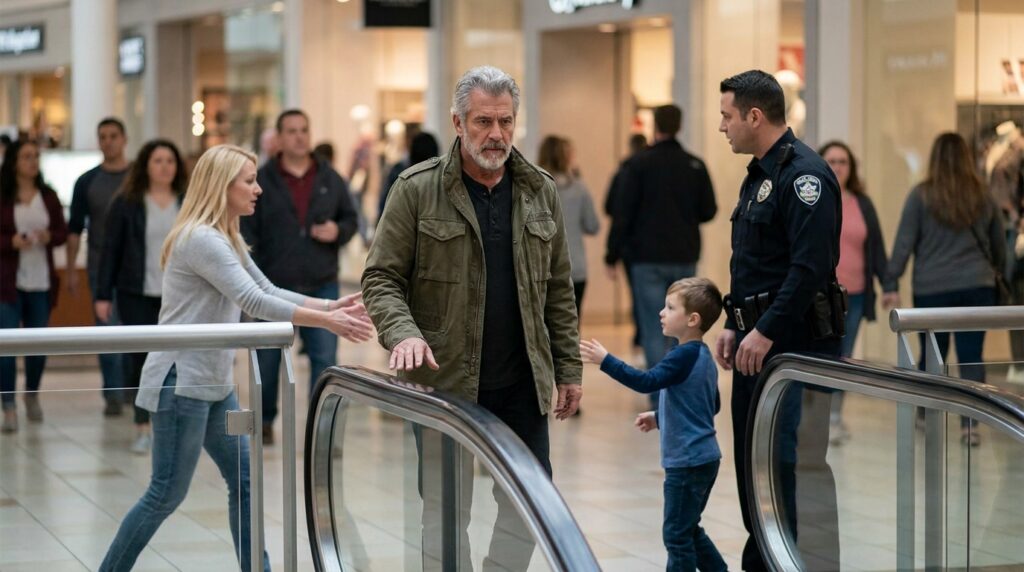
The hum of the mechanical escalator stairs was a steady, rhythmic vibration beneath Arthur Vance’s heavy leather boots. It was the kind of low-frequency drone that usually allowed a sixty-two-year-old man to disappear into his own thoughts, but today, the air inside the Ridgefield Galleria smelled too thick with sweat and cheap cinnamon. From his position halfway down the descending incline, Arthur’s eyes didn’t look at the bright window displays of the upper levels. They were fixed entirely on the bottleneck formatting at the ground-floor landing.

Below him, the polished terrazzo floor reflected the harsh, white glare of fluorescent mall lights like ice. A row of black nylon stanchions had been pulled across the access lane, and behind them stood Tyler. The young security guard was athletic, his navy blue uniform freshly pressed, but his shoulders were hunched forward into a rigid, defensive block. He was a kid playing a part, his hand nervously hovering over a leather radio casing as if it were a sidearm.

“I said stay behind the line!” Tyler shouted again, his chest swelling as he stepped closer to a frantic, blonde woman in a light gray top.

Elena was shaking. Her fingers clutched the velvet rope divider so hard her knuckles were the color of chalk. “My son is right there! Toby! Just let him walk across!”

Arthur watched the child. Toby was small, maybe eight years old, his blue long-sleeve shirt twisted at the collar where Tyler had gripped him moments before to stop him from running. The boy was crying without sound, his face wet, his small sneakers sliding slightly on the slick tile. The surrounding crowd of weekend shoppers had already begun to freeze in place, their consumer indifference melting into a sharp, expectant tension. Several people dropped their shopping bags, their hands diving into pockets to pull out smartphones. The lenses rose in unison, a silent jury catching the light.

Arthur’s hand didn’t leave the rubber handrail. His tarnished silver wristwatch ticked heavily against his wrist, measuring the seconds. He didn’t feel anger; he felt the cold, familiar calculation of a man who had spent three decades sorting out human terrain under canvas tents and mortar fire. He saw the fraying edge of the guard’s discipline. He saw the danger of a crowd that was beginning to turn into a mob.

The escalator carried Arthur closer, the metal steps flattening out as they approached the floor. He didn’t look at the crowd. He didn’t look at the crying boy. His eyes locked onto Tyler’s profile, tracking the pulse jumping in the young man’s neck. Arthur adjusted the collar of his faded olive field jacket, his thumb brushing against the small, silver service pin tucked beneath the lapel. The metal was cold.

As the moving stair gave its final click, Arthur stepped off the tread and directly into the narrow interaction lane between Tyler and the mother. He didn’t rush. He simply filled the space, his solid build cutting off the young guard’s forward momentum. The sudden physical presence of an older man with gray hair and an unblinking, calm expression caused Tyler to take a half-step back, his boot heel clicking sharply against the stone floor.

The space between them shrunk to less than two feet. Arthur could smell the synthetic starch on the guard’s uniform. He didn’t raise his hands. He kept them loose at his sides, his posture perfectly vertical, carrying the invisible weight of a command structure that didn’t require a plastic badge to be recognized.

“Move aside,” Arthur said. The voice wasn’t loud, but it possessed a dense, gravelly resonance that instantly dropped the room’s volume by half. “The boy needs his family right now.”

Tyler’s hand twitched near his utility belt, his face reddening as he met Arthur’s gaze. “Sir, this is a restricted incident zone. You need to use the upper exit or I’ll have to—”

Arthur didn’t let the sentence finish. He didn’t shift his weight. He simply looked down at the younger man’s eyes, watching for the exact micro-second the boy’s internal certainty began to fracture. Tucked into the inner lining of Arthur’s field jacket, just visible through the open zipper, was a small, plastic-laminated military courier pass from 1998—an old ghost that didn’t belong in a suburban mall, but carried a signature that still made local law enforcement hesitate.


CHAPTER 2: THE FRACTION OF PROTOCOL

The young guard’s uniform shirt didn’t just smell of crisp starch; it carried the sour, metallic tang of a man whose adrenaline had spiked past his ability to process it. Tyler’s jaw remained unhinged for a fraction of a second, his lips frozen in the middle of a syllable that Arthur had effectively cut out of the air. The mall’s multi-level atrium seemed to contract around their immediate two-foot pocket of space, the ambient noise of descending shoppers and distant cash registers flattening into a low, pressure-cooker hum.

“I have a directive from mall administration,” Tyler managed to say, though his pitch lacked the sharp velocity it had carried only moments before. His hand remained hovering over the black plastic casing of his radio, his fingers twitching against the toggle switch like an itch he couldn’t scratch. “The perimeter is non-negotiable, sir. If you interfere with a securing action during an active code, I am authorized to hold every civilian in this lane for municipal transport.”

Arthur didn’t blink. He allowed the silence between them to stretch, a tactical weight he had used a thousand times in gray briefing rooms across the Atlantic. He watched the subtle giveaway in Tyler’s eyes—the way the pupils dilated not out of authority, but out of a deep, exhausting panic. Underneath the pristine navy blue fabric of the guard’s shoulder straps, the fabric was slightly frayed at the seam, a small cluster of loose threads unraveling under the pressure of his hyper-extended posture. It was a faded texture, a sign of wear that exposed the cheap contract nature of the security firm beneath the glossy presentation.

Behind Arthur, Elena’s breath came in ragged, uneven gasps. Her palms were still pressed against the smooth, cold surface of the chrome stanchion pole, the metal groaning softly under her shifting weight. “He’s just a boy,” she whispered, her voice cracking against the unyielding stone floor. “Please. He doesn’t know what a code means.”

Arthur’s gaze remained locked onto Tyler’s face, but his peripheral vision was already cataloging the surrounding perimeter. He noticed the scuff marks on the white terrazzo tile—the dark, jagged streaks left by rubber-soled boots during the initial rush of the crowd. And then his eyes dropped slightly, catching a detail on the small blue long-sleeve shirt of the child. Toby had stepped back into the shadow of a large concrete structural pillar, his small hands clutching the nylon straps of his backpack.

Looping through the metal teeth of the main zipper on that backpack was an unauthorized orange plastic routing tag. It wasn’t a standard retail price tag or a colorful key chain. It was thick, industrial-grade plastic, stamped with a specific seven-digit tracking sequence and a faded matte finish. It was the exact type of cargo-routing marker used in high-security commercial freight yards—the kind of tag Arthur used to inspect on supply crates in the logistics depots of the mid-nineties. It didn’t belong on a child’s schoolbag in an Ohio shopping center.

“You’re running a secondary protocol, son,” Arthur said, his voice dropping into a register that was sparse, transactional, and entirely devoid of anger. He took an absolute, three-inch step forward, closing the remaining distance until the dull brass buttons of his olive field jacket almost brushed the silver-painted shield on Tyler’s chest. “You’re thinking about the report you had to sign three weeks ago. The one where the jewelry gate didn’t drop in time.”

Tyler went entirely rigid. The color drained from his lips, leaving them a pale, bluish gray that matched the tint of the mall’s tinted skylights overhead. The psychological strike landed cleanly, hitting the hidden pocket of professional shame the young guard had been trying to mask with aggressive enforcement.

“How did you…” Tyler started, his voice dropping out of its command rhythm entirely. He glanced nervously toward the gathering crowd of shoppers whose phones were still tilted toward them like polished obsidian mirrors. The collective weight of those lenses was an immense, silent pressure, a modern witness layer waiting for a single misstep to record an institutional collapse.

“Because you’re looking at the access lane instead of the exit,” Arthur said softly, his thumb resting lightly against the old silver watch on his left wrist. The watch’s internal gears gave off a faint, mechanical click that only the two of them could hear in the tight space between their chests. “A man who wants to secure a perimeter watches the doorways. A man who’s terrified of losing his job watches his supervisor’s line of sight.”

Arthur reached slowly into the fold of his jacket, his fingers wrapping around the smooth, scuffed edge of his old laminated service card. He didn’t pull it out completely. He merely allowed the top half of the faded seal—the unmistakable eagle crest of federal command logistics—to peek above the canvas lip of his pocket.

Tyler’s eyes dropped to the sliver of plastic. He didn’t know the exact division or the specific rank, but he recognized the cold, administrative permanence of the ink. It was the language of real institutional power, an ancient echo of authority that made private mall regulations look like chalk lines on a rainy sidewalk. The young guard’s shoulders dropped exactly two inches, the rigid, militaristic illusion of his posture finally beginning to show its cracks.

“I’m just trying to keep the sector clear, sir,” Tyler muttered, his head tilting slightly downward as the defensive anger left his voice, replaced by the heavy, shared burden of a man who felt completely isolated in a crisis he couldn’t control. “They told us anything within twenty yards of the escalator landing had to be locked down until the inventory count on the third floor was verified.”

“Then verify it from the side of the lane,” Arthur commanded quietly, his tone shifting into a gentle but unyielding instructional guide. “Let the boy cross. The mother isn’t your threat, Tyler. And neither is the child.”

The young guard’s hand slowly left his radio casing, his fingers dropping to his side with a heavy, loose limpness. He looked at Toby, then back to Elena, whose face was still strained with a desperate, human hope that seemed to soften the sharp edges of the white fluorescent room. Tyler turned his body slightly, his leather belt squeaking against his uniform trousers as he prepared to unhook the nylon stanchion line.

But before his fingers could touch the metal clasp, a sharp, erratic burst of static tore through the speaker on Tyler’s shoulder. The sound was brutal, cutting through the silence of the atrium like tearing tin.

“All units, all units,” a voice rasped through the small plastic grille, the tone frantic and completely undisciplined. “We have a secondary alarm trigger at the western loading dock. The vehicle registry doesn’t match the manifest. Repeat, the blue transit van is moving toward the lower service ramp. Block all exit lanes immediately.”

Arthur’s eyes snapped toward the upper walkway directly across from their position. A man in a dark, unlabeled utility uniform was standing by the glass balustrade, looking straight down at the escalator landing. He wasn’t watching the security guard, and he wasn’t watching the crowd. He was looking directly at the orange plastic tag dangling from Toby’s backpack, his fingers tapping a rhythmic, tactical pattern against the scuffed aluminum railing.

Arthur realized with a cold, hollow certainty that the entire retail theft on the third floor hadn’t been an uncoordinated crime at all—it was a calculated diversion designed to drive everyone down to this exact bottleneck, and the man on the walkway was waiting for the boy to step into the clear.

CHAPTER 3: THE VANTAGE LAYER

The voice from the radio didn’t just rattle the small plastic casing on Tyler’s shoulder; it fractured whatever thin veneer of control remained at the base of the escalator. The young guard’s hand rose instantly, his fingers fumbling with the volume dial as if turning down the frantic audio could lessen the weight of the emergency spinning out in the western corridors.

Arthur did not look down at the radio. His head remained perfectly level, his chin slightly tucked into the worn collar of his olive jacket. His eyes stayed trained upward, tracing the high, cold geometry of the multi-level atrium where the man in the unlabeled utility uniform stood. The watcher’s hand had stopped tapping. His fingers now gripped the top of the glass balustrade, the skin over his knuckles tightening into small, bloodless circles against the grease-smudged surface.

“Tyler,” Arthur said, keeping his voice beneath the level of the surrounding crowd’s gathering murmur. The tone was steady, carrying the low, dull hum of an old turbine. “Look at me. Do not look at the walkway. Look at my coat.”

Tyler’s eyes snapped toward Arthur, his breathing shallow and quick, the fabric of his navy shirt dampening under the arms. “Sir, the lower service ramp is completely open from this sector. If they’re moving a vehicle through the loading dock, I have to clear the landing and anchor the gate—”

“If you move toward that gate, you leave the access lane empty,” Arthur interrupted, his words clipped, transactional, and hard. He shifted his weight, his heavy leather boot scuffing a micro-inch across the tile, subtly wedging his physical bulk between the child and the upper line of sight from the balustrade. “The radio report told you the van is moving west. Why is the man above us looking south?”

Behind them, Elena didn’t wait for Tyler’s permission. The sudden crackle of the emergency channel had broken her hesitation. She slid her hip against the black stanchion pole, the loose metal ring at the base clinking sharply against the stone floor as she reached over the barrier. Her fingers caught the soft, faded denim of Toby’s sleeve.

“Toby, come here,” she pleaded, her voice a low, desperate friction against the noise of the mall. “Get behind me. Right now.”

The boy didn’t sprint. He moved with a strange, heavy hesitation, his small shoes dragging across the floor as if the nylon straps of his backpack were loaded with iron. The orange plastic routing tag swung in a brief, mechanical arc against his side, its stamped numbers catching the white glare of the skylight. It was a marker meant for freight, an inanimate tracking label that now felt like a bullseye pinned to the child’s shoulder.

Arthur’s hand slowly lifted from his side. He didn’t reach for Tyler, and he didn’t reach for the boy. His thumb hooked into the heavy canvas strap of his own shoulder bag, adjusting the balance of his frame. He could feel the eyes from the third level shifting. The watcher on the walkway had taken a half-step back into the shadow of a closed storefront, his dark uniform blending into the unlit display windows behind him. The man’s movement was disciplined—no wasted motion, no panic. It was the movement of someone working off an active grid.

“They’re flushing the sector, Tyler,” Arthur murmured, his focus returning to the guard’s pale face. He noticed the slight smear of blue ink on Tyler’s thumb—a stain from a cheap logbook pen, the residue of a shift spent filling out worthless corporate check-sheets. It was a tiny detail, a faded texture of a mundane life completely unsuited for the coordinated pressure dropping into the room. “The theft on the third floor wasn’t about merchandise. It was a wedge to get your team to pull the stanchions and isolate the lanes. If you run toward the dock, you’re completing their movement for them.”

Tyler’s lips parted, his gaze dropping to the silver service pin nestled under Arthur’s lapel. The small piece of metal looked old, its edges softened by years of storage in a drawer, but the authority it represented wasn’t civilian. It was the specific emblem of a command unit that had handled logistics interception during the old deployments—a life where every missing crate meant someone didn’t come home.

“I don’t have authorization to ignore a dock alarm,” Tyler whispered. His voice had lost its sharpness, turning into the hollow rattling of a boy caught between two massive gears. “If the supervisor sees me standing here while the western ramp is breached…”

“Your supervisor is currently three hundred yards away dealing with an empty jewelry case,” Arthur said. He didn’t offer comfort; he offered reality. He reached out, his thick, calloused index finger lightly tapping the center of Tyler’s silver chest badge, the metal clicking under the pressure. “The boy stays within five feet of this stanchion. You stay within three. If anyone asks you why the access lane wasn’t abandoned, you tell them Command Sergeant Major Vance held the post.”

The name didn’t mean anything to the mall’s corporate system, but the title had a specific weight that made the young guard’s knees lock. Tyler looked at the mother, who was now kneeling on the terrazzo, her arms wrapped around Toby’s shoulders, her face buried in the rough blue fabric of his long-sleeve shirt. The crowd of shoppers had slowed their pace, their phones still tilted downward, a wall of glass lenses recording every movement like a silent jury.

On the upper walkway, the man in the utility uniform turned. His hand left the glass rail, leaving a faint, oily smudge where his fingers had been. He moved toward the service elevator behind the retail corridor—not running, but walking with a long, calculated stride that matched the rhythm of the radio static still buzzing on Tyler’s shoulder.

Arthur checked his wristwatch. The silver hand clicked over the marker. The decoy secret was starting to show its seams, but the real center of the trap was still locked behind the service doors, and the clock was already running.

CHAPTER 4: THE LESSON OF THE REMAINDER

The glass doors of the mall service elevator on the upper level slid shut with a dull, pneumatic hiss that Arthur felt through the rubber soles of his boots rather than heard. The watcher in the utility uniform was gone, but the spatial pressure he left behind remained anchored to the escalator landing like cold soot.

Tyler was shaking now, his fingers trembling so violently that when he tried to clip his microphone back onto his shoulder strap, the plastic prong slipped from the nylon webbing. The radio fell, clattering against the terrazzo tile before sliding into the base of a nearby stanchion. As it hit the floor, it struck a black plastic clipboard that had been tucked behind the heavy base of the barrier, knocking it out into the clear white light of the atrium.

Arthur leaned down with the deliberate, unhurried precision of an old mechanic. His joints didn’t complain, but they carried a slow rhythm that belonged to a different era. He picked up the radio first, placing it firmly back into Tyler’s damp palm, and then his hand closed over the edge of the clipboard. The acrylic plastic was heavily scuffed, covered in the dull, greasy smudges of repeated handling.

The top sheet was a standard, faded pink carbon copy of a mall disciplinary action report dated three weeks prior. The ink was uneven, the needle-printer letters frayed at the margins. It detailed a severe reprimand for an officer who had failed to activate an automated security gate during a smash-and-grab at a jewelry boutique on the opposite side of the complex. The signature at the bottom, written in a tight, panicked script, belonged to Tyler.

“You aren’t protecting the perimeter because of today’s code, son,” Arthur said softly, his voice dropping into that quiet, gravelly frequency that kept the surrounding shoppers from overhearing. He held the clipboard up, his thick thumb resting right over the pink carbon paper’s infraction line. “You’re holding this line because you think if you let one person cross without authorization, they’ll put this paper in your permanent file before the sun goes down.”

Tyler looked down at the paper, his jaw tightening as his eyes widened with the specific, vulnerable exposure of a young man whose deepest professional failure had just been pulled from the shadows. “They said… they told me if I had another sector failure, my license would be revoked by the state board,” he muttered, his voice cracking slightly as the shared burden of his fear spilled out into the small space between them. “I can’t lose this job. My grandfather had to vouch for me just to get me on the roster.”

“Your grandfather gave them a worker, Tyler. He didn’t give them a hostage,” Arthur said, his eyes scanning the crowd beyond the stanchions. The smartphones were still raised, their lenses catching the fluorescent glare like small, black stones. “Look around you. The people with the phones aren’t watching your protocol. They’re watching a mother who can’t touch her boy. If you keep this rope up, you aren’t saving your job—you’re giving them the footage that ends it.”

Behind Arthur’s shoulder, Elena had managed to pull Toby completely over the threshold of the nylon rope. She was sitting flat on the cold terrazzo, her jeans smudging against the floor dust as she pulled the boy’s blue long-sleeve shirt close against her chest. The child’s breathing was leveling out, his small hands still clutching the backpack straps, but his eyes were wide, staring at the old silver wristwatch on Arthur’s left sleeve as the internal gears gave off their rhythmic, tiny clicks.

Arthur reached out, his hand moving toward the orange plastic routing tag that was still looped through Toby’s backpack zipper. He didn’t pull it. He merely turned it over between his calloused fingers, checking the faded matte finish. The tracking numbers weren’t generic; they were stamped with an operational prefix that Arthur recognized from his years coordinating transport lanes through the regional distribution lines outside Columbus. It was a commercial logistics marker used to flag crates containing sensitive, high-value materials that had been diverted from standard cargo terminals.

A sudden realization began to take root in Arthur’s mind, cold and solid. The incident report on the clipboard showed that the previous boutique robbery had occurred exactly when the mall’s main delivery logs were being processed in the basement. And now, the radio was screaming about a transit van moving toward the western loading dock while a lone watcher was tracking the child from above.

“Tyler,” Arthur said, his tone shifting from a gentle guide into a low, transactional command. “The previous breach three weeks ago—did the investigators look at the shipping logs from the western dock before they signed this reprimand?”

Tyler blinked, his brow furrowing as he tried to connect the old shame to the current crisis. “No… they just said I didn’t hit the gate switch fast enough. The paperwork came straight from the regional administrative office, not our local supervisor.”

“The regional office didn’t write this to punish you,” Arthur murmured, his thumb moving along the scuffed edge of the acrylic clipboard. “They wrote it to make sure that the next time an alarm went off, you would keep your eyes fixed on this specific escalator landing and nowhere else.”

Before Tyler could answer, the static on his shoulder microphone surged again, but this time it wasn’t the frantic dispatcher. It was a rhythmic, three-beat clicking sound—the unmistakable manual override signal of someone using a handheld transmitter from within the same building to jam the primary security frequency.

Arthur’s eyes instantly cut toward the glass entry doors fifty yards away. The weekend shoppers were still drifting through the outer corridor, their movements slow and heavy, but a white utility truck with a faded logo on the side panel had just backed up into the passenger drop-off lane, its hazard lights blinking in the afternoon shadow like an unblinking eye.

CHAPTER 5: THE SIGNAL SHATTER

The white utility truck parked outside the passenger drop-off lane hummed with a heavy, low-diesel rumble that vibrated through the plate-glass entryway fifty yards away. Its amber hazard lights pulsed in a steady, aggressive rhythm, throwing long, geometric shadows across the polished terrazzo flooring. The light didn’t feel like a standard traffic warning; it sliced through the soft, faded mall interior like an unblinking eye cutting through dust.

“Tyler,” Arthur said, his hand dropping from the orange tracking tag but remaining within inches of Toby’s shoulder. His voice had lost its conversational edge entirely, taking on the dense, blunt architecture of a perimeter warning. “Keep your fingers off that microphone dial. The manual click you’re hearing isn’t your dispatcher testing the channel. It’s an active block. Someone is sweeping the local security loop from inside this wing.”

Tyler’s hand froze mid-air, his skin turning a sickly, pale translucent color under the harsh fluorescent tubes. The three-beat burst of static rattled from the small speaker grille on his shoulder again—click, click, click—dulling the ambient sounds of the nearby department store into a tense, metallic hush. “If the frequency is jammed, I can’t check in with the central office,” he whispered, his eyes darting frantically toward the glass doors where the truck’s lights continued to pulse. “The protocol says if we lose communication during a code, we have to fall back to the primary exit lanes.”

“The protocol was written by someone sitting in a corporate park three states away, Tyler. Right now, you’re looking at the execution of a spatial flush,” Arthur said. He shifted his footing, his heavy leather boot soles grinding against a small patch of grit on the tile. The physical movement was small, but it completely repositioned his solid, sixty-two-year-old mass between the glass doors and the kneeling mother. “A white van at the western dock draws your roving team away. An incident report keeps you anchored to this escalator base. And a utility vehicle blocks the primary civilian extraction point. They aren’t trying to lock this mall down. They’re trying to clear a specific line of sight.”

Behind Arthur’s field jacket, Elena’s fingers tightened around Toby’s blue sleeve until the cotton fabric bunched into tight, white wrinkles. She had pulled the boy into the narrow architectural recess behind the escalator’s concrete support pillar, her back pressed against the cold, scuffed masonry. “Arthur,” she breathed, her voice a thin, frayed wire against the low drone of the utility truck outside. “The truck… that’s the same logo from the service company that came to fix our water heater two days ago. I thought… I thought it was just local maintenance.”

Arthur’s thumb brushed the scratched crystal of his old silver wristwatch. The internal gears clicked with a dry, mechanical certainty that measured the shrinking window of safety. He didn’t ask her for details; he didn’t need to. The pieces of the trap were sliding into alignment with an ugly, professional precision. The staged retail theft on the third floor wasn’t a crime of opportunity—it was a calculated distraction designed to force Elena and Toby down into this exact pedestrian bottleneck, where Tyler’s rigid enforcement of an old reprimand would hold them in place like targets on a range.

“They’re using your old failure as their anchor, Tyler,” Arthur murmured, keeping his gaze fixed on the passenger drop-off lane. Two men had stepped out from the utility truck. They wore identical, unlabeled gray canvas jackets, their faces partially obscured by the low brims of standard baseball caps. They didn’t move like frantic shoplifters or chaotic thieves; they walked with a synchronized, measured stride that kept their hands free and their shoulders dropped into a relaxed, tactical carriage. “They knew exactly how hard you would squeeze this rope to keep your job.”

Tyler looked down at the black clipboard resting against the stanchion base, his knuckles turning white as he gripped his plastic radio. The realization of how his fear had been weaponized against him hit the young guard like a physical blow. The pride he had tried to project with his crisp uniform and authoritative police-style patches evaporated, leaving only the raw, shared burden of a man who had been used as an unwitting gatekeeper for a kidnapping.

“What do I do, sir?” Tyler’s voice dropped into a rough, raspy register, the aggressive posture completely gone. He looked up at Arthur, effectively surrendering his civilian authority to the unyielding command presence of the veteran standing before him. “I don’t have a sidearm. We aren’t authorized for anything past zip-ties and pepper spray.”

“You have three hundred pounds of steel stanchions and a crowd of sixty people with their phones out,” Arthur said, his tone transactional, sharp, and entirely focused on environmental friction. “Unhook the nylon line from this post. Move it ten yards to the left and anchor it to the structural column. If those men step through the outer vestibule, you don’t challenge them—you command the crowd to clear the access lane. Make enough noise to turn every phone in this atrium toward those glass doors.”

Before Tyler could reach for the stanchion clasp, the glass entry doors swung open with a heavy, ungreased groan. The warm, humid Ohio summer air rushed into the air-conditioned corridor, bringing with it the smell of damp asphalt and hot exhaust. The two men in the gray canvas jackets stepped across the threshold, their boots clicking in a slow, rhythmic cadence against the terrazzo.

Arthur didn’t pull his hands from his pockets. He didn’t shift into a fighting stance. He simply waited at the base of the escalator, his solid frame casting a long shadow over the crying child. The first man in gray didn’t look at Arthur’s face; his eyes dropped immediately to the orange plastic routing tag dangling from Toby’s backpack zipper, his hand sliding slowly into the deep, unzipped pocket of his canvas coat.

The ultimate reality of the trap was completely unmasked now, but the distance between the entryway and the escalator landing was closing fast, and the first minor victory over Tyler’s protocol had just opened a much larger, more devastating breach.

CHAPTER 6: THE STANCHION STANDDOWN

The brass clip of the nylon barrier didn’t give way easily; it was old, its internal spring clogged with years of floor wax and accumulated lint. Tyler’s fingers slipped twice against the cross-hatched metal casing, his thumb leaving a small, pale smudge where his sweat hit the tarnished plating. The entire structure groaned—a low, metallic scrape that echoed across the stone floor of the atrium as Tyler yanked the heavy cast-iron base ten yards to the left, jamming it hard against the concrete structural column exactly as Arthur had instructed.

“Back up! Clear the access lane!” Tyler’s voice finally found its register, breaking out of the brittle administrative squeeze that had choked it for the last ten minutes. He didn’t use the polite, standardized phrasing of the employee handbook. He threw his weight against the second stanchion, his leather boots skidding slightly on the polished floor. “Every shopper in this sector, clear the lane immediately! Turn your cameras toward the glass entryway!”

The crowd didn’t disperse; they did something far more effective for Arthur’s tactical calculus. They shifted their weight as a singular, dense mass, their consumer curiosity hardening into defensive alertness. The smartphones that had been tracking Arthur’s profile swung around in a wide, synchronized sweep, sixty glass lenses catching the flashing amber glare of the utility truck parked outside. The collective witness pressure in the room grew heavy, a wall of small black mirrors reflecting the entry vestibule back at the two men in the gray canvas coats.

The first man had already taken three long, calculated strides past the inner matting before the shift hit him. He froze. His right hand remained submerged inside the unzipped cavity of his gray canvas pocket, his fingers clearly wrapped around something dense and metallic, but his head jerked upward, tracking the sudden glare of dozens of raised phone screens. The low brim of his baseball cap no longer offered concealment; the white fluorescent light of the multi-level atrium caught the greasy line of his jawline and the tight, flat press of his lips.

Arthur didn’t move an inch from the base of the escalator. His solid, sixty-two-year-old frame remained anchored between the intrusion lane and the concrete recess where Elena held Toby against her chest. He unbuttoned the top notch of his faded olive field jacket with a slow, deliberate twist of his calloused thumb, letting the fabric pull away just enough to expose the heavy silver star insignia pinned securely to the pocket flap beneath. The star wasn’t a modern civilian decoration; it was a weathered piece of command brass, its edges dull from decades of deployment crates and high-altitude logistics management.

“You’re out of your sector, son,” Arthur said. The gravelly resonance of his voice didn’t rise to a shout, but it carried across the twenty feet of tile with the heavy, unyielding friction of a closed gate. He kept his hands visible, his fingers loose and steady, but his posture possessed the dense, unbothered physical permanence of a man who had spent his life managing logistics blockades under real fire. “The vehicle outside doesn’t match the service manifest for this wing. And your partner on the third-floor walkway just missed his elevator check.”

The man in gray didn’t answer. He took one slow half-step backward, his boots making a dry, sticky sound against the terrazzo where some spilled soda had dried into a faded stain. His eyes traveled from the silver star on Arthur’s jacket up to the unblinking, slate-gray intensity of the veteran’s face. He wasn’t looking at an old mall patron anymore; he was looking at an active command barrier—an equal intellect that had dismantled the geometry of his trap before he could even reach the target.

Behind the man, the second worker in gray remained at the threshold of the glass doors, his hand resting flat against the aluminum frame to keep the automated slider from cycling shut. He caught his partner’s eye, a brief, silent communication passing between them that carried the sharp, bitter taste of an operation that had just lost its invisibility. The three-beat manual override click on Tyler’s shoulder radio stopped instantly, replaced by a low, hollow rush of standard white noise as the jamming transmitter was cut off from above.

“Tyler,” Arthur murmured, never taking his eyes off the man’s right pocket. “The local sheriff’s department drops their transport units at the north ring road every Saturday at three-fifteen. Hit the emergency toggle on your belt console now. The signal will clear the main junction box even if your handheld frequency is down.”

Tyler didn’t ask for verification. He slammed his palm against the small, yellow plastic box clipped to his belt behind his utility pouch. A dull, distant siren began to throb from the mall’s exterior facade—not the frantic fire alarm, but the low, steady building-evacuation pulse used to signal a vehicle gate breach at the commercial loading bays.

The man in the gray jacket let his hand slide slowly out of his canvas pocket. It was empty, his fingers splayed wide to show compliance under the glare of sixty recording lenses. He gave Arthur a single, cold nod—a recognition of the unyielding wall he had just slammed into—and turned on his heel. He and his partner moved back through the glass entryway with the long, rapid strides of men who knew their escape lane was narrowing by the second. The white utility truck’s diesel engine roared outside, its tires barking against the asphalt as it lunged out of the drop-off lane into the afternoon traffic.

The immediate bottleneck at the escalator was broken, but as Tyler dropped his arms from the stanchion post and the surrounding shoppers began to murmur in relief, Arthur looked down at the pink carbon report still gripped in his left hand. The signature of the regional administrator who had authorized Tyler’s old reprimand wasn’t standard corporate print; it was signed with the exact same specific, seven-digit logistics prefix stamped onto the orange tracking tag dangling from Toby’s backpack.

The immediate rescue was complete, but the deep paradigm shift had just begun—the corporate hand that had set Tyler’s bottleneck in motion belonged to someone inside Toby’s own family circle, and the final truth was still heavily locked behind the administrative offices upstairs.

CHAPTER 7: THE REMAINDER OF SAFEGUARD

The distant throb of the exterior building-evacuation siren pulsed through the concrete columns, a low, mechanical heartbeat that made the glass balustrades above hum in a continuous, dry vibrato. Outside the main vestibule, the screech of tires faded into the standard background murmur of the regional bypass, leaving the Galleria’s atrium trapped in a sudden, thick pocket of civilian static. Shoppers began lowering their phones, their movements slow and heavy with the awkward realization that the immediate theater of violence had dissolved.

Arthur did not track the crowd’s dispersion. His eyes remained anchored to the pink carbon sheet in his left palm, his thick thumb pressing against the frayed edge of the paper until the fiber flattened completely against the acrylic backing of the clipboard. The signature line at the bottom—Admin-Sec Reg-074-B892—was not just a corporate reference number. It matched the high-contrast ink printed on the thick, industrial-grade orange routing tag hanging from Toby’s backpack zipper. The loop was complete, but it didn’t lead back to a simple security firm. It pointed directly toward the central administrative suites on the fourth floor of the complex, where the corporate logs were routed before municipal filing.

“Tyler,” Arthur said, his tone dropping below the hum of the overhead cooling ducts. The gravelly resonance was sparse, carrying the transactional weight of a tactical update. “Look at this line. The signature that cleared your reprimand three weeks ago—did you receive the physical packet from the local supervisor, or was it left in your station locker by the evening courier?”

Tyler wiped a streak of cold sweat from his upper lip with the back of his sleeve, the navy blue polyester of his uniform rustling against his chest. His posture was no longer rigid; he looked hollowed out, his shoulders dropping into a curved line that exposed the cheap, mass-produced nature of his equipment. “The courier… it was marked priority routing from the main regional office. They told me if I disputed the infraction, the local board would freeze my grandfather’s retirement escrow until the hearing was cleared. I didn’t question it, sir. I just signed the return receipt and kept my eyes on the sector logs.”

“They didn’t want you to question it,” Arthur murmured. He turned his frame slightly, his heavy leather boot soles clicking against the floor as he looked down at Elena. She was still kneeling behind the support column, her arms wrapped tightly around Toby’s blue long-sleeve shirt. The child had stopped crying, his eyes fixed on the steady, mechanical movement of the hands on Arthur’s silver watch. “Elena. Who manages the escrow accounts for your father’s estate? The regional office in Columbus or the local branch here?”

Elena’s face went completely bloodless under the white glare of the fluorescent lighting, her fingers bunching the denim of Toby’s jeans until her knuckles turned the color of chalk. “My brother… Uncle Marcus. He took over the administrative logistics for the family distribution yards last winter. He was the one who told us the mall was the only safe place to meet for the custody exchange today. He said… he said the security presence here would guarantee nothing went wrong.”

The trap didn’t just smash through the illusion of mall safety; it broke the decoy secret that had kept Arthur focusing entirely on a localized security breach. The overzealous enforcement, the jammed radio loop, the white truck—they weren’t an external intervention from standard thieves. They were an internal cleaning mechanism designed by Marcus to exploit Tyler’s fear, using a false flag alert to hold the boy at this exact escalator bottleneck until the gray-jacketed workers could secure the collection. Arthur’s strategic pursuit logic shifted immediately, his internal calculation recognizing that the real danger wasn’t fleeing into the street—it was waiting in the corporate office directly above them, where the final custody registry was being altered in real-time.

“He’s sealing the lane from the top, Tyler,” Arthur said, his voice dropping into a register that carried the cold permanence of iron. He handed the clipboard back to the young guard, his calloused finger tapping the carbon paper one last time. “If Marcus clears the administrative log before the sheriff’s units reach the junction box, the state board will show a lawful transport order instead of an abduction. Your grandfather’s escrow isn’t a leverage point—it’s the payment voucher for the utility truck outside.”

Tyler’s face hardened, the last remnants of his bureaucratic hesitation burning away under the steady intensity of Arthur’s gaze. The shared burden of his past failure turned into an active drive. He reached down and unhooked his master key ring from his utility belt, the heavy steel keys clinking with a sharp, industrial rhythm against his badge. “The service elevator behind the third-floor corridor bypasses the main security desk, sir. It leads straight to the administrative vault. If Marcus is using the regional terminal, he’ll be logged into the freight manifest on the fourth level.”

“Stay here with Elena and the boy,” Arthur commanded quietly, his thumb adjusting the strap of his shoulder bag as he prepared to re-enter the moving stairs. “Keep the stanchions locked. Do not let anyone near this column until the sirens change pitch. If the frequency clears, you tell your supervisor that Command Sergeant Major Vance is auditing the regional ledger.”

Arthur stepped onto the ascending tread of the escalator, his boots anchoring his mass to the metal steps as they began their slow, rhythmic climb back toward the upper levels. He didn’t look back at the crowd or the flashing lights below. He watched the high glass windows of the fourth-floor administrative balcony, where a lone shadow had just crossed the lit partition behind the blinds. The decoy was broken, his minor victory at the landing had failed to secure the asset, and the absolute final truth was now a race against the ticking of the silver watch on his wrist.

CHAPTER 8: THE AUDIT OF INTERESTS

The mechanical teeth of the escalator treads disappeared one by one into the steel comb of the upper landing, a slow, unyielding consumption of distance that carried Arthur Vance into the muffled stillness of the fourth floor. Up here, away from the wide-open cavern of the central atrium, the air was different. It didn’t carry the sharp, synthetic scent of the retail corridors; it smelled of old paper, static electricity, and the dry, warm plastic of humming office machinery. The floor beneath his heavy leather boots shifted from polished terrazzo to a thin, faded gray industrial carpet, the pile worn flat along the narrow walkway leading to the administrative suites.

Arthur didn’t accelerate his pace. He maintained the same disciplined, measured stride that had carried him through thirty years of logistics checkpoints. His hand stayed loose near the side pocket of his olive field jacket, his fingers occasionally brushing the cold metal edge of his silver service star. Ahead of him, the door marked Regional Operations – Authorized Personnel Only was unlatched, a single inch of yellowish interior light spilling out through the vertical crack into the dim corridor.

He pushed the door open with the flat of his palm, the old brass hinge letting out a faint, dry click that was instantly swallowed by the rhythmic throb of the building’s exterior sirens.

Inside, the suite was small, cluttered with metal filing cabinets whose drawer edges were chipped and graying with age. At the center of the room sat a single wood-grain desk, its surface illuminated by the stark blue glare of an old desktop terminal screen. Marcus stood before the monitor, his fingers slamming against the yellowed plastic keys with a frantic, uncoordinated velocity that left grease smudges on the casing. His blonde hair was thin and damp, clinging to the side of his forehead in dark, matted streaks. He wore an expensive wool suit jacket, but the cuffs were slightly frayed at the seam, an unmistakable sign of a man trying to maintain the presentation of wealth while the foundation was turning to dust.

“The registry is locked, Marcus,” Arthur said. His voice was remarkably quiet, yet it filled the small office with the dense, gravelly permanence of a stone wall.

Marcus didn’t jump. He froze, his hands hovering an inch above the keyboard like a thief caught by a sudden searchlight. Slowly, his shoulders dropped into a heavy, defeated curve, the illusion of his corporate authority evaporating under the steady intensity of the veteran’s gaze. He turned his head, his blue eyes bloodshot and wide with the exhausting panic of a strategist whose entire grid had just been unraveled.

“You don’t know what’s on this drive,” Marcus whispered, his voice a raspy friction against the steady hum of the computer’s cooling fan. He didn’t reach for a weapon; his fingers simply curled into tight, helpless fists against the edge of the desk. “The distribution yards in Columbus went under three weeks ago. The state regulators are freezing every asset we have left. If I don’t log Toby as a corporate dependent under the regional escrow before the municipal court opens on Monday, the family estate is gone. Everything our father built. Gone.”

Arthur walked closer, his heavy boots sinking slightly into the frayed carpet fibers. He looked past Marcus’s shoulder at the screen. The digital form was half-filled, a blinking cursor idling next to the boy’s name like a tiny, green pulse. It was the same seven-digit prefix that had signed Tyler’s reprimand and tagged Toby’s backpack—the administrative ink of a desperate man trying to forge a supply line through his own nephew’s life.

Time seemed to dilate in the small room, expanding into a slow-motion clarity that stripped the conflict of its anger, leaving only the raw, human weight of a family’s internal collapse. Arthur looked at the blinking cursor, then down at the old silver watch on his own left sleeve. The internal gears ticked with that small, mechanical rhythm, a reminder of every broken deployment line and missing cargo crate he had ever had to catalog in his previous life. He didn’t see an enemy in Marcus; he saw a commander who had ordered his own retreat through a minefield because he was too terrified to admit the war was already lost.

“I’ve seen men try to salvage a burning depot before, son,” Arthur said softly, his tone shifting into a gentle but unyielding instructional guide. He reached out, his thick, calloused index finger pressing the main power toggle on the side of the monitor. The blue glare snapped shut into a flat, black reflection of their two faces. “They always think if they burn the manifest, the loss doesn’t count. But the smoke still clears. And when it does, you’re still standing in the ashes, only you’ve lost the people who were supposed to help you rebuild.”

Marcus looked at the dark screen, his reflection staring back at him through the grease-smeared glass. The rigid, defensive logic that had driven him to stage a retail theft, jam a security frequency, and weaponize a young guard’s professional fear finally shattered. He pulled his hands away from the desk, his head sinking into his palms as a long, ragged breath escaped his chest—the sound of a man whose heavy burden had finally grown too large for his shoulders to bear.

“Elena won’t forgive this,” Marcus muttered into his hands, the words muffled by the dry fabric of his sleeves.

“She’s flat on the floor downstairs holding her boy because she thought the world was coming apart,” Arthur said, turning back toward the doorway. He paused at the threshold, his solid frame blocking the yellow office light one last time. “She doesn’t care about the escrow, Marcus. She cares about the remainder. Go down there and tell her the truth before the sheriff’s units clear the junction box.”

Arthur didn’t wait for an answer. He walked back down the narrow carpeted mezzanine, his boots tracking the steady rhythm of his watch as he descended the mechanical stairs for the final time.

At the base of the escalator, the stanchions were still locked into their defensive square against the concrete column. Tyler stood there, his posture straight and his hand resting lightly on his belt box, no longer a panicked kid running from a reprimand, but a guard who had finally learned the difference between an administrative rule and a real post. Beside him, Elena was standing up, her fingers smoothing the blue cotton fabric of Toby’s long-sleeve shirt as the boy watched the crowd with quiet, recovered grace.

Arthur stopped five yards away, inside the shadow of the upper walkway. He didn’t step into the center of the landing, and he didn’t wait for praise. He simply checked the scratched crystal of his wristwatch one last time, ensuring the internal hands were still matching the steady pulse of the afternoon. He gave Tyler a single, disciplined nod of command approval—a silent salute between two men who had both held the line when the pressure dropped.

Elena looked up, her eyes scanning the escalator base, but Arthur had already adjusted the collar of his faded olive field jacket, turning his shoulder toward the main exit corridor. He stepped back into the shifting stream of weekend shoppers, his solid build blending seamlessly into the collective movement of the crowd, disappearing into the mundane gray textures of the Galleria like a ghost who had restored the peace before the world could even notice it was broken.

Similar Posts

Leave a Reply

Your email address will not be published. Required fields are marked *






