
The Weight of Salt and Iron: A Narrative of Rusted Truths on the Concrete Frontier

CHAPTER 1: THE TASTE OF METAL

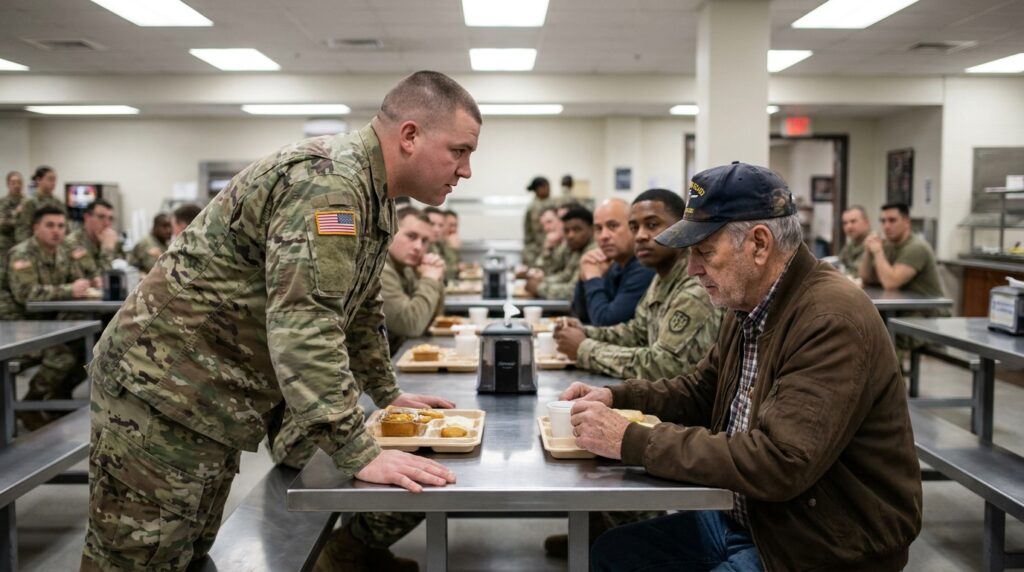
The fork was standard-issue stamped steel, cold and slightly greasy from the base dishwasher. Marcus held it between two scarred fingers, his thumb resting over a silver signet ring that had long since lost its engraving to the slow friction of decades. Around him, Fort Meade’s main dining facility roared with the specific, aggressive mechanical energy of three hundred men in freshly pressed camouflage utilities. It was the smell of scorched grease, starch, and young sweat. They moved fast because their time was measured in minutes; they talked loud because they believed they owned the air.

Marcus did not look up when the shadow fell across his gray plastic meal tray.

“You’re sitting in thirty-third brigade territory, old man,” a voice said. It was thick, meat-fed, and carried the specific edge of a junior non-com who had just received his extra stripe and hadn’t yet learned how to carry the weight of it.

Marcus kept his eyes on his creamed chipped beef. He peeled a piece of white bread away from the crust, his movements slow, rhythmic, and heavy with the inertia of a man whose bones had settled into their final configuration sixty years ago.

A hand slammed down on the edge of the laminate table. The plastic tray jumped three millimeters, the tin water cup rattling against the side of the fruit bowl. The hand was wide, the knuckles raw from the range or the sandbags, the skin stretched tight over a stocky wrist. Above it stood the corporal—late twenties, a heavy jaw that had never seen a ration cut, and a buzz cut so close the pink scalp showed through like raw meat under the harsh glare of the overhead fluorescent tubes.

“I asked you a question,” the corporal sneered, leaning down until the smell of his wintergreen tobacco crowded the space between them. “You think that jacket means something? You’re in my house now. The civilian tables are out by the transit gate.”

Marcus took a slow breath. The air inside the hall tasted of salt and dry iron. Through the small window to his left, the Maryland sun was flat and pale against the gravel of the motor pool. He could feel the eyes of the four junior enlisted men at the neighboring bench shifting away from their phones. The laughter at the salad bar died down, a sudden, localized patch of silence spreading outward from the corner of the table like oil on water.

“I’ve sat at tables like this,” Marcus said, his voice dropping into the gap between the clattering of trays, “since before your father was a thought in a diner.”

He didn’t check the corporal’s posture. He didn’t need to. He could hear the short, sharp hitch in the young man’s breathing—the unmistakable sound of an ego hitting a hard boundary in front of witnesses. The corporal’s fingers twitched, his shoulder dropping three inches as his weight shifted to his front heel. He was going to reach for the worn navy service cap resting just to the right of the bread crusts. He was going to take it to prove he could.

Marcus let his fingers loosen around the stamped steel fork. The silver ring on his finger caught the reflection of the white ceiling, a single bead of light that stayed perfectly still as the stocky hand in front of him began its downward sweep.


CHAPTER 2: THE BOUNDARY OF RUST

“Keep your hand off the brim,” Marcus said.

The words didn’t carry the weight of a shout; they had the thin, dry scrape of a file over an iron bolt. The corporal’s fingers stayed suspended two inches above the faded blue twill of the navy service cap. For a split second, the only movement in the Fort Meade dining hall was the slow, greasy wobble of yellowish gravy settling on Marcus’s tray. The young soldier’s face went through three distinct changes—confusion, a flash of targeted cruelty, and then a tightening of the jaw as his knuckles shifted into a hard, defensive knot.

“You’ve got a lot of nerve for a ghost,” the corporal whispered. He didn’t pull his hand back. He dropped his weight lower, his camouflage chest pocket brushing the edge of the laminate table. The fabric gave off the synthetic, chemical scent of base laundry starch, sharp enough to cut through the heavy smell of fried lard from the scullery. “The gate guards must be slipping to let an old civilian stray this far into the barracks.”

Marcus didn’t shift his hips. His spine remained a straight, rigid column against the orange fiberglass bench, a shape formed by old transit trucks and wet trenches before the corporal’s squad-mates were even names on a draft registry. He noticed the slight tremor in the corporal’s left knee—an uncalculated leak of adrenaline. The boy was ready to shove the tray into Marcus’s chest just to see if the old bones would rattle.

“The gate didn’t have a lock on it when I was your size,” Marcus murmured, his voice maintaining that small, flat baseline. His left hand, still resting near the fork, didn’t move toward a weapon. His thumb simply felt the smooth, cold metal of his worn signet ring. “And the men inside knew how to clear a table without making a spectacle.”

A low snicker escaped from one of the junior enlisted men two benches down. It was a small, dangerous sound, the kind that strips an insecure non-com of his leverage faster than a formal demotion. The corporal’s face went dark, the skin around his buzz cut turning a mottled, furious red. His fingers curled into a claw, his forearm tensing as he prepared to grab the old man by the collar of his brown bomber jacket and drag him out into the gravel lane.

Marcus didn’t wait for the grip to close.

The transition wasn’t a movie fight; it was pure geometry and old iron. Marcus stood up. He didn’t scramble or lunged; he simply corrected his posture, his six-foot frame uncoiling with a sudden, heavy mass that caught the corporal completely off-balance. Before the younger man’s hand could find leather, Marcus’s left forearm rose—not a punch, but a solid, angled wedge that met the corporal’s wrist mid-air.

The impact was short, a dull thud of bone against starched sleeve. Marcus didn’t try to hold the arm. He let the corporal’s own forward momentum do the work. With his thumb locked down against his palm, Marcus pivoted his heel on the grease-filmed linoleum, shifting his hip just enough to take away the corporal’s spatial anchor. A single, short downward stroke of his palm against the corporal’s inner elbow broke the younger man’s posture entirely.

The corporal didn’t roll; he dropped. His stocky frame hit the floor with a flat, ringing slam that rattled the bolted legs of the neighboring benches. A metal salt shaker fell off the table, rolling three feet before hitting the corporal’s boot with a tiny, hollow click.

The entire wing of the cafeteria went dead. A private three tables over froze with a plastic cup of milk halfway to his chin, his eyes wide, tracking the sudden change in elevation. The clatter of the conveyor belt near the dishwashing station seemed to double in volume against the sudden, absolute silence of the room.

Marcus remained standing. He didn’t huff; his breathing was the same dry click through his nose. His brown bomber jacket had shifted slightly at the shoulder, revealing the fraying gray thread along the seam of the lining. He looked down at the floor, his gaze detached, like a farmer looking at a broken fence post that needed to be hammered back into the dirt.

The corporal lay on his side for two long seconds, his breath knocked loose from his lungs, his camouflage trousers covered in the gray dust of the linoleum floor. His hands scrambled against the slick tile, trying to find traction, his face twisted in a mixture of raw shock and the sudden, terrifying realization that three dozen of his subordinates had just seen him handled like a heavy sack of grain.

Marcus reached down. His hand didn’t go for the corporal’s throat; his fingers closed around the edges of a faded manila folder that had been tucked under his meal tray—the administrative file he had carried through the main gate three hours ago. The paper was old, the corners slightly yellowed, but the metal prong binding inside was pristine, entirely free of rust.

“Respect is earned, son,” Marcus said, his tone dropping into the cold silence like a stone into a dry well. “Don’t mistake age for weakness.”

The corporal was on his knees now, his hands shaking as he wiped a smear of floor-wax grease from his sleeve. His squad-mates hadn’t moved to help him; they stayed locked in their seats, their expressions careful, none of them willing to meet the eyes of the man who had just moved with the heavy, unblinking certainty of an old machine.

Marcus picked up his navy service cap, settling the brim low over his forehead until the shadow hid the gray stubble along his cheek. He didn’t look back at the tray.

“Pick yourself up,” Marcus said, his voice flat as he turned toward the exit lane. “And learn.”

He took three steps toward the double screen doors before he noticed the change in the light. Standing near the condiment station, a thin man in a civilian suit with an base access badge pinned to his lapel was watching him. The man wasn’t looking at the corporal on the floor; his eyes were fixed on the yellowed corner of the manila folder in Marcus’s hand, his fingers lifting a small black notebook from his breast pocket.

CHAPTER 3: THE CONDIMENT STATION STANDOFF

The thin man did not slip the black notebook back into his coat pocket until Marcus took his fourth step. The screen doors of the dining hall were still rattling on their rusted coil springs from the sudden drop in air pressure behind him. Marcus kept his left thumb pressed firmly against the edge of the yellowed folder, feeling the slight indentation where the heavy iron binding staples bit into the cardboard cover.

“You move clean for a man who doesn’t exist on the active payroll,” the thin man said. He had an accent that belonged to the Tidewater country—flat, dry, with vowels that sounded like river gravel grinding together under a low tide. His base access badge hung from a woven black lanyard that showed signs of fraying around the plastic clip.

Marcus didn’t stop, but he adjusted his stride, his heavy leather boot soles catching the grain of the concrete apron outside the cafeteria doors. The air out here was thick with the midday exhaust of the logistics trucks idling by the secondary fuel depot. The ground vibrated with a dull, sixty-cycle hum that Marcus felt in the back of his teeth.

“The payroll hasn’t been my concern since the year they stopped using silver in the quarters,” Marcus replied. He kept his head down, the bill of his navy cap angled just enough to break the direct glare of the sun hitting the gravel lane.

The thin man stepped into the path, his leather dress shoes looking thin and brittle against the heavy granite crushed stone of the driveway. He didn’t have the posture of a soldier—his shoulders were slightly rounded from years of leaning over steel filing cabinets—but he had the stillness that belonged to men who spent their lives reading things other people thought they had burned. On the lower corner of his laminated credential, a faint, purple-inked stamp read G-2-Record-Audit, the ink oxidized into a dark, dried-blood color that matched the alphanumeric marks on the bottom of Marcus’s folder.

“The record office at Fort Holabird closed down thirty-five years ago,” the thin man said, his eyes scanning Marcus’s brown bomber jacket, lingering on the small grease stain near the pocket flap where an old oil can had leaked during his time at the railway yards. “Most of the files from the seventy-one cycle were supposed to be in the furnace at Aberdeen before the treaties were signed. Yet you’re walking across a modern installation with an unvented ledger corner under your arm.”

Marcus stopped five inches short of the man’s shoulder. The proximity allowed him to smell the dry scent of carbon paper and old paste coming off the clerk’s wool trousers. “A folder doesn’t burn well when it’s packed too tight,” Marcus muttered. “The center stays cold.”

“The center of this one is hot enough to interest three different offices in the Pentagon, Mr. Vance,” the clerk said, using the name with a quiet, transactional flatness that suggested he had spent the morning looking at old microfiche screens until his retinas were scorched. “We’ve been tracking the serial numbers on that specific lot of cardstock since the transit office in Saigon cleared the logs in May of seventy-two. We thought they went into the river.”

Marcus looked down at the folder. Through the dry cardboard, he could feel the ghost of the old administrative ink. He knew what was typed on the first leaf—the three-letter designation that claimed he had abandoned his post at the logistics dock in Vung Tau to sell stolen generator parts to the locals. A dishonorable discharge recommendation, signed by a major who had died of a stroke in a Florida retirement community twelve years back. It was a useful document; it kept people from asking him what he had been doing with four hundred pounds of dry batteries and three boxes of zinc strips fifty miles upstream from the Cambodian line.

“The river was low that year,” Marcus said. His hand shifted, the silver signet ring scraping against the manila folder with a sound like a small animal scratching at a dry door. “A lot of things didn’t sink the way the planners intended.”

The clerk reached out, his long, ink-stained index finger stopping short of touching the metal prong binding on Marcus’s file. “The current commander of the transit wing doesn’t know what’s in that drawer. He thinks you’re just another old veteran with a grudge about his pension index. But if that corporal inside gets his captain involved, they’re going to run your fingerprints through the modern terminal at the gate. The new system doesn’t recognize the seventy-one bypass codes. It’ll flag the file as an active recovery asset.”

Marcus turned his head slightly, his gaze drifting past the clerk’s shoulder toward the low, corrugated tin roof of the base maintenance shed. A line of six-ton trucks stood there, their grilles caked in the yellow clay of the Virginia training grounds. “Then I’ll have to use the secondary gate,” Marcus said.

“The secondary gate has a double-strand barrier now, and three cameras with digital resolution clear enough to count the threads on your service cap,” the clerk whispered, his voice tightening as an officer’s staff car rumbled past the motor pool, its tires throwing up small spurts of limestone dust. “You won’t make the state line before the terminal locks your identity down. There’s an audit team already down at the archives room in Building 400. They found the duplicate index card an hour ago. The card that says your file was supposed to be delivered to a Major General named Miller back when the walls were still wet.”

Marcus’s thumb remained locked on the corner of the paper. He didn’t tell the clerk that he had known about the duplicate card for twenty years. He didn’t tell him that the Major General had been buried with full honors at Arlington before the current active-duty generation was old enough to hold a wooden rifle.

“Let them look,” Marcus said, his step resuming as he edged past the clerk’s sleeve. “The archives room has two thousand feet of shelving, and the air conditioning has been broken since Tuesday. They’ll get tired of the dust before they find the third key.”

The clerk didn’t grab his arm—he didn’t have the muscle for it, and he knew what had just happened to the stocky corporal inside the dining facility—but he turned as Marcus passed, his voice rising just enough to carry over the low, thrumming growl of the diesel generators.

“They won’t get tired, Mr. Vance,” the clerk called out, his notebook clamped hard under his elbow. “Because the signature on the recovery order didn’t come from the record branch. It came from the office that handles the old riverine logistics accounts. The ones that don’t have a name on the door.”

Marcus kept moving, his boots crunching rhythmically against the hot gravel as he headed toward the long shadow of the logistics warehouse. He could feel the dry friction of the old paper against his ribs, a weight that had traveled ten thousand miles over salt water just to find him again under the pale, flat sky of Maryland.

CHAPTER 4: THE SHADOW OF THE BAY

The shadow of the logistics warehouse didn’t bring cool air; it just smelled older, thick with the grease of heavy winches and the stagnant heat trapped beneath thousands of square feet of corrugated tin. Marcus slid his boots from the white limestone gravel of the driveway onto the oil-blackened concrete floor of Bay 4. Behind him, the low thrum of the base generators dropped a octave as the heavy machinery inside the maintenance shop kicked into gear, sending a steady, greasy vibration through his heels.

He did not tuck the manila file under his jacket. He held it flat against his thigh, his fingers curled over the edge where the coarse paper had worn white from his grip.

A shadow moved between two stacks of olive-drab engine crates. It wasn’t the thin clerk from the cafeteria. This shape was wide, low-slung, and carried the specific, unhurried weight of a senior non-commissioned officer who had spent thirty years watching officers come and go through the same gates. A pair of greasy coveralls hung loose from his shoulders, the name KOWALSKI stenciled in faded black across the pocket tab, just below a master sergeant’s insignia that had been blackened with boot polish to kill the shine.

“The transit gate is three hundred yards back, traveler,” Kowalski said. He didn’t look up from the brass coupling he was scraping with a wire brush. The metallic scratch of the steel bristles against the metal was rhythmic, dry, and sharp enough to make the air feel thin.

Marcus stopped near a stacked column of heavy truck tires. The rubber gave off a dense, sulfurous stink that mixed with the odor of damp oil cloths rotting in the corner of the bay. “The transit gate has too many questions today,” Marcus said. “I’m looking for the old administrative siding. The one that used to handle the riverine equipment pools.”

The mechanic stopped scraping. The wire brush remained motionless in his thick, scarred palm, the gray grease on his knuckles catching a stray beam of light from a cracked pane in the roof. He slowly turned his head, his small, dark eyes shifting from Marcus’s worn navy service cap down to the yellowed folder held against his leg.

“That siding was filled in with gravel during the ninety-six consolidation,” Kowalski muttered, his voice dropping into the lower register of the shop’s exhaust fans. “Nothing left out there but rusty tie-downs and three acres of scrub pine. If you’ve got papers to file, the clerk’s office is in Building 400. They’ve got air conditioning and three computers that don’t like dirt.”

“Computers don’t read seventy-one lot numbers,” Marcus said. He stepped closer, his boots making a dry, scratching sound against the grit on the floor. He laid the folder down on the flat top of an iron tool chest. The heavy steel lid was pitted with orange spots of rust where water had dripped from the ceiling during the spring rains. “The clerk outside says there’s an audit team looking for the duplicate index card. I want to know who signed the retrieval requisition.”

Kowalski wiped his hands on a scrap of burlap, the rough fabric making a dry, rasping noise against his calloused skin. He didn’t touch the file, but he leaned over it, his eyes tracking the alphanumeric stamp on the lower rim of the cardboard cover. He noticed what the young corporal in the dining hall had missed—the single, rusted iron binding staple that pinned the third leaf of the document completely shut, preventing the pages from turning cleanly.

“The signature on the lot log doesn’t belong to anyone active on this post,” Kowalski said, his thumb tracking a jagged white scar that ran from his wrist up into his sleeve. “The order came through the old maritime logistics desk at the annex. The one they forgot to close when they dismantled the brown-water assets in California. A man named Miller.”

Marcus kept his hands loose, his thumb resting over his signet ring. “Miller’s been in the ground at Arlington since the winter after the drawdown.”

“Then his desk is still writing letters,” the mechanic said. He reached down and picked up an ancient, heavy iron spanner from the bench, the tool cold and dark with decades of industrial oil. He didn’t brandish it; he just turned it over in his hand, checking the balance like a man preparing to clear a jammed gear. “They didn’t just flag your file, Vance. They locked the gate log three minutes ago. I can hear the air brakes on the security trucks over by the main barrier. They aren’t looking for a civilian who strayed off the path. They’re looking for the man who brought the seventy-one ledger back through the gate.”

Marcus didn’t flinch. He looked through the open bay door toward the perimeter fence, where the double-strand wire glinted like silver thread against the dry pine needles of the woodlot. He could hear the distant, metallic squawk of a security radio from the guard shack, the sound chopped into fragments by the hot wind.

“The ledger stays here,” Marcus said, his voice flat.

“The ledger doesn’t belong here,” Kowalski countered, his fingers tightening around the cold iron of the spanner. “It belongs in the furnace at Aberdeen with the rest of the garbage from the Delta. If you open that third leaf, you’re going to find twelve names that don’t match the casualty logs at the memorial. Six of them are still drawing checks under different social numbers in Delaware. If the captain from the audit team sees that purple stamp, he’s not going to put you in the brig. He’s going to put you in a car that doesn’t have handles on the inside of the doors.”

Marcus reached out, his calloused palm flattening against the yellow cover of the folder, his fingers covering the rusted iron staple. He felt the cold truth of the metal beneath his skin—the heavy, unyielding fact of an event that had been scrubbed from the history books but remained locked in the bone memory of the survivors.

“Let them bring the car,” Marcus said, his voice dropping below the steady, grinding rhythm of the shop. “The gate’s only half a mile from the state line, and the secondary fence has three panels that were put up with standard steel bolts. They turn easy when you have the right wrench.”

Kowalski looked at Marcus’s worn cap, then down at the silver signet ring with its smooth, flat face. A slow, heavy silence settled between them, the internal pressure of the bay rising as the shadows outside began to lengthen across the concrete apron.

“The captain’s already in Building 400,” Kowalski whispered, setting the iron spanner down on the tool chest with a dull, heavy clink that echoed through the empty rafters. “And he didn’t bring clerks. He brought four boys from the command squad who have new boots and no names on their shirts.”

Marcus didn’t answer. He picked up the file, tucking it firmly into the deep interior pocket of his brown bomber jacket, the coarse paper scraping against the leather with a sound like dry grass moving in the wind. He turned toward the narrow exit lane behind the engine stacks, his active agency driving him toward the high-friction boundary of the base where the real truth remained locked behind three layers of iron wire.

CHAPTER 5: THE COLD SILENCE THROUGH THE SCREEN

Marcus did not accelerate his pace when the gravel gave way to the packed red clay along the fence line. Behind him, the mechanical hum of Bay 4 was completely swallowed by the dry, whistling sigh of the Maryland pines. He kept his right arm pressed hard against the bulge in his leather bomber jacket, feeling the sharp corner of the yellowed folder digging into his lower ribs like a broken tooth.

The secondary fence stood ten feet tall, its galvanized steel links encrusted with gray lichen and orange flakes of rust where the salt from the winter road crews had drifted against the wire. Fifty yards down the line, a security truck with matte-black quarter-panels idled near the drainage ditch, its exhaust pipe puffing thin, greasy rings of blue diesel smoke into the stagnant heat.

“You’re walking the wrong way from the bus stop, Vance,” a voice said from the brush.

It wasn’t a soldier. It was the audit clerk, his thin wool trousers snagged on a wild blackberry vine, his face pasty under the flat glare of the sky. He had three distinct sweat rings encircling his collar, and his leather dress shoes were caked in dry, yellow mud that had hardened into a crust over his laces. He held a piece of yellow carbon paper between two ink-stained fingers—a duplicate voucher with a hand-written requisition code at the top.

Marcus stopped near the rusted turnbuckle of a guy-wire. The silver signet ring on his thumb clicked against the zinc coating of the post with a dry, metallic snap. “The bus stop doesn’t go where I need to be,” Marcus said.

“The captain from Building 400 just pulled your full index,” the clerk whispered, his teeth clicking together slightly from an excess of adrenaline. He held out the yellow slip, the paper rustling in the dry wind like a dead leaf. “Look at the line beneath the seventy-one discharge recommendation. It’s not an administrative entry. It’s a recovery manifest for three tons of battery plates and sixteen crates of copper bullion from the river pool at Chau Doc. They didn’t kick you out for selling generator parts, Vance. They used the dishonorable recommendation to strip your security clearance so you couldn’t be called to testify before the maritime committee.”

Marcus looked at the yellow slip, his eyes fixed on the purple alphanumeric code typed across the header. It was the same stamp that marked the corner of his own folder—the one Kowalski had warned him to bury. He didn’t take the paper from the clerk’s hand.

“The committee has been out of session for forty years,” Marcus said, his voice dropping into the lower register of the wind.

“The money hasn’t,” the clerk said, his hand shaking as he dropped the slip back onto his notebook. “The corporate entity that took over the old riverine logistics contracts still has an active ledger at the treasury. If you cross that fence with the original staples intact, you’re not just breaking an installation rule. You’re exposing a fifty-year-old operational reserve that’s currently funding three black-budget maritime satellite programs. The captain isn’t looking for a thief, Vance. He’s closing an account.”

A sharp, metallic clatter echoed from the drainage ditch. The door of the security truck swung open, and two men in sterile utility uniforms—no name-tapes, no rank badges, just clean green twill and high-gloss black boots—stepped down into the gravel. One of them carried a heavy, short-barreled bolt-cutter with long, blue-painted handles; the other kept his right hand tucked casually inside his cargo pocket, his elbow angled out in the unmistakable posture of a shooter waiting for an indicator.

Marcus didn’t move toward the wire, nor did he look back toward the warehouse bay. He stood perfectly still against the rusted post, his body absorbing the low, rhythmic thud of the truck’s engine vibrating through the red clay.

“You should have stayed at the table inside,” the lead shooter said, his voice completely flat, devoid of the young corporal’s anger or the clerk’s panic. He didn’t pull a weapon, but he moved with the economical efficiency of a modern machine, his boots clearing the blackberry briars without a single rustle. “The captain wants the folder back in the cabinet, Mr. Vance. You can walk back to Building 400 with us, or we can carry the file alone. It doesn’t make a difference on the log.”

The clerk took two short, scraping steps backward into the scrub pine, his eyes fixed on the blue handles of the bolt-cutter. He knew what happened to auditors who stayed in the room when the balance sheets were cleared by force.

Marcus reached into his bomber jacket. His hand didn’t move fast enough to trigger a draw-response from the shooter, but his fingers found the yellowed cardboard cover of his file. With a single, sharp twist of his wrist inside the leather pocket, he caught the rusted iron staple on the third leaf against the inner ring of his signet ring.

The old metal gave way with a dry, screeching pop that felt like a needle driving into his thumb. The leaf flew open, the rough paper scraping against his skin as the hidden carbon copy inside slipped loose from its binding.

“The file is already open,” Marcus said, his voice thin and level as he drew his hand out, holding the unsealed third leaf between his fingers. The pristine yellow carbon copy beneath the staples was exposed to the light for the first time since the summer of 1971, the purple ink bright and clean, completely un-faded by the years.

The lead shooter stopped five feet from the post, his boots sinking an inch into the soft clay. His eyes dropped to the paper, tracking the column of twelve hand-written names and the specific, four-digit grid coordinates marked along the margins—the extraction points where the unacknowledged black-budget crews had been pulled out of the Delta while their units were being listed as missing in action.

“That copy doesn’t leave the perimeter,” the shooter said, his elbow shifting three inches as his hand began to tighten inside his cargo pocket.

Before Marcus could answer, the low, metallic squawk of the truck’s radio turned into a solid, high-frequency whine that shattered the quiet of the woodlot. From the gravel drive behind Bay 4, a second vehicle—a dark grey staff car with a silver star mounted on the front grille—rumbled into view, its tires throwing up a wide, blinding screen of limestone dust that completely swallowed the fence line.

CHAPTER 6: THE RED CLAY TURNING

The limestone dust hit the fence line like a dry wave, taste-testing the back of Marcus’s throat with the chalky grit of ground mountain stone. It coated the lichen-crusted links of the wire, turning the orange flakes of rust into a pale, pasty slurry where the hot air from the staff car’s radiator fanned against the post.

Marcus didn’t blink. Through the white cloud, the silhouette of the grey staff car slammed to a stop, its brake linings giving off a short, mechanical shriek that vibrated through the clay beneath his boots. The shooters didn’t draw; their postures remained locked, their weight distributed low into the grit, their eyes tracking the sudden shift in administrative shadow.

The rear door didn’t swing open fast. It opened with a heavy, oiled click—the sound of an armored seal releasing.

An administrative clerk from Building 400 didn’t step out. A man with three silver blocks pinned to his starched utility collar slid his boots onto the gravel lane. He was old—not Marcus’s age, but deep enough into his fifties that his skin had the dry, cross-hatched leathering of a man who had spent his youth on river patrol boats before the black-budget accounts were moved to the computers. His nametag read STERN, stenciled in sharp, block letters that looked entirely permanent against the green twill of his chest pocket.

Stern didn’t look at the two shooters by the truck, nor did he look at the pasty auditor trembling in the blackberry briars. He looked at Marcus’s worn navy service cap, then his eyes dropped to the exposed yellow carbon copy held between Marcus’s scarred fingers.

“The log says you passed through the transit barrier with a civilian card, Vance,” Stern said. His voice was deeper than the clerk’s, holding the slow, rhythmic cadence of a man who spent his mornings signing destruction vouchers for things that didn’t go into the fire. “But your card index has an old riverine prefix that hasn’t been active since the year the dock at Vung Tau was dismantled.”

Marcus held the paper steady, the hot wind from the car’s engine compartment blowing the edge of the sheet until it flagged against his sleeve. Along the inner margin fold, just below the twelve handwritten names, a small purple-inked “V-7” designation was visible—a stamp used only by the logistics teams that supplied the unacknowledged operations fifty miles inside the line.

“The card works if you know which slot to put it in,” Marcus said, his voice level against the thrumming engine.

“The slot was welded shut during the ninety-six audit,” Stern replied, stepping closer until the smell of hot motor oil and leather seats from the staff car crowded out the sulfurous stink of the maintenance yard. “The captain thinks you’re trying to leverage a private settlement out of the logistics office. He thinks that lot number belongs to a pile of surplus generator sets that were written off as scrap. But he doesn’t know how to read the purple ink, Vance. He doesn’t know that every name on that carbon has an active insurance annuity being paid out of an administrative shell company in Dover.”

The lead shooter shifted his weight, his fingers twitching inside his cargo pocket as he looked at Stern for a signal to close the space.

Stern didn’t give it. He reached out, his hand stopping six inches away from the folder. “The 1971 discharge recommendation has a lock on it. If you walk that carbon copy past the second barrier, the computerized system at the gate is going to send an automated alert to the district court. The lawyers for the Dover account won’t let you reach the highway. They’ll use the old sovereign property statutes to claim you’re hauling unauthorized military records, and they’ll have the marshals pick you up before you clear the county line.”

Marcus looked down at the paper. The names were still sharp, written in the indelible ballpoint ink of an era when people expected documents to outlast the houses they were signed in. “The county line is four miles down the ridge road,” Marcus said. “And the marshals don’t have the key to the archives where the original manifest is logged.”

“The original manifest is gone,” Stern said, his voice dropping into a flat whisper that didn’t carry past the radiator grille of his car. “The major who signed that paper burned the primary logbook before he left the terminal at Long Binh. This yellow slip in your hand is the only piece of cardstock left that connects the Dover fund to the extraction points at Chau Doc. If you drop it into the furnace here, your service card gets re-indexed with an honorable classification, and the back-pension from seventy-two is deposited into your bank by Friday. A clean trade.”

Marcus felt the smooth metal of his signet ring press against the rough edge of the yellow carbon copy. It would be a simple conclusion—an easy calculation that would let his bones rest in a small house near the coast without the weight of the old iron siding hanging over his shoulder. The narrative appeared to offer a clean exit, a resolution that satisfied the paperwork.

But he knew how the logistics desks worked. A clean trade on a Friday always meant another folder was opened on Monday with a different colored stamp on the cover.

“The back-pension wouldn’t cover the cost of the bread,” Marcus said, his thumb tightening over the purple “V-7” stamp until the paper creased under the pressure of his calloused skin. “And the major didn’t burn the logbook. He gave it to a general named Miller who told me to keep the duplicate safe until the line went dark.”

Stern’s jaw tightened, the leathered skin around his collar turning a dark, dangerous red that matched the oxidized ink on the folder. “Miller’s dead, Vance. The line is as dark as it’s ever going to get.”

“Not while I can still read the ink,” Marcus muttered.

Before Stern could signal the men behind him, the lead shooter’s hand came out of his cargo pocket, his fingers wrapped around a small, heavy black cylinder—an un-serialized acoustic pressure wand used for non-lethal compliance within institutional confines. He took one sharp step forward, his boot grinding a piece of limestone gravel into powder as he reached for Marcus’s collar.

Marcus didn’t move backward. His active agency drove his weight into his front heel, his left hand rising in a sudden, short arc that caught the shooter’s wrist before the black cylinder could align. The impact was dry and heavy, the kinetic energy of the old man’s frame absorbing the rush and breaking the shooter’s spatial balance with the same mechanical certainty he had used on the floor inside the dining facility.

The acoustic wand flew from the shooter’s grip, landing with a dull thud in the soft red clay near the wild blackberry briars.

CHAPTER 7: THE FRICTION OF THE REAR ENCLOSURE

The shooter’s wrist felt like a cold piece of iron bar stock wrapped in damp canvas. When Marcus clamped down with his left palm, the momentum of the younger man’s forward rush drove the impact deep into Marcus’s shoulder assembly, sending a dry, tooth-rattling ache straight through his collarbone. Marcus didn’t wrench or struggle; he kept his feet planted flat in the red clay, his center of gravity dropped low toward the rusted guy-wire anchor. Using his thumb as a toggle, he twisted his forearm three inches to the left, shifting the shooter’s forward vector away from the manila folder and downward into the limestone dust.

The second shooter didn’t hesitate. His hand came out of his utility shirt pocket with a heavy, parkerized iron steel socket wrench—the kind used for locking the stabilization lugs on the mobile base radar assemblies. He didn’t wave it; he swung it in a short, economical downward arc meant to break the old man’s collarbone and end the interaction before the staff car’s engine could complete another cylinder cycle.

Marcus didn’t have the velocity to clear the path. He chose the friction.

He shifted his left shoulder inward, taking the force of the iron tool across the heavy leather padding of his old bomber jacket. The impact made a dull, wet thud against his ribs, the leather tearing along an old oil seam with a sharp riiiip that sounded like dry weeds catching in an auger. The force drove him back two inches, his heel hooking against the lower strand of the galvanized fence, the wire screaming as the tension springs took the weight.

“Get the paper,” Stern said from the open rear door of the staff car. He hadn’t drawn a sidearm; his hands were still hooked into his green web belt, his three silver blocks catching the dull gray glare of the dust cloud. His voice carried no anger—just the hard, transactional necessity of a man who needed a specific ledger line cleared before the evening log transmission.

The auditor from Building 400 was gone, his thin leather shoes leaving a trail of broken blackberry canes as he scrambled backward toward the safety of the base maintenance bays.

The shooter Marcus had redirected was back on his heels, his breath coming in a short, rhythmic hiss through his teeth. He didn’t reach for the acoustic wand in the mud; he lunged straight for the interior pocket of Marcus’s jacket, his fingers catching the worn yellowed edge of the manila cardboard.

Marcus let the folder slide.

The paper didn’t stay in the younger man’s grip because Marcus’s right hand was already moving along the reverse path. His thumb caught the shooter’s lower knuckles, his signet ring scraping across the young skin with a rough, rasping slide that peeled back a layer of gray grease from the maintenance yard. With a single, sharp downward leverage—the exact mechanics taught to the river teams for clearing a jammed latch on an ammunition box—Marcus broke the shooter’s hold, the yellow carbon copy fluttering down onto the hot steel plate of the truck’s running board.

The page lay there face up under the pale sun, the purple “V-7” designation perfectly visible against the black grease of the vehicle’s frame.

“That’s enough, Vance,” Stern said, his boots crunching slowly over the crushed stone toward the wire enclosure. He stopped three feet short of the running board, his hand reaching down to lift the paper. “The major’s signature on this voucher is forty-five years out of date. It doesn’t have a modern routing index. Even if you get it past the secondary gate, the federal marshals will have a preservation order on your vehicle before you reach the interstate junction. You’re holding a dead ledger.”

Marcus leaned his spine against the fence post, his breathing heavy but shallow, the ache in his ribs tightening with every inhalation. He didn’t look at Stern; his eyes were fixed on the small, raised weld on the inner rim of his own brass belt buckle—the hidden alignment mark that the old river crews had stamped onto their gear to calculate current drift when the instruments were choked with mud.

“The ledger isn’t dead,” Marcus said, his voice dropping into the quiet gap between the idling truck engines. “The names on that carbon belong to the third section of the ninety-first detachment. The ones the major said were lost when the barge went down near the canal junction. They weren’t lost, Stern. They were reassigned to the Dover account before the hull sank.”

Stern stayed motionless, his hand hovering two inches above the yellow carbon sheet. The limestone dust was settling now, coating the silver blocks on his collar with a fine, chalky film that made him look like a relic from the same archive room Marcus had cleared three hours ago.

“The Dover account doesn’t exist on the base active index,” Stern whispered, his eyes shifting toward the two shooters who were waiting for a renewed indicator. “And the ninety-first detachment was struck from the roll by presidential order in seventy-four. There’s no file left to audit, Vance. There’s nothing but this cardstock and your memory.”

“Then the memory is the asset,” Marcus muttered.

Before Stern’s fingers could close over the purple ink, a low, mechanical whistle cut through the pine woods from the direction of the main installation. The heavy steel transit barrier at the secondary gate—the one the clerk had warned was locked—began to grind backward along its track, the massive gears making a dry, screeching howl that signaled a command override from the central office.

A high-ranking officer wasn’t walking down the gravel lane. But from the shadow of Building 400, a third vehicle—a heavy, olive-drab communication van with a dual-whip antenna array mounted on the rear roof—was moving toward the enclosure at high velocity, its massive tires throwing up a new, thicker screen of red clay that threatened to wipe out the boundary entirely.

Marcus didn’t move toward the opening gate. He reached down and picked up the folder cover from the clay, his fingers locking onto the remaining prongs as the true weight of the confrontation shifted into a space where the old rules no longer applied.

CHAPTER 8: THE LAST COLD LINE

The heavy whip antennas of the communication van sliced through the low pine branches with a sharp, mechanical hiss that sounded like water hitting a hot stove pipe. As the massive, mud-flaked tires ground to a halt against the red clay perimeter, the wall of dust collapsed over the grey staff car, coating Stern’s polished silver blocks in a thick, uniform layer of red silt. The roar of the large diesel block didn’t rattle Marcus’s teeth; it matched the steady, old vibration that had lived behind his breastbone since the brown-water patrols went dark.

The side door of the van did not pop open with the light click of a modern vehicle. It slid back on a massive, dry iron rail, the iron-to-iron screech freezing the two shooters in their tracks.

Stern did not move his hands from his web belt. He stood perfectly still as a gray-haired master sergeant—a man whose utility shirt showed the faint ghost lines where a Command Sergeant Major’s wreaths had been unstitched—dropped down into the limestone gravel. The old soldier carried a heavy leather logbook with brass corners, its spine scarred by the oil of a hundred engine bays. He did not look at the shooters, nor did he look at the fallen acoustic wand in the mud. He walked straight past Stern’s shoulder and stopped two inches from Marcus’s torn sleeve.

For three seconds, the only sound was the deep, rhythmic thump-thump-thump of the van’s compressor. The master sergeant looked down at Marcus’s left hand, his eyes locking onto the smooth, unengraved face of the silver signet ring.

The master sergeant didn’t offer a modern salute. He simply reached out and flattened his palm against the brass corner of his own logbook, a gesture used by the old detachment handlers when the radios were compromised and the line was officially closed.

“The registry is clear, Mr. Vance,” the old sergeant said. His voice was a dry, heavy rattle that had the same iron density as Kowalski’s tools. “The Dover account was logged out of the central terminal at noon. The duplicate index cards in Building 400 have been moved to the incinerator bin under special voucher seven-one-six.”

Stern shifted his weight, his boots making a wet, crunching slide in the red clay. “The captain has an active retrieval asset order from the maritime division,” he said, his voice losing its flat authority, dropping into the careful register of an administrator who had just realized he was standing on a shifting foundation. “The file under his arm is military property.”

“The file under his arm doesn’t exist on the active index,” the old sergeant replied without turning his head. He reached down and lifted the yellow carbon copy from the truck’s running board, his thick thumb resting precisely over the faded blue ink thumbprint on the reverse side—the permanent mark left by Major General Miller before the barge was cleared from the log. “This lot was written off as unrecoverable river silt forty-five years ago. The names are registered on the independent logistics roll. They don’t report to Building 400.”

The lead shooter pulled his hand completely out of his utility cargo pocket. He didn’t look at Marcus or the folder; he looked at the open door of the communication van, where three modern electronic terminals were humming in the dark, their screens displaying the old four-digit grid coordinates from the Mekong Delta in bright, unblinking green phosphorus. The modern squad knew how to handle an old man at a table, but they didn’t have a counter-move for an unacknowledged command loop that could rewrite their unit’s payroll from a vehicle behind the maintenance shed.

Marcus took a slow, deep breath, his fingers relaxing their grip on the manila cover. The ache in his ribs was still sharp, but the internal pressure of the base seemed to drop, the heavy institutional weight of the installation sliding away from his shoulders like dry sand off a tin roof. The decoy secret—the false discharge that had served as his mask for forty-four years—was gone, but the final truth remained locked in the iron-bound pages of the leather logbook.

“You should have stayed in the kitchen, Vance,” Stern murmured, his hands finally dropping from his belt as he turned back toward the rear seat of his staff car. “The dust out here doesn’t clear.”

“The dust keeps the rust from setting too fast,” Marcus said, his voice flat and thin as he settled his navy service cap lower over his eyes.

The old master sergeant held the van’s rail open, his head tilted just enough to indicate the narrow gravel lane that led past the secondary gate toward the state highway. “The road is clear to the bridge, sir,” he said, using the title with a quiet, generational gravity that made the two shooters stand back from the wire. “The gate guards have the old bypass plates on their clips.”

Marcus didn’t answer with a speech. He didn’t look back at the stocky corporal’s fallen wand or the grey staff car idling in the limestone haze. He stepped out of the red clay enclosure, his heavy leather boots catching the hard, unyielding grain of the asphalt road that led away from the frontier. He held the yellowed folder against his ribs, no longer a hidden asset or a marked target, but a man walking through the white midday glare of his own country, unchanged, un-reconstructed, and entirely done with the ledger.

Similar Posts

Leave a Reply

Your email address will not be published. Required fields are marked *






