
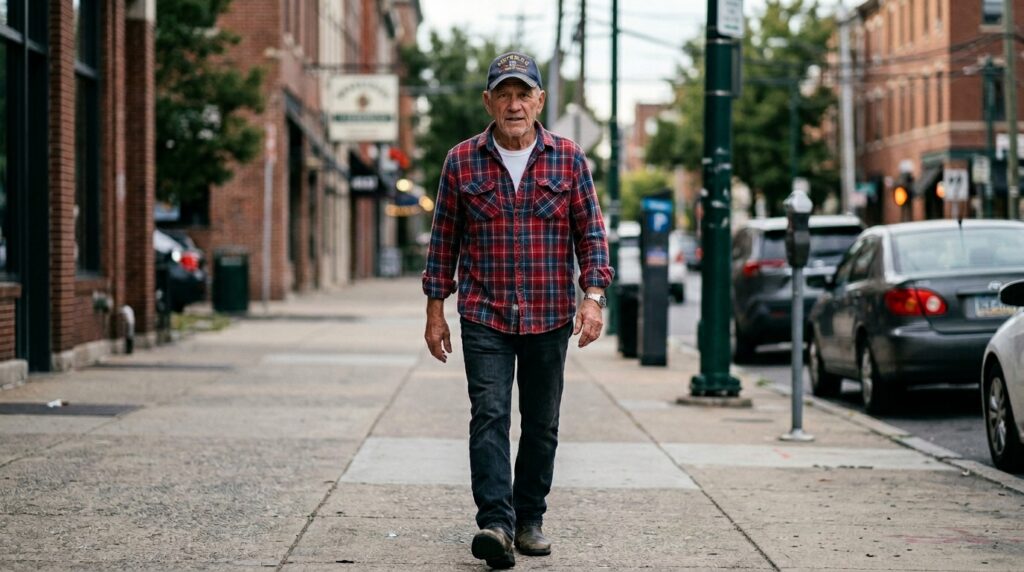
The Weight of Iron and Asphalt: A Chronicle of the Unbroken
CHAPTER 1: THE FOREGROUND OF RUST
The heat coming off the asphalt smelled of spent diesel and old grease, a dry, gray weight that settled into the deep lines of Arthur’s face. He adjusted the brim of his navy veteran cap, his calloused thumb catching on the frayed edge of the gold lettering where the anchor thread had begun to unravel a decade ago. Every movement was deliberate. In his pocket, his fingers rolled the cool, scarred brass of the Zippo lighter, feeling the precise hairline fracture along its hinge—the metal-on-metal friction a steady anchor against the dull, throbbing ache in his left patella.
The city moved around him at a frantic, disjointed velocity. High-end commuters blurred past the storefronts, their eyes locked onto glass screens, entirely detached from the cracked pavement beneath their polished shoes. Arthur didn’t alter his pace to accommodate them. His upright posture was a structural habit, an internal architecture framework that refused to lean into the weight of his late seventies. He wore his plaid overshirt unbuttoned, the heavy flannel shifting softly against the stark white of his cotton tee with every measured step.
Then the laughter cut through the ambient roar of the midday traffic.
A cluster of four younger pedestrians lounged against the rusted iron security grate of an abandoned electronics shop. The ringleader, a tall youth with a tracking scowl and an oversized nylon jacket, leaned back with an air of casual ownership over the public walkway. He pointed a finger, his gold plated watch catching the harsh, desaturated sunlight.
“Look at this old timer, still living in the past with that dusty hat,” the youth called out, his voice loud enough to draw the attention of a nearby street vendor. His companions smirked, crossing their arms, stepping forward slightly to narrow the corridor of the sidewalk. They expected the old man to veer toward the curb, to lower his chin and look for an escape route in the gutter.
Arthur’s gaze locked instantly onto the ringleader’s eyes. He didn’t blink. He didn’t quicken his stride, nor did he slow it down. He stayed perfectly aligned to the center depth of the pavement, advancing straight toward the center of the group. The spatial pressure between them changed instantly, the casual air of the sidewalk tightening into something dense and volatile.
With every heavy click of his orthotic soles against the concrete, the smirk on the youth’s face lost a fraction of its certainty. Arthur stepped into their immediate radius, his shadow falling across the ringleader’s boots. The smell of iron and dry earth seemed to emanate from the old man’s coat, a suffocating contrast to the cheap cologne and exhaust fumes of the street.
“Age may slow your body,” Arthur said, his voice a low, gravelly rasp that possessed the unmistakable weight of iron chain being dragged over stone. He stopped exactly twenty inches from the youth’s chest, his chest rising and falling in steady, disciplined intervals. “But it never defeats what’s inside.”
The silence that followed was absolute. The surrounding commuters slowed down, their footsteps halting as the mocking atmosphere completely evaporated. The youth opened his mouth to deliver a practiced retort, but the words died in his throat under the unyielding pressure of Arthur’s stare. As the youth defensively dropped his hands to his sides, his right hand shifted into the light, exposing a heavy, silver signet ring on his finger—etched with the distinct, tarnished insignia of the 9th Infantry Division.
Arthur’s heart hit his ribs like a hammer. He knew that exact ring; he had watched it being pulled from a blood-slicked mud hole in 1969.

CHAPTER 2: THE ECHO OF THE DELTA
“Where did you get that ring?”
Arthur’s voice didn’t just break the silence; it ground through it. The gravel in his throat sounded like a landslide. He didn’t move his hands, but his entire frame tightened, a coiled spring of rusted iron. The youth in the nylon jacket—the one who had been so tall and loud seconds ago—stiffened. His eyes darted to the silver band on his finger, then back to Arthur’s weathered face. The arrogance was leaking out of him, replaced by a twitchy, modern brand of fear.
“What’s it to you, old man?” the youth spat, but the bravado was thin. He tried to pull his hand back, to tuck it into his pocket, but Arthur’s gaze acted like a physical tether.
“I saw that ring pulled out of the red clay of the Long Hai hills,” Arthur said. He took a half-step forward, closing the remaining distance until he could smell the stale energy drink on the boy’s breath. “It belonged to a man named Miller. A man who didn’t make it back to see the city grow this ugly. Now, I’m going to ask you one more time, and the quality of your afternoon depends entirely on the truth: Where. Did. You. Get it?”
The bystanders—the small-time crowd that had gathered for a laugh—were backed up against the security grate now. The “Urban Witness Layer” had frozen. A street vendor twenty feet away stopped mid-transaction, sensing the shift in atmospheric pressure. This wasn’t a senile rant; this was a tactical interrogation happening in the middle of a Tuesday.
The youth swallowed hard. He looked at his friends, but they were busy looking at their own shoes. The unyielding discipline in Arthur’s posture—the way he didn’t fidget, the way his eyes never left the boy’s pupils—was a weapon they had no defense against.
“I… I found it, okay?” the boy stammered. “In a box. Down at the Community Center on 4th. My grandad… he’s got a room there. They were clearing out some old lockers. Said the stuff was abandoned.”
Arthur felt a cold prickle at the base of his neck that had nothing to do with the city heat. The Community Center on 4th wasn’t just a local hub; it was the primary administrative office for the neighborhood’s veteran outreach programs. It was where the checks were processed, where the housing vouchers were filed, and where men like Miller’s survivors were supposed to be looked after.
“Abandoned?” Arthur repeated the word like it was a curse. “Nothing is abandoned. Everything has a ledger.”
He reached into his pocket and pulled out the brass Zippo. He didn’t light it. He simply held it up between them, the sunlight reflecting off the scarred metal and the hairline fracture. “My friend Miller had a son. That son had a daughter. That ring doesn’t belong in a locker, and it certainly doesn’t belong on the hand of someone who mocks the uniform it represents.”
Arthur didn’t wait for a reply. He reached out—a move so fast and economical it bypassed the youth’s reflexes—and gripped the boy’s wrist. It wasn’t a violent grab; it was a secure, military-grade hold. He didn’t squeeze, but the youth felt the immovable strength in the old man’s calloused palm.
“You’re going to walk with me,” Arthur commanded.
“Hey! You can’t just—” the youth started, but Arthur leaned in, his voice dropping to a terrifying, intimate whisper.
“I’ve walked through monsoon rains with a forty-pound pack and a hole in my shoulder, son. Walking three blocks to 4th Street with you is the easiest thing I’ll do today. You can come willingly, or I can treat you like a prisoner of war. Your choice.”
The youth looked at Arthur’s eyes—deep-set, shadowed, and utterly devoid of hesitation. He nodded once, a sharp, jerky movement.
They began to move. It was a strange procession: the aging veteran, back straight as a bayonet, and the lanky youth in the nylon jacket, walking side-by-side. The crowd parted like water before a prow. Arthur noticed the friction of the city differently now. Every rusted trash can, every peeling piece of industrial paint, every shuttered window felt like a symptom of a larger rot.
As they crossed the intersection of 5th and Main, Arthur felt the rhythmic rolling of the Zippo against his thigh. He wasn’t just thinking about Miller anymore. He was thinking about the other lockers. He was thinking about the “abandoned” boxes. He had spent years maintaining his own dignity, keeping his apartment spotless and his cap centered, but he realized now he had been blind to the slow-motion scavengers picking at the bones of his generation.
They reached the Community Center—a brutalist slab of concrete and stained glass. A group of men in suits stood near the entrance, holding clipboards and talking to a foreman in a hard hat. They looked efficient. They looked clean. They looked like the kind of men who never had grease under their fingernails or red clay in their boots.
Arthur felt the youth’s wrist twitch in his grip. The boy wasn’t looking at the building; he was looking at one of the men in suits—a man with a sharp, predatory smile and a gold tie bar.
“That’s him,” the boy whispered, his voice trembling. “That’s Mr. Vance. He’s the one who gave me the ring. He said it was a ‘bonus’ for helping him move the files out of the basement.”
Arthur slowed his pace, his eyes narrowing as he analyzed the scene. The “decoy” was simple: a messy locker room, a bit of light looting by a bored kid. But the truth was sitting right there in a gold tie bar, overseeing the removal of “files” from a sanctuary for the forgotten.
He didn’t let go of the boy. Instead, he adjusted his cap, feeling the weight of the warrior still standing within him. He wasn’t just a pedestrian anymore. He was on a reconnaissance mission, and he had just spotted the primary target.
“Stay quiet,” Arthur muttered, his gaze fixed on Vance. “The mission just changed.”
The man in the suit looked up, his professional smile faltering as he caught sight of the weathered man in the navy cap advancing toward him with the relentless, grinding momentum of a tank.
CHAPTER 3: THE FOREGROUND OF RUST
The screen door of the neon-dimmed pool hall rattled on its rusted track, letting in a hot gust of exhaust from the street before slamming shut with a flat, metallic clatter. Inside, the air was dense with the sharp tang of cheap chalk, stale tobacco, and the damp odor of water-damaged drywall. Arthur kept his grip firm on the youth’s nylon shoulder, steering him past a row of scarred, green-felt tables where the local regulars sat like statues carved from charcoal.
“In the back,” the boy, Marcus, muttered, his head low, eyes darting to avoid the gaze of the older men leaning over their cues. “That’s where Vance sets up his secondary office when the community center gets audited. He keeps the ledger boxes under the old bar counter.”
Arthur didn’t answer. His boots made a rhythmic, heavy thud against the buckled linoleum floor, a sound that carried the rigid weight of an infantry march. In his pocket, his thumb continuously traced the split hinge of his brass Zippo, using the rough edge to measure his patience. The room was a landscape of decay—the zinc countertops were corroded at the edges, the iron supporting brackets were flaking with layers of oxidization, and the light fixtures overhead hummed with a low, dying frequency.
He pushed through a heavy plywood door at the rear of the hall, entering a cramped, windowless storage room that smelled intensely of industrial cleaner and dry-rotting paper. Sit-down desks had been improvised from stacked crates of soda bottles, and on top of them sat a battery of old steel lockboxes, their gray enamel scratched down to the bare, dark metal.
“Get the box,” Arthur commanded, releasing his grip on Marcus but remaining close enough to block the only exit.
Marcus didn’t hesitate. The absolute lack of panic or defensive anger in Arthur’s voice had stripped away the boy’s remaining willingness to resist. He scrambled toward the lower shelf of a rusted utility rack, hauling out a heavy, green ledger container secured by a crude brass padlock.
“It’s locked,” Marcus said, pulling at the metal hoop. “Vance has the key on his chain. The one with the gold eagle.”
Arthur reached out, his thick, scarred fingers brushing Marcus aside. He didn’t look for a key. Instead, he gripped the side of a heavy, iron crowbar resting against the wall—a tool caked in dried grease and rust flakes. Slipping the flat edge beneath the lock’s hasp, he leaned his entire body weight into the lever. The physics of the movement were clean and economical; he didn’t strain or curse, he simply applied a lifetime of mechanical leverage. The rusted rivets holding the hasp to the sheet metal gave way with a sharp, echoing CRACK that sounded like a low-caliber pistol shot in the enclosed room.
The lid popped open, exposing stacks of manila folders, printed spreadsheets, and ancient carbon-copy logs from the 4th Street Veterans Home.
Arthur’s hand moved methodically, lifting the top layers of paper. His eyes, trained decades ago to spot wire traps in the dense brush of the Delta, quickly locked onto a pattern of red ink marginalia. They weren’t records of building repairs or recreational funds. They were pension routing receipts. Column after column listed names he knew—men who lived in the single-room occupancies up and down the avenue, men whose bodies were failing them, men who depended on those meager monthly transfers to keep the gas stoves burning.
Next to every third name, a neat, blue-ink stamp read: UNCLAIMED / TRANSFER TO ADMINISTRATIVE DISCRETIONARY FUND.
“He’s taking them,” Arthur murmured, the gravel in his voice dropping an octave, becoming cold as well water. “He’s marking the ones who don’t have family left to check on them. He’s declaring them dead or incompetent on paper and rerouting the checks to his personal accounts.”
“I didn’t know that part, swear to God,” Marcus whispered, backing into the corner of the room, his eyes wide as he watched the old man’s face darken. “He just told us to clean out the storage lockers because the old timers were ‘dead weight’ and wouldn’t miss the personal effects. He said the jewelry and medals were just scrap metal.”
Arthur picked up a ledger sheet, his eyes tracking a specific name at the bottom of the list: Miller, Thomas E. – Benefit Status: Suspended.
The decoy secret—the simple idea that a group of neighborhood kids had been committing casual acts of petty theft in a messy basement—crumbled away entirely under the weight of the paper in his hands. This wasn’t a localized nuisance. This was a calculated, institutional slaughter of dignity, executed by men who wore gold tie bars and smiled for the local newspapers while they bled the neighborhood’s history dry. The silver ring on Marcus’s finger wasn’t a random trophy; it was a casual piece of garbage thrown to a street kid to buy his silence while thousands of dollars were systematically siphoned from the men who had paid for this country in blood.
A sudden sound from the front of the pool hall cut through the silence—the heavy, rhythmic strike of leather shoes on linoleum, followed by the muffled, authoritative murmur of Vance’s voice demanding to know where the old man had gone.
Arthur didn’t look up from the ledger. He slowly folded the paper containing Miller’s name and slipped it into his breast pocket, right behind his veteran cap’s gold-stitched emblem. The absolute reality of the corruption was still locked behind Vance’s corporate network, but the frontline had just been drawn right through the center of this dust-choked room.
“Stay behind me,” Arthur said to Marcus, his hand dropping back into his pocket to grip the cold brass Zippo. “The negotiation is over.”
The storage room door began to swing inward.
CHAPTER 4: THE ARCHITECTURE OF BETRAYAL
The storage room door didn’t just open; it was kicked. The thin plywood shuddered against the cinderblock wall, sending a shower of dry-rot dust over the rusted utility racks. Vance stood in the frame, his tailored suit a sharp, jarring contrast to the grease-stained atmosphere of the pool hall backroom. Behind him loomed two men—muscle for hire, wearing the faces of people who were paid to ignore the weight of their own actions.
Vance’s gaze swept the room, landing on the broken lock of the ledger box, then finally settling on Arthur. His professional smile was gone, replaced by a cold, bureaucratic disdain. He didn’t look like a man afraid of being caught; he looked like a man annoyed by a clerical error.
“You’ve got a real talent for trespassing, old man,” Vance said, his voice smooth and devoid of the gravel that defined Arthur’s world. He stepped into the room, the gold eagle key on his belt chain jingling with a hollow, metallic sound. “I suppose that’s what happens when we let people like you linger too long. You start thinking you still own the pavement.”
Arthur didn’t flinch. He stood his ground in the center of the cramped space, his feet planted wide, his posture as unyielding as a support beam. Marcus was a huddled shadow in the corner, but Arthur was a monolith. He felt the folded ledger sheet in his breast pocket—the paper evidence of a betrayal that spanned decades.
“I don’t own the pavement,” Arthur said, the rasp in his voice sounding like iron dragging over concrete. “But I know the men who paid for it. Men like Miller. Men whose names you’ve been crossing out with red ink while you collect the interest.”
Vance chuckled, a dry, joyless sound. He signaled to the two men behind him. They stepped into the room, the space suddenly feeling claustrophobic. The air grew thick with the smell of stale tobacco and the impending friction of violence.
“Miller was a ghost,” Vance spat. “Most of them are. They sit in those rent-controlled rooms, waiting for checks they don’t even remember how to spend. I’m just optimizing the local economy, Arthur. Putting stagnant capital back into circulation. The neighborhood is changing. It needs development, not a museum of broken soldiers.”
“You aren’t optimizing anything,” Arthur countered. He reached into his pocket, his fingers closing around the brass Zippo. The metal was cold, but the internal heat of his resolve was rising. “You’re a scavenger. You wait for the pulse to get weak enough, then you start picking. But I’m still breathing, Vance. And I still remember how to hold a line.”
The largest of the two hired men moved first. He didn’t use a weapon; he used his weight, lunging forward with a heavy, swinging hook intended to put the old man down quickly. Arthur didn’t meet the force head-on. He used the economy of motion he’d learned in the dense brush of the Long Hai hills—a slight pivot, a sharp drop of his shoulder, and a thrust of his palm into the man’s solar plexus.
It wasn’t a movie punch. It was a tactical strike, focusing on environmental disruption and momentum. The man gasped, his air leaving him in a ragged burst, and stumbled back into the utility rack. The iron shelf groaned, a stack of soda crates sliding off and shattering on the linoleum in a chaotic spray of glass and sugar.
The second man hesitated, surprised by the speed of the “old timer.” Vance’s face contorted with a sudden, sharp rage.
“End this,” Vance commanded, backing toward the door. “Now.”
Arthur felt the sting of a knuckles-to-cheek impact as the second man landed a desperate jab. The world blurred for a micro-second, the phantom pains in his knees flaring like white-hot needles, but he refused to buckle. He leaned into the friction, his heavy wool overshirt absorbing the brunt of the follow-up strike. He grabbed the man’s lapel, using his own weight to pull the aggressor into the edge of the corroded zinc table.
The sound of the impact—flesh against metal—was dull and final. The man slumped to the floor, grasping at his ribs.
But the victory was a false flag. As Arthur turned back to Vance, he saw the man in the suit holding a small, black device—a modern tablet. Vance’s thumb hovered over the screen.
“You think a few ledger sheets mean anything in the digital age?” Vance sneered, his voice trembling with a mixture of fear and triumph. “I’ve already initiated the final transfer. By the time you get to the authorities, those funds will be buried in three different offshore shells. And as for your friend Miller’s family? I’ve already filed the paperwork for a ‘voluntary’ forfeiture of their remaining claims due to lack of proof. You’re fighting for a past that’s already been deleted.”
Arthur felt a sudden, devastating weight in his chest. It wasn’t the physical exhaustion; it was the realization that the decoy secret—the physical boxes and paper logs—was just the shell. The core truth was deeper, a digital siphon he couldn’t stop with a crowbar or a well-placed strike.
Vance stepped out of the room, slamming the plywood door shut. Arthur heard the metallic slide of a heavy bolt being thrown from the outside.
“Enjoy the dust, Arthur,” Vance’s muffled voice came through the wood. “It’s all you have left.”
The room fell into a heavy, suffocating silence, broken only by the sound of Marcus’s ragged breathing and the hum of the dying light fixture. Arthur stood among the wreckage of glass and paper, his veteran cap slightly askew for the first time in years. He pulled the Zippo from his pocket and looked at the hairline fracture. He had lost the tactical engagement. The decoy was shattered, and the deeper reality of the theft was accelerating toward a total, irreversible conclusion.
He looked at Marcus. The boy was staring at the silver ring on his finger, his face a mask of sudden, profound shame.
“The warrior is still standing,” Arthur whispered to the empty, rusted room, his voice more a promise than a statement. “But the battlefield just got a whole lot bigger.”
He reached for the iron crowbar again. He didn’t have much time, and he had a neighborhood to wake up.
CHAPTER 5: THE SOVEREIGN ACCOUNTING
The iron bar didn’t strike the plywood center; it found the seam where the steel bolt met the rotting frame. Arthur swung with the weight of a man who spent forty years matching his bones against industrial presses. Splinters of dry pine bit into his neck as the frame groaned, a high, screaming protest of metal tearing through fibrous wood. On the third impact, the bolt sheared through its casing, the door giving way with a concussive bang that echoed across the smoky expanse of the pool hall pool room.
Arthur stepped through the dust cloud, his breath a disciplined whistle through his teeth. Marcus stumbled behind him, clutching the stolen silver signet ring like a talisman.
The main floor of the hall had gone dead. The regulars had abandoned their tables, gathered in a loose semicircle near the front windows. Outside on the concrete sidewalk, the glare of the afternoon sun hit the plate glass, silhouetting Vance. The coordinator was standing near his idling sedan, his thumb working the black tablet with a furious, jagged rhythm. The digital siphon was active; the green light on his vehicle’s dashboard transceiver was pulsing a rapid, steady amber.
Arthur didn’t run. A warrior doesn’t give up his posture to a ticking clock. He maintained his long, calculated strides, his boots striking the linoleum with an unhurried, terrifying weight. Every step was a commitment. His left knee flared with an oily, sharp agony, but he suppressed it, sliding his fingers over the cracked hinge of the Zippo in his coat pocket. The metal was hot now, warmed by the friction of his palm.
He pushed through the front door, the city’s heat hitting him like an abrasive sheet of sandpaper.
“Vance,” Arthur said. The name wasn’t shouted. It was thrown like a handful of gravel against a zinc roof.
The coordinator froze, his thumb hovering three inches above the tablet’s glass screen. His sharp face twisted as he looked at the splinters clinging to Arthur’s plaid overshirt, his eyes wide with the sudden realization that the local muscle hadn’t even delayed the old man. The two hired drivers were nowhere to be seen—likely slipping out through the kitchen alley.
“It’s done, Arthur,” Vance said, his voice rising an octave as he backed toward the open door of his car. The gold eagle key on his belt chain rattled against the door frame. “The authorization codes are submitted. The regional database is locking the ledger alterations. In exactly sixty seconds, the discretionary redistribution becomes permanent. You can’t stop the code.”
Arthur kept advancing. He didn’t look at the tablet. He looked at Vance’s throat. “Code is just ink on a screen. But the names on those papers are men. You think because our hands shake and our boots move slow, we don’t know how to defend our perimeter?”
“You don’t understand the scale here!” Vance yelled, his back hitting the car’s roof pillar. “This isn’t just your block! The municipal development board approved the reallocation weeks ago. The community center is being cleared for a transit hub. The old timers are being relocated to state facilities anyway. I’m just taking the administrative residue before the city dissolves the charter! If it isn’t me, it’s the contractors!”
The core truth lay bare under the white-hot glare of the afternoon sky. It wasn’t a petty thief or a lone bureaucrat; it was a structural eviction of an entire generation’s memory, authorized by signatures in air-conditioned offices three miles away. Vance was just the blade. The system itself was the handle.
Arthur stopped five feet from the sedan. He reached into his breast pocket and pulled out the folded ledger sheet containing Miller’s name. The paper was worn, the edges flaking into gray dust between his calloused fingers.
“Then we change the ledger,” Arthur said quietly.
He didn’t use violence. He reached out and gripped the top edge of the tablet with his left hand. Vance pulled back, but Arthur’s grip was an anchor forged in the ironworks of another era. With his right hand, Arthur didn’t strike Vance; he reached down and yanked the gold eagle key chain from the coordinator’s belt loop. The small metal clip snapped with a clean, sharp ping.
“Marcus,” Arthur called out without breaking eye contact with Vance.
The youth stepped out from the shade of the pool hall awning, his face pale but his jaw set. He was holding his phone out, the screen recording every word, every line of the ledger sheet Arthur held against Vance’s chest, and the active transfer screen on the coordinator’s tablet.
“The local news desk has a tip line,” Arthur said, his voice dropping into that heavy, gravelly register that left no room for negotiation. “And the federal district attorney’s office still keeps an ombudsman down on 8th Street. Tell them the supervisor of the 4th Street Center just gave a full confession on the sidewalk.”
Vance’s face went the color of wet lime. He looked at the phone in Marcus’s hand, then at the ledger sheet, then at the small crowd of neighborhood commuters and street vendors who had closed a circle around his car. These weren’t indifferent bystanders anymore. They were the children and grandchildren of the men Vance had written off as “residue.” Their faces were hard, their arms crossed, their silence an indictment.
The transfer light on the dashboard transceiver flickered, then died as Vance’s hand shook, his fingers slipping off the validation sequence. The screen read: SESSION TIMEOUT – RE-AUTHENTICATION REQUIRED.
Arthur released his grip on the tablet. He took the silver signet ring from Marcus’s open palm and dropped it onto the hood of Vance’s car with a heavy, metallic clink.
“Keep the ring on the metal where everyone can see it,” Arthur said, adjusting his navy veteran cap, pulling the brim down until the gold lettering caught the direct rays of the sun. “Let them know the warrior is still standing. Every single one of us.”
He turned his back on the coordinator, not waiting for the police sirens that were already beginning to wail three blocks to the east. He started his walk back down the center depth of the asphalt, his gait slow, his posture perfectly upright, his boots marking the rhythm of a long, unbroken march through the heart of his own city.
CHAPTER 6: THE LOWER LEDGER
The heavy oak door of the 4th Street Center didn’t give way to a crowbar this time; it yielded to the small, brass tumbler mechanism of the gold eagle key. Arthur turned the metal until a clean, heavy click echoed through the dark reception hall. The building was dead at midnight, the daylight-soaked bustle of the bureaucracy replaced by the low, humming static of a dozen idling computer towers and the scent of chemical floor wax.
Behind him, Marcus kept watch by the frosted glass entryway, his nylon jacket rustling softly against the door frame. “The night patrol hits this block at 12:40,” the boy whispered, his eyes scanning the empty, streetlight-streaked asphalt outside. “We have twenty minutes before the grid resets.”
Arthur didn’t waste breath on an answer. He moved down the narrow corridor, his boots pressing into the thin industrial carpet with a measured, deliberate weight. His left patella throbbed with a dull, rhythmic friction, a reminder of the afternoon’s exertion, but his spine remained straight, an unbending column beneath his plaid shirt. He pulled his navy cap lower, the brim casting a sharp wedge of shadow across his eyes as he stepped into Vance’s private office.
The room smelled of expensive leather and cold coffee. On the desk, the main administrative terminal sat dark, its glossy black screen reflecting the distant amber glow of the city’s traffic lights. Arthur reached down, slipping the gold eagle key into the heavy steel lockbox bolted beneath the desk’s kneewell. It wasn’t a standard drawer lock; it was a heavy-gauge commercial cylinder that secured the building’s physical server line.
The cylinder turned. A small drawer slid outward, exposing not papers, but a secondary, unlisted security terminal—a green-monitored system that ran independent of the facility’s digital network.
Arthur sat in the leather chair, his large, calloused fingers looking out of place against the compact plastic keys. He didn’t know the modern programming strings, but he knew how to read an inventory manifest. He inserted Vance’s administrative card into the side slot, the green monitor immediately blinking to life with a series of rapidly scrolling text directories.
“Look for the logistics file,” Marcus said, stepping into the room and leaning over the desk, his hand resting near the silver signet ring he had reclaimed from the car hood. “Vance said the municipal board had already signed off on the reallocations. There has to be a master list of the contractors buying the land.”
Arthur’s eyes tracked the code strings. Column after column of file names flashed across the glass, but his attention settled on a directory labeled PROJECT MERIDIAN: PHASE II DISPOSAL.
He pressed the return key. The terminal groaned, its internal drive clicking as it loaded a spreadsheet that detailed the systematic liquidation of every veteran asset within a six-block radius. It wasn’t just pensions. It was housing deeds, property titles, and medical trust funds, all cross-referenced with a corporate entity called Apex Development Group.
“They aren’t just siphoning the money,” Arthur murmured, the gravel in his voice tight and dry. “They’re buying the debt. Every time Vance marked an elder as ‘incompetent,’ the deed to their apartment was transferred to this holding company as ‘administrative collateral’ for their care.”
The micro-mystery of the neighborhood’s sudden decay became starkly clear. The shuttered storefronts, the broken streetlights, the slow withdrawal of city services—it wasn’t a natural economic decline. It was an engineered starvation. Apex was systematically devaluing the land from the inside out, using Vance to clear the human ledger before the bulldozers arrived to turn the blocks into a high-density commercial transit hub.
Suddenly, a sharp, metallic chime cut through the office’s silence.
On the secondary screen, a red warning box began to pulse. REMOTE LOG-IN DETECTED: MUNICIPAL AUDIT TERMINAL 4.
Arthur’s hand tightened around his brass Zippo. The system wasn’t just logging his presence; someone from the central office three miles away was actively deleting the directory from the remote server. The lines of text began to vanish, disappearing from the bottom up like burning paper.
“They’re scrubbing it,” Marcus hissed, his voice rising in panic. “Arthur, we have to go. If that log completes, the security locks on the front doors will trigger automatically.”
Arthur didn’t pull the card. He reached into his pocket, pulled out his pocket notepad, and began copying the primary contractor registration numbers by hand, the pencil lead snapping twice against the paper under the heavy pressure of his thumb. He had spent his youth watching perimeters crumble in seconds; he wasn’t going to retreat until he had the coordinates.
“Write fast,” Arthur muttered, his eyes fixed on the disappearing text. “Because tomorrow morning, we show them how an old soldier holds a trench.”
From the front lobby, the heavy electric strike of the main entrance doors engaged with a loud, final thud. The traps were closing.
CHAPTER 7: THE BARRICADE LINE
The magnetic lock on the internal fire door didn’t just engage; it slammed home with a deep, echoing thud that vibrated through the floorboards under Arthur’s boots. The primary exit was dead. High-voltage security plates had sealed the frame, trapping the hum of the dying terminal within the narrow office.
Arthur didn’t pivot into a panic. He stuffed the pencil-scrawled notepad into his plaid shirt pocket, snapping the button down with an even, economical press of his thumb. He checked the spatial geometry of the room. A single ventilation shaft ran along the upper seam of the drywall, but its aperture was too narrow for a grown man’s shoulders. That left the window—shatter-resistant laminate framed in heavily oxidized steel brackets.
“Marcus. Grab the base of that filing cabinet,” Arthur ordered, his voice dropping into the low, gravelly rasp of an artillery instructor.
The boy was already trembling, his fingers white where they gripped his phone. “Arthur, those are armored glass panes. The city put them in during the riots. You can’t just kick them out.”
“Everything breaks under the right lever, son.” Arthur moved to the utility rack, his palms catching the cold, flaking paint of a heavy iron strut. He didn’t strain his lower back; he bent his knees, aligning his posture directly with the center of gravity of the steel unit. With a single, explosive thrust of his legs, he drove the top corner of the frame into the corner of the window glass.
The sound was a high-frequency spike—a sharp CRACK that webbed the laminate film with thousands of silver fractures but didn’t puncture the core. The second strike was mechanical physics. Arthur hit the exact same structural point, adding the momentum of his shoulder. The frame tore loose from the rotting brickwork, the entire glass unit tumbling outward onto the alley gravel with a wet, heavy smash.
“Out,” Arthur grunted, hoisting Marcus by the belt before the boy could calculate the drop. He followed immediately after, his boots hitting the debris with a crunch that sent a sharp, white flash of agony up his left patella. He didn’t stop to nurse it. He adjusted his navy cap, his fingers identifying the split hinge of the brass Zippo in his coat pocket to steady his internal rhythm.
The alley was freezing, the air smelling of stagnant water and cold diesel exhaust. But as they emerged onto the main avenue of 4th Street, the night wasn’t empty.
Three yellow flatbed transport trucks from the Apex Development Group were already idling along the curb, their heavy air brakes hissing in the dark like iron vipers. A crew of workers in reflective orange vests was unrolling heavy steel barricade chains across the entrance of the veteran housing complex across the street. The eviction wasn’t scheduled for next month; the digital audit Arthur had triggered had forced their hand. They were closing the perimeter before sunrise.
“They’re locking them in,” Marcus whispered, his teeth clicking together. “They’re putting up the demolition fencing while everyone’s asleep.”
Arthur looked down the line. At the center of the complex gate stood a foreman—a thick-necked man with a clipboard and a heavy zinc padlock chain slung over his shoulder. He was directing two security guards who were pushing a mobile iron wire screen into place across the driveway.
Arthur started moving. He didn’t run—running ruined the sight picture and wasted tactical energy. He walked with that long, upright military gait, his silhouette cutting through the amber streetlamp beams like a shadow on an old map. His plaid overshirt flapped slightly against the white cotton of his tee, the cold air hitting his skin but failing to cool the hot iron in his chest.
“Hey! Old timer! Sidewalk’s closed!” the foreman shouted as Arthur crossed the centerline of the asphalt. “This is a private development sector now. Turn around.”
Arthur didn’t alter his trajectory by a single degree. He walked straight up to the iron gate, stopping exactly where the foreman’s shadow met the gravel. The surrounding workers stopped, the clatter of the heavy steel chain links dying away as they recognized the total composure of the man in the navy cap.
“This gate was paid for by the men who live inside those doors,” Arthur said, his gravelly voice carrying across the empty street with absolute, unyielding clarity. “It stays open.”
“I have a signed municipal clearance right here,” the foreman said, tapping his clipboard with a heavy, grease-stained thumb. “The residents were notified. The relocation transport arrives at five AM. We’re just securing the property lines. Move along before we have the city marshals remove you for vagrancy.”
Arthur looked at the clipboard, then raised his gaze to meet the foreman’s eyes. There was zero panic in Arthur’s face—only the quiet, terrifying discipline of a survivor who had seen lines drawn in blood, not ink.
“The notification was a fraud,” Arthur said, stepping closer until his chest was inches from the iron wire mesh. “The deeds were rerouted through an administrative shell. You’re not moving residents; you’re clearing a crime scene.”
The foreman’s expression hardened, his posture shifting as he prepared to signal the two guards. But before he could raise his hand, a light went on in the second-floor window of the complex. Then another. The sound of Arthur’s voice—that low, carrying rasp—had penetrated the thin glass of the single-room occupancies.
Old faces began to appear in the amber frames. Men with gray hair and weathered cheeks, men who had spent their lives maintaining a quiet, forgotten dignity in the corners of the city, looked down at the streetlamp light. They saw the navy cap. They saw the upright posture of the warrior still standing in the center of the roadway.
“Arthur?” a voice called out from above—old Miller’s brother, Thomas, his hand leaning heavily on the window sill.
“Hold your rooms, Thomas!” Arthur called back, his gaze never leaving the foreman’s pupils. “Don’t sign the logs. The perimeter isn’t broken.”
Marcus stepped up behind Arthur, holding his phone high, the lens capturing the foreman’s name badge and the logo on the side of the yellow trucks. “The stream’s active,” the boy said, his voice finding a strange, steady strength it hadn’t possessed yesterday. “There are four thousand people watching this fence right now.”
The foreman looked at the phone, then at the windows filling with old soldiers, then at the unmoving monolith of the old man standing before him. The legal authority he had carried on his clipboard suddenly felt thin, a fragile piece of paper facing an army that had already survived the worst the world could throw at them.
The foreman didn’t drop the clipboard, but he didn’t throw the lock either. He stepped back a half-inch, his thumb twitching against the metal clip. “We’re just doing our job, old man.”
“So am I,” Arthur said, his hand dropping into his pocket to roll the Zippo. “And my shift isn’t over.”
The sky to the east was turning the color of oxidized iron, the first gray light of morning catching the webbed cracks in the center window across the street. The first phase of the siege was set.
CHAPTER 8: THE VOID MATRIX
The gray dawn didn’t bring warmth; it broke over the city like a cracked pane of industrial glass, throwing sharp, desaturated light across the muddy tire tracks of the Apex flatbeds. The city marshal’s black utility cruiser pulled up to the curb with a low, hydraulic hiss. Its roof lights didn’t flash—they sat cold, reflecting the gray sky. A single man stepped out from the back seat: regional auditor Vance, his suit replaced by a dark, tactical windbreaker, flanked by a city attorney holding a leather-bound legal case.
Arthur didn’t shift his stance. He stood exactly where the asphalt met the perimeter gravel, his boots anchored into the ground. His plaid shirt was stiff with dried sweat and the dust of the shattered window, but his posture was a steel framework that refused to settle. Behind him, fifty old men stood in a silent column, their faces lined with the geometry of old wars, their eyes fixed on the man with the leather case.
“The time is five AM, Arthur,” Vance said, his voice flat, devoid of the previous night’s desperation. He didn’t look at Marcus’s phone camera anymore; he looked at the city attorney, who stepped forward and opened the brass latches of the leather file. “The temporary injunction you filed with your copied notes was rejected at the municipal level two hours ago. The administrative discretionary clause overrides local historic claims when a sector is declared an infrastructure vacancy. The bulldozers have clearance.”
The city attorney pulled out a heavy parchment sheet, its bottom edge stamped with three thick, purple corporate seals from the Apex Development Group and the municipal housing authority. “By order of the state development board, this property is condemned. Any individual remaining within twenty feet of the iron line after the count of sixty will be processed for criminal obstruction.”
Arthur looked at the seals. He didn’t look at the text; his eyes analyzed the purple ink, identifying the specific crest of the 1974 neighborhood charter buried beneath the modern corporate stamps. The decoy secret—the idea that this was just a contractor land grab—dissolved entirely into the final, systemic truth. The city hadn’t forgotten these men; the city had systematically traded their existence for an expanded commercial transit tax base, using Vance to erase the physical records so the legal matrix could close without a single red line appearing on a public ledger.
“You have the paper,” Arthur said, his voice a low, gravelly grinding sound that seemed to come from the pavement itself. He reached into his pocket and pulled out his brass Zippo, his thumb rolling over the split hinge, feeling the precise point where the metal had almost failed but held. “But you don’t have the ledger.”
“The ledger was scrubbed from the main server last night, old man,” Vance sneered, stepping closer under the protection of the marshal’s presence. “There is no record of Miller’s pension. There is no record of these deeds. The system recognizes this block as empty ground.”
Arthur didn’t argue. He reached down to his waist, his hand catching the heavy, iron crowbar he had carried from the pool hall. He didn’t raise it to strike; he drove the flat edge deep into the concrete seam at the base of the gatepost, using the weight of his body to lever a single, loose flagstone upward. The stone cracked with a sharp, dry snap, releasing a cloud of gray alkaline dust that smelled of ancient cement and dry earth.
Beneath the stone lay a flat, corroded zinc cylinder—the original 1974 municipal foundation capsule, placed there when the complex was built for the returning veterans of the 9th Infantry.
Arthur reached down, his large, scarred fingers twisting the oxidized cap of the cylinder until the metal threads sheared off with a screech of high friction. He pulled out a thick roll of heavy, blue-backed linen sheets—the original, un-digitized corporate charter of the neighborhood, signed by the governor and witnessed by the names of every man standing behind him on the gravel.
“The city didn’t buy this ground from a development company, Vance,” Arthur said, holding the blue linen up to the gray dawn light. The text was crisp, untouched by the modern digital scrubbers. “The state deeded it directly to the veterans’ union as a sovereign trust in perpetuity. It can’t be dissolved by an administrative discretionary clause. It can’t be reallocated by a municipal board. It takes a full act of the legislature to touch these bricks, and you don’t have that signature on your clipboard.”
The city attorney’s hand froze mid-air, his eyes locking onto the faded gold seal at the center of the linen sheet. The legal architecture he had spent three weeks building fell apart in a single micro-second, exposed as a shallow, unauthorized fraud that violated the baseline foundation of the city’s own charter. He looked at Vance, his professional composure shattering into a twitchy, bureaucratic panic.
“Is this valid?” the attorney whispered, his voice cracking against the morning air.
Vance didn’t answer. His face went gray, his eyes staring at the blue linen as if it were a ghost rising from the red clay of the Delta. The absolute authority of his suit, his tablets, and his corporate connections evaporated under the weight of an old piece of cloth preserved beneath a cracked stone by a man who refused to look away.
Arthur took a step forward, his boots crushing a piece of broken glass into the dust. He didn’t shout. He didn’t call for an arrest. He simply held the line, his upright frame casting a long, shadow that extended all the way to the door of the marshal’s cruiser.
“The warrior is still standing,” Arthur said to the silence of the street, his words a final accounting that froze the foreman, the workers, and the trucks where they stood. “Now pack your chains. We’re done moving.”
The foreman didn’t wait for Vance’s order. He signaled his men, the heavy steel links clattering back onto the flatbeds as the yellow trucks began to back out of the alley, their exhaust plumes dissolving into the gray sky. The line had held. The neighborhood’s living history remained anchored into the concrete, unwritten by the matrix, protected by the unyielding discipline of a true survivor.







