
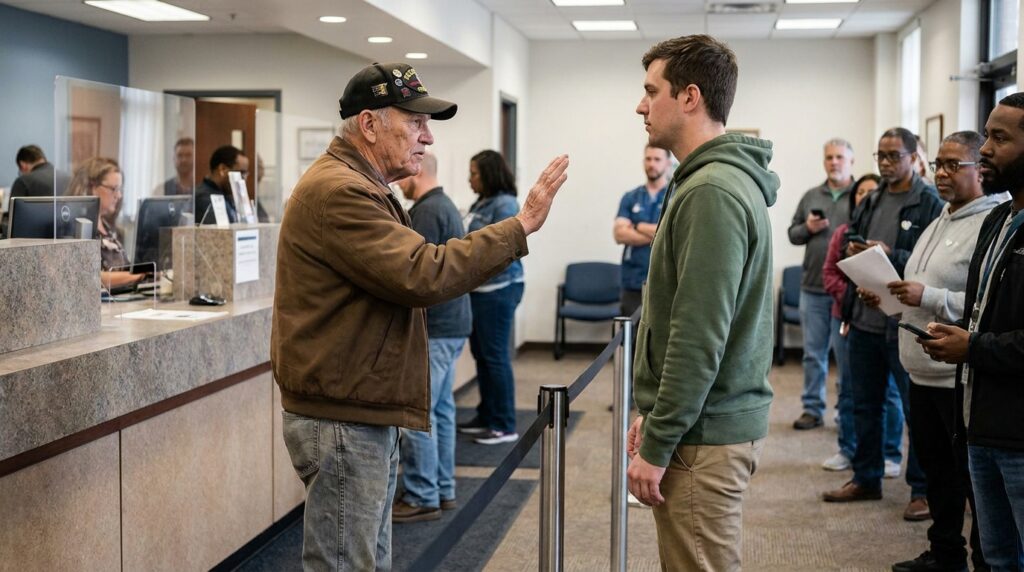
The Precision of Order and the Calculated Friction of a Failing Line

CHAPTER 1: THE TENSION AT THE GLASS

The fluorescent tubes overhead hummed at a frequency that vibrated inside Arthur’s lower jaw. It was a cheap, institutional sound, the rhythm of municipal waiting rooms where the air stayed gray and the linoleum had long since lost its lacquer. He kept his feet planted exactly two inches behind the yellow safety stripe painted on the floor. His boots were old, the leather split across the instep from years of oil-slicked shop floors, but the soles were flat and thick. They held the ground.

To his right, the stanchion belt trembled. A man in an oversized green pullover hoodie had bypassed the three distinct switchbacks of the nylon rope, his shoulder checking a woman in a winter coat without a glance. He moved with the heavy, unblinking velocity of someone who believed the world was an unrendered space until he occupied it.

Arthur did not turn his head. He adjusted the brim of his dark veteran cap, feeling the rigid, structured edge of the buckram buckl-strap against his forehead. He watched the reflection in the thick security glass of the service counter window. The young man’s face was sharp, damp from the rain outside, his teeth catching his lower lip as his hand went into the deep pocket of his hoodie. He was aiming for the three-inch gap beneath the speaker grate.

“There’s a line here,” Arthur said. The voice came from the center of his chest, dry and unhurried, a flat stone dropped into shallow mud. “Wait your turn like everyone else.”

The green sleeve froze. The young man turned, his heels skidding a fraction of an inch on the salt-stained floor. He was a foot taller than Arthur, his shoulders wide but loose, carrying the unearned confidence of raw mass. His eyes ran down Arthur’s brown canvas jacket, lingering on the frayed cuffs, before rising to the small, brass emblem pinned above the cap’s visor. A corner of the youth’s mouth hitched upward, a gesture born from the assumption that age was simply a slow leakage of force.

“Move back, old man,” the younger man muttered. His voice was low, intended for the immediate radius of the counter, a transactional threat. “You don’t know what I’m dealing with. Get out of the lane.”

Arthur did not shift his weight. He felt the cold iron of the stanchion base near his left ankle. The crowd behind him had grown thin and quiet, that sudden, breathless stillness that occurs when a room realizes the social grease has failed. Nobody moved to help. They simply drifted backward, widening the circle, leaving Arthur alone at the glass interface. The young man took a half-step forward, his chest nearly brushing the canvas of Arthur’s shoulder, his fingers curling into a fist inside his pocket. Arthur logged the distance: twelve inches. The exact space required for a short-arc lever.

In the reflection of the glass behind the youth, a small white rectangle glinted from the corner of the green pocket—a plastic edge that didn’t belong to a standard wallet.


CHAPTER 2: THE MEASURE OF THE GAP

“You think that little brass pin makes you bulletproof, old man?”

The words came hot, smelling faintly of stale energy drinks and cold grease. The young man shifted his hips, his weight transferring to the balls of his feet. To an untrained eye, it was a display of aggressive dominance—the widening of the chest, the chin thrust forward like an iron wedge. To Arthur, it was an invitation. The youth was off-balance, his right heel slightly elevated, leaving his entire left flank vulnerable to a simple trip if he chose to drive his mass forward.

Arthur kept his hands low, fingers lightly hooked into the pockets of his canvas jacket. The fabric was stiff with years of embedded oil and shop grime, providing a small shield against a sudden slash or grab. He didn’t look at the young man’s eyes; he watched the notch where the collarbone met the throat. A man could lie with his eyes, could blink away fear or telegraph a punch he didn’t intend to throw, but the tension in the sternocleidomastoid muscle never lied. It was tightening now, a hard cord drawing the head down into a protective huddle.

“I asked you to step back,” Arthur said. The rhythm of his speech remained flat, a steady metronome against the erratic clicking of the office’s automated ticket dispenser fifty feet away.

“I’m not stepping anywhere.” The youth leaned in, his green hoodie bunching at the shoulders. “You’re going to let me through to that window, or I’m going to put you through the damn glass myself.”

The threat was public, loud enough to cut through the low-frequency murmur of the eighty-odd people waiting behind the stanchions. A woman three places back let out a small, sharp intake of breath, her keys rattling against her thigh as she pulled her child closer to her wool coat. The rest of the line did what crowds in the city always did—they became small. They narrowed their gaze, looked down at their phones, or focused on the scuffed grey tile between their shoes. They were treating the violence like bad weather, hoping if they didn’t acknowledge the storm, it wouldn’t wet them.

Arthur felt the hard line of the service counter counter-weighting his hips. There was no escape route to the rear; the security partition was thick, reinforced polycarbonate anchored into steel channels. The clerk behind the window, a middle-aged woman with a laminated county badge pinned to her blouse, had already stopped typing. Her fingers hovered over her keyboard like frozen spiders, her face pale against the blue glow of her monitor. She didn’t call for security. Her eyes were fixed on the green sleeve of the hoodie.

Arthur didn’t need security. He was tracking the white corner of plastic protruding from the young man’s pocket. As the youth shifted his weight forward, the material caught the harsh glare of the overhead fluorescent tube. It wasn’t a standard credit card or a driver’s license. The edges were too thick, the laminate too matte. It was a high-frequency proximity card, the kind used to trip the electromagnetic locks on restricted municipal buildings. Arthur recognized the specific shade of security blue on the border—the color of the public works department, the group that held the master keys to the city’s underground infrastructure.

The young man didn’t look like a city worker. His knuckles were clean, devoid of the split skin and dark grease that came with handling valves or heavy rigging. The badge was a foreign object on his person, carried with the awkward care of something newly acquired and poorly understood.

“You’ve got ten seconds to get back behind the yellow line,” Arthur murmured, his eyes still locked on the tightening cord of the youth’s throat. “After that, the choice isn’t yours anymore.”

The youth laughed, a short, barking sound that lacked any real center. He reached out with his left hand, his fingers spreading into a claw, aiming for the collar of Arthur’s brown jacket. His movement was slow, heavy with the assumption that the elderly body before him would freeze, that the spine would buckle under the mere suggestion of mass.

Arthur didn’t buck. He felt the cold air of the room rush into the gap between them as the hand closed the distance. His right hand came out of his pocket not as a fist, but as a flat, unyielding blade of bone and sinew, rising inside the arc of the youth’s arm to catch the wrist before the fingers could latch onto the canvas.

The contact was dry and loud, the skin-on-skin slap echoing against the security glass like a small caliber round.

CHAPTER 3: THE PRECISION OF LEVERAGE

The slap of Arthur’s palm against the youth’s forearm was not an ending; it was a pivot. Before the sound could dissipate against the reinforced polycarbonate window, the young man’s reach died in mid-air. Arthur’s skin felt cold, dry, and split like treated canvas, but beneath the surface, the structural alignment of his radius and ulna formed a perfect brace. He didn’t push back against the mass. He allowed the younger man’s momentum to spend itself against the lock of his bones.

The youth’s eyes widened, the pupils contracting into tiny black points under the harsh overhead fluorescent grid. He tried to yank his arm back, his shoulder dropping to gain leverage, but Arthur had already closed the gap. His left hand moved in a short, four-inch arc from his jacket pocket, his thumb finding the soft, vulnerable junction between the younger man’s thumb and wrist. It was a precise, measured application of pressure—not violence, but an exact mechanics lesson delivered in real time.

Arthur turned his hips exactly fifteen degrees to the left. The motion was small, almost invisible beneath the heavy hang of his brown canvas jacket, but it removed his centerline from the youth’s trajectory. The young man’s own forward velocity became his undoing. With his left wrist secured and his center of gravity pulled forward by his own entitlement, his balance failed. The rubber sole of his sneaker slid through a slick of melted gray sleet on the tile.

The drop was mechanical. There was no theatrical struggle, no exchange of blows, no cinematic drama. The youth simply ran out of feet. His knees buckled under the sudden, downward acceleration of his own weight, and his hip struck the edge of the service stanchion before he hit the linoleum floor with a heavy, hollow thud that shook the plastic base of the divider line.

The office fell into a dead, airless freeze. The low-frequency rattle of keys and the quiet murmur of waiting citizens ceased completely. A child’s toy—a small plastic truck—dropped from a numbed hand three rows back, its wheels clicking twice against the floor before rolling into a floor drain. Behind the safety glass, the clerk stood entirely still, her mouth slightly open, her breath fogging a small white circle onto the polished surface of the partition.

Arthur stood over him. He did not look down with anger; his face remained a map of gray, lined indifference, the brim of his dark veteran cap casting a sharp, angular shadow across his cheekbones. His breathing hadn’t altered by a single cycle. His hands went back to his sides, the fingers loosely hooked into the oil-stained canvas of his pockets, re-establishing his baseline posture as if the interruption had been nothing more than a glitch in the room’s machinery.

On the grey linoleum between the youth’s outstretched boots, an object slid out from the deep pocket of the green hoodie. It was the white rectangle Arthur had noted earlier—a heavy, matte-laminate proximity card bordered in high-visibility municipal blue. The face of the card was stamped with a gold city seal and an expiration overlay that hadn’t been punched. Beneath the laminate, the bold black letters read: DEPARTMENT OF PUBLIC WORKS – MAIN INFRASTRUCTURE CONDUIT – LEVEL 4.

The young man sat on the floor, his palms pressed into the salt-rimed tile behind him, his chest heaving as he stared up at Arthur. The aggression had been shocked out of him, replaced by the pale, greasy sheen of sudden adrenaline and social displacement. His mouth opened, but no sound came out—only a dry, breathy gasp as he tried to reconcile the speed of his descent with the frail appearance of the man who had ordered it.

Arthur’s eyes caught the name printed beneath the security seal on the dropped badge: M. VANCE – CHIEF OPERATOR. The young man on the floor was barely twenty-two. His hands were smooth. He was not Chief Operator Vance. He was a boy holding a key that could open every subterranean high-voltage junction and valve locker beneath the civic center, and he had tried to force his way to a window that wasn’t supposed to be processing public funds. Arthur looked from the card to the youth’s pale face, realizing the decoy of the long queue was beginning to fracture.

“You dropped something,” Arthur said, his voice dropping below the acoustic threshold of the glass speaker grate. He didn’t reach for the card. He kept his boots planted, locking the space.

The youth looked down at the blue-bordered badge, his skin turning from pale to a dull, blotchy red. His hand twitched toward the laminate, but he didn’t dare lean forward into the vertical space Arthur commanded. The silence of the eighty people behind them had changed; it was no longer avoidant. It was expectant, a heavy weight pressing down on the front of the line.

Behind the security partition, a heavy steel door clicked. The latch didn’t sound like a standard office lock. It was a multi-point mechanical throw, the deep clunk of an armored vault gate being unseated from its frame.

CHAPTER 4: THE RECKONING OF THE WEIGHT

The mechanical throw of the door behind the security glass was a dry, heavy sound—the specific thud of triple-hardened locking bolts sliding back into a steel lintel. The dense, climate-controlled air of the inner facility surged through the speaking grate, smelling sharply of static electricity and unboxed paper. The clerk didn’t return to her keyboard. She stood with her arms pinned straight against her sides as a shadow fell across her terminal from the rear office corridor.

Arthur didn’t pull his eyes away from the floor where the blue-bordered proximity card lay between the youth’s sneakers. His mind logged the parameters of the room’s geometry. Eighty people at his back remained entirely fixed, their breathing shallow, their collective weight shifting forward as they watched the space around the front of the line. The young man on the tiles had stopped moving his fingers toward the card. He sat frozen, his chest rising and falling against the tight fabric of his green hoodie, his gaze locked on the lower edge of Arthur’s brown canvas jacket.

“Next time respect the line,” Arthur said, breaking the silence with the same level, unhurried cadence he had used since the first skip of the nylon stanchion. “That’s how this works.”

The youth did not respond with words. He swallowed hard, a visible ripple passing down the strained muscle of his neck. His shoulders lost their artificial width, rounding forward into a protective hunch that made him appear smaller, his age finally matching his smooth hands. He was looking at the brass emblem on Arthur’s cap now, not with the dismissive arrogance of a minute ago, but with the hollow, tracking look of someone who had just hit a wall he couldn’t see.

“Alright,” the young man muttered, his heels sliding an inch backward through the gray slush as he abandoned his trajectory toward the service counter window. “Alright, I get it.”

He didn’t make a move to stand. His fingers twitched once against the cold tile, his skin pale where the salt from the floor had transferred to his palms. He looked at the blue laminate badge, then at Arthur’s boots, waiting for a clearance that wasn’t being granted.

The glass partition did not slide open. Instead, a secondary pass-through drawer at the base of the counter clicked forward, its stainless steel tray scraping against the frame. A man stepped into the space behind the frozen clerk—not an officer in blue wool, but a senior administrator wearing an unpressed gray wool suit and a security clearance pass that bore the same gold municipal seal as the card on the floor. His face was weathered, his skin carrying the sallow discoloration of someone who lived under fluorescent tubes, his left hand gripping a heavy aluminum clipboard.

He didn’t look at the young man on the floor. His eyes went directly to Arthur, scanning the dark veteran cap, the oil-creased canvas of the jacket, and the flat, unyielding placement of his boots behind the safety stripe.

“Arthur Vance?” the administrator asked. The voice was thin, practiced in the neutral tone of state-level notifications, but there was a distinct fracture in his delivery—a slight hesitation on the surname.

Arthur kept his hands in his pockets. He let the silence stretch for three full beats of the wall clock before he nodded. “That’s correct.”

The administrator turned his clipboard over, revealing a laminated sheet with a red diagonal strip across the header—the specific mark of a federal asset disbursement holding order. He didn’t use the desk microphone. He leaned close to the glass speaker grate, his breath clouding the lower left corner of the pane.

“The voucher you submitted for the Class-4 atmospheric exposure settlement is being held for manual secondary verification,” the administrator said. His fingers tightened on the edge of the aluminum board until the metal groaned. “The automated approval issued by the regional registry was flagged twenty minutes ago. We cannot process the instrument at this counter.”

A dry murmur rippled through the front rows of the waiting line behind Arthur—a low wave of frustration from those who recognized the distinctive vocabulary of a bureaucratic freeze. They didn’t see the connection. They only saw an old man being turned away from a window after defending the space.

But Arthur’s eyes were tracking the administrator’s left hand. The thumb was covering a secondary signature line at the bottom of the red-stripped form. Beneath the edge of the administrator’s glove, a single printed line was partially visible: AUTHORIZED BY: RESIDENT COMPTROLLER M. VANCE.

Arthur didn’t look back at the young man on the linoleum, but his internal calculation shifted into a cold, dark alignment. The badge on the floor read M. VANCE – CHIEF OPERATOR. The signature on the freeze order bore the same initial and name. The young man in the green hoodie hadn’t been trying to cut the line out of simple, youthful impatience; he had been trying to reach the window before Arthur’s voucher could clear the terminal, carrying the exact Level-4 clearance card required to override an automated local asset distribution.

The youth on the tiles let out a low, ragged breath, his knees drawing up toward his chest as he realized the administrator had already moved the documents out of the desk frame. He looked from the window to the badge on the floor, his face completely empty of the entitlement that had driven him across the nylon lines.

“You need to step out of the queue, Mr. Vance,” the administrator said through the glass, his voice dropping into a flat, procedural demand. “There’s an issue with the funding origin code. Security has been notified.”

Arthur stood perfectly still. The cold weight of the iron stanchion against his ankle felt heavier now, an anchor in a space that had just ceased to be a simple public waiting room. He didn’t look at the eighty people watching his back, nor at the clerk whose fingers were now trembling against her desk blotter. He reached into his left pocket, his fingers closing around the cold, brass edge of his original service record cylinder, realizing the line he had been holding wasn’t an order sequence at all. It was an ambush.

CHAPTER 5: THE ANCHOR IN THE SEAM

“Security isn’t coming,” Arthur said.

He didn’t say it loud. He didn’t have to. The words carried the flat, rhythmic density of an old machine settling into its foundation. His right hand remained submerged in the canvas pocket of his jacket, fingers wrapped securely around the cold brass of the service cylinder. He could feel the fine, precision-lathed threads of the end-cap pressing into the meat of his thumb.

The administrator behind the polycarbonate glass didn’t blink. His left hand remained clamped over the aluminum clipboard, the metal warping slightly under the steady leverage of his thumb. But his eyes dropped for a fraction of a second, tracking the micro-movement of the young man still sitting on the grey linoleum floor. The boy in the green hoodie had grown small, his heels pulled tight against his thighs, his gaze fixed entirely on the blue-bordered proximity card that sat between them like an unexploded shell.

“The registry was flagged at the state level, Mr. Vance,” the administrator repeated. His mouth left a greasy grey halo of moisture on the speaker grate with every syllable. “This office is merely a collection node. We don’t make the policy. If the resident comptroller places a hold on a voucher origin code, the transaction locks. Automatically. You need to clear the lane before the terminal logs a refusal.”

“The resident comptroller didn’t place the hold,” Arthur murmured. He stepped closer, his chest nearly touching the glass, his movement so smooth it didn’t even stir the air around the stanchion ropes. “M. Vance didn’t sign that red-stripe sheet twenty minutes ago. Because M. Vance isn’t in the back office.”

Arthur shifted his gaze down to the youth on the tiles. “The boy has his badge. He had it in his pocket when he tried to clear the front of the line. Your chief operator didn’t flag the voucher from a terminal behind that vault door. He flagged it from a sedan in the south lot before he gave his kid the key to the main infrastructure conduit.”

The administrator’s face didn’t go pale; it went gray—the dead, unventilated color of ash left inside a cold stove. His fingers loosened on the aluminum clipboard, and the laminated ledger slid two inches down the metal face, revealing the full signature block that had been obscured by his glove. The ink was fresh, the ballpoint strokes leaving deep, sharp ridges in the paper that caught the blue glare of the CRT monitor.

The eighty people in the queue behind Arthur didn’t murmur this time. The silence had expanded, growing so thick that the dry, mechanical hum of the central air ventilation system sounded like iron tracks grinding together under a heavy load. They were listening now, not to a dispute over a place in line, but to the slow, physical unravelling of the authority that kept the room ordered.

“You’re making assumptions that don’t align with the municipal code,” the administrator said, though his voice had lost its flat, institutional weight. It was thin now, whistling through the speaker grate like wind through a cracked pane. “The Level-4 infrastructure clearance has nothing to do with the atmospheric exposure fund. This window processes civil standard adjustments.”

“This window hasn’t processed a standard adjustment since the fiscal year turned,” Arthur said. He pulled his right hand out of his jacket pocket. He didn’t drop a weapon; he placed the brass cylinder down on the stainless steel pass-through tray with a soft, metallic clink that sounded like a latch dropping into place. “The exposure fund isn’t civil. It’s a closed-circuit federal draw. That’s why the vault door has three mechanical throws instead of an electronic strike. And that’s why the boy here needed the conduit badge to ground the terminal’s outbound telemetry before the regional network noticed the volume of the transfer.”

The youth on the floor let out a sharp, wet hiss through his teeth, his sneakers barking against the tile as he tried to find traction to stand. He didn’t look at Arthur. He looked at the administrator behind the glass, his eyes wide and slick with a panic that had nothing to do with the physical fall he had just taken.

“He knew,” the young man whispered, his voice cracking on the syllable. “Dad, I told you he’d know the code layout. He was the supervisor at the primary intake block before they sealed the underground lines.”

The word hung in the static air between the counter and the floor, stripping away the final layer of the office’s bureaucratic pretense. The administrator—the resident comptroller whose name matched the signature on the asset freeze—did not correct the boy. He stood behind the glass partition like a specimen inside a jar, his hand still frozen over the slipped clipboard, his mouth slightly open as he looked at the brass cylinder sitting in the metal tray.

Arthur reached out with one finger and rolled the cylinder ninety degrees. The rotation revealed a series of five-digit serial numbers stamped into the brass casing, their edges blackened by decades of contact with machine oil and storage vaults. On the clerk’s terminal display, reflected in the mirror-finish of the glass, a matching string of five-digit figures was blinking in red text at the top of the frozen voucher entry.

The decoy of the security breach was gone, broken by the simple physics of the record Arthur had carried into the room. But the absolute truth of the hub remained locked behind the armored steel door behind the desk—a reality that had nothing to do with standard civic paperwork, and everything to do with the names written on the red-stripe lines.

The heavy steel door didn’t open. Instead, the red light on the terminal’s peripheral modem went out, replaced by a steady, solid amber that meant the local system had completely severed its connection to the outside world.

CHAPTER 6: THE FINAL DRAIN AT THE FRONT

The amber light on the modem did not click; it settled. It cast a dull, sulfurous glare across the dust-filmed glass separating Arthur from the administrator who shared his last name. With the outbound line severed, the faint, high-frequency whistle of the local servers died, leaving only the sound of eighty people behind the stanchions discovering how to hold their collective breath.

Arthur did not reach for the brass cylinder. He left it sitting in the center of the stainless steel pass-through drawer, an unpolished wedge of industrial truth that had frozen the gears of the entire room. His eyes were small, dark slits beneath the brim of his veteran cap, tracking the rapid, rhythmic pulse at the hollow of the administrator’s neck. The gray wool suit jacket was damp at the armpits now. The man behind the glass wasn’t an operator executing a policy anymore; he was a machine whose main bearing had just seized from dry friction.

“The lot is clear,” Arthur said. His voice was lower than the drone of the dead fans, yet it reached the boy on the tile with the clean impact of an iron rod. “Your sedan won’t start, Vance. I pulled the distribution lead from the block before I took my position behind the yellow stripe.”

The youth in the green hoodie let out a small, clicking noise from his teeth. His fingers dug into the scuffed linoleum, his boots kicking uselessly at the base of the plastic stanchion as he tried to pull himself further from Arthur’s vertical frame. “Dad,” he choked out, his throat dry and rough with salt. “Dad, the terminal’s logging an unvalidated manual override. It’s writing to the local platter.”

The administrator didn’t look down at his son. His hand, still flat against the aluminum clipboard, began to shake, the metal edge chattering against the wooden desktop with a tiny, frantic vibration. “You don’t understand the scale of the distribution, Arthur,” he whispered through the speaking grate. The practiced, civil neutrality had evaporated, leaving behind the raw, brittle panic of a man who had built a career out of hiding behind forms. “The atmospheric exposure fund wasn’t a standard legislative appropriation. It was an off-book settlement for the down-winders from the primary intake block. The state level registry was never supposed to authorize local cash vouchers. If those serial numbers clear this desk, the system drains the entire municipal contingency reserve.”

“It’s not an adjustment,” Arthur said, his eyes drilling into the name on the red-stripe sheet. “It’s a debt. And the people standing in this room have been waiting forty years for the registry to open the valves.”

He leaned closer to the glass, his forehead nearly touching the pane, his breath leaving no moisture this time. The surface was too cold. “You took the comptroller seat to ensure the ledger stayed balanced in favor of the county’s infrastructure budget. You used the kid to bridge the telemetry because you knew if the outbound signal went dark during an active transaction, the fault would look like a line failure from the sealed tunnels. But the record doesn’t lie in the wire, Vance. It lies in the brass.”

Arthur tapped his index finger once against the cylinder in the tray. The sound was flat, final, and absolute.

Behind the partition, the clerk who had been frozen over her keyboard suddenly moved. Her hand went to her blouse, her fingers catching the edge of her laminated badge and ripping it from the safety pin. She didn’t speak. She didn’t look at the resident comptroller. She simply stepped backward out of the blue glow of her monitor, her boots clicking twice on the rear concrete floor before she vanished into the shadow of the open vault doorway. She was a civil servant, and she knew exactly when a building had ceased to belong to the state.

The young man on the floor finally found his feet. He scrambled upward, his oversized green hoodie catching the hook of the stanchion belt and tearing a six-inch seam through the pocket fabric. He didn’t look back for the blue-bordered proximity card. He ran toward the heavy side exit, his palms striking the panic bar with a loud, metallic clang that let the raw winter air into the grey interior. The door stayed open, the sleet blowing across the threshold to melt into small, clear pools on the tile.

The administrator stayed behind his glass. He looked at the sheet on his clipboard, then at the amber modem light that indicated total isolation from the state network. His empire had shrunk to the four feet of desk beneath his hands and the old man standing on the other side of the safety stripe.

“They’ll audit the local drive within the hour,” the administrator said, his shoulders dropping into the same rounded, defeated posture his son had taken on the floor. “They’ll see the entry was forced from this counter.”

“Let them audit,” Arthur murmured. He reached down and picked up his brass cylinder, dropping it back into the deep canvas pocket of his jacket, where it settled with a familiar, heavy thump against his thigh. “The line is still here. And we’re still waiting our turn.”

He turned his back on the security partition. The eighty citizens in the queue did not move to let him through. They parted slowly, creating a wide, clean lane through the center of the nylon ropes, their faces silent and grave as they looked at the dark cap and the frayed sleeves of the man who had held the front. Nobody spoke. Nobody checked their phone. They simply stood at attention, their shoulders square, their alignment perfect, as Arthur walked past the stanchions and into the cold grease of the city rain outside.

Similar Posts

Leave a Reply

Your email address will not be published. Required fields are marked *






