
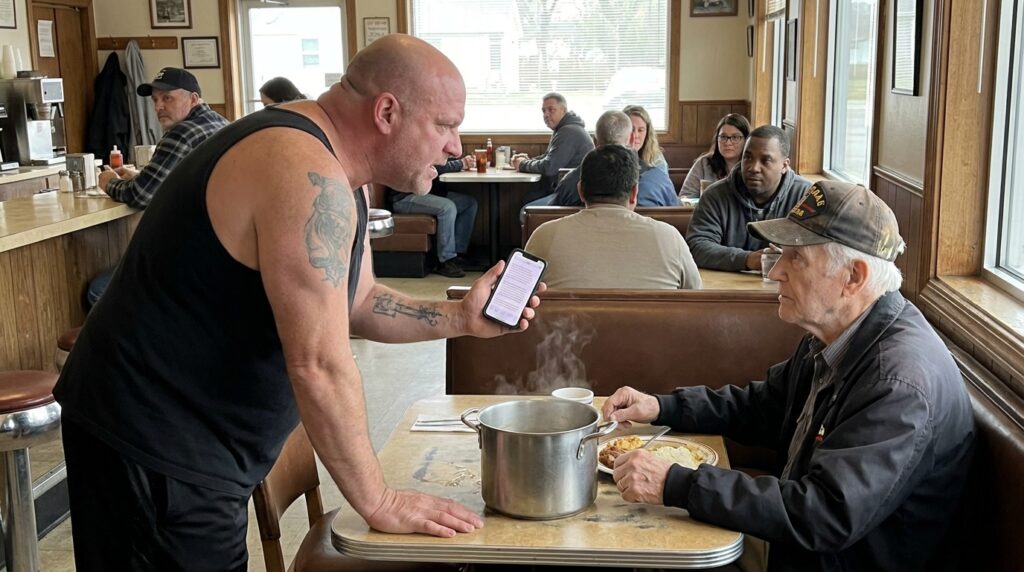
The Weight of Silence and the Cold Steel Residing in the Shadows of the Diner
CHAPTER 1: THE GEOMETRY OF THE BOOTH
“You should move now, old man. This seat is mine.”
The words cut through the low, jagged hum of the diner’s overhead fluorescent tubes like a blade dragged across concrete. The air in the room died instantly. At the midground booths, the clatter of silverware against cheap porcelain ceased, replaced by the suffocating weight of absolute stillness.
He did not look up immediately. He kept his eyes on the half-eaten plate of eggs, mapping the immediate geography of the space. The laminate tabletop was a slab of winter ice beneath his forearms. Two inches to his left sat a heavy, stainless-steel stock pot left by the busboy, radiating a curtain of sharp, hissing steam. It was an environmental barrier. A weapon of opportunity if the distance closed too fast.
The shadow of the man eclipsed the overhead light. Late thirties. Heavy, dense muscle mass layered over a frame built for blunt-force trauma. The dark fabric of his tank top stretched tight across his chest as he leaned in, deliberately violating the invisible boundary of the table.
He pressed his right thumb against the silver bezel of his wristwatch. His nail caught in a deep, jagged indentation in the metal—a permanent scar on the steel from a winter in a forgotten valley thirty years ago. He traced the groove, feeling the cold metal ground his heart rate. Sixty beats per minute. Steady. The man looming over him was breathing too fast, his respirations shallow and erratic.
He is big, but he is running out of time, the veteran calculated, his gaze finally tracking upward, rising past the thick torso and the heavily tattooed arms, anchoring onto the challenger’s eyes.
There was aggression there, yes, but beneath the bravado was a frayed edge of sheer panic. The man’s hips were bladed slightly, not in a fighter’s stance, but awkwardly shifted. His gaze wasn’t fixed on the veteran’s face. For a fraction of a second, the challenger’s eyes had darted downward, tracking beneath the edge of the laminate table, targeting the empty space near the central iron pillar.
The veteran maintained absolute, unflinching eye contact. He did not shift his weight. He did not pull his shoulders back in defensive posturing. To retreat an inch was to surrender the psychological perimeter.
“I’m not going to ask you again,” the heavy man pressed, his voice dropping into a tighter register. He planted a massive hand flat on the edge of the table. The coffee in the veteran’s mug vibrated, dark ripples bouncing off the ceramic walls. The proximity was suffocating, smelling of cheap diesel and old sweat.
The veteran’s thumb remained locked on the indented steel of his watch. He calculated the torque required to shove the steaming stock pot outward. It would take one point four seconds to blind the man with boiling water, another half-second to clear the booth. But violence was loud, and violence drew police. There was a more efficient architecture to dismantling a threat.
He took a slow, measured breath, preparing to issue the warning that would end the escalation. But as the challenger shifted his weight, the fluorescent light caught the underside of the younger man’s thick forearm.
Beneath the swirling, chaotic ink of a fresh tribal sleeve, there was a patch of raised, pale scar tissue. The veteran’s eyes locked onto it. It wasn’t just a burn. It was a brand. A fractured spearhead enclosed in a broken circle.
The veteran’s heart rate spiked to sixty-five. The 104th Logistics Division. A ghost unit that had been officially wiped from the Pentagon’s registry the same year the silver dent had been carved into his watch.
And the man wearing it was staring directly at the underside of the table.

CHAPTER 2: THE GRAVELLY LINE IN THE SAND
“You’re making a mistake, son,” the veteran said. His voice didn’t carry the trembling register of an old man begging for quarter; it was flat, dry, and carried the specific, unhurried cadence of an officer who had spent half his life speaking over the low rumble of idling diesel engines. “Leave while you still can.”
The challenger’s hand remained flat on the laminate table, but the skin across his knuckles went white. His gaze, previously locked on the empty space near the table’s central iron support pillar, snapped back to the veteran’s face. The raw malice in his expression flickered, replaced by a sudden, razor-sharp hyper-vigilance. His eyes tracked the absolute stillness of the old man’s shoulders, then dropped to the right hand resting beside the plate—motionless, fingers loose, mere inches from the steaming lip of the steel stock pot.
The small-town diner had entered a state of arrest. In the midground booths, a local mechanic slowly lowered his coffee mug back to its saucer, his eyes darting toward the counter. The waitress held a glass pitcher of iced tea two inches above a table, her knuckles locked around the handle. Nobody breathed. In an environment defined by predictable local routines, the sudden introduction of professional tactical posturing was a foreign antibody.
The veteran watched the younger man’s chest. The respirations were still shallow, but the cadence had shifted from blind, aggressive panic to a calculated evaluation of risk. The shadow cast by the challenger’s bulk seemed to tighten, his center of gravity shifting slightly backward, away from the table’s edge. He was recognizing the geometry. He was realizing that the frail old man in the faded veteran cap wasn’t looking at his massive arms; he was looking at his throat, his balance point, and the branded circle on his forearm.
“Who the hell are you?” the challenger muttered, his voice dropping into a raspy whisper that barely cleared the ambient hum of the refrigeration units behind the counter. He didn’t lift his hand from the table, but the downward pressure was gone. His fingers curved slightly, ready to pull back or strike depending on the next shift in the room’s temperature.
“A man who knows what happens to people who come looking for things left by the 104th,” the veteran answered. He didn’t raise his voice. He didn’t need to. The subtext was a physical weight between them, sharper than the cold edge of the Formica booth. He kept his left thumb firmly anchored over the silver scar on his wristwatch, tracking the precise rhythm of the moment. The challenger was intelligent enough to calculate odds, which made him dangerous, but it also made him compliant when the metrics turned against him.
The challenger’s eyes dilated. The brand on his forearm—the fractured spearhead inside the broken circle—seemed to tighten as the muscles beneath it flexed. For three agonizing seconds, the silence in the diner was absolute, broken only by the steady, rhythmic hiss of steam escaping from the stock pot between them. The younger man’s jaw clamped shut, his teeth grinding as he balanced the immediate cost of a public brawl against the ticking clock of his true objective.
The calculation ended. The aggressive forward lean collapsed entirely. The challenger pulled his hand off the table, the black tank top shifting as he squared his shoulders and took a deliberate, heavy step backward. His boots scraped against the worn linoleum tiles, creating a wide, respectful distance between his torso and the boundary of the booth.
“Fine,” the challenger muttered, his eyes darting toward the kitchen doors before returning to the veteran with a cold, lingering threat. “I’ll back off. For now.”
He turned on his heel, his large frame cutting through the static air of the diner as he retreated toward a corner booth near the back exit, his eyes never truly leaving the central iron pillar beneath the veteran’s table.
The veteran didn’t watch him walk away. He kept his eyes fixed on the steaming stock pot, his hand remaining loose and ready by his plate, waiting for the ambient sound of the room to return. But as the tension faded into the background chatter of the patrons, his fingers drifted beneath the lip of his own table, his calloused skin searching for the exact seam where the old industrial adhesive met the iron support.
His fingertips brushed against the underside of the wood. The surface was smooth, except for a three-inch strip of thick, recently sliced duct tape hanging loosely from the center of the iron pillar. The space where a heavy manila envelope should have been secured was entirely bare.
His pulse didn’t change, but his mind rearranged the board. The challenger thought the data was still hidden beneath the booth.
The veteran slowly withdrew his hand, his eyes tracking across the diner to the far counter where the cook was leaning against the pass-through window. On the stainless-steel shelf behind the order wheel, half-hidden beneath a stack of clean kitchen towels, sat a thick, grease-stained manila packet that hadn’t been there when the rain started.
CHAPTER 3: THE BACKBOOTH ATTRITION
The bald man did not sit down immediately. He stood at the edge of the rear corner booth, his broad shoulders blocking the narrow corridor that led toward the emergency exit doors. When he finally dropped his weight onto the vinyl bench, it was a structured, tactical movement. He chose the seat that kept his back strictly against the wood paneling, his face angled forty-five degrees to maintain a clear line of sight through the dirty glass partition separating his table from the rest of the floor.
From his original position by the counter, the veteran watched the reflection in the wet windowpane to his right. The storm outside had intensified, thick sheets of June rain striking the plate glass and blurring the neon sign across the highway into jagged streaks of red and amber. Inside, the ambient noise of the diner was slowly reconstituting itself like water closing over a stone. The waitress’s boots squeaked as she moved toward the kitchen, her breath escaping in a sharp, defensive exhale as she passed the counter.
The challenger was checking his watch. It was an unpolished, military-issue tactical piece, strapped tightly over the thick ridges of his tattooed wrist. His fingers tapped a rhythmic four-beat cadence against the laminate surface of his new table.
He is waiting for a synchronization window, the veteran noted. He took a slow sip of his black coffee, letting the bitter, over-boiled liquid burn his tongue. The pain was small, sharp, and focused. It kept his senses from drifting into the gray fatigue that always threatened to settle into his joints when the weather turned cold and wet.
The room was still operating under a false premise. The challenger thought the package was missing because someone had stolen his drop, but he still believed the perimeter of the diner was secure. He didn’t know that the ledger wasn’t beneath the iron pillar anymore. He didn’t know that the game had shifted from a simple recovery contract into a containment operation.
The veteran’s eyes drifted toward the stainless-steel pass-through window. The line cook, a quiet man named Miller who had worked the early shift for seven years, was currently scraping the flat-top grill with a heavy iron stone. Each stroke produced a harsh, metallic rasp that filled the gaps between the thunderclaps outside. Right beside Miller’s grease-stained apron, half-hidden by a stack of clean kitchen towels on the secondary warming shelf, sat the manila packet.
It was thick, sealed with yellow packing tape that had begun to lift at the corners due to the ambient humidity of the kitchen. The veteran had observed it an hour ago, long before the large man walked through the front doors. He had recognized the distinct, blocky hand-lettering on the spine—the standard alphanumeric routing codes used by the logistics tracking offices before the division was dissolved and its records burned in the yard behind the warehouse.
The challenger’s gaze snapped toward the counter. His hyper-vigilance was expanding. His eyes swept over the napkin dispensers, the chrome sugar shakers, and finally anchored on the kitchen doors. He was noticing the irregularities. A man with his training would eventually realize that the cook wasn’t just working; he was guarding the line.
The veteran set his coffee mug down. The ceramic base clicked against the laminate tabletop, a precise, intentional sound. He didn’t look at the rear booth, but he knew the challenger’s eyes would track the movement. He needed to keep the man’s attention anchored strictly to this section of the room. If the challenger moved toward the kitchen before the rain stopped, the local employees would become collateral.
“You need a warm-up on that, Frank?” the waitress asked, her voice cracking slightly as she stopped three feet away, the glass coffee carafe hovering between them. Her nametag said Claire, her fingers trembling against the handle. She was looking at his veteran cap, searching for the familiar safety of an old regular, but her eyes kept drifting toward the large, silent figure in the back.
“No, Claire. I’m fine,” the veteran said, his gravelly voice dropping into that quiet, rhythmic lower register that had once commanded an entire motor pool during a fuel depot mortar attack. “Go check on the couple in booth four. They’ve been waiting on their check.”
“Are you sure?” she whispered, her eyes pleading for a reassurance he wasn’t about to give her.
“I’m sure. Just keep your distance from the rear door.”
She nodded once, a quick, jerky motion, and retreated toward the cash register. The veteran kept his hands flat on the table. Through the cold metal frame of his chair, he could feel the faint vibration of an engine idling in the gravel lot behind the building. It wasn’t a standard delivery truck. The frequency was too low, the diesel exhaust hitting the air intake valve on the diner’s roof with a heavy, rhythmic thrum.
The challenger heard it too. His head tilted toward the rear exit. His hand slid off the table, disappearing completely beneath the shadow of the bench.
The veteran knew that movement. It was the reach for a concealed sidearm, tracking the safety release by feel through the thin fabric of a waistband. The decoy secret—the assumption that this was an isolated drop recovery—was about to disintegrate. The challenger wasn’t just waiting for a clock to hit a number; he was waiting for his extraction team to clear the alleyway.
The veteran shifted his weight, his left hand dropping to the side of his dark jacket, his fingers brushing against the heavy, blunt iron utility wrench tucked inside his deep internal pocket. It wasn’t a gun, but at three feet, against a man whose center of gravity was caught beneath a fixed booth table, it would be enough to break a knee and reset the distance.
The kitchen door swung open two inches. The cook, Miller, didn’t look out. He simply reached back, his calloused fingers sliding the manila packet off the warming shelf and dropping it into the empty space inside a clean, galvanized grease trap bucket sitting on the floor.
The challenger stood up. His large frame uncoiled from the back booth, his boots hitting the linoleum with a dull, heavy thrum that silenced the room for the second time.
CHAPTER 4: THE COVERT CONVERT
The uncoiling of the large man from the rear booth took precisely zero point eight seconds. His center of gravity shifted cleanly over his heavy boots, his large muscular frame cutting through the dim, grease-laden atmosphere of the diner toward the swinging kitchen doors. He didn’t look at the veteran. His right arm was held in a stiff, guarded position against his flank, masking the distinct imprint of an iron utility frame beneath the black tank top.
From his counter stool, the veteran initiated his own counter-movement. He didn’t rise into a standing position that would broadcast tactical alarm to the rest of the room. Instead, he smoothly slid his boots off the chrome metal ring of the stool, his heels hitting the wet linoleum with measured weight. His right hand dipped into the internal lining of his jacket, fingers wrapping tightly around the cold, textured iron shaft of the utility wrench.
The decoy secret was unraveling in real-time. The challenger had completely abandoned the idea that the package was under the booth. His trajectory was locked directly on the stainless-steel pass-through where Miller had dropped the galvanized bucket.
The veteran stepped into the narrow interaction lane between the counter and the booth dividers, forcing his body into the younger man’s path. He didn’t use force yet; he used geometry. He leaned his left hip against the corner of booth three, cutting off the angles of approach.
“The kitchen’s closed to public foot traffic, son,” the veteran said, his gravelly voice flat and unyielding under the hum of the overhead lights.
The challenger didn’t slow his pace until his chest was less than two feet from the veteran’s shoulder. The proximity brought the sharp smell of rain-soaked canvas and industrial hydraulic fluid. His bald head tilted down, his neck muscles twisting into tight, thick ridges as he attempted to look over the old man’s head toward the swinging doors.
“Get out of the way, old man,” the challenger whispered. The transactional calmness was entirely gone from his tone, replaced by an abrasive, jagged desperation. “You don’t know what’s in that room. You don’t know who’s coming through that back door.”
“I know Miller’s got a hot grill, and I know you’ve got no business past the threshold,” the veteran answered. He kept his posture entirely loose, but his thumb remained locked over the silver scar of his wristwatch. His mind calculated the distance. If the challenger’s right arm cleared his flank, the response would have to be defensive and instantaneous—a sweeping wrist release followed by a hard, lateral balance shift into the heavy iron support pillar.
The equal intellect of his adversary showed itself in the next micro-second. The challenger didn’t swing. He didn’t try to use his bulk to push through the line. Instead, his left hand shot out in a lightning-fast, highly disciplined redirection maneuver, his thick fingers grabbing the veteran’s right lapel while his body weight shifted downward to lock the old man’s hips against the laminate table edge. It was a precise tactical restraint, designed to clear a path without throwing a loud punch.
But the veteran had spent three winters in the motor pools of the 104th predicting physical failures under stress. He didn’t pull back against the lapel grab. He went with the momentum.
As the challenger pulled, the veteran allowed his upper torso to rotate cleanly into the pressure. He brought his left forearm up in a sharp, defensive wedge, striking the inside of the challenger’s left elbow with the hard bone of his wrist. The friction was immediate and mechanical. The alignment of the younger man’s arm shattered, his fingers slipping off the dark jacket fabric as his balance point was pulled violently forward over the steaming stock pot on the table edge.
The environmental disruption was instant. The challenger’s hip struck the metal side of the stock pot, sending a heavy splash of boiling water across the laminate surface. He let out a sharp, guttural hiss as the heat penetrated his black tank top, his boots sliding six inches across the wet linoleum as he fought to restore his center of gravity.
The victory, however, was a false flag.
Before the veteran could close the distance to establish an immobilization lock, the external pressure system broke wide open. The heavy diesel engine that had been idling in the rear gravel lot suddenly surged. The rear emergency exit doors of the diner didn’t just open—they were violently breached from the outside, the metal lock system snapping with a sharp, high-velocity crack that echoed through the kitchen.
Through the two-inch gap in the swinging kitchen doors, the veteran saw a flash of dark rain-gear and the matte-black barrel of an industrial tracking unit. It wasn’t an extraction team for the challenger. It was something else entirely.
The line cook, Miller, didn’t even have time to lift his iron scraping stone. A heavy, gloved hand slammed into his chest, forcing his frame backward into the grease traps. The galvanized bucket containing the grease-stained manila packet was kicked sideways, sending the thick document sliding across the greasy tile floor directly toward the base of the dishwashing station.
The challenger looked at the kitchen door, then back at the veteran, his face pale beneath the fluorescent lights as the ultimate final reality began to bleed through the margins of the room.
“They tracked the signature,” the challenger muttered, his hand finally clearing his waistband to reveal a heavy, serialized tracking key instead of a gun. “They didn’t come for the drop. They came for the person who intercepted it.”
He didn’t mean himself. His eyes were locked directly on the veteran cap.
CHAPTER 5: THE TACTICAL FAULT
The swinging kitchen doors didn’t settle. They rattled violently on their industrial spring hinges, throwing a spray of cold rain and localized grease smoke directly into the interaction lane. Through the splintered wood gap, two operators moved in a low, synchronized wedge configuration. Their gear was slick with June storm runoff, the matte-black barrels of their compressed tracking frames scanning the room with mechanical, unhurried precision.
The veteran didn’t pause to process the tactical shift. His internal calculation bypassed fear, routing directly into structural preservation. He seized the challenger’s heavy, rain-soaked canvas collar before the younger man could bring his tracking key up into a defensive orientation.
With a single, disciplined rotation of his hips, the veteran anchored his weight against the iron support pillar of booth three. He shoved the muscular challenger backward, forcing his large bulk down into the narrow footwell beneath the laminate table. It wasn’t a gesture of protection; it was an extraction of space. He needed the larger man out of the primary line of fire to keep the diner’s structural columns between the advancing wedge and the remaining civilian witnesses at the far booths.
“Stay down and turn that tracker off,” the veteran commanded, his gravelly voice slicing through the high-pitched hum of the kitchen’s refrigeration alarms.
The challenger hit the linoleum hard, his bald head striking the iron base of the booth table. The heavy serialized tracking key in his hand clicked against the metal, its small amber indicator light pulsing rapidly as it attempted to broadcast through the structural steel. He scrambled backward, his tattooed arms scraping against the cold floor grease as he jammed the device deep inside the pocket of his black tank top. “They aren’t private contractors, old man,” he rasped, his teeth clicking together as he fought for oxygen. “That’s a retrieval team from the logistics oversight office. They’re purging the records.”
A sudden blast of high-velocity impact shattered the glass partition above booth three. A non-lethal, compressed pneumatic kinetic slug struck the laminate border, tearing a three-inch gap through the synthetic wood and sending a cloud of sharp, white resin dust across the veteran’s plate. The shockwave rattled the silver bezel of his wristwatch, the vibration pulsing directly against the permanent scar in the metal.
The veteran dropped his center of gravity by six inches, his dark jacket absorbing the spray of fractured glass. He tracked the origin of the shot through the swinging door gap. The lead operator was advancing past Miller’s flat-top grill, his boots slipping slightly on the greasy tiles near the dishwashing station.
He is over-correcting his balance on the wet surface, the veteran noted, his strategic pursuit logic locking onto the structural weakness. Three seconds before his partner clears the grease trap bucket.
The veteran did not have a projectile weapon, but his hand was still wrapped around the cold, heavy iron shaft of the utility wrench inside his pocket. He pulled the tool free, the heavy metal catches clicking quietly against the zipper lining. He didn’t lift his arm to throw it. Instead, he reached out with his left boot, catching the lower edge of the heavy stainless-steel stock pot that still sat steaming on the edge of the table.
With a sharp, lateral snap of his heel, he kicked the iron support base of the burner assembly.
The heavy pot rolled outward, its three gallons of boiling, grease-slicked stock cascading over the counter ledge and flooding the floor directly in front of the swinging door threshold. The wave of boiling liquid hit the linoleum just as the lead operator’s boot cleared the wood paneling. The synthetic sole lost all mechanical friction against the floor tiles, the man’s weight shifting violently backward as his hips rotated out of alignment.
The operator went down hard, his tactical tracking frame striking the metal corner of a trash receptacle with a loud, hollow clang. The secondary operator behind him halted instantly, his weapon tracking down to avoid targeting his partner, his advance completely bottle-necked by the narrow kitchen corridor and the pool of hissing, steaming liquid.
It was a functional counter-move, but it was a temporary reprieve. The veteran felt the cold draft from the shattered back doors hit the back of his neck. The diesel engine in the alleyway was revving higher, the exhaust note shifting into a high-pitched whine as a secondary vehicle entered the lot.
The veteran pulled himself tight against the iron pillar, his knuckles white around the iron wrench. He looked down into the dark footwell beneath the booth. The challenger was staring up at him, his face pale under the white resin dust coating his shoulders.
“The packet in the grease trap,” the challenger whispered, his fingers trembling as he held his breath against the white smoke. “It’s not just an accounting ledger. It’s the decommissioning log for the entire 104th. Every name. Every address. If they secure that bucket, none of us clear the month.”
The veteran’s pulse didn’t waiver from its sixty-five beats per minute, but the parameters of the board had just changed. The decoy secret—the idea that this was an envelope full of encrypted financial data—was completely dead. The ultimate final reality was shifting into focus, but it remained locked behind the iron doors of the kitchen.
He looked at his watch bezel, his thumb finding the deep indentation. Then he looked toward the cash register where Claire was crouching behind the counter, her eyes fixed on his veteran cap.
Before he could initiate his next physical progression toward the kitchen threshold, a heavy, metallic sound echoed from the rear alleyway. The secondary vehicle had backed directly into the diner’s industrial transformer unit. The overhead fluorescent tubes flickered twice, turned a sickly shade of violet, and died completely, plunging the room into the desaturated, shadow-filled gray of the storm.
CHAPTER 6: THE TERMINAL THRESHOLD
The dark was not empty; it was a physical weight that smelled of scorched copper and rain.
The veteran’s heart rate held at sixty-five beats per minute. In the absolute black of the diner, the strategic framework of the room remained burned into his retinas. The pool of hot grease stock was six inches to his front. The down operator was shifting weight on his side seventy inches past the threshold. The secondary operator was standing eighty-five inches back, his boots tracking left against the line cook’s iron prep counter.
He didn’t swing the iron utility wrench. He didn’t move toward the door. Instead, he reached out in the dark, his left hand finding the cold iron rim of the structural pillar supporting booth three. He pulled his frame forward, his boots clearing the wet floor without a scrape, sliding through the interaction lane like oil moving over steel.
Time dilated. The peak of the climax expanded into an emotional slow-motion where every micro-texture became an anchor. The far booths were silent, the civilian breaths held in tight, rhythmic terror. In the kitchen, the low hiss of the flooded flat-top grill sounded like a dying turbine.
The secondary operator fired into the dark. The muzzle flash was a sharp, violet strobe that lasted less than a hundredth of a second, but it was enough to reveal the architecture of the threat. The operator was aiming high, tracking the level of an adult chest.
He was expecting an active, standing combatant. He wasn’t looking forty inches below the light line.
The veteran closed the distance during the sensory shadow of the flash. He stepped inside the partner’s bladed stance, his left shoulder striking the operator’s wet canvas vest. The tactical vest was rigid, packed with trauma plates, but the human frame inside it was still bound by physics. The veteran didn’t strike the chest; he drove his iron utility wrench downward into the narrow gap where the operator’s heavy combat boot met the lower line of the shin guard.
The iron tool caught the edge of the tracking plate. With a sharp, sudden torque of his wrist, the veteran leveraged his body weight against the operator’s knee.
The joint didn’t shatter; it locked. The operator’s center of gravity collapsed instantly into the grease pool on the floor, his frame hitting the stainless-steel dishwashing station with a muffled, metallic thud that cut off his breath. His weapon clattered against the grease traps, its internal battery pack sparking once before shorting out against the wet tiles.
The room returned to absolute black.
“Miller,” the veteran said. His gravelly voice didn’t rise above a whisper, but it carried the absolute authority of an officer clearing a lane. “The galvanized bucket. Move it now.”
A low grunt came from the floor near the pantry door. “Already down the chute, Frank,” the cook’s voice answered through the dark, tight and short. “It’s in the basement grate.”
The veteran reached down, his fingers finding the collar of the large challenger who was still crouching beneath the laminate table line. He hauled the younger man up by his tank top, forcing his bulk toward the rear emergency exit door before the recovery team’s secondary element could cycle their vehicles in the gravel lot.
The challenger was shaking, his breath hitting the veteran’s neck in cold, panicked gasps. The tracking key in his pocket was dead, its amber light extinguished by the electrical surge from the transformer box. “We don’t have the packet,” he muttered, his hands fumbling against the wet metal bar of the door. “We’re leaving it behind.”
“The packet was never under the table, son,” the veteran said. He pushed the door open, the wet June storm hitting his face with the force of an industrial spray. The red neon cross across the highway threw a desaturated, crimson wash across his lined face and the faded insignia of his cap. “I took the ledger out of that envelope at dawn. What Miller dropped down the chute was an old delivery manifest from ninety-four.”
The challenger froze, his hand locking around the wet frame of the door as the ultimate final reality broke through his calculation. His intellect had been equal to the decoy, but it had entirely missed the baseline. “The tracking signatures… they weren’t chasing the ledger. They were chasing the original intercept code.”
“They were chasing me,” the veteran said. He didn’t look back at the dark diner floor where the two operators were beginning to stir against the grease traps. He adjusted the brim of his veteran cap, his calloused thumb resting one final time against the silver indentation of his wristwatch. “Now move. Before they realize the data is already on the wire.”
The veteran stepped into the rain, his dark jacket absorbing the red shadow of the highway sign, leaving the empty booth and the cold laminate table behind him in the gray.
CHAPTER 7: THE COLD ARCHITECTURE OF THE WAREHOUSE
The rusted corrugated iron of the roof shrieked as the wind caught the loose western edge. Inside the abandoned logistics warehouse, the darkness was vast, hollow, and smelled of decades of decomposing pine crates and dead oil.
The veteran didn’t stop until his boots cleared the greasy tracking pad of the old freight elevator. He released his grip on the challenger’s wet canvas collar, letting the younger man stumble forward onto a stack of rotting wooden pallets.
“Get your breath,” the veteran said. His gravelly voice didn’t echo; the immense volume of the empty structural space swallowed the sound instantly. He reached into his coat pocket and pulled out a small, heavy aluminum casing no larger than a cigarette pack—the true ledger he had pulled from the manila packet at dawn. He snapped it onto the housing of a portable field terminal sitting on a rusted iron barrel.
The field terminal flickered to life, its low green phosphorus glow casting sharp, desaturated shadows across the deep lines of his face and the faded fabric of his veteran cap. The cooling fan inside the machine whined, a thin, high-pitched mechanical squeal that sounded like an old radar unit warming up on a cold runway.
The challenger pushed himself up from the pallets, wiping a streak of black iron dust from his bald head. His black tank top was torn at the shoulder, the pale, branded circle of the 104th Logistics Division glistening with rain under the green light. He stared at the glowing monitor, his large chest heaving as his hyper-vigilance dialed back into a cold, desperate focus.
“You had it the whole time,” the challenger rasped, his teeth chattering against the drop in temperature. “You let me walk into that diner thinking I was pulling a live drop.”
“If you didn’t think it was live, your posture would have given it away the second you crossed the threshold,” the veteran said. He didn’t look up from the screen. His calloused fingers hit the heavy mechanical keys with a rhythmic, unhurried cadence, entering the bypass codes he had kept memorized since the winter of ninety-four. “The oversight office doesn’t deploy field operators for data. They deploy them to clean the perimeter of anomalies. You were the anomaly, son. I was the anchor.”
The screen flashed once, a horizontal line of white code cutting through the green phosphorus background before stabilizing into a dense vertical column of names, dates, and alphanumeric designators.
The veteran’s thumb rested flat against the silver bezel of his wristwatch, his nail catching the deep indentation in the steel. His pulse held firm at sixty-five beats per minute. He knew the structural layout of the file; he had helped catalog the original manifest before the logistics units were systematically dismantled. But as the third sub-directory opened, the strategic pursuit logic of his mind detected a fatal discrepancy in the file size.
There was a secondary data string attached to the routing codes—an active tracking sub-protocol that was currently updating its target metrics in real-time.
The challenger took a heavy step toward the barrel, his large frame leaning over the green glow of the screen. His eyes dilated as he tracked the movement of the cursor down the column of names. He wasn’t looking for a corporate ledger. He wasn’t even looking for the operational history.
His thick, tattooed finger shot out, stopping less than an inch from a single line of text near the bottom of the registry.
“There,” the challenger whispered, his voice cracking into a jagged, broken register that completely destroyed his previous bravado. “That’s not a list of survivors. That’s a target manifest.”
The veteran didn’t answer. He watched the screen as a small, amber icon began to pulse next to the name the challenger had targeted. The alphanumeric designation code beside it didn’t belong to an old supply sergeant or a retired motor pool mechanic. It belonged to an active residential address less than four miles from the county line bridge.
The ultimate final reality of the second phase was bleeding through the green light. The challenger hadn’t come to the diner to sell the ledger to the highest bidder; he had come to steal it before the cleanup team could execute the next line on the list.
A low, static-filled hiss erupted from an old shortwave radio receiver sitting on a shelf behind the iron barrel. It wasn’t a standard emergency broadcast. It was an unencrypted, military-grade secondary frequency, and through the white noise, the low thrum of a heavy diesel engine began to pulse in perfect synchronization with the storm outside.
CHAPTER 8: THE SHADOW INVESTIGATOR
The radio didn’t broadcast words; it emitted the steady, rhythmic click of a tactical transceiver checking a directional bearing. Five quick bursts of static, then an unbroken hiss that matched the low, mechanical rattle of the diesel idling outside the warehouse’s western wall.
The veteran reached down and cut the power toggle on the shortwave unit. The hiss died, but its absence only hollowed out the cavernous silence of the iron rafters above them. He did not ask the challenger questions. He did not waste time looking at the large man’s sweating face. His strategic pursuit logic was already tracing the spatial boundaries of the floor plan, tracking potential paths of ingress.
“Get off the pallet,” the veteran said. His gravelly voice was a low, vibrational warning that stayed below the noise of the rain thudding against the iron ceiling trusses. “They didn’t find this grid by luck. They followed the active transmission signature from your tracking key before you buried it.”
The challenger stood up slowly, his large muscular frame casting a jagged, elongated green shadow against the brickwork behind the iron barrel. His eyes remained anchored to the single line of glowing text on the monitor. The name—Marcus Vance—pulsed under the cursor. Beside it, the active routing code for an address near the river loop was marked with a tiny, blinking red asterisk.
“They’re moving on him tonight,” the challenger muttered. His large hands curved into tight, defensive blocks against his sides. The raw, territorial aggression he had brought into the diner had completely flattened out, replaced by the desperate clarity of a man who realizes he is a move behind his opponent. “My brother was the logistics dispatcher who signed the fuel requisition logs for that valley. He didn’t leak anything, Frank. He’s just a name that connects the dates.”
“The oversight office doesn’t sort by guilt, son. They sort by proximity,” the veteran said.
He reached out and yanked the portable aluminum casing from the field terminal’s expansion bay. The green phosphorus screen went dark instantly, plunging the immediate radius back into the desaturated gray shadow of the rafters, save for the faint red glint of the storm through the high glass windows. He slid the casing into the hidden internal pocket of his jacket, letting the heavy iron weight of the utility wrench rest against it to serve as a physical shield.
He turned toward the dark interior of the floor, his eyes tracking a line of old, grease-filmed forklift chassis parked near the central storage lane. The air was heavy with the smell of wet rot and oxidized iron, a sensory landscape he had navigated across three different staging zones before his official retirement. He knew the layout of these old municipal hubs; they were always built with a secondary maintenance tunnel running beneath the primary tracking scales to allow for structural repairs without shutting down the yard.
A sharp, high-velocity click resonated from the warehouse’s eastern loading bay. It was the sound of a spring-loaded hydraulic bolt cutter cleanly biting through a hardened iron pad eye.
Entry element has reached the threshold, the veteran calculated, his thumb tracking the silver indentation of his watch. Sixty-five beats per minute. The cadence was automatic. Two operators on the bolt. One marksman holding the lane from the rear bumper of the idling diesel. They aren’t rushing because they assume our tactical visibility is zero.
The challenger reached into his pocket, his hand tightening around the deactivated tracking key as if he wanted to smash the light. “We have to break through the western doors. If we can reach the loop road before they deploy the secondary element—”
“If you clear the western door, the marksman on the diesel has your torso aligned before your boot hits the gravel,” the veteran interrupted, his whisper cutting through the younger man’s panic like a wire. “He’s using a passive infrared frame. He isn’t looking for your tank top; he’s looking for the ninety-eight-degree heat bloom of your lungs against the cold rain.”
He grabbed the challenger’s left bicep, his calloused fingers locking around the muscle with enough force to halt the man’s forward momentum. He dragged him forty-five degrees to the right, toward the concrete pit where the old floor scales had been removed.
The concrete edge was jagged, the iron reinforcing bars rusted into black, pitted spikes that reached out from the mortar like teeth. Beneath the lip lay a narrow, black trench filled with three inches of stagnant rain runoff and old hydraulic oil. It was tight, filthy, and completely invisible from both the eastern doors and the high window tracks.
“Get in,” the veteran commanded.
“Frank, if we get pinned in a ditch—”
“In a ditch, your heat signature is masked by four inches of reinforced aggregate and three feet of groundwater,” the veteran said. He didn’t wait for compliance. He applied downward pressure, using the challenger’s own forward lean to drop the large man into the trench. The water splattered against the concrete walls with a dull, muffled slap that was immediately buried by a massive crack of thunder outside.
The veteran slid into the trench beside him, his dark jacket absorbing the black grease film of the wall. He reached up with his left hand and pulled a rotting section of a cedar shipping crate over their heads, leaving a two-inch gap that aligned perfectly with the base of the iron barrel where the terminal had been sitting.
Through the crack in the wood, the veteran watched the eastern door frame.
The heavy iron door didn’t swing wide. It slid open three inches on its tracks, a silent, grey hand in a matte-black puncture glove slipping inside to test the internal air resistance. A second later, a thin, needle-like probe extended from the gap, its tip spinning silently as it sampled the room’s electromagnetic frequencies, searching for the green phosphorus signature they had left on the wire less than ninety seconds ago.
The equal intellect of the oversight office was visible in the deliberate patience of the search. They weren’t soldiers looking for a fight; they were investigators conducting a forensic extraction, and they knew exactly how a veteran of the 104th calculated distance in the dark.
CHAPTER 9: THE TACTICAL FRACTION
The needle-like probe didn’t vibrate. It hummed at a frequency that set a thin, high-pitched resonance into the pooled hydraulic fluid near the veteran’s left boot. Through the splintered two-inch crack of the rotting cedar crate, the green phosphorus trail left by the deactivated terminal hung in the humid air like cold steam, slowly being pulled toward the eastern bay doors by the building’s natural exhaust draught.
The veteran didn’t breathe. He had calibrated his lung capacity to the narrow volume of the trench, his chest pressed flat against the slick concrete wall. Beside him, the challenger’s large muscular frame was rigid, his skin covered in a film of cold grease and black industrial sediment. The younger man’s right hand was frozen inches from the waistband of his trousers, his thick fingers locked around the dead tracking key. His panic had transformed into a silent, calcified immobility. He was tracking the sound of boots on the floor above.
Three sets of soles. Polyurethane-injected tactical tread. Non-marking. The weight distribution was uniform, indicating individuals carrying less than fifteen kilograms of individual kit—streamlined, rapid-intervention profiles.
“The terminal housing is warm,” a low voice reported from the center of the bay. The sound was clipped, flat, and stripped of regional inflection, identical to the standard communication protocols used by the logistics oversight investigators during the final audit of the 104th. “Cooling fan bearing is still rotating down. Intercept occurred less than ninety seconds ago.”
“Verify the line,” a secondary voice answered from the threshold of the loading dock. “The driver on the diesel has zero thermal emergence on the perimeter loop. They’re still inside the structural shell.”
The veteran watched the primary operator’s shadow cut through the red glint of the storm window. The man was moving in a tight, three-meter search box, his matte-black tracking frame held at a low forty-five-degree angle. He wasn’t checking the rafter tracks or the high storage bays. He was checking the floor. He knew the specific weight signatures of the concrete slab. He knew that an iron scale foundation left a distinct hollow return if struck with a localized acoustic pulse.
The thumb of the veteran remained anchored over the silver bezel of his wristwatch. His pulse sat at sixty-four beats per minute. A single drop. He was calculating the exact decay rate of the phosphorus signature on the terminal’s copper heat sink. In forty seconds, the temperature of the casing would drop below the ambient threshold of the iron barrel, rendering it invisible to a standard passive search frame.
But forty seconds was a luxury the board wasn’t going to afford them.
The primary operator stopped two paces from the edge of the scale pit. The spinning probe on his left flank tilted downward, its optical lens catching a thin reflection of the green light that still lingered in the micro-cracks of the iron barrel’s base. His boot shifted, the thick sole scraping against a rusted iron bolt head with a sharp, metallic ping that signaled immediate recognition.
He’s found the alignment anomaly, the veteran noted.
He didn’t wait for the operator to adjust his tracking frame. He reached sideways through the oil-slicked water, his fingers finding the hard, square shoulder of the challenger’s arm. He didn’t pull; he delivered two quick, rhythmic taps against the younger man’s skin—the old motor pool signal for an emergency auxiliary start.
The challenger reacted with the survival instinct of a cornered animal. Instead of uncoiling upward into the line of fire, he drove his heavy boots laterally against the rusted iron reinforcement spikes of the concrete wall, using the leverage to push their combined weight three feet deeper into the black horizontal recess of the maintenance tunnel.
The movement was mechanical and violent. The rotting cedar crate above them split completely, its fractured pieces hitting the concrete slab with a hollow clatter just as the primary operator’s acoustic pulse struck the center of the pit.
The shockwave hit the trench like a physical blow, a high-density sound pocket that rattled the veteran’s teeth and set a violent vibration into the silver watch bezel against his thumb. The resin dust from the broken wood erupted into a white cloud, obscuring the view through the gap as the ceiling of the maintenance tunnel began to shed old mortar flakes.
The veteran didn’t look up to check the structural integrity of the ceiling. He was already on his knees in the black fluid, his right hand drawing the heavy iron utility wrench from his jacket lining. The decoy secret—the assumption that they could sit out the search in the dark—had collapsed under the precise geometry of the investigator’s sweep.
Through the white haze of the resin dust, the primary operator’s boot cleared the edge of the pit, his tracking frame dropping into a vertical tracking lane to clear the trench.
The veteran went under the light line before the lens could cycle its target acquisition. He drove the square head of the iron wrench upward through the dust, targeting the thin synthetic seal where the operator’s heavy ankle guard met the flexible compression fabric of his tactical boot.
The impact was short, dry, and carried the full force of a man who had spent forty years lifting truck blocks off assembly rails. The iron tool bit deep into the structural tendon behind the heel. The operator didn’t scream; his breath escaped in a sharp, guttural hiss as his leg buckled beneath his weight, his entire frame tilting sideways into the rusted iron teeth of the scale foundation.
“Contact!” the secondary voice barked from the bay doors, followed instantly by the high-velocity crack of a pneumatic slug tearing through the iron trusses above the trench.
The veteran grabbed the fallen operator’s tactical tracking frame before the man’s torso hit the water, his fingers locking around the matte-black composite handle. He didn’t try to use the weapon; he slammed the heavy battery casing directly into the spinning electromagnetic probe on the man’s flank, shorting out the circuit in a violent shower of blue sparks that blinded the infrared optics of the remaining team at the door.
“Move,” the veteran whispered into the black smoke, his gravelly voice cutting through the hiss of the shorted battery. He didn’t look back to see if the challenger was following. He was already dragging his frame through the narrow, oil-filmed pipe toward the loop road exit, his calloused hand shielding the aluminum data casing against his ribs as the entire warehouse grid entered a state of terminal escalation.
CHAPTER 10: THE COUNTY LINE THRESHOLD
The corrugated mouth of the drainage tube did not offer a clean egress; it terminated in a jagged, rusted lip that dropped eighteen inches directly into the choked gravel runoff of the loop road.
The veteran’s heels struck the loose stone with an unhurried, mechanical thud. He didn’t drop his center of gravity into a roll. He maintained his stride, his bladed profile cutting through the dark, diagonal curtain of the June downpour toward the western concrete abutment of the county line bridge. Behind him, the challenger emerged from the pipe, his large muscular frame slicked with black fuel sediment, his boots sliding six inches across the wet shale before he stabilized his mass.
“The secondary vehicle is circling back from the loop interchange,” the challenger rasped. He wiped a mixture of grease and rainwater from his bald head, his thick fingers shaking as he checked the horizon. The serialized tracking key inside his pocket remained completely dark, but his eyes kept tracking the high power lines stretching across the river. “We’re box-locked, Frank. If they establish a tracking lane on the bridge span, we don’t have the velocity to clear the county line.”
“They aren’t tracking the lane anymore, son,” the veteran said.
He stopped against the cold, vertical face of the bridge’s concrete anchor block. The surface was pitted by forty winters of salt and frost, the aggregate stones showing through the mortar like gray teeth. He reached into his dark jacket, his fingers passing the heavy iron shaft of the utility wrench to pull the aluminum casing of the portable drive from his internal pocket. The green phosphorus data was locked inside the casing, but the metal housing was freezing to the touch now, completely adjusted to the atmospheric temperature of the storm.
Time dilated. The terminal threshold of the narrative arc expanded into an emotional slow-motion where the kinetic elements of the landscape became absolute parameters. The river below the span was a churning, black muscle, its crests catching the dull crimson reflection of the highway sign three miles upstream.
The veteran reached down and caught the edge of his wristwatch bezel. He did not check the numerals. He simply pressed his thumb against the permanent indentation in the steel, letting the memory of the winter of ninety-four anchor his pulse rate. Sixty-five beats per minute. Solid. The oversight office investigators were moving with high tactical velocity, but their methodology was bound by administrative efficiency. They were clean, precise, and entirely dependent on electronic tracking certainty.
“They’re coming through the brush,” the challenger whispered, his hand diving back toward his waistband as the headlights of the secondary diesel truck cut through the tree line five hundred yards out. “Give me the drive, Frank. I’ll run the span. If I can draw the marksman’s heat frame toward the eastern pier, you can clear the loop.”
“You run that span, and Marcus Vance dies before you hit the midpoint,” the veteran said, his gravelly voice dropping into that low, flat register that brooked no modification.
He didn’t give the younger man the aluminum pack. Instead, he unlatched the heavy silver buckle of his watch strap. The old mechanical timepiece, its steel housing permanently scarred by the service records it had survived, slipped into his calloused palm. He laid the watch flat against the top of the aluminum drive casing, then reached into his jacket for the dead tracking frame he had taken from the operator in the warehouse pit.
The short-circuited battery pack inside the tracking frame was still emitting a low, residual electromagnetic loop—an electronic phantom signature that simulated an unencrypted field cipher being compiled in real-time.
“Frank, what are you doing?” the challenger asked, his chest hitching as he recognized the components. “That’s the original signature. If you ground that circuit here, the entire retrieval team converges on this block.”
“That’s the calculation,” the veteran answered.
He used the square head of the iron utility wrench to jam the shorted battery pack directly into the internal terminal contacts of the drive casing. A single, bright violet spark erupted against the concrete wall, illuminating the lines of his face and the faded emblem of his veteran cap for a fraction of a second before dying into the gray spray of the rain. The phantom signature was live now, anchored to the permanent steel of the bridge’s iron reinforcement bars.
He shoved the combined assembly deep inside a narrow expansion joint in the concrete abutment, burying the tracking loop five feet beneath the road grade.
“Now we cross below the deck,” the veteran commanded. He pointed toward the rusted iron cat-walk running beneath the structural beams of the bridge floor. It was a five-inch steel ledge, suspended twenty feet above the black river, slick with grease and completely shielded from thermal optics by the massive mass of the bridge’s reinforced deck plates.
The equal intellect of the oversight team revealed itself three seconds later. The secondary diesel truck didn’t slow down as it reached the loop interchange; it accelerated, its heavy tires screaming against the wet asphalt as its internal sensors locked onto the high-density electronic signature emitting from the expansion joint. Two operators emerged from the wood line, their tracking frames held high, their trajectories completely routed toward the concrete block where the watch was ticking.
They were purging a ghost.
The veteran pulled his frame onto the iron cat-walk, his fingers wrapping around the cold, rusted rivets of the primary structural beam. He didn’t look back at the flashing lights or the operators advancing on his old timepiece. Beside him, the challenger moved with deliberate care, his large frame staying low in the shadows of the iron trusses, his bicep brushing against the veteran’s shoulder as they crossed the county line in the absolute dark.
The data was gone from the drop site, the tracking parameters were shattered, and the names on the list remained secure under the weight of the concrete anchor.







