
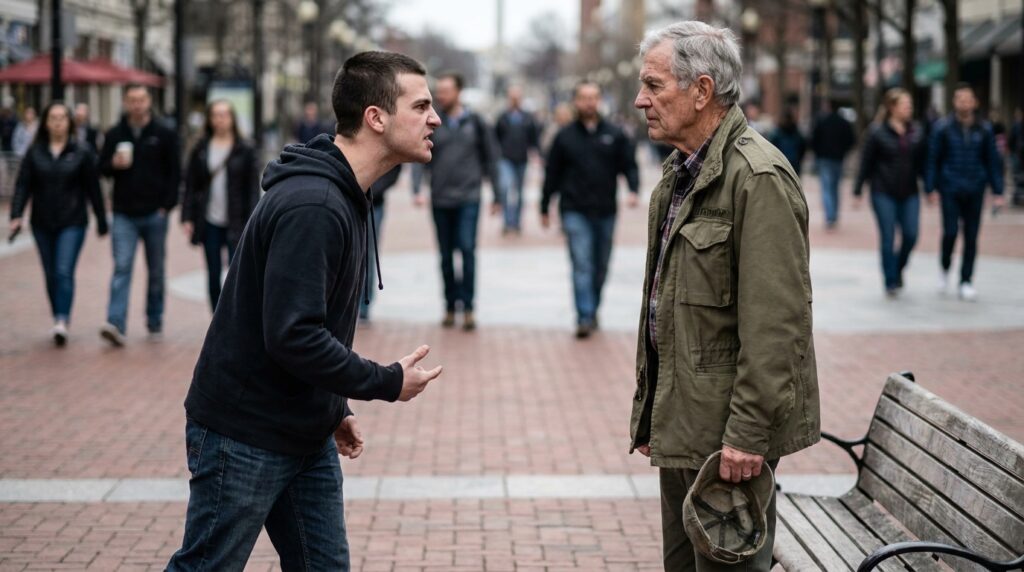
Buried Beneath the Clay: The Chilling Reason a Ruthless Corporate Director Is Trying to Evict His Own Father from an Abandoned Town Park Before Dawn
CHAPTER 1: THE FAULT LANE
“You should walk away before this gets embarrassing for you.”
The voice was too loud for the heat of the afternoon. It had the sharp, tinny edge of an engine running without enough oil.
Arthur did not shift his weight on the green-painted iron slats of the bench. His hands stayed flat on his thighs, the skin there cross-hatched with pale scars from the old lathe work at the valve plant, forty years of oil-grease ground so deep into the prints it looked like charcoal. He kept his eyes on the far side of the walkway, where the weeds were pushing through the cracked asphalt of the old rail spur.
The boy—man, technically, though he had the narrow, unpadded shoulders of someone who hadn’t finished growing into his ribs—took another half-step forward. His sneakers made a dry, scraping sound against the gravel. He was wearing an oversized black pullover despite the heavy June air, the fabric clean but stiff.
“I’m talking to you, old man,” the boy said. He leaned down, bringing the smell of stale tobacco and cheap mints into Arthur’s space. His shadow fell right across Arthur’s boots, cutting off the small patch of yellow clover growing near the base of the iron frame. “People are tired of looking at you sitting out here like you own the block. Move it along.”
Arthur let the silence stretch. In the valley, if you didn’t answer a dog right away, it either barked harder or it moved on to a different fence. He waited to see which way the boy’s blood would run. The park was empty except for an old woman three hundred yards down by the dry fountain, shaking out a plastic grocery bag. No one was coming to change the math.
The boy’s right hand was tucked deep into his pouch pocket, his wrist turning inward. A small, rhythmic click-click came from the fabric—the latch of a cheap folding knife, or maybe just a heavy set of keys being thumbed over and over.
“I know who your people are, son,” Arthur said. His voice didn’t rise above the drone of the locusts in the dead elms behind them. It came out dry, like two shingles rubbing together in a low wind. “Your grandfather had the third forge from the gate. He didn’t leave his tools to someone who spends his two-o’clock hours running errands for a landlord.”
The boy flinched, his jaw tightening until a small white knot appeared near his ear. “You don’t know anything about my family. The forge closed before I was born. My house is on the list for the July demo.”
“I know,” Arthur said. He finally turned his head, his gray eyes fixing on the boy’s face with the flat, heavy stare of an inspector checking an engine block for cracks. “That’s why you’re standing here instead of doing something that pays. You think if you clear the bench, the town looks bigger to the people with the papers.”
The boy’s hand came out of his pocket, empty but white-knuckled. He reached for the back of the bench, his fingers curling over the iron. “Get off the seat.”
Arthur looked down at the boy’s hand. There was a small, blue ink tattoo between the thumb and the forefinger—a crude line drawing of a broken wheel, the mark the local casual crews used down by the railyards. But underneath the fresh ink, the skin was raw and yellowed by a massive, deep-tissue bruise that ran all the way up under his sleeve. It wasn’t an injury from a fight; it was the distinct, mottled discoloration of chronic chemical exposure, the kind Arthur had seen on forty men before the foundry pumps were sealed.
Arthur didn’t rise. He reached into his casual jacket, his fingers wrapping around the cold, heavy casing of his grandfather’s iron pocket watch. He didn’t pull it out. He just held it against his ribs, feeling the mainspring hum its broken, frantic rhythm.
“I gave you every chance,” Arthur said, his voice dropping into the low, stone-gray register that used to quiet the floor when the cranes were moving overhead. “Now we’re finished here.”
The boy opened his mouth to speak, but the words seemed to stick behind his teeth. He looked at Arthur’s shoulder—upright, unyielding—and then down at the old man’s boots, which hadn’t shifted an inch since the shadow first fell. The bravado went out of his shoulders like air from an unknotted tube, leaving him looking smaller, the streetwear suddenly too large for his frame.
He took a slow step back, his heel catching on the edge of the concrete walkway before he found his balance. His eyes stayed on Arthur’s hands, which were still flat, still still.
“Understood,” the boy muttered, his voice dropping an octave as his eyes darted toward the gravel path behind the bench. “I’m done.”
He didn’t turn around immediately. He backed away three paces, his hands deep in his pullover again, before turning his hip and striking out toward the northern gate where the abandoned freight cars sat rusting in the sun.
Arthur watched him go until the black pullover disappeared behind the gravel bins. Then he let his left hand fall from his jacket. As he pulled his fingers out, his nail caught on the small brass fob of the watch, dragging a small, folded strip of heavy yellow paper out of the lining. It wasn’t his. It had been slipped into his pocket while he’d been watching the boy’s face—a legal description for the land parcel directly beneath the park bench, stamped with an official corporate seal that bore his own last name.

CHAPTER 2: THE LAND REGISTER
The yellow paper felt like dried snakeskin between Arthur’s thumb and forefinger. It had the distinct, oily weight of document stock that had sat too long in a basement filing cabinet, absorbing the humidity of the valley until the edges grew soft and furred.
He didn’t open it fully until the boy’s black pullover had been swallowed entirely by the iron-gray silhouettes of the gravel bins at the northern edge of the yard. The park remained quiet, save for the dull, rhythmic clanking of a loose metal guy-wire hitting a utility pole somewhere down by the dry canal.
Arthur flattened the sheet against his thigh. His hands, scarred from forty winters of tool steel and lathe bite, looked dark against the crisp typography of the heading: Valley Development & Holdings, LLC. Below the description of the parcel—the precise coordinates of the acre surrounding this very bench—was the signature line. The ink was a sharp, aggressive blue, written with a heavy-nibbed fountain pen that had driven hard enough into the paper to leave a visible ridge on the reverse side.
David Vance. Regional Director.
The name sat there like an unexploded shell in an old trench. Arthur didn’t blink. He reached down into the deep pocket of his canvas coat, pulled out his heavy tortoise-shell reading glasses, and hooked them behind his ears with a single, practiced motion. The blue ink didn’t change under the glass. David’s handwriting hadn’t altered since he was twenty, though the flourish at the end of the ‘V’ had grown longer, more calculated—the stroke of a man who spent his mornings signing away things he’d never seen with his own eyes.
Arthur stood up. His knees gave a dry, splintering crack that echoed softly against the iron legs of the bench. The air tasted of hot asphalt and the faint, bitter tang of wild mustard growing along the ditch. He didn’t head toward his small house on Fourth Street. Instead, he turned his face toward the old industrial boundary line, following the trail of crushed slag the boy had taken.
The town didn’t end so much as it dissolved into grease. Within four blocks, the sidewalks crumbled into gray dirt lanes where the wild sumac grew through the floorboards of abandoned loading docks. This was the old rim—the zone where the foundry’s breathing used to rattle the windows of the workers’ cottages every night at ten. Now, the stacks were cold, their brick bases white with lime-bleed, looking like monumental teeth rising from the thistle patches.
He found the tracks where the boy had gone. The grass was bent, the seed-heads broken off by the thick rubber soles of new streetwear. Arthur walked with a slow, deliberate stride, his old work boots finding the solid ties between the rotting sleepers.
A quarter-mile past the switching tower, the rail line cut through an old drainage gully. There, tucked against the concrete abutment of a forgotten overpass, sat three trailers. They weren’t the aluminum recreational kind; they were rusted construction shacks, their wheels long since removed and replaced by stacks of split pine blocks that were beginning to rot into the dark earth.
A dog—some mix of red setter and hound—was tied to a rusty axle with a length of yellow plastic rope. It didn’t bark when Arthur approached. It just lay in the dirt, its tongue out, its ribs rising and falling with a shallow, clicking breath.
“He ain’t here,” a voice said from the shadow of the middle trailer.
Arthur stopped, his boots grinding into the slag.
An older woman sat on a plastic milk crate near the trailer’s single aluminum step. She was wearing a faded cotton housecoat that had been patched at the elbow with a square of blue denim. Her hands were tucked into her lap, but Arthur could see the skin on her forearms—it had that same yellowed, mottled discoloration he’d noticed on the boy’s arm at the bench, the skin look tight and slightly shiny, as if it had been cooked in lard.
“I’m not looking for trouble, Martha,” Arthur said. He took off his cap, holding it by the brim.
The woman looked up, her eyes watery and surrounded by deep, purple pockets of fatigue. She recognized him; everyone who had survived the ninety-two layoff knew Arthur Vance. He’d been the one who stayed behind to grease the main gears even after the receivers locked the gate, just so the machinery wouldn’t seize before the pensions were settled.
“He’s got a fire in him, Arthur,” she said softly, her voice catching on a dry cough. “The boy thinks he can fight the paperwork. He bought those clothes with the last of his father’s disability check because he said you have to look like someone if you want people to listen to you in the city.”
“He came to the park,” Arthur said, moving closer until the smell of old grease and boiling cabbage from the trailer door reached him. “He was carrying this.” He held out the yellow sheet.
Martha didn’t look at the paper. She looked at Arthur’s face, her mouth twisting into a small, bitter line. “We all know who signed it, Arthur. We knew when the trucks first came to lease the storage lot behind the school. Your boy’s name is on every fence they put up.”
“David doesn’t know about the people,” Arthur said, though the words felt heavy and false even as they cleared his teeth. “He’s in the office in the state capital. He sees numbers on a grid.”
“He lived here until he was eighteen,” she spat, her hand coming out of her lap to point a crooked, yellow-tinged finger at Arthur’s chest. “He drank the same well water we did. He knows exactly who lives in these shacks. He knows my boy can’t work the line because his lungs are full of gray dust from the grinding shed.”
Arthur didn’t answer. He looked past her, into the open doorway of the construction shack. On a folding card table inside, illuminated by a single unshaded bulb, sat three large ledger books with heavy canvas bindings. They were the old payroll and maintenance logs from the plant—the ones that were supposed to have been shredded when the state environmental inspectors came through after the final shutdown.
A pair of small, grease-smeared binoculars sat on top of the ledgers, their lenses focused through the small trailer window toward the south—directly toward the park where Arthur spent his afternoons.
Arthur stepped toward the door, his boot coming down on a piece of rusted hoop-iron that groaned under his weight. “Where did the boy get those books, Martha?”
Before she could answer, the dog rose from the dirt, its ears flattening against its skull as a low, wet rattle began in its throat. From the gravel path behind the overpass, the sound of a vehicle approaching on the service road cut through the heat—the heavy, rhythmic thrum of an eight-cylinder engine running slow, its tires crunching over the large stones with an unhurried, official authority.
Arthur didn’t run. He turned his back to the trailer door, his eyes narrowing as a black sedan with tinted glass rolled into the clearance beneath the overpass, its clean paint completely out of place against the rusted iron of the valley.
CHAPTER 3: THE COLD OFFICE
The black door of the sedan didn’t swing; it clicked with a heavy, oiled precision that belonged to things kept away from valley dust.
A man stepped out into the gravel, his leather-soled shoes making a sharp, unyielding crunch that seemed to strike a chord in the rusted underbelly of the bridge. He was forty, maybe forty-five, his graying hair cropped with the same geometrical accuracy as the corporate headings on the yellow paper. His lightweight gray wool suit looked entirely separate from the damp heat of the ditch, like something sealed behind plate glass.
David didn’t look at the trailers. He didn’t look at Martha or the dog, whose throat was still rattling with an old, wet hate. He looked straight at Arthur.
“You shouldn’t be out here, Dad,” David said. His voice was smooth, trained to level out any local vowels that might hint he had spent his first twelve years running down these same slag heaps. “The air near the old spur isn’t clear. You know what the county reports say about the particulate count.”
Arthur didn’t drop his cap. He held it against his stomach, his thumb tracing the worn sweatband where his own salt had stained the leather over thirty seasons. “The county reports are written by people who live sixty miles north, David. This is Martha’s lane. Her boy’s grandfather worked the third forge.”
David took a pair of thin leather driving gloves from his pocket and tapped them against his palm. The motion was small, rhythmic, and perfectly controlled. “The third forge has been dead since eighty-eight, Dad. The property belongs to Valley Holdings now. We took title to the three acres behind the spur three weeks ago. The people here are occupying corporate staging ground.”
“They’re living in their houses,” Arthur said, his voice dropping into that stone-heavy register that used to halt the yard engines.
“They’re shacks on unzoned ballast,” David replied, his eyes moving for a fraction of a second toward the trailer door where the ledger books sat under the unshaded bulb. His expression didn’t change, but his fingers tightened on the gloves. “The county signed the clearance order on Tuesday. I have the master plan in the car. It’s a greenway, Dad. It’s light commercial and a historical park. We’re putting five million into the soil to cap the old industrial footprint. It’s what you and the committee wanted ten years ago.”
Arthur looked down at the yellow paper still crumpled in his hand. “The committee wanted the town kept whole, David. We didn’t ask for the names on the mailboxes to be scraped off with a grader.”
David took a step closer, his leather shoes slipping slightly on the loose slag before his weight adjusted. For a second, the light from under the overpass caught his face, and Arthur saw the faint, pale line of a scar near his chin—the mark from an old bicycle fall on the very rail ties they were standing near. It was the only part of him that looked like it belonged to the valley.
“The town is dead, Dad,” David said softly, his voice dropping enough so Martha wouldn’t catch the edge of it. “It died when the boilers were dumped. You’re sitting on an iron bench waiting for people who went into the ground twenty years ago to come back and take their shift. I’m trying to bring capital back into the basin. If we don’t clear the liability, the state won’t release the highway funds.”
“What liability?” Arthur asked.
David reached out, his gloved hand coming down on Arthur’s forearm with a firm, checking pressure. It wasn’t an attack; it was the gesture of a doctor holding a patient down. “The structural kind. The old foundations are rotting into the water table. The town hall has a four-inch list to the east because the old drainage tunnels beneath Third Street are collapsing. If we don’t cap the whole sector, the center of the block goes down.”
Arthur pulled his arm back, his old skin scraping against the tight grain of David’s leather glove. The friction left a thin white line on Arthur’s wrist. “You signed the eviction for the boy, David. He’s got the mottled skin. His father died of the lung-rot, and now you’re turning him into the ditch because he looks bad from the road.”
David’s face finally hardened, the smooth corporate mask settling until his eyes looked like two cold rivets. “The boy broke into the vault at the old administrative building, Dad. He took six boxes of archived maps and three ledgers that belong to the receiver’s estate. That’s a felony. I’m here with the county marshal to secure the company’s property before he does something that can’t be settled with a check.”
As if on cue, the rear door of the black sedan opened another three inches. A man in a brown uniform with a heavy brass star on his pocket sat in the shadow of the wheel, his hand resting on the rim of the steering column. He didn’t get out, but the interior light stayed on, illuminating a stack of red-stamped warrants on the dashboard.
Arthur turned his head toward the trailer door. The boy was standing there now, his black pullover bunching around his throat, his face pale except for the bright red circles around his eyes. He had the heaviest canvas ledger tucked under his left arm, his hand gripping the rotting binding so hard his fingernails were bleeding into the cloth.
“Don’t let them take the books, Arthur,” the boy yelled, his voice cracking into a high, frantic scream that made the red setter jump to its feet. “They’re hiding the numbers from forty-four! The maps show where the pipeline ran before they filled the ditch with lime!”
David didn’t look back at the boy. He kept his eyes locked on his father’s weathered face. “The maps are public record, Dad. They’re in the courthouse index. The boy is reading old rumors from the union newsletters. There is nothing under the park but six feet of gravel and two hundred miles of dead wire.”
He reached out his hand, palm up, toward the paper in Arthur’s fingers. “Give me the register sheet. Let me do my job, and I’ll have the marshal drive you back to Fourth Street before the storm hits.”
Arthur looked at his son’s open palm. The leather was clean, without a single spot of grease or rust. Then he looked past him, down the gully toward the southern gate where the park bench sat in its small circle of yellow clover, directly above the deep, silent stone well that had been boarded up since the year David was born. He didn’t give him the paper. He tucked it back into his jacket pocket, right next to the iron watch that was ticking too fast against his ribs.
“The courthouse burnt its records in ninety-six, David,” Arthur said, his voice dropping into a register that wasn’t heavy anymore—just cold and flat like a winter creek. “I was on the council that year. We didn’t burn the maps. We gave them to your office for safe-keeping.”
He turned away from the sedan, his boots turning toward the trailer door where the boy stood with his bleeding fingers. Behind him, the car door clicked again, louder this time, as the man with the star put his boots into the gravel.
CHAPTER 4: THE GROUND UNDERFOOT
The iron bench sat in a pocket of cold purple shadow when Arthur reached the park gate. The storm had held off, but the air had the sour, yellow weight of a stagnant river pool. He could feel the vibration of the valley roads in the arches of his feet—the low, continuous groan of empty flatbeds moving toward the rail yards, their steel tailgates rattling against the frames.
The boy was already there. He was sitting on the grass five yards from the concrete walkway, his knees pulled up to his chin, his oversized pullover smeared with dark grease from the overpass ditch. The heavy canvas ledger lay between his boots like a block of unhewn stone. His hands were tucked inside his sleeves, hiding the fingers that had bled into the rotting twine of the spine.
Arthur didn’t sit. He stopped beside the rusted iron leg of the bench, his palm coming down on the top slat where the green paint had entirely flaked away, leaving the bare, rough metal exposed to the salt of the air.
“They didn’t follow you,” the boy said without looking up. His voice was thin, scrubbed of the mocking bite he had used in the afternoon. “The marshal took the bypass road toward the development office. I saw the lights from the water tower.”
“They won’t come until dawn,” Arthur said. He pulled the yellow register sheet from his coat pocket and let it drop onto the grass near the boy’s sneakers. It didn’t flutter; the paper had absorbed too much dampness to catch the low wind. “David’s checking the land register records at the municipal basement. He thinks I have the original deed from seventy-two.”
The boy reached out a foot and touched the edge of the paper with the toe of his shoe. “Your name is on the fence line, Arthur. My mother told me. She said your family owned the drainage rights from the upper culvert all through the thirty-year run.”
“My grandfather owned the surface,” Arthur said softly. He reached into his coat and pulled out the old pocket watch. The crystal was cracked across the center, a thin white line dividing the copper face into two unequal halves. He didn’t look at the hands; he turned the winding stem three times until the internal spring gave a dry, metallic screech and stopped. “The town council took the depth rights in fifty-one when they laid the main conduit for the foundry cooling beds. They paid us three hundred dollars and a brass voucher for the municipal company store.”
He moved around the bench, his boots crunching into the yellow clover until he stood directly over the circular concrete cap that marked the old unmapped well. The concrete was five feet across, its surface pitted by decades of acid rain until the limestone aggregate showed through like tiny, white teeth. A heavy iron inspection plate was set into the center, secured by four square-headed bolts that had rusted into solid lumps with the casing.
“Open the book,” Arthur said.
The boy shifted, his shoulders dropping as he pulled his hands out of his sleeves. He turned the canvas ledger over, his thumbs finding the back cover where the lining paper had separated from the board. Inside the split, tucked between the pasteboard and the moldering gray cloth, was a single sheet of tracing linen—the blue ink faded to the color of wood smoke, but the lines still sharp, drawn with the heavy, unyielding ruling pens of the old plant engineers.
Arthur knelt. His knees hit the pitted concrete with a dull, wet sound. He didn’t look at the boy’s face; he kept his eyes on the linen layout as the boy unrolled it across the iron inspection plate.
The map didn’t show the streets or the houses or the third forge. It showed lines of flow. A cluster of thick, red-inked arrows originated at the base of the old chemical leaching vats two miles north, following the natural limestone fault lane directly down the dip of the basin. The arrows didn’t stop at the boundary of the yard. They converged into a single, dense spiral centered exactly where the concrete cap sat beneath the bench.
“They filled the ditch with lime in ninety-six because the state inspectors found the sulfur count was too high in the creek,” the boy whispered, his finger tracing the red lines until his nail rested on the spiral. “But they didn’t seal the bottom. They just turned the overflow into the old municipal pump line. My father drank from the Third Street pipe until the day he went into the hospital.”
Arthur reached down and touched the iron inspection plate. The metal was freezing cold despite the June heat, coated with a thin, greasy film that tasted of sulfur and iron-scale when he drew his finger across his lip. “The company didn’t hide the maps from the council, son. The council gave the maps to the company because the town couldn’t afford the remediation bonds. If the state had found out about the well-leak in ninety-six, they’d have cordoned the whole basin from the highway to the ridge. No one could have sold their house. No one could have stayed.”
The boy looked up, his eyes wide and dark in the gathering dusk. “Your boy knew. David knew when he signed the clearance order for the greenway.”
“David knows the land is unbuildable,” Arthur said. His voice came out flat, without anger, the finality of forty years of small compromises settling into the gray gravel around them. “He’s not building houses here. He’s putting five feet of river silt and clay over this acre so the surface runoff doesn’t show the lime-bleed when the county does the ten-year test. He’s capping his own birthright so the firm can sell the upper valley to the rail company.”
He stood up slowly, his joints groaning against the weight of his frame. He reached down, took the tracing linen from the boy’s fingers, and folded it twice before sliding it into the back pocket of his trousers, right against the brass fob of his watch.
“What do we do?” the boy asked. His hand was still resting on the ledger, his body small against the blackening silhouette of the bench.
Arthur looked toward the northern gate where the lights of the sedan were visible now, two pale yellow discs cutting through the dust of the service road. “Go home to your mother, son. Tell her to pack the bedding into the truck. The water from the Third Street tap isn’t going to turn clear because we stayed to watch the grader.”
He turned back to the bench, his canvas coat catching on the iron slats as he sat down, his boots finding the same worn hollows in the gravel where he had spent every afternoon of his retirement. He didn’t look back as the boy rose and began to run toward the gully, the heavy canvas book left behind on the concrete, its pages rustling softly in the first cold wind of the storm.







