
The Weight of Cold Iron and the Unforgiving Friction of a Concrete Horizon

CHAPTER 1: THE FRICTION OF THE TRAY

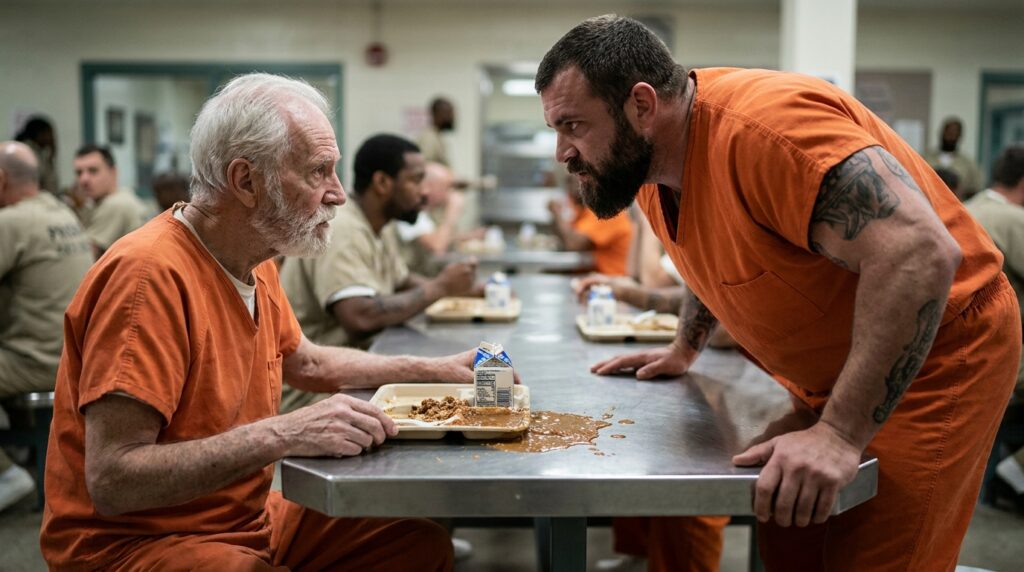
“You got nothing left, old man, nobody here fears you.”

The words smelled of stale tobacco and raw adrenaline. They vibrated across the narrow, grease-filmed space of the bolted metal table, carrying the distinct, heavy heat of a challenge meant for an audience.

Cobb didn’t look up immediately. His focus remained fixed on the plastic cafeteria tray between them. The impact had been deliberate—a heavy, tattooed forearm catching the edge just enough to lift it, sending the lukewarm mountain of gray slop and boiled cabbage slithering across the pitted aluminum surface. A thin, yellowish broth pooled around Cobb’s left thumb. The metal table was cold beneath his wrists, the institutional chill seeping through the coarse orange cotton of his sleeve. The desaturated light of the cafeteria, filtered through high, wire-reinforced glass, caught the fine particles of dust suspended in the air between them.

Opposing him, the younger man—Miller—leaned lower. The skin over his jaw was tight, dark stubble framing the jagged edge of a home-inked throat tattoo. His breath was shallow, fast, the muscle in his forearm twitching where it remained anchored to the table. Miller was breathing through his nose, a predator tracking the micro-movements of a cornered animal. In the background, the vast, echoing roar of four hundred men scraping plastic forks against trays slowed, a localized pocket of silence expanding outward from their bench like grease on water.

Cobb let his gaze trace the yellow broth as it reached the edge of the metal, dripping onto his canvas shoe with a rhythmic, heavy patter. His knuckles, swollen and permanently thick from forty years of industrial laundry labor, felt like rusted hinges inside his pockets. His thumb rolled the jagged edge of the salvaged hex-nut hidden in his lining. The friction of the iron was a grounding weight.

“Look at me when I’m talking to your old ass,” Miller hissed, his voice dropping into a razor-thin rasp, his chest nearly touching the spilled tray. “The tier changed, old man. Your people are gone. You’re just a ghost waiting for a hole.”

Cobb’s white beard shifted against his collar. He didn’t calculate the guards’ positions by the wall; he knew the blind spots of the central pillar by heart. He knew the reaction time of a second-tier response was forty-two seconds.

He didn’t speak. He moved.

The surge wasn’t a young man’s fluid grace; it was the heavy, violent snapping of an old oak branch under a winter load. Cobb’s left hand shot out from the broth, his fingers hitting the slick aluminum first, using the friction to launch his lean frame forward across the table. His right hand—thick, calloused, smelling of industrial bleach—clenched into the front of Miller’s collar before the younger man’s eyes could widen.

The impact was a dull, wet thud of bone meeting fabric. Cobb dragged Miller’s chest down into the spilled cabbage, the metal table groaning against its floor bolts.

“I have nothing left to lose,” Cobb whispered. His voice was a dry, gravelly scrape, barely louder than the drip of the broth onto the concrete. He pulled Miller closer, until the younger man’s nose was inches from his own white, unblinking eyes. “Don’t play with me.”

Miller’s dominance evaporated into the smell of sour food. The muscular frame went rigid, then instinctively recoiled, his boots skidding backward on the grease-filmed floor. But Cobb’s fingers held, the orange cotton tearing slightly under the strain. Miller’s mouth opened, no longer mocking, his chest heaving as the reality of the grip set in. The old man wasn’t shaking. He was anchored.

“Alright, alright,” Miller muttered, his hands coming up, palms flat, a sudden, desperate tilt to his head as he tried to break the line of sight. “Back off. Just… back off.”

Cobb held him for one more rhythmic pulse of the background noise, letting the iron-hard weight of his knuckles sink into the young man’s throat. Then, with a slow, deliberate release, he let his fingers uncurl.

Miller scrambled backward, his thighs hitting the opposite bench with a loud metallic clang. He didn’t look around to see who had watched. His eyes remained locked on Cobb’s face, his hand rising instinctively to touch his own throat, where three deep, pale indents were already beginning to turn a dark, bruised purple.

Cobb didn’t clean the front of his uniform. He sat back down on the cold iron stool, his right hand slipping back into his pocket, his fingers finding the rusted hex-nut once more. He looked down at the tray.

Lying in the center of the gray cabbage slurry, exposed where Miller’s shirt had dragged across the plastic, was a small, stamped brass key with an administrative serial number—the specific key to the pharmacy storage room on the maximum-security tier.


CHAPTER 2: THE COST OF THE GRIP

The brass key sat embedded in the gray grease of the spilled cabbage, its stamped serial number gleaming like a gold tooth in a jawful of rot. Cobb did not reach for it immediately. A man who grabbed too quickly in the central block was a man who revealed the shape of his hunger, and hungry men were chewed up first. Instead, he let his thick palm flatten against the pitted aluminum of the table, his thumb tracking the rusted grain of the metal edge, feeling the vibration of four hundred inmates slowly returning to their low, rhythmic chatter as the immediate threat of a riot subsided.

Across the bench, Miller was still breathing in short, ragged gasps, his boots grinding against the salt-rimmed concrete floor as he pulled himself up. His eyes didn’t drop to the tray; they remained pinned to Cobb’s face, wide and defensive, tracking the old man’s hands with the frantic intensity of a dog that had just felt the boots. The dark purple imprint of Cobb’s knuckles was already darkening along the soft skin beneath his jaw, a stark contrast to the sharp, black lines of his throat tattoo.

“Take your tray, Miller,” Cobb said. His voice was a low, dry rasp, the sound of iron dragging over gravel. He didn’t look at the guards stationed near the high reinforcement pillars, but he could feel the shift in their weight, the metallic clink of heavy key rings swinging against utility belts as they prepared to clear the room. “The slop’s getting cold.”

Miller didn’t answer with the bravado he had carried into the lane three minutes ago. His mouth twitched, a sour taste clearly rising in his throat. He reached out with a hand that shook just enough to rattle the plastic edge, his tattooed fingers closing over the lip of the tray. As he dragged the mess toward himself, his thumb naturally covered the brass key, sweeping it into the palm of his hand with a clumsy, desperate theft. He didn’t look at it. He just stuffed the wet metal into his uniform pocket, left his stool, and vanished into the gray sea of orange shirts moving toward the tray-return line.

Cobb stood up slowly, the joints in his knees popping with a sound like dry kindling. His right hand remained deep in his pocket, his fingers rolling the iron hex-nut against his thigh, the constant friction his only shield against the deep, throbbing ache settling into his wrist. The surge had cost him. The cartilage in his shoulder felt dry, scraped clean by the sudden expenditure of force, and a dull heat was beginning to bloom across his knuckles. He followed the slow, single-file march out of the cafeteria, his boots tracking the thin film of dust that seemed to permanently coat the facility’s lower decks.

The transition back to the cellblocks was governed by the heavy, mechanical rhythm of the tier locks—the sequential slam of steel against steel that punctuated every hour of his life. But as Cobb reached the threshold of Tier 3, the floor officer didn’t check his name off the standard clipboard. The guard, a thick-necked man named Henderson whose uniform always smelled of scorched coffee, reached out with a blunt forearm, barring the gate.

“Not that way, Cobb,” Henderson said, his eyes fixed on the ledger page rather than the old man’s face. “You’ve been reallocated. Floor four, section D. Moving today.”

The iron nut stopped rolling in Cobb’s pocket. Section D was the old boiler block, a desaturated corridor of leaking steam pipes and rusted cell doors that had been partially condemned three winters ago. It was a blind spot in the prison’s architecture, a place where the air was thick with the smell of wet coal and old damp, and where the guards rarely walked the galleries after the evening lock. It was where the administration put the men they wanted the house to forget.

“Who signed the order, Henderson?” Cobb asked. He kept his posture relaxed, his weight shifted onto his heels, a sovereign protector defending the small boundary of his remaining stability.

“The house signs the orders, Cobb. I just turn the key,” Henderson muttered, his finger tapping the bottom of the carbon sheet. He didn’t show the signature line, but Cobb’s eyes, sharpened by decades of tracking the subtle shifts in institutional paper, caught the purple ink of the stamp at the margin. It wasn’t the standard housing lieutenant’s mark. It was the heavy, double-bordered seal of the Warden’s private administrative office.

Cobb didn’t argue. He knew the friction of a useless protest only wore down the gears. He turned his face toward the rusted iron stairs leading up to the fourth tier, his boots heavy on the open metal risers. Every step echoed through the central well, a hollow, metallic ring that felt less like a walk to a new cell and more like the slow lowering of a crate into a dark hold.

When he reached Cell 412, the door was already racked open. The interior was narrow, the concrete walls weeping a thin line of lime-white mineral crust where the upper yard’s drainage leaked through the seams. A single iron cot was bolted to the left wall, its canvas mattress stained with the grease of a dozen previous tenants.

Sitting on the lower stool, his back pressed against the rusted utility pipe that ran from the floor to the ceiling, was Miller.

The younger man looked up, his face silhouetted against the narrow, dirt-crusted window at the back of the cell. The brass key he had taken from the cafeteria tray was sitting on the edge of the sink, catching the faint, orange glow of the setting sun as it cut through the yard’s perimeter wire. Miller wasn’t holding a weapon, but his posture was wired tight, his muscles coiled like a spring that had been compressed past its safety margin.

“They put me in here twenty minutes ago,” Miller said, his voice no longer carrying the mocking edge from the cafeteria, replaced instead by the hard, flat tone of a man who realized he had been dropped into a trap with the door already welded shut. He reached out with one finger, tapping the brass key until it slid into the porcelain bowl of the dry sink with a sharp click. “They told me if you didn’t look handled by the evening bell, neither of us makes the morning shift.”

Cobb stepped into the cell, his shoulder brushing the cold iron frame as the mechanical track above them groaned, the heavy door sliding forward until the lock dropped with a final, unyielding thud.

CHAPTER 3: THE BROKEN LEDGER

“Who told you?” Cobb asked. He didn’t move toward the sink. He remained planted by the door, his frame casting a long, lean shadow across the weeping concrete wall.

Miller shifted on the stool, the iron legs scraping against the grit. “The cell-house lieutenant. When they brought me up the back stairs, he handed me that brass key. Said it opens the lockbox in the industrial laundry office where they keep the master shift-logs. Said if I went down there during morning detail and burned the April sheets, my sister’s medical bills outside get wiped by a dummy trust. If I don’t, they drop the segregation gate on me and let the block factions have their turn.”

The silence that followed was heavy, broken only by the rhythmic hissed exhale of a steam pipe somewhere down the section line. Cobb’s fingers remained steady inside his pocket, turning the rusted hex-nut. The metal surfaces of the cell felt small, compressing them into an artificial proximity where every breath was a calculation. Miller’s story was precise, the physical mechanics of prison leverage clear in every syllable, but it carried the distinct weight of a half-truth designed to protect a deeper vulnerability.

“They didn’t give you that key to burn paper, Miller,” Cobb said softly. He stepped forward, his canvas shoe coming down on a dry patch of floor. “They gave you that key because the laundry office is where they keep the high-voltage maintenance conduit. If those sheets burn there, the main breaker trips. The cells on Tier Four unlock manually from the box at the end of the gallery. It’s a clearance run.”

Miller’s head snapped up, the color draining from beneath his neck tattoo, leaving the black ink stark against pale, sweat-slicked skin. “They told me it was just a fire. A distraction to clean the books.”

“They lied to you,” Cobb muttered, his hand finally coming out of his pocket to touch the cold, calcified pipe running up the wall. “They want the tier open. And they want us inside when it happens.”

The mechanical rattle of the ten-minute warning bell cut through the floor, a dull vibration that shook the rust flakes from the overhead fixture. Cobb reached into the dry porcelain sink, his thick fingers picking up the stamped brass key. The metal was cold, smelling faintly of machine oil and wet soap. He didn’t look at Miller as he tucked it into the inner lining of his waistband. If the house wanted a fire, they would have to build it with different kindling.

Eight hours later, the morning work whistle blew with the dry, iron shriek that signaled the opening of the industrial details. The air in the lower laundry sorting facility was thick with the suffocating humidity of steam presses and the sharp, chemical tang of commercial chlorine. Cobb moved through the sorting bins with the practiced, mechanical rhythm of a man who had spent half his life dragging wet canvas bundles across concrete.

Miller stayed four paces behind him, his large, tattooed frame uncharacteristically stiff as he loaded the heavy extraction drums. The guards on the catwalk above were sparse, their attention fixed on the far wall where the main steam intake was rattling under pressure.

Cobb waited for the rotation cycle to hit the thirty-minute mark—the window where the floor boss always retreated to the glass-walled office for the morning count. Moving with a silent, deliberate efficiency, Cobb slipped behind the massive industrial dryer units, his boots tracking the slick slurry of gray water and lint that collected in the floor drains. The brass key slid smoothly into the padlock of the corner office door, the tumblers falling with a dull, muffled click.

Inside, the room was small, desaturated by decades of lint dust that covered the filing cabinets like a layer of gray frost. Cobb didn’t go for the active logs on the desk. He went to the rusted iron lockbox bolted beneath the main fuse panel. He twisted the key, pulling the heavy lid back until the hinges screamed.

There were no shift-logs inside.

Lying in the bottom of the iron box were three thick packets of internal administrative transfer sheets, each stamped with the Warden’s private seal. Cobb’s calloused thumb flicked through the top pages, his eyes skipping past the names until he hit the allocation dates. Every inmate transferred to Section D over the last six months—including Miller, and including himself—had been processed through a private corporate entity named Apex Reclamation Group.

The documents weren’t prison records. They were land assignment rosters.

Attached to the final sheet was a blue-line survey map of the prison’s northern foundation line, showing the deep core-drilling sectors directly beneath the old textile yard. Across the top corner, written in the Warden’s sharp, precise longhand, were the words: Site clearance authorized upon cessation of tier occupancy. Old guard assets to be contained permanently.

Cobb felt a cold, metallic chill settle into the small of his back that had nothing to do with the drafts in the laundry room. The confrontation in the cafeteria hadn’t been an isolated incident of prison politics; it was a manufactured trigger. The younger inmate was a tool, sent to pull a lever he didn’t understand, while Cobb was the target marked for permanent containment to ensure the ground beneath his feet remained quiet.

A shadow broke the yellow light coming through the frosted office glass.

Cobb didn’t look up from the ledger sheets as the door creaked open behind him. He could hear the heavy, uneven breathing, the smell of copper and sweat entering the small room.

“You found it,” Miller said from the doorway. His voice was flat, but his right hand was tucked deep inside his orange shirt, his shoulder turned forward in a defensive stance that Cobb had seen a thousand times before a blade came out. “The lieutenant’s waiting by the main gate, Cobb. He said if I don’t bring him the key and the April sheets in five minutes, the whole block goes down early.”

Cobb slowly folded the land survey map, stuffing the rough paper into his uniform pocket beside the iron hex-nut. He turned to face the young man, his eyes steady, his old hands hanging loose at his sides.

“There are no April sheets, Miller,” Cobb said, his voice entirely devoid of fear, carrying only the hard, pragmatic weight of a man who had just seen the edge of his own horizon. “They aren’t trying to clear your debts. They’re trying to clear the block.”

From the yard outside, the emergency siren began its long, rising wail—the distinct, three-tone pulse that meant an immediate, unscheduled facility-wide lockdown.

CHAPTER 4: THE HORIZON OF DUST

The siren’s first blast didn’t just rattle the glass in the laundry office; it vibrated inside the fillings of Cobb’s teeth. It was a three-tone mechanical shriek that tore through the heavy, wet air of the lower facility, followed instantly by the deep, structural thud of the main intake vents shutting down. The standard workspace lights went black, leaving only the dull, pulsing amber of the emergency strobes casting long, rhythmic sweeps across the dust-frosted iron cabinets.

Miller didn’t drop his hand from his shirt. The amber light caught the hard line of his shoulder, the shadow of his posture widening as he took a step back toward the door frame. “The back stairs are locked, Cobb. I heard the gate seals drop from two tiers down. If we’re on the floor when the tactical detail sweeps the laundry, they don’t count heads. They clear the lane.”

Cobb didn’t answer with words. He adjusted his grip on the folded blue-line map inside his canvas pocket, his fingers feeling the stiff, coarse edge of the paper scraping against the rusted hex-nut. He moved past Miller into the main sorting floor, his boots sliding through a fresh patch of gray lint-slurry. The massive extraction drums were already spinning down to a dead stop, their internal cylinders groaning like exhausted beasts as the residual pressure bled from the lines.

The floor was entirely empty of guards now. The catwalks above were dark, narrow iron tracks suspended in the sulfurous gloom. The administration hadn’t just called a lockdown; they had cleared their own people out of the kill zone.

“Follow the steam line,” Cobb muttered, his voice cutting through the mechanical rattle of the cooling dryers. He pointed a calloused hand toward the massive, corroded conduit that ran along the spine of the western wall, where the insulation had rotted away into frayed, yellow ribbons. “The exhaust well doesn’t go to the yard. It drops directly into the old drainage crawl beneath the textile block.”

Miller hesitated, his boots grinding against the iron filings near the drain. “The map. What did it say about Section D?”

“It said we aren’t prisoners anymore, Miller. We’re the topsoil,” Cobb said, not slowing his pace. He reached the heavy maintenance hatch at the base of the conduit, his fingers catching the rusted wheel-lock. The metal was blistered with heat, the dry paint biting into his palms as he threw his full weight against the iron. The wheel resisted, grinding through layers of calcified corrosion before snapping loose with a dry, metallic crack that echoed down the empty corridor.

The door swung back, releasing a thick, choking cloud of hot dust and old grease that smelled faintly of scorched copper. Beyond the opening, a narrow, vertical ladder descended into an absolute, unyielding blackness—a throat of brick and iron that led down into the deepest foundations of the facility.

“Go,” Cobb said, gesturing to the hatch.

Before Miller could reach the iron rung, the heavy double doors at the far end of the laundry facility buckled. The sound wasn’t the standard wooden rattle of a guard detail; it was the sharp, concussive strike of a hydraulic ram meeting reinforced steel. A cold draft from the upper yard cut through the room, carrying the distinct, heavy smell of tactical chemical propellant and the high-pitched hum of portable spotlight generators.

Miller scrambled through the hatch first, his large frame squeezing into the narrow shaft, his heavy boots clanging against the iron rungs as he went down into the dark. Cobb followed immediately, his swollen knuckles gripping the heat-scorched metal of the rim as he pulled the heavy hatch shut behind him. He didn’t lock it—he couldn’t—but he jammed the iron hex-nut from his pocket directly into the hinge track, wedging the rusted cylinder into the teeth of the gear until the metal bit deep.

They dropped thirty feet through the sulfurous heat before their boots hit the unstable shale floor of the drainage crawl. The space was barely four feet high, the roof formed by the massive, rough-cut granite blocks of the prison’s original nineteenth-century foundation. The air down here was different—it wasn’t the chemical-bleached rot of the upper tiers, but a dry, ancient dust that tasted of iron ore and dead limestone.

Cobb pulled the survey map from his pocket, flattening it against the damp surface of a granite pillar while Miller held the small, glowing screen of a salvaged maintenance timer toward the paper. The orange light illuminated the blue lines, but as Cobb’s eyes followed the core-drilling marks back toward the center of the grid, the true nature of the layout became legible.

The drilling sectors weren’t designed to expand the prison’s footprint. They were designed to locate a series of old, deep-level industrial waste shafts from the original state foundries that had been buried in the late fifties—shafts containing thousands of tons of unrecorded chemical sludge that the current administration had been paid millions by Apex Reclamation to quietly build over. The corporate privatization wasn’t a future plan; it was a cleanup operation. And Cobb’s name was on the roster because his original, forty-year-old conviction for an industrial logistics error had been signed by the exact same young county clerk who now sat in the Warden’s office. He had been kept inside to ensure the chain of custody for those old logs never found the daylight.

The realization didn’t come with an explosion of anger; it settled into Cobb’s chest like a heavy block of cold iron. His entire life hadn’t been an accident of justice; it had been an item on a balance sheet.

“Cobb,” Miller whispered, the orange light of the timer shaking against the stone. “Look at the utility line on the map. The crawl space doesn’t clear the perimeter. It dead-ends at the central intake reservoir directly beneath the Warden’s private office wing.”

Above them, through forty feet of solid granite, the dull, rhythmic thudding of the tactical team’s boots began to vibrate through the stone—not searching the laundry floor, but systematically moving toward the main maintenance lines.

Cobb folded the map one final time, his hands completely steady as he tucked the paper back into his orange uniform. He looked down the dark, narrow tunnel where the rusted pipes ran like veins through the ancient rock, his white beard catching the last faint glow of the small timer screen. He had spent four decades surviving by fading into the background of another man’s house, but the house was no longer holding him. It was trying to bury him.

“We don’t go out, Miller,” Cobb said, his voice dropping into the lowest, most absolute register of his life as he turned toward the central reservoir line. “We go up.”

The evening cell-count bell began to ring above them, its hollow, mechanical tolling completely out of sync with the empty cells on the tiers.

CHAPTER 5: THE INTAKE CORE

The evening cell-count bell ran through the stone like a dying pulse, three muffled, hollow thuds that vibrated into the thick mud at Cobb’s feet. Below the foundation, the sound lost its authority; it was just a mechanical twitching from a world that had already written them off.

“Move,” Cobb said, his voice a low grunt against the wet roar of the water pipes.

He didn’t wait for Miller’s response. He pulled his lean frame through the narrow gap between two granite pillars, his shoulder scraping against a thick crust of lime and mineral salt that had taken half a century to grow. The air was changing here. The sulfurous dust of the exhaust shaft was gone, replaced by the heavy, cold humidity of the central reservoir—the reservoir that held eighty thousand gallons of gray river water used to cool the prison’s internal generators.

Miller followed, his large chest heaving as he jammed his shoulders through the gap, his orange uniform tearing with a sharp rasp against the rough stone. The small orange screen of his maintenance timer flickered twice before dying completely, leaving them in a dark so thick it felt like wet canvas pressed against their eyes.

“Cobb,” Miller hissed, his boots skidding into a fast-running gutter of cold water. “I can’t see the pipe lines. The floor’s dropping.”

“Keep your left hand on the corroded thread,” Cobb commanded, his own palm flat against a four-inch intake pipe that vibrated with high-pressure flow. The surface was blistered with iron scale, the sharp flakes biting into his calloused skin. “The pressure’s rising. That means we’re near the pump housing.”

They crawled file-style for twenty yards, the ceiling dropping until the granite blocks were brushing the back of Cobb’s neck. The water in the gutter was up to their shins now, an ice-cold current that carried the smell of river silt and heavy machine oil. Every few seconds, a concussive shudder passed through the iron line under Cobb’s hand—the regular, heavy thud of the main extraction pumps pushing water up to the administrative tier.

Suddenly, the pipe beneath Cobb’s palm branched sharply upward. He reached into the dark, his fingers tracking the square, cold edge of a structural iron bracket bolted directly into a vertical masonry shaft. It was the central intake core—the vertical conduit where the utility lines ran straight through the floorboards of the Warden’s private office suite.

A sudden, sharp hiss cut through the darkness from above.

It wasn’t the sound of a pipe leaking; it was the high-pressure whistle of a steam trap clearing its line. A blast of scalding, sulfurous vapor shot out from an exhaust valve ten feet overhead, the heat blooming against the cold stone ceiling like a physical blow.

“Back off!” Miller yelled, his boots splashing violently as he tried to retreat into the narrow crawlway. “The line’s blowing!”

“Stay down!” Cobb roared, his voice cracking with the effort as he pinned Miller’s shoulder against the granite pillar with his good hand. “If you drop back now, the back-pressure from the secondary pump will fill this crawl in two minutes. Hold the bracket!”

The vapor rolled over them, a heavy, blistering fog that smelled of scorched iron and stale coal. Cobb pressed his face into the wet fabric of his sleeve, his eyes stinging as the steam cooked the sweat on his forehead. The skin on his knuckles felt tight, raw, the internal tax of his age screaming through every joint in his spine. He didn’t let go of the bracket. He held the iron until the whistle began to die down, the high-pressure hiss fading into a low, gurgling rattle inside the main pipe.

The amber emergency strobe from the laundry floor above had found a way down down here—a single, razor-thin line of orange light cutting through a drainage weep-hole in the concrete ceiling of the core. The light illuminated the vertical shaft, revealing a rusted iron ladder that rose sixty feet into the dark, its rungs encrusted with decades of gray lime and grease.

But it also illuminated something else.

Bolted to the masonry wall halfway up the shaft was a secondary administrative junction box—the old manual override for the section’s fire gates. Hanging from the bottom of the box by a thick loop of industrial wire was a heavy, military-grade tactical flashlight, its lens taped over with black vinyl to narrow the beam into a single, sharp pencil of light.

The light was turned on. Someone had left it there less than an hour ago.

Cobb reached up, his thick fingers straining until his tips caught the edge of the wire loop. He dragged the light down, his thumb finding the rubber switch. He didn’t turn it off; he shone the narrow beam up the vertical ladder.

The light caught the wet, glistening rungs, tracing them all the way to the top of the shaft where a heavy, rectangular iron hatch formed the floor of the Warden’s private basement vault. The hatch was unbolted, its locking dogs turned outward into the release position.

“They didn’t just clear the tier for a fire, Cobb,” Miller whispered, his voice shaking as he stared up into the orange beam of the light. “Someone left the house wide open.”

From the top of the ladder, thirty feet above their heads, the distinct, metallic snick of an automatic rifle bolt clearing its chamber echoed down the dark throat of the core.

CHAPTER 6: THE UNBURIED ARCHIVE

The metallic scrape of the rifle bolt froze the air inside the vertical core. Cobb didn’t lift his head further; his decades of survival had beaten a single rule into his marrow—never offer a target to the dark unless you know the size of the barrel. He squeezed the taped tactical light against his ribs, extinguishing the narrow pencil of light with a blunt squeeze of his thumb. The shaft went instantly black, the only remaining illumination being the single, thread-like line of amber strobe light slicing through the ceiling weep-hole.

Beside him, Miller’s breathing went shallow, a sharp catch of air in his teeth. He had his hands clamped onto the lower rung of the ladder, his large frame pressed tight against the wet granite blocks to minimize his profile.

“Don’t move,” Cobb whispered, the sound less than a breath, lost beneath the low, rhythmic throb of the water pumps thirty feet below.

A long, heavy interval stretched through the iron throat of the shaft. No flash of a muzzle followed the bolt’s clearing. Instead, a wet, rattling cough rumbled down from the open rectangle of the vault floor—not the disciplined breath of a tactical squad officer, but the jagged, exhausted wheeze of a civilian.

“Cobb?” the voice came down, muffled by the thick iron framing of the hatch. It was high, thinned out by fear, carrying a distinct tremor that didn’t belong to the warden or his perimeter guards. “Cobb, if you’re down there… the block’s empty. The keys are in the desk.”

Cobb didn’t answer. He reached out into the dark, his thick fingers finding the canvas collar of Miller’s orange uniform and giving it a single, authoritative tug upward. He began to climb, his canvas shoes making no more than a dull leather rub against the lime-encrusted rungs. His joints burned, each lift of his knees a heavy, physical transaction against the gravity of his eighty years, but his hands remained locked to the cold iron with the unyielding friction of a vice.

When Cobb’s head cleared the lip of the vault floor, the amber strobe light from the upper office windows filtered through the iron mesh divider, casting long, barred shadows across the room. This wasn’t the Warden’s public office. It was the private, sub-level archive—a low-ceilinged vault lined with row after row of old green steel filing cabinets whose drawers were swollen shut by fifty years of dampness.

Sitting on the concrete floor beside an overturned desk was a man wearing the dark wool trousers of the facility’s clerical staff. His shirt was torn at the shoulder, his face smeared with gray soot from the laundry fire above. In his lap rested an old, rusted pump-action shotgun, its slide cracked back halfway—the origin of the mechanical sound that had echoed down the core. His hands were shaking so hard the barrel rattled against the metal drawer behind him.

“The lieutenant left me,” the clerk whispered, his eyes wide and unfocused as Cobb hauled his lean frame over the rim of the hatch. “He took the active registers. He said they were dropping the main line gate at the five-count. They left the section to burn.”

Miller climbed up behind Cobb, his large shadow blocking out the amber strobe as he surveyed the room. His hand immediately reached for the shotgun, his tattooed fingers closing over the barrel and wrenching it away from the clerk’s weak grip with a single, transactional twist. He checked the magazine tube, then threw the empty weapon onto the floor with a hollow clang. “There’s no lead in it. He’s just noise.”

Cobb didn’t waste time on the clerk. His focus had already shifted to the central cage—a floor-to-ceiling enclosure of heavy iron mesh that housed the pre-computer logs of the state foundries. The gate to the cage was locked with a heavy brass deadbolt, but the corrosion had done most of the work over the years; the iron frame was bowed away from the masonry wall by the pressure of the earth behind it.

“Help me with this,” Cobb said to Miller, his voice a flat, pragmatic command.

The two men jammed their fingers into the gap between the mesh and the stone pillar. Miller provided the raw, muscular leverage, his shoulders bunching beneath his orange shirt until the black ink of his throat tattoo turned dark red under the skin. Cobb applied his weight to the leverage point, using a thick piece of scrap iron from the overturned desk to wedge the latch out of its keeper. With a loud, structural groan that sounded like a nail being pulled from dry pine, the gate popped open.

Inside, the smell of decaying wood pulp and sour groundwater was suffocating. Stacked on three levels of rotting timber shelves were the original 1980s logistics registers—heavy, thick volumes bound in cracked pigskin and held together by rusted iron rivets.

Cobb’s hand moved down the second row until his thumb hit the year: 1986. He dragged the volume down, the weight of the water-logged paper nearly pulling his old wrists out of alignment. He threw the book onto the floor beneath the narrow line of the amber strobe, his fingers flipping the stiff, yellowed pages until he found the industrial transport manifests for the northern reclamation sector.

The entry was dated September 14th, 1986.

It wasn’t a standard shipment of foundry slag. The handwriting in the log belonged to the county clerk from forty years ago—the exact same precise script Cobb had seen on the administrative transfer sheets in the laundry office. The manifest detailed three hundred shipments of unrefined mercury sludge and industrial run-off from the private foundries owned by the current Warden’s family trust, dumped directly into the deep drainage wells beneath the textile yard.

But the final line was what made Cobb’s hand freeze against the paper.

The signature certifying that the cargo was non-hazardous didn’t belong to a logistics manager or a foundry boss. It was his own name—Cobb, Jesse—written in a smooth, fluid hand that he had never possessed. The original conviction hadn’t been an error based on circumstantial evidence; it had been an absolute forgery executed before the trucks had even dumped their loads into the earth. They hadn’t put him in this prison to punish him; they had put him here because his physical presence as an inmate served as the permanent, legal lock on the secret. If he died inside as an old man with a clean record, the case remained closed forever.

“Cobb,” Miller said, his boots stepping into the center of the cage as he looked down at the forged ledger. “The sirens… they stopped.”

The sudden absence of the three-tone wail left the vault in an unnatural, ringing silence. The amber strobes outside the high windows continued their steady, silent sweep, but the low hum of the portable spotlight generators in the yard had been replaced by the deep, heavy rumble of commercial bus engines entering the main sally port.

The state inspection detail had arrived forty minutes ahead of schedule.

From the iron door at the top of the vault stairs—the door leading into the Warden’s private office suite—the sharp, mechanical chime of the electronic lock sounded as a master keycard was slid through the reader.

CHAPTER 7: THE THIRD EXCHANGE

The green light on the wall card-reader didn’t blink; it stayed solid, a hard emerald eye in the dim vault. The heavy iron door didn’t slam—it slid inward on grease-less tracks with a thin, metallic hiss that smelled of hydraulic fluid and ozone.

Cobb didn’t drop the pigskin volume. He swung his lean frame behind the nearest line of green cabinets, his shoulder catching the sharp corner of a drawer, the metal rasping against his orange cotton sleeve. Miller didn’t run. He stepped directly into the center of the threshold, his large arms hanging slightly forward, his thumbs tucked into the waistband of his uniform right above where his tool was seeded.

It wasn’t the Warden who stepped through. It was Lieutenant Vance.

The cell-house officer had his tactical helmet unbuckled, the strap dangling against his thick jaw like a broken chin-piece. His black utility vest was wet with sweat, the smell of scorched fabric from the laundry fire clinging to his gear. He didn’t have his rifle up, but his right hand was clamped onto the textured grip of his sidearm, his thumb resting flat against the retention holster’s plastic clip.

“The key, Miller,” Vance said. His voice was flat, rhythmic, carrying the dry monotony of an officer executing a daily manifest check. “The ledger sheets. Now.”

Miller didn’t reach into his pocket. He looked past Vance’s shoulder toward the upper office windows, where the headlights of the inspection buses were throwing long, searching bars of white light across the administrative ceiling. “The block’s down, Lieutenant. You said thirty minutes. The sirens went off at twenty.”

“The inspection detail crossed the north gate ahead of the bell,” Vance muttered, his eyes tracking the micro-movements of Miller’s shoulders with the seasoned vigilance of a yard cop. “The ledger box is open. Where are the registers?”

“They aren’t here,” Miller lied. His voice didn’t have the tremor it had carried in the cell; it had hardened into the transactional stone of a man who knew he was bartering with his last ninety seconds of breath. “The old man threw them down the drainage core before I could get the lock loose. They’re in the water line.”

Vance’s gaze didn’t drop to the floor. It shifted instantly to the shadow behind the steel filing cabinets where Cobb stood. The old man could feel the weight of the look—it was the same look a butcher gave an old cow before the bolt hit the skull. Vance’s hand moved down from his holster, his fingers dropping instead to the small utility pocket on his left thigh, pulling out a slim, black polymer knife tool with an automatic release.

“You’re a bad investment, Miller,” Vance said softly, the mechanical snick of the blade opening providing a brief, sharp counterpoint to the distant rumble of the bus engines. “The trust for your sister’s account was signed by the Apex group forty-eight hours ago. It requires a clearance verification sheet from this section before the bank opens at nine. If the old man is still breathing when the state detail hits this floor, the sheet stays unsigned. You go back to the tier with the tags on.”

Miller didn’t look back at Cobb. He took half a step toward Vance, his large frame blocking the line of sight between the officer and the pigskin book lying in the strobe light. “You said it was a fire. You said he’d go down in the smoke.”

“The smoke didn’t work,” Vance whispered.

He surged forward with the fluid, explosive economy of a trained tier tactician. The polymer knife didn’t make a wide sweep; it shot out low, a short, straight thrust aimed directly under Miller’s ribs where the orange fabric was stretched tight over his hip.

But Miller had already calculated the distance. He didn’t try to block the iron; he dropped his weight, his heavy canvas shoulder striking Vance’s chest with the concussive thud of a timber hitting stone. The two men hit the concrete floor together, their boots skidding through the gray lint-dust as they fought for the leverage of the knife.

Cobb didn’t stay behind the cabinet. His calloused fingers closed over the thick iron bracket he had used to pry the mesh gate. His eighty-year-old muscles didn’t offer speed, but they carried the heavy, mechanical momentum of a lifetime of physical labor. He stepped into the lane, his shadow falling over Vance’s face just as the officer managed to wedge his forearm against Miller’s throat.

Cobb didn’t strike Vance’s head; he brought the iron bar down with a single, precise stroke directly onto the officer’s right wrist, where the bone met the retention strap of his watch.

The sound was a dry, hollow snap—like a winter branch breaking under an ice load. The polymer knife clattered across the concrete, its black blade spinning until it hit the lip of the vertical masonry core and vanished into the dark below.

Vance didn’t scream. He gasped, his face turning an instant, ash-gray as he rolled away from Miller, his left hand grabbing his broken wrist and pinning it against his tactical vest. He stayed on his knees, his breath rattling through his nose as he stared up at Cobb.

“You’re already dead, old man,” Vance hissed, the blood leaking from beneath his watch strap onto the gray floor dust. “The Warden’s got the gate logs. You don’t have a record to clean.”

Cobb stood over him, the iron bar held low at his side, his face completely unyielding under the rhythmic sweep of the amber strobe. He didn’t answer the lieutenant. He reached down with his left hand, his thick fingers catching Vance’s master keycard where it hung from his belt reel, and wrenched the plastic strip loose with a single, sharp jerk.

“Take the register, Miller,” Cobb said, his voice a flat, sovereign command that brooked no debate.

Miller scrambled to his feet, his shirt torn at the collar, his breath coming in jagged ragges as he hauled the heavy pigskin volume off the floor. He didn’t look at Vance. He followed Cobb toward the administrative elevator door at the back of the archive vault—the private shaft that led straight up into the public lobby where the state inspection detail was currently unloading their cases.

The elevator gears began to whine behind the wall, a high-pitched, metallic vibration that meant the car was responding to the card in Cobb’s hand.

CHAPTER 8: THE CLEAR HORIZON

The administrative elevator car hit the lobby level with a soft, pneumatic hiss that felt completely severed from the sulfurous damp of the lower wells. The brushed steel doors slid back, revealing a bright, desaturated expanse of terrazzo flooring, white acoustic tiling, and the sharp glare of contemporary fluorescent tubes. The change in atmosphere was an abrasive shock—the sterile smell of floor wax and corporate air conditioning hitting Cobb’s face like a physical hand.

Cobb did not wait for the air to clear. He stepped out of the car first, his posture pulled straight, his canvas boots tracking dark, wet streaks of laundry grime and rust-slurry across the polished white floor. In his left hand, he held Vance’s keycard; his right hand remained pinned against his ribs, clamping the heavy, water-logged pigskin ledger against his orange cotton uniform.

Miller flanked him, his large frame tensed, his tattooed hands clamped onto the corners of the book. His throat tattoo looked black under the clinical lights, his chest heaving as he prepared for the immediate resistance of the lobby security desk.

But the lobby was already a dead zone for the prison’s internal authority.

Standing by the central glass revolving doors were six members of the state inspection detail, their dark wool suits and yellow oversight badges a stark contrast to the institutional orange. They had three heavy aluminum equipment cases open on the security desk, their clipboards and digital tablets reflecting the cold white ceiling lights. Standing opposite them, his tailored uniform shirt immaculate except for a fine glaze of sweat at the temples, was the Warden.

The Warden’s hand froze mid-gesture as the elevator doors chimed behind Cobb. His jaw tightened, the smooth skin over his cheekbones twitching as he tracked the slow, rhythmic advance of the two orange-clad figures moving through the center of the lobby lane.

“Warden,” the lead investigator said, her eyes skipping from the tablet to the dark slurry pooling around Cobb’s boots. “We were informed the lower levels were entirely locked down due to an active laundry fire.”

“An isolated incident,” the Warden said, his voice smooth, professional, though his fingers were tapping a fast, shallow rhythm against his leather utility belt. He didn’t look at Cobb; he looked at the two gate officers who had just entered from the sally port corridor behind the desk. “The inmates are being relocated to safety sectors. Officers, return these men to the tier immediately.”

“The tier is empty, Warden,” Cobb said. His voice wasn’t loud, but it carried the unyielding, gravelly weight of a man who had spent forty years listening to the hollow echo of concrete wells. He didn’t look at the guards moving toward him. He reached out with his left hand, lifting the pigskin volume from Miller’s grip and slamming it flat onto the polished aluminum of the investigator’s desk.

The impact was a wet, heavy thud that sent a spray of century-old dust and yellowed pulp fibers across the clean white ledger sheets of the inspection detail.

“September fourteenth, nineteen eighty-six,” Cobb said, his calloused thumb pinning the water-damaged page down until the binding groaned. “Check the transport manifest numbers against the Apex Reclamation transfer logs from this morning. Check the signature at the margin.”

The lead investigator didn’t wait for the Warden’s authorization. She stepped forward, her fingers tracking the dark, blurred ink where Cobb’s name had been forged forty years ago beside the chemical shipment codes for the textile yard foundations. She looked up, her gaze shifting from the old man’s weathered beard to the precise, double-bordered administrative seal stamped on the corner of the survey maps that Miller pulled from his pocket.

The Warden didn’t call for the guards a second time. He stood perfectly still under the clinical glare, his arms hanging loose, his eyes tracking the dark, grease-stained paper as it was spread flat across the clean surface of the desk. The silence that settled into the room wasn’t the tactical quiet of the cellblocks; it was the heavy, administrative silence of a closed register.

Cobb let his hand drop from the pigskin page, his fingers sliding back into his uniform pocket. His thumb found the small, empty space where the iron hex-nut had been, the skin feeling only the coarse, frayed edge of the lining. He looked through the high glass windows of the lobby, out toward the perimeter wire where the morning sun was just beginning to cut through the gray mist of the outer valley. The horizon was still dusty, still desaturated by the geography of his life, but for the first time in forty winters, the gate lines didn’t have a lock on them.

“We’re done here, Miller,” Cobb whispered, his voice dry, flat, completely devoid of triumph as he turned his back on the desk and walked toward the security bench by the wall.

He sat down on the hard plastic seat, his knees popping with the familiar, dry click of old wood. He didn’t look back to see the investigators seal the room, nor did he watch the two officers shift their stance away from him and toward the Warden’s side of the desk. He simply leaned his head against the cold concrete of the outer pillar, his old eyes closing as the first clean light of the morning began to warm the floorboards at his feet.

Similar Posts

Leave a Reply

Your email address will not be published. Required fields are marked *






