
The Heavy Iron of a Forgotten Acre: A Story of Ruined Legacies and Rusted Truths
CHAPTER 1: THE FRICTION OF ACCREDITED DEBT
“Move your boots, old man. You’re leaking shade on turf that isn’t yours anymore.”
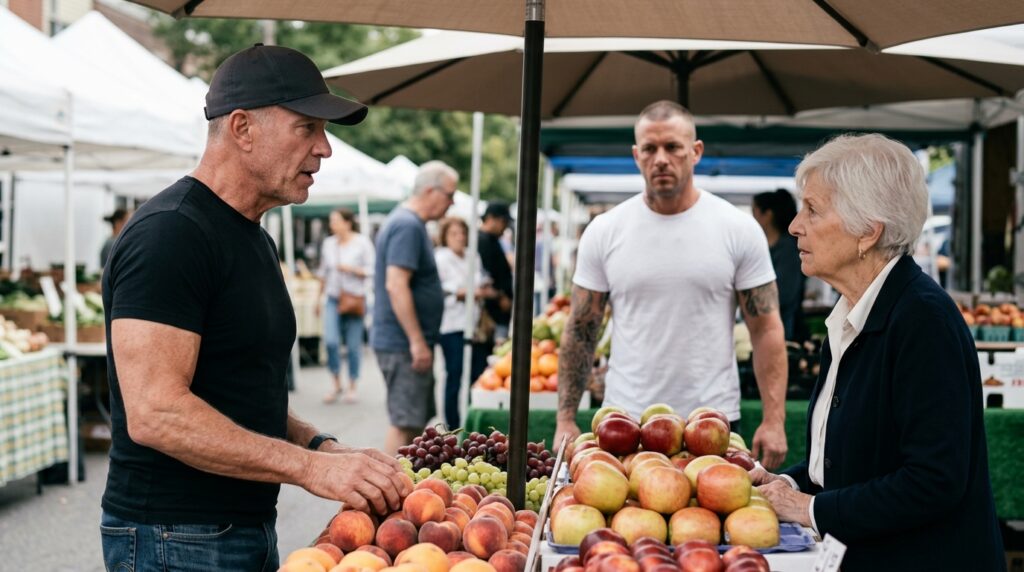
The voice had the raw, ungreased rasp of an iron gate swinging on sand. It belonged to Miller, a man whose skin was a map of cheap blue ink and heavy, thick-set muscle that still retained the twitchy, explosive heat of his late thirties. He didn’t look at the produce. His eyes stayed locked on the wide, denim-clad chest of the man blocking the path to the awning.
Jesse didn’t move his boots. He felt the dry, grit-laden wind of the valley scrape across the knuckles of his left hand, which rested heavily on the timber edge of the display crate. Under his palm, a bruised peach gave slightly, venting a sickly sweet scent into the sharp smell of hot asphalt and rusted iron scales. He was sixty-one, and his spine felt like a stack of dry bricks, but he kept his shoulders square, casting a broad, gray shadow over the small metal cash box behind him.
“Mrs. Gable’s been under this canvas thirty years, Miller,” Jesse said. His voice was low, a rhythmic, gravelly rumble that lacked the high pitch of anger. “The lane’s public. The dirt under her stool belongs to the county, last I checked the maps. Go back to the truck.”
Behind them, the small, frail shape of Mrs. Gable remained perfectly still. Her short white hair caught the glare of the noon sun where the canopy frayed into loose threads. She didn’t drop the tin scoop she held. The metal clicked twice against the iron rim of the scale—a rhythmic, terrified little telegraph that only Jesse seemed to catch. She knew the arithmetic of this lane. She knew how many ounces of peace a man had to trade before the blood started coming out of his nose.
Miller laughed, a short, dry bark that didn’t reach his eyes. He stepped closer, the sour smell of stale energy drinks and hot leather coming off his vest. “The county doesn’t pay the drainage taxes on the culvert behind this lot, Jesse. My people do. The old lady’s three months behind on the maintenance assessment. You want to talk about maps? Talk about the title deed the bank signed over to the holding company on Tuesday.”
Jesse’s jaw tightened. A dull, rhythmic throb began behind his right ear—the old familiar warning that his body was calculating the seconds. Ninety seconds of efficiency was all his knees had left in them before the fluid ran dry. He didn’t look down at Miller’s hands, but he noted the way the younger man’s weight shifted to his rear heel. A striker’s posture.
“The holding company hasn’t served an eviction,” Jesse said, his voice dropping another octave, transactional and flat. “You’re a long way from a sheriff’s badge, boy.”
“I’m the guy who keeps the bulldozers from rolling over her crates before the weekend rush,” Miller hissed, leaning in until the shadow of his heavy jaw crossed Jesse’s face. “But maybe you want to pay her bill? Maybe you want to pull another miracle out of that rusted-out garage of yours? Everyone knows why you stay here, old man. You’re trying to buy back a name that went down the river twenty years ago.”
The silence that followed was heavy with the weight of the whole valley’s dust. Mrs. Gable let out a small, thin breath, her fingers tightening on the iron scoop until her knuckles showed white through the liver spots.
Jesse didn’t answer the taunt. He didn’t move an inch. Instead, he reached into his breast pocket with deliberate, agonizing slowness, keeping his eyes fixed on Miller’s throat. He pulled out a small, heavy piece of iron—the old five-ounce counterweight from the platform scale in his own shop. He dropped it onto the wood of the produce crate with a dull, solid thud that shook the apples.
“The lane stays open today,” Jesse said softly. “Come back with the paper from the court, or don’t come back at all.”
Miller looked down at the iron weight, then up at the steady, unblinking gray eyes of the older man. A muscle twitched in the enforcer’s jaw. He didn’t strike, but he reached out, his thick fingers deliberately picking up a single green pear from the top of the pile. He crushed it slowly in his fist until the pale juice ran through his knuckles and dripped onto Jesse’s boot, leaving a dark, wet stain in the gray dust.
“See you at sundown, sovereign,” Miller whispered, turning his back with a slow, arrogant jerk of his shoulders.
Jesse watched him walk toward the idling black pickup at the edge of the gravel lot. His own left knee was shaking under the denim, a quiet, internal failure he kept strictly hidden. He turned back toward the stall, intending to find a rag for his boot, but stop-motion froze his hand.
Lying in the bed of squashed fruit where Miller’s hand had just been was a small, tarnished brass key with three distinct notches filed into the spine—a key that Jesse recognized instantly because he had machined its duplicate for his own cellar thirty years ago.

CHAPTER 2: THE ANATOMY OF CORRODED ALIGNMENTS
The brass key felt unnaturally heavy against the meat of Jesse’s thumb, its crude, file-notched spine biting into his skin with a sharp, cold reminder of things that should have stayed under forty ground-feet of caliche. It didn’t belong in a bin of bruised Bartlett pears. It belonged in the bottom drawer of his workbench three miles away, where the grease from old tractor parts dried into something resembling pitch.
He didn’t look back toward the gravel lot where Miller’s truck had left two black streaks of burnt rubber in the dust. Instead, he gripped the timber edge of the produce table, his knuckles turning the color of tallow as his left knee ground together—bone against dry bone—before the joint clicked back into its groove. He forced his breathing to flatten, keeping his chest from heaving while he reached for a burlap sack to clear the ruined fruit.
“He’s a small man with a big shadow, Jesse,” Mrs. Gable said. She hadn’t put the iron scoop down. She stood behind her scale, her small, bent frame casting a thin shadow across the counter that looked like a crack in the wood. Her knuckles were yellowed, the skin translucent enough to show the dark, winding currents of her veins underneath. “You shouldn’t have given him that five-ounce weight. He knows what an iron bar does when it hits an axle.”
“He knows how to talk,” Jesse said, his tone dry, carrying the scratchy texture of a hemp rope being dragged across a rough sill. He bent slowly, his spine popping twice in the quiet heat of the canopy. He used the coarse burlap to scoop up the green mush Miller had left behind, his fingers deliberately closing around the brass key through the fabric before sliding it into his pocket. “He won’t come back before the sun clears the water tower. He’s got to report to whoever’s holding the lease.”
“He has the papers,” she whispered. Her white hair caught the glare of the noon sun where the canvas was thin, making her look smaller, like something dried and stored in an attic. “They have the signatures from the district court, Jesse. My grandfather’s name is on the original water rights, but the county doesn’t look at ink that old. They look at the stamp on the tax lien.”
“The tax lien is an old lie,” Jesse said flatly. He stood up straight, his face an unreadable mask of weathered lines and gray stubble. “I looked at the record books when the county clerk still used bound ledger paper. The line doesn’t cross your culvert. It stops six feet short of the willow tree.”
He walked behind the counter, his heavy work boots dragging through the dry soil that had blown under the awning. The smell of oxidized iron from the ancient platform scale was thick here, mixing with the sharp odor of turnip tops and old wood. He reached for the handle of the tool storage bin beneath her display—a reinforced iron box that had once belonged to an old International Harvester tractor.
“Don’t go digging in those old iron boxes,” Mrs. Gable said, her voice dropping into a raspy click, like a beetle moving inside a dry wall. “There’s nothing in there but grease rags and old receipts from the seed house. You can’t fix a legal title with a socket wrench, Jesse.”
“I’m not looking for a wrench,” he muttered.
He knelt, the pain in his patella a sharp, hot needle that he systematically ignored. The lock on the Harvester box was a heavy, circular disk of iron, encrusted with a orange coat of rust that flaked off in scabs under his fingers. He pulled the brass key from his pocket. The metal was warm now from his thigh, the three distinct notches filed into its back catching the low light under the bench. He didn’t think about the last time he’d seen this specific pattern; he didn’t have the room in his head for his twenty-year-old failures while Miller was still within a mile of the lane.
The key slid into the keyway with a dry, grinding scream of metal against grit. It didn’t turn at first. Jesse had to brace his left forearm against the iron rim of the box, using the dead-weight leverage of his shoulder to force the tumbler. A sharp snap echoed under the stall—the sound of forty years of accumulated scale giving way.
He lifted the lid. The hinges shrieked, shedding a fine trail of red powder onto his boots.
Inside, there were no grease rags.
There was an old ledger bound in dark oilcloth, its edges frayed into gray fringe, and beside it sat three bundles of uncashed cashier’s checks, each one secured with a thick, perished rubber band that had melted into the paper over time. Jesse reached past the checks, his fingers finding the coarse grain of the oilcloth. He opened the ledger to the last marked page, his eyes scanning the columns of faded purple ink.
The names weren’t court clerks or bank trustees.
The entries were all written in a sharp, slanted hand that he had spent fifteen years trying to erase from his mailbox. Every two weeks for five years, a sum of four hundred dollars had been logged as “Clearance Fee.” And below the final line, dated less than a month ago, the signature authorizing the collection didn’t belong to Miller, or the holding company, or any syndicate from the city.
It was signed in the shaky, aggressive script of his estranged son, David.
Jesse sat back on his heels, the iron weight of the box lid cold against his forearm. The silence under the market umbrella became absolute, save for the rhythmic, metallic ticking of the old produce scale above him as the wind caught the hanging pan. He didn’t look up at Mrs. Gable, but he could hear the steady, dry patter of her breathing directly above his head—soft, patient, and completely devoid of surprise.
“You knew the ink on this page before I turned the lock,” Jesse said, his voice dropping into the quiet, dangerous flat of a man who has just found a snake in his well.
“David’s a boy who needs a lot of grease to keep his wheels turning, Jesse,” she said from the shadows above. “He always has.”
Jesse’s thumb smoothed over his son’s name, the dry paper rasping under his calloused skin like sand on glass. The decoy had a face now, and it wore his own name. He closed the book, the oilcloth cold against his palm, knowing that every step he took from this lot would be a calculation toward his own blood.
CHAPTER 3: THE DINER ON TENSION LINES
“The grease on that apron costs more than everything you’ve got in your pockets, Jesse. Sit down before your knees drop you.”
Miller didn’t look up from his plate when the bell above the diner door stopped rattling. He was sitting in the corner booth, where the desaturated yellow vinyl was split open like a fresh wound, exposing chunks of rotten gray foam. A thick, ceramic mug of coffee sat between his elbows, the steam carrying the bitter scent of scorched beans and oil. He was using a bone-handled pocketknife to scrape a sliver of dried mud from beneath his fingernails.
Jesse didn’t slide into the booth. He stood at the edge of the table, his broad frame blocking the late afternoon light that filtered through the grease-filmed window. He took his time, his large, calloused hand reaching into his coat to pull out the three bundles of uncashed cashier’s checks he had pulled from the Harvester box. He dropped them next to Miller’s plate. They landed with a dull, heavy papery click.
“The serial numbers are sequential,” Jesse said, his voice flat, carrying the cold friction of iron filings. “They were drawn from the valley branch of Western First. Every single one is made out to the holding company, but they never cleared the ledger. Why isn’t David cashing them, Miller?”
Miller’s knife hand paused. For three seconds, the only sound in the diner was the low, electric hum of the ancient neon sign over the grill. Then he slowly folded the blade into the horn handle, his dark, tattooed fingers tracing the brass rivets on the casing. He didn’t look surprised; he looked like a mechanic who had just identified the exact tooth missing from a transmission gear.
“David’s smart enough to know when a piece of paper is a receipt, and when it’s a noose,” Miller said, finally looking up. His eyes were bloodshot from the valley dust, their pupils pinpointed under the harsh fluorescent tube. “If those checks hit the automated clearing house, the county tax assessor gets a red flag on the drainage district parcel. Your boy isn’t running a shakedown, Jesse. He’s running a quarantine.”
“He’s taking four hundred dollars every two weeks from an eighty-year-old woman who lives on a pension and cabbage sales,” Jesse said. He leaned his weight forward, his palms resting flat on the Formica tabletop. The surface was sticky with decades of spilled syrup, the veneer worn down to the brown particle board where too many elbows had rubbed it raw. “That’s not a quarantine. That’s a parasite.”
“You always were blind to the grade of the hill, old man,” Miller spat, his voice dropping into a transactional hiss that didn’t carry past the next booth. He pointed a thick finger at the checks. “That ‘parasite’ is the only thing keeping the county from declaring the whole lane an environmental hazard. The old lady’s well has been leaking nitrates into the ditch since the winter of ninety-eight. If the inspectors smell it, the water rights revert to the district. And guess who sits on the district board?”
Jesse’s mind didn’t jump. It ground through the logic slowly, like an old diesel engine drawing cold fuel. He thought of the three notches on the brass key. He thought of David’s signature, shaky but determined, at the bottom of the oilcloth ledger.
“The board belongs to the aggregate company,” Jesse muttered.
“The aggregate company wants the gravel under her fruit trees,” Miller said, leaning back until the rusted springs of the booth shrieked in protest. “David’s been buying time with those checks. He holds the liens in the holding company’s name so the aggregate boys can’t force a public auction. He’s your blood, Jesse. He took your old ledger and he took your old key, and he’s using your old tools to do what you never had the stomach for—keeping the fence mended with dirty iron.”
“He didn’t get that key from my shop,” Jesse said. His heart gave a single, hard thump against his ribs, a slow accumulation of pressure. “I locked that cellar twenty years ago when the foundry went under. The only other person who had a casting of that spine was her husband.”
Miller picked up his coffee mug, his eyes drifting back to the split vinyl between his knees. His expression didn’t change, but his shoulders tightened beneath his leather vest—the subtle, protective shift of an intellect recognizing a counter-move it hadn’t prepared for.
“Old man Gable’s been in the churchyard since the frost of five,” Miller said softly, his teeth clicking against the thick rim of the ceramic. “If David’s got his key, he didn’t find it in your grease drawer. Maybe you ought to ask the widow why she keeps three sets of books and one set of stories for her neighbors.”
Jesse stood up from the table, his knees aching with a dull, throbbing heat that felt like rusted iron expanding in the sun. He didn’t take the checks back. He left them lying there on the stained Formica, a white, paper bridge between his family’s ruin and the old woman’s canvas awning. The mystery was splitting open, its false bottom cracking under the weight of the serial numbers, but the absolute truth remained locked behind the gray mask of the neighborhood’s oldest face.
“The sun’s under the water tower,” Jesse said, turning toward the rattling door. “Tell David I’m going down to the culvert.”
“He won’t be alone when you find him, Jesse,” Miller called out after him, his voice flat and ungreased as the bell chimed against the glass.
Jesse didn’t stop. He pushed into the hot, desaturated valley air, the smell of dust and iron immediately coating his tongue as the door slammed shut behind him.
CHAPTER 4: THE DEBRIS OF INHERITED SECTIONS
The gravel gave way beneath Jesse’s boots with a dry, sliding crunch as he went down the lip of the embankment. His bad knee fired a white-hot spike of agony straight into his groin, but he didn’t check his stride. He used his hand to brace against the corrugated rim of the drainage culvert, the rusted iron flaking off under his palm like dry scabs. Down here, below the grade of the blacktop, the air was stagnant, heavy with the stench of stagnant ditch water, sour rot, and the sharp chemical tang of agricultural nitrate runoff.
“I told Miller you’d come here first,” a voice said out of the concrete gloom.
David was sitting on an overturned plastic chemical drum near the mouth of the twin pipes. He looked tired. He had Jesse’s nose and the same wide set of the shoulders, but the skin around his eyes was pinched, dark with the restless fatigue of a man who spent his nights recalculating debts he couldn’t cover. A heavy steel flashlight lay across his lap, its lens scarred with fine gray scratches from being dragged through dirt.
“You took the money, David,” Jesse said. His rumble was thick, scraping against the curved metal walls of the ditch like a shovel blade on shale. He didn’t approach his son. He stayed ten feet back, his boots sinking two inches into the gray, calcified silt. “Every two weeks. Four hundred dollars. Signed with the name I gave you.”
“I used the holding company, Dad. It was the only shield that had enough legal teeth to stall the county inspectors,” David said, his hand twitching toward the flashlight but stopping short. He didn’t look at his father; he looked at the rusted mouth of the pipe where a thin trickle of oily water spilled into the mud. “If those nitrites hit the main canal test-point, the district shuts down every single stall in the cooperative. Mrs. Gable wouldn’t just lose her patch. The whole neighborhood loses their water allocation. I was caching the money to pay for the private filtration installation.”
“You don’t cure a rot by stealing from the roots,” Jesse said. He stepped forward, the silt sucking at his heels with a wet, heavy friction. “Miller says you’re keeping a quarantine. But the checks are sequentially drawn from Western First. That’s not a holding company’s operational pool, David. Those are Gable’s personal reserves. The old woman was funding her own shakedown.”
David finally looked up, his face hardening into a brittle reflection of Jesse’s own stubborn mask. “She didn’t have a choice. If she paid the district directly, the aggregate company would have flagged the transaction as an admission of property damage. They would have used the contamination clause to void her ninety-nine-year lease by sunset. She had to funnel it through an outside entity. Through me.”
“And the key?” Jesse reached into his pocket, his calloused fingers brushing against the notched spine of the brass fragment he’d pulled from the pear bin. “The duplicate key to my cellar that turned the lock on her Harvester box? The one Miller dropped?”
“I found it in her house,” David whispered, his voice losing its heat, falling into a hollow, defeated cadence. “Ten years ago, when old man Gable died and she asked me to clear out his survey gear from the shed. It wasn’t in a grease drawer, Dad. It was in an old iron lockbox stamped with the county surveyor’s seal from 1986. The year your foundry went under.”
Jesse didn’t move. The dull throb behind his ear became a deafening pulse. He looked past his son, into the dark interior of the concrete pipe where the old property line markers were supposed to be anchored.
Near the footing of the headwall, half-buried in the gray sludge, a heavy, cone-shaped piece of metal caught a stray glint of the setting sun. It was an old surveyor’s brass plumb bob, its tip blunt and scarred from striking stone, its side deeply stamped with the initials E.G.—Elias Gable. But it wasn’t hanging from a line. It had been driven into the joint of the concrete like a wedge, forcing a gap in the seam where the dark, sulfur-smelling water was actively weeping from the subterranean stratum.
The decoy secret was crumbling right there in the mud. David thought he was playing the protector, hiding an accidental contamination to save a neighborhood’s lease, but the concrete itself had been deliberately breached. The puncture wasn’t an accident of aging infrastructure; it was a mechanical intervention executed with a surveyor’s precision.
“She told me the leak was an old pipe failure,” David said, his voice tracking his father’s fixed stare toward the wedge. “She said Elias found it before he passed, but they couldn’t afford the city repair fee.”
“Elias didn’t drive this brass into the wall, David,” Jesse said softly. He knelt down, his knee screaming as he reached into the gray water, his fingers tracing the cold, jagged edge of the concrete fracture. “Elias was blind in his left eye by eighty-six. He couldn’t hit a chisel with a hammer, let alone wedge a structural seam three feet inside a culvert.”
He pulled at the brass bob. It didn’t budge. It was corroded into the iron reinforcement grid of the headwall, a permanent seal on an ancient transaction. The realization hit him like a heavy piece of timber—the ultimate truth was still locked behind the fragile, maternal smile of the woman he had spent thirty years trying to shield from the valley’s predators. She hadn’t been caught in the crossfire; she had laid the fuse before the first gun was ever bought.
A loose pebble rattled down the embankment behind them.
Jesse didn’t turn his head, but his muscles locked into a rigid, predator-prey alignment. Above the lip of the ditch, the silhouetted shape of a long, double-barreled tool box on the back of a truck cut against the desaturated violet of the valley sky. The shadow wasn’t Miller’s. It was smaller, leaner, and held the distinct, rounded edge of an old woman’s straw hat.
“You should have stayed by the produce stacks, Jesse,” a thin, raspy voice drifted down through the weeds. “The fruit dries out if you leave it in the sun too long.”
CHAPTER 5: THE COLD LEASE ON GRAVITY
The gravel above gave way under the weight of an oncoming downpour, the first fat drops hitting the dry caliche with the sharp, rhythmic hiss of hot iron entering oil. Down in the ditch, Jesse didn’t stand up immediately. He stayed on his one good knee, his fingers still wet with the sulfurous, black slime weeping from the seam. His gaze moved slowly up the concrete headwall, past his son’s frozen silhouette, until it found the frail, crooked shape standing at the rim against the darkening valley sky.
“Thirty years, Martha,” Jesse said. His voice didn’t rise above the rumbling thunder in the hills, but it carried the dead weight of an anvil dropping into dust. “You let my family believe the land surveyor’s error was a mechanical mistake. You let my foundry pay the structural indemnity when the drainage basin failed back in eighty-six.”
Mrs. Gable didn’t lean on a cane. Her small hands were tucked inside the deep pockets of a stained oilskin apron, her shoulders narrow but steady under the grey drizzle. The straw hat she wore was grayed by decades of valley grit, its brim dripping water onto her boots. Beside her, the black pickup idling at the shoulder of the road was silent, its headlights throwing two long, white spikes of light over the weeds, illuminating the pelting rain.
“Your foundry was already dying, Jesse,” she said. Her voice lacked the fragile crackle it had used at the produce stall. It was flat, hard, and functional—the sound of an old winch grinding over an empty shaft. “Elias knew the grade was shifting. If we didn’t drive that brass bob into the seam, the county would have re-routed the irrigation canal three miles east. My family would have been left with dry clay. Your father had insurance for the basin. We had nothing but the dirt.”
David stood up from the chemical drum, his steel flashlight slipping through his wet fingers and clacking against the concrete with a dull metallic ring. “You used me, Mrs. Gable. You had me collecting those cashier’s checks under the holding company name… you told me we were keeping the aggregate district from finding the leak.”
“You’re a good boy, David, but you’ve got your father’s head,” she said, without looking at him. Her eyes stayed on Jesse’s broad, grey-stubbled face. “You look at an iron fence and you think it’s there to keep people out. You never see that it’s there to hold the property lines together when the bank starts looking at the acreage. The aggregate company didn’t find this leak. I called them three weeks ago.”
Jesse’s teeth ground together, a sharp click in the gray light. The world didn’t move in a kinetic rush; it slowed down to the specific weight of the rain hitting his leather coat. Every micro-action became a heavy, deliberate calculation. The true predator wasn’t Miller or the enforcers from the town center. It was the fragility he had spent his entire life protecting.
“You sold the water rights,” Jesse said. It wasn’t a question.
“They paid four times the valuation of the orchard,” she said, her head tilting slightly as the wind caught her hat. “But the contract required the parcel to be cleared of all local encumbrances before the transfer on Monday. That means the cooperative stalls have to go. It means your boy’s holding company has to be dissolved for failure to maintain the drainage code. I needed a record of contamination, Jesse. I needed David’s name on those ledger pages so the county wouldn’t look at who drove the brass into the brick thirty years ago.”
Miller’s shadow stepped out from the glare of the truck’s high beams, his heavy hand resting on the metal edge of the open tailgate. He didn’t have a weapon drawn, but his weight was back on his heels, his jaw set in the transactional silence of a man who had already been paid his percentage. He was just waiting for the old parameters to clear.
Jesse forced his body up, his left patella clicking with a sickening, wet friction that sent a shudder of cold sweat down his spine. He stood at his full height in the middle of the ditch, the rain washing the gray silt from his boots. He was surrounded by his own blood and the old iron of a town that had forgotten its own markers, but his agency remained absolute—flawed, heavy, and unyielding.
“The ledger stays in my pocket, Martha,” Jesse said, his hand closing over the oilcloth book inside his coat. “And the checks are going to the state bank examiner before the offices open on Monday. If the aggregate company wants this acre, they’re going to have to dig through thirty years of indemnity fraud to find the title.”
Mrs. Gable looked down into the gloom of the culvert, her expression lost beneath the shadow of her straw brim. She didn’t shout. She didn’t call for Miller. She simply reached into her apron pocket and pulled out an old, rusted iron line-weight—the identical twin to the one Jesse had dropped on her fruit table that morning. She let it drop.
The iron hit the concrete header with a sharp, fracturing ring, then rolled into the gray sludge at David’s feet.
“Then we’ll see who stays in the lane when the water comes down from the reservoir, Jesse,” she said softly.
The black truck’s doors slammed above. The engine roared, tires spinning on the wet gravel shoulder before the red tail-lights disappeared into the sheets of valley rain, leaving the father and son alone in the dark, rising water of the ditch. The main conflict remained entirely unresolved, the true debt uncollected, and the horizon ahead was slick with the mud of an ongoing war.
CHAPTER 6: THE WEIGHT OF THE FLOODING HEADWALL
The ditch didn’t fill gradually; it filled with a single, muddy heave as the automated spillway up at the reservoir tripped its primary gates.
A brown wall of water, thick with choked weeds and dead willow branches, slammed into the upper mouth of the culvert. The impact vibrated straight through the soles of Jesse’s boots, a dull, subterranean shudder that rattled the loose gravel down the bank. Within three seconds, the gray silt around his ankles was buried under a foot of swirling, cold current that smelled heavily of river clay and rotted marsh grass.
“Dad! The headwall isn’t venting!” David shouted over the mounting roar of the water. He was waist-deep in the secondary channel now, his fingers slipping on the slime-covered concrete as he tried to haul the overturned chemical drum out of the path of the intake. “The debris from the orchard clearing is wedged inside the twin pipe!”
Jesse didn’t waste breath on an answer. He moved his boots, each step through the rushing water a heavy, deliberate battle against the drag on his denim trousers. His left knee ground like a dry hinge under the pressure, but he used the corrugated iron of the culvert wall to anchor his weight. The rain was coming down in gray sheets now, pocketing the surface of the rising pool and turning the clay banks into a slick, sliding paste.
He reached the mouth of the twin pipe just as a massive, rotted timber from an old bridge support drifted down the center line, jamming horizontally across the twin concrete intakes. It was an absolute block. The current behind it immediately began to pile up, the water level jumping six inches in a matter of seconds, pushing the muddy pool up toward the lip of the market lot above.
“Get the jack from the truck,” Jesse roared, his gravelly baritone cutting through the sound of the storm like an old horn.
“The truck’s three hundred yards up the road, Dad! By the time I get back, the water’s over the display stalls!” David was bracing his shoulder against the timber, his boots sliding uselessly in the mud as the current pinned the log tighter against the concrete headwall.
“Then use the lever,” Jesse hissed. He pointed his large, calloused hand toward the five-ounce iron scale weight that Martha Gable had dropped into the muck. Beside it lay an old three-foot section of rusted drill stem line, left behind by the county maintenance crews two winters ago.
Jesse dropped into the current, the freezing water rising past his belt line, numbing the chronic fire in his joints until there was nothing left but the raw calculation of leverage. He jammed his fingers under the slick, barkless belly of the timber, his muscles knotting beneath his wet leather coat as he found a handhold in the grain.
“On three,” Jesse said, his face an unreadable mask of gray stubble and rain. “Notch it under the concrete rim. Don’t let the iron slip.”
David grabbed the drill stem, his knuckles white as he rammed the rusted pipe beneath the timber, using the concrete headwall as a fulcrum.
“One. Two. Three.”
Jesse lifted with his legs, his spine locking into a rigid column of old bone and scar tissue. The timber didn’t shift at first; it held the full gravity of the rising reservoir behind it, a permanent weight that wanted to bury the lane in mud. Jesse’s breath caught in his throat, a sharp, iron taste rising under his tongue as his bad knee threatened to give way entirely. He didn’t drop his hands. He leaned his shoulder directly into the wood, his teeth bared against the rain.
David threw his entire weight onto the drill stem. The rusted pipe groaned, bending slightly under the leverage before a sharp crack echoed through the ditch—the sound of the timber’s rotted end fracturing against the concrete point.
The log pivoted. The current seized the released edge, swinging the massive timber around with a violent, kinetic lurch that nearly dragged Jesse into the black mouth of the pipe. He threw himself backward into the silt, his hand catching David’s collar as the log vanished down the culvert, its exit followed by a deep, guttural gurgle as the twin intakes began to suck the pool down.
The water receded as quickly as it had risen, leaving a thick, black coating of clay over the concrete walls and the gray silt of the floor. Jesse sat back against the headwall, his breath coming in ragged, shallow wheezes, his left leg stretched out straight and useless before him.
David dropped the drill stem. It fell into the mud with a soft, wet plop. He looked down at his father, his chest heaving, the steel flashlight he had retrieved earlier casting a long, shaking beam over the now-cleared headwall.
The concrete seam where the brass plumb bob had been driven was still weeping, but the force of the flood had washed away the outer layer of calcified scale. Hidden behind the junction, pinned by a heavy loop of rusted utility wire that had been plastered over with old mortar, was a modern, zinc-plated industrial padlock. It was holding a thick steel cable that ran directly into the earth behind Martha Gable’s boundary line—a remote-activation line for an unlisted valve.
The old woman hadn’t just predicted the flood; she had the tether to the gate chained right inside the district’s infrastructure.
Jesse reached up, his wet fingers gripping David’s forearm with a transactional intensity that had nothing to do with family, and everything to do with survival.
“Get me up,” Jesse said, the gravel in his voice harder than the stone behind his back. “We’re going to the bank.”
CHAPTER 7: THE LIEN ON SHIFTING RESERVES
The glass partition at Western First didn’t slide; it was a fixed sheet of thick, yellowing safety laminate frosted over with fifty years of cigarette smoke and fine valley grit. Behind it sat Vance, a man whose skin looked like wet cardboard left in the sun, his small eyes twitching behind spectacles that were wired together at the bridge with a thin strip of lead solder.
“The vault records from eighty-six don’t move just because you brought a wet ledger, Jesse,” Vance said. His voice was a thin, dry whistle, the sound of air escaping an old tire. His fingers, gray with carbon smudge from old ledger carbon paper, tapped a rhythm against a heavy iron desk seal. “David’s signature is authorized under the holding company charter. If he deposited the drafts into the clearing account, the bank doesn’t question the origin. We look at the stamp, not the conversation in the lane.”
Jesse didn’t sit in the low armchair Vance had offered. He stood against the frosted glass, his broad frame casting a dark, heavy shadow that filled the small corporate alcove. The rain had soaked through his denim jacket, leaving a wet, triangular patch across his ribs that smelled of the sulfur and clay he’d dragged from the culvert. He dropped the oilcloth ledger onto the oak counter, its wet edges smudging Vance’s clean blotter paper.
“Look at the serial numbers on the uncashed drafts, Vance,” Jesse said. His rumble was slow, carrying the rough friction of ungreased gears. He reached into his coat and produced the zinc-plated industrial padlock he’d severed from the subterranean gate valve with the drill stem line, placing it beside the book. “They aren’t drawn from a standard corporate pool. They were drawn against a dormant account held by the old Regional Transit Authority. An authority that went into receivership the same month my foundry was condemned.”
David leaned against the oak door frame behind his father, his face pale under the low-wattage ceiling fixture. His knuckles were raw from the work at the headwall, a thin smear of dried mud crusted along his thumb line. “The signature on the Transit Authority escrow wasn’t Elias Gable’s, Dad. I checked the clearing manifest while Vance was pulling the vault boxes. It was Martha’s name on the initial corporate filing.”
Vance’s hand stopped tapping. He didn’t pick up the ledger, but his eyes drifted toward the zinc padlock, his tongue clicking against his teeth—a quiet, mechanical calculation that Jesse had seen a thousand times before in men who knew where the money was buried.
“Martha Gable was the corporate secretary for the transit line before the county took the tracks,” Vance muttered, his voice dropping into a flat, defensive tone that stayed low to avoid the open lobby outside the partition. “That account was set up to handle the drainage indemnities for the entire eastern section. If there’s money left in it, it’s because the county never filed the final release of lien after the foundry closed its doors.”
“The county didn’t file because Martha’s husband was the surveyor who signed the structural failure report,” Jesse said. He leaned closer, his palms flat against the safety glass, leaving two broad, greasy smears on the laminate. “She kept the transit escrow open for forty years, paying David forty-eight hundred a year in uncashed drafts to keep the aggregate district from pulling the public title deeds. She wasn’t saving her orchard, Vance. She was paying my son to act as the legal shield for an asset that belongs to the state.”
“If the state finds out that account is active, they’ll seize the water rights back to the valley baseline,” Vance said, his small eyes fixing on Jesse with a hard, defensive stare. “Your boy’s name is on the deposit slips for the maintenance assessments, Jesse. If this book goes to the bank examiner on Monday, David doesn’t just lose his business charter. He goes to the county farm for handling receivership assets without a state license.”
David took a step forward, his chest heaving under his wet shirt, but Jesse’s arm went out like a rusted iron bar, catching his son across the breastbone and pinning him back against the oak frame.
“He didn’t cash them,” Jesse said, his tone dropping until it was nearly silent, a flat line of pure survival logic. “The bands are still on the bundles. The ledger shows the collection, but the clearing house never stamped the back of the paper. It’s an unexecuted trust, Vance. The legal weight stays with the person who signed the drafts.”
“Martha didn’t sign the drafts,” Vance whispered, his hand finally reaching out to flip the ledger open to the final purple-inked line. “Look at the authorization code at the top of the section, Jesse. That’s not a secretary’s stamp. That’s the code for the primary trustee.”
Jesse looked down through the safety glass. The ink was faded, the purple letters turning a pale, desaturated blue where the rain from his coat had dripped onto the page, but the alpha-numeric code wasn’t his son’s or the old woman’s. It was the original commercial registration number for his own father’s foundry—the corporate entity that had supposedly bled to death forty years ago under the weight of the drainage basin failure.
The false bottom had dropped out of the ledger, but the floor below was made of his own family’s iron. The old woman hadn’t just used his son; she had used an unextinguished clause in his family’s ruined legacy to keep her own hands off the trigger. Every drop of water that had leaked into that culvert had been legally charged to a dead man’s estate, leaving Jesse’s entire life work as the ultimate collateral for a debt that had been manufactured before his son was even born.
“She didn’t sell the orchard to the aggregate company,” Jesse said, the realization settling into his bones with the cold weight of the rain outside. “She’s selling the foundry’s remaining water shares. The ones my father left in the transit escrow because he thought they were dry.”
“The aggregate boys are moving the fences onto the lot tomorrow morning, Jesse,” Vance said, closing the book with a short, final snap that sounded like a pistol shot in the small alcove. “They don’t care about the ink from eighty-six. They have the machinery.”
Jesse picked up the zinc padlock and slid it back into his pocket, his face turning back toward the rattling lobby doors where the valley storm was still lashing the glass.
CHAPTER 8: THE PREEMPTIVE DEED SURVEY
The glass doors of the County Administration Building didn’t frame a sanctuary; they filtered a gray, desaturated institutional light onto linoleum floors that smelled of floor wax and old, rotting paper.
Outside, in the gravel lot, an aggregate company lowboy was idling, its massive diesel engine sending a deep, rhythmic vibration through the concrete foundations of the county recorder’s wing. The rain had slowed to a persistent, oily mist that hung over the yellow weeds at the edge of the property line, turning the red caliche dirt into a slick, deceptive paste.
“The clerk’s already pulling the baseline plats for the morning transfer, Jesse,” Miller said from the side of the building. He was leaning against the rusted fender of a county service tractor, a grease-stained clipboard cradled under his forearm. His face was gray with the exhaustion of a twelve-hour shift, his fingers tracing the blunt edge of a brass land-office transit level. “The lawyers from the aggregate firm brought the absolute release from Martha Gable’s title insurance provider. They aren’t waiting for Monday morning. They filed an emergency clearing action under the 1986 disaster clause.”
Jesse didn’t stop to look at him. He moved straight toward the basement stairs where the old surveyor plats were shelved in bound, iron-spined volumes. His left knee gave an audible, wet click with every second step, the chronic ache a heavy weight he carried like a sack of scrap iron. David was right behind him, his boots carrying three inches of gray headwall sludge that left dark, wet tracks across the clean marble threshold.
“The 1986 clause requires a signature from the surviving direct officer of the defunct corporate entity,” Jesse said, his gravelly rumble vibrating within the narrow brick staircase. “My father was the sole underwriter on that basin bond. If Martha signed a release using the old Transit Authority code, she signed for a ghost.”
“She didn’t sign as an officer, Dad,” David said, catching the iron handrail to swing himself around the landing. “She signed as the principal claimant under the original water district charter. Look at the entry lines from forty years ago. When the foundry’s indemnity fund went into receivership, the water rights weren’t frozen. They were assigned to the district as a temporary maintenance reserve. She’s spent thirty years keeping that reserve from being audited.”
They hit the bottom of the stairs, their boots striking the cold, unpainted concrete of the records vault. The air down here was thick with the scent of oxidized iron shelves and centuries of disintegrating cloth maps. Sitting at the low oak reading table in the corner, her wet oilskin apron draped over the back of a metal folding chair, was Martha Gable.
She had three open leather portfolios spread before her like an open map of a battlefield. Standing behind her was a lean man in a desaturated charcoal suit, his fingers holding a fresh county recording stamp that gleamed with wet purple ink.
“You’re thirty minutes late, Jesse,” Martha said without looking up from the linen plat map. Her white hair was pinned back with a rusted surveyor’s hair-clip, her small, translucent face illuminated by the harsh glare of a bare fluorescent tube hanging from the pipe-lined ceiling. “The registrar has already entered the initial verification. The water rights under the old transit line are being transferred to the aggregate company’s secondary washing plant at noon.”
“The verification is fraudulent, Martha,” Jesse said. He didn’t approach the desk. He stayed at the edge of the row, his large, scarred hand resting on the heavy steel corner of the 1980–1990 ledger rack. “The transit line escrow was funded by my father’s corporate account, not your grandfather’s water district allocation. You used David to disguise the source because you knew if the county land board audited the drainage entries, they’d find the original brass monument your husband altered in the culvert.”
The lawyer stepped forward, his pen poised over the final amendment sheet like a weapon. “The 1986 failure report is an unappealable document, Mr. Core. The statute of limitations on the structural liability ran out during the nineties. My client has the legal right to assign the remaining assets of the drainage basin to any corporate entity she chooses.”
“Not if the monument itself was moved after the baseline survey,” Jesse said, his tone flat and heavy, carrying the finality of an iron gate dropping into place. He reached into his denim jacket and pulled out the old five-ounce scale weight, along with the stamped brass plumb bob he had pried from the headwall concrete. He dropped them onto the linen plat map directly over the orchard section. “Look at the stamp on the brass tip. That’s the county land surveyor’s mark from the winter of eighty-five. Elias Gable didn’t use that to test the drainage grade. He used it to shift the section boundary six feet to the west, putting my father’s foundry inside the contamination boundary line.”
Martha’s thin fingers tightened on the edge of the table, her knuckles showing the color of old bone through the liver spots. For five seconds, the only sound in the concrete vault was the deep, rhythmic thrum of the diesel lowboy in the lot above.
“Your father knew what I did, Jesse,” she whispered, her voice dropping into that raspy, dry-leaf scrape that had no empathy in it, only the hard math of survival. “He knew the foundry was going into liquidation anyway. He gave Elias the key to his cellar because he wanted the water to stay with the orchard, not the city banks. We had an agreement written in the iron of that basin.”
“He didn’t agree to let you shakedown my son for forty-eight hundred a year to hide your own leak,” Jesse said, taking a slow, painful step toward the table, his gray eyes locked on her face. “He didn’t agree to let you sell the whole lane out to a gravel quarry when you got too old to hold the fruit crates.”
The lawyer looked down at the brass plumb bob, then at the wet purple stamp in his hand. The ink was already drying, but the numbers on the baseline document didn’t match the coordinates engraved on the old surveyor’s tool. The intellectual armor of their legal scheme had cracked under the physical evidence pulled from the mud.
“The transfer isn’t clean,” David said from the doorway, his arm extended toward the stairs. “The sheriff’s deputy is upstairs checking the registration on the lowboy. If that machinery moves onto the lane before the land board reviews the baseline coordinates, it’s a criminal trespass on a disputed state easement.”
Martha slowly closed the leather portfolio, the heavy cardboard covers coming together with a dull, hollow thud that signaled the end of the morning’s alignment. She stood up, her small frame looking incredibly old and fragile against the cold iron shelving, but her eyes held the unyielding, pragmatic iron of a woman who would rather see the whole valley turn to dust than lose an inch of her fence line.
“The quarry trucks are already at the crossroads, Jesse,” she said, her voice flat and cold as the rain outside. “You can stall the paperwork for twenty-four hours, but the gravel company doesn’t run on county ink. They run on iron and diesel. See you at the boundary line tomorrow morning.”
CHAPTER 9: THE OPEN FRONTIER SEED
The rain had stopped by dawn, leaving the valley floor coated in a thick, desaturated crust of gray caliche mud that stuck to the tires of the aggregate company’s front-end loaders.
Jesse stood exactly on the six-foot line—the narrow strip of weeds between the culvert headwall and the first row of Martha Gable’s withered peach trees. His boots felt like they were made of cast iron, sunk two inches into the wet clay. The cool morning air carried the heavy, oily stink of yellow grease and unrefined diesel exhaust from the three yellow excavators idling fifty yards back in the gravel lot.
“The county injunction doesn’t have an engine, Jesse,” Martha Gable said. She was sitting on her old wooden stool under the frayed canvas market umbrella, her hands resting flat on her knees. The canvas was soaked through, dark water dripping from its perimeter wires onto the rusted iron produce scale. She looked incredibly small against the backdrop of the massive yellow iron behind her, but her eyes held the hard, flat clarity of a ledger sheet that had finally been balanced. “The district board signed the physical entry authorization at five o’clock this morning. Miller’s boys are just waiting for the clerk to open the gates.”
Jesse didn’t pull the oilcloth book from his coat. He simply leaned his weight onto his right leg, his left knee locked straight to keep the joint from buckling under the steady, throbbing heat of his injury. “The district board signed a clearance order for a drainage easement, Martha. They didn’t sign for the water rights under the foundry lot. David’s at the state capitol registry office right now. The baseline numbers Elias filed in eighty-six are being stripped from the public registry.”
Miller stepped out from behind the lead excavator, his heavy boots dragging a dark trail through the gray mud. He carried a heavy iron crowbar across his shoulder, his tattooed forearms slick with wet mist. He stopped ten feet from Jesse, his eyes moving from the older man’s broad chest to the rusted scale weight sitting on the display table between them.
“The machines are on a commercial lease, old man,” Miller said, his rasp carrying the cold friction of dry gears. “Every hour they sit here idling costs the holding company twelve hundred dollars. I don’t care about the registry ink from forty years ago. I care about the fuel voucher. Move your boots.”
Jesse looked past Miller, his gaze fixing on the first excavator’s steel bucket, its teeth scarred and shiny from tearing through the valley’s flint and gravel. Time seemed to dilate, the sensory textures of the scene sharpening into real-time detail—the slow, heavy drip of water from the umbrella rib, the ticking sound of the cooling manifold on Miller’s truck, the smell of damp earth and oxidized steel. He wasn’t a passive observer; his flaw was his pride, his belief that he could hold an entire district’s sins on his own back, but his agency down here in the dirt remained absolute.
“If that bucket drops into the ditch, Miller, you’re hitting the main pipeline code extension,” Jesse said softly. His rumble stayed low, carrying no anger, only the hard pragmatism of a man who had spent his life working with templates. “The one Martha’s husband buried three feet above the county spec. The moment the steel breaks the clay, the pressure drops across the entire western section. The aggregate plant won’t have enough head-water to wash a single load of gravel.”
The enforcer didn’t swing the bar, but his posture shifted, his eyes narrowing as his intellect ground through the calculation. He looked back at the lead driver, then down at the gray water still gurgling quietly inside the concrete mouth of the culvert. He was the protagonist of his own ledger; he wasn’t going to destroy his employer’s equipment for a title deed that might turn into smoke by noon.
“She told us the main valve was clear of the work zone,” Miller muttered, his voice dropping into a transactional hiss.
“She lied to you the same way she lied to my son,” Jesse said, taking a slow, excruciating step forward, his boots tearing out of the clay with a wet, heavy suction. He reached out and picked up the five-ounce iron counterweight from the scale, holding it in his open palm like a spent shell. “She needed the equipment to open the ground before the state examiner could check the seals. She wanted the evidence buried under twenty tons of quarry wash.”
Martha didn’t move from her stool. She watched the iron weight in Jesse’s hand, her thin lips tightening until they disappeared into the pale, lined parchment of her skin. The false bottom of her thirty-year protection scheme had been completely stripped away, leaving nothing but the raw, unpainted reality of a neighborhood that had been built on a foundation of stolen water and broken lines.
“You can’t keep the fence up forever, Jesse,” she said, her voice rising into a sharp, dry whistle that caught the morning wind. “The trees are dying anyway. The salt’s coming up through the caliche. If the quarry doesn’t buy this acre, the bank takes the whole section for the drainage assessment. Your father knew that. That’s why he let Elias move the monument.”
“He let Elias move it because he trusted his neighbors to stay behind the line,” Jesse said. He walked past Miller, his heavy hand dropping the iron weight back into the tin pan of the scale with a loud, ringing clink that signaled the absolute conclusion of the transaction. “The line’s back where it belongs, Martha. The dirt’s yours, but the water stays in the ditch.”
The lead excavator’s engine suddenly died, the massive turbos whining down into a hollow silence that allowed the sound of the valley birds to return through the mist. Miller spat into the mud, shook his head, and gestured to his crew with a short, rough jerk of his arm. They began climbing down from the yellow cabs, their boots striking the gravel lot with a series of dull, final thuds.
The neighborhood wouldn’t forget this morning, and the scars left on the land would never fully heal, but the protector had held his ground near the produce stacks. He turned his back on the old woman under the canvas awning, his bad leg dragging slightly through the gray soil as he began the long, slow walk back toward his shop, his son’s truck already coming over the distant crossroads against a warm, rising sunset.







