
The Static of Broken Teeth: A Novel of Pragmatic Survival and Rusted Truths

CHAPTER 1: THE TENSION OF METALS

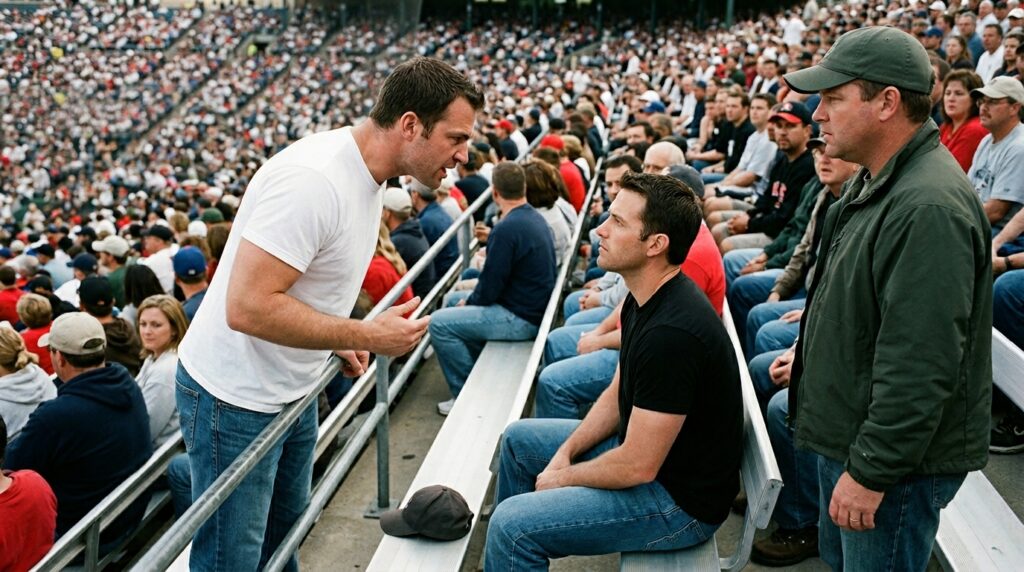
The aluminum bleacher bit into his hamstrings through the thin denim of his jeans, vibrating with every collective stomp of five thousand people he didn’t know. The air tasted of fried grease, spilled corn syrup, and the dry, alkaline dust blown in from the northern valley flats. On the field below, a whistle blew—sharp, tinny, meaningless.

“You got a deaf ear, Miller, or just a soft spine?”

The voice came from above, dropping down with the weight of stale malt and old sweat. The shadow fell first, blocking the glare of the four-panel stadium lights. It was a broad shadow, wide-shouldered and thick-necked, wearing a white graphic tee that stretched over a heavy torso.

Miller didn’t look up immediately. His eyes remained fixed on a discarded red baseball cap resting two steps down, its brim frayed into gray threads. Beside him, Vance’s knuckles went white where they gripped the metal edge of the seat. The green-and-tan camouflage pattern of Vance’s sleeve didn’t rustle; he stayed perfectly still, a block of salted iron.

“He’s talking to you, Frank,” Vance murmured, his voice flat, low enough to stay under the roar of the crowd after a four-yard gain.

“I hear him,” Miller said. His own voice sounded dry to his ears, like two bricks rubbing together in a bucket.

The challenger took another step down. The concrete aisle was narrow, grit grinding beneath the thick lugs of his work boots. He stopped within arm’s reach, his groin nearly level with Miller’s shoulder. Up close, the man smelled of raw adrenaline—the sour, sharp tang of someone who had spent three hours convincing himself he was a giant.

“Look at me when I’m talking to you, clear-out,” the man spit. A drop of saliva hit the concrete near the red cap. “You think because you bought that five-acre patch behind the mill you belong here? If you got a problem with how things run in this county, you say it to my face. Not through some legal notice stuck to a fence post.”

Miller counted the pulses in his own throat. Forty-eight beats a minute. The internal clock was steady, cold, unbothered by the stadium horn blaring a third-down warning. He looked up then, his gaze scraping past the man’s heavy chin to settle on the small, pale scar just below his left eye—the mark of an old, poorly stitched bar fight. The man’s right hand was tucked into his pocket, thumb hooking the seam. Not a weapon. Just a habit of weight distribution.

“The fence post was on my side of the ditch,” Miller said.

“Everything this side of the highway is our side,” the man snapped. He leaned down, his face closing the distance until Miller could see the broken veins in his nose. “Get up. Let’s see what that black shirt is covering.”

The air between them turned into a solid thing. Vance shifted his weight, his military cap tilting a fraction of an inch as he prepared to block the aisle from the inevitable crowd spill. Miller felt the familiar, greasy click in the back of his brain—the opening of the valve he had spent three years soldering shut.

He didn’t stand up. He went forward.

It wasn’t a punch; punches made noise, drew the eyes of the orange-vested event staff three sections over. Miller’s left hand shot out like a piston, palm striking the inside of the challenger’s right knee, forcing the joint to buckle outward against the concrete step. At the same instant, his right hand gripped the man’s white collar, using the challenger’s own forward lean to pull him down and across his own center of gravity.

The impact was a dull, wet thud. The challenger’s forehead clipped the iron corner of the bleacher rail before his chest hit the concrete steps. The air left his lungs in a ragged whoof.

Before the man could roll, Miller was out of his seat, his knee dropping directly into the small of the man’s back, pinning him to the gray stone. He grabbed the man’s right wrist, twisting it behind his shoulder blade until the tendons creaked.

“Stay down,” Miller said into the man’s ear. His voice hadn’t risen. It was the same level tone he used to check the oil in his tractor. “Calm down. Breathe through your nose.”

The challenger thrashed once, a heavy, desperate heave that did nothing but grind his cheek deeper into the dry salt on the step. “You’re done here,” the man wheezed, his mouth filling with the gray dust of the stadium floor. “You think this is over? My brother’s got your name on the logging manifest. He knows where the deep well is.”

Miller’s thumb tightened on the wrist joint. The word manifest didn’t belong in a stadium grudge. It was a word from a ledger.

Vance stood over them now, a broad wall of camouflage blocking the view of the family three rows up who were too busy watching a fumble on the thirty-yard line to notice the brief scuffle below. “Frank,” Vance said, his voice tight. “Security’s moving at the gate. Two minutes. Maybe less.”

Miller looked down at the man beneath his knee. The challenger wasn’t bleeding badly—just a scrape along the temple—but his eyes were wide, white-rimmed with a sudden, pragmatic understanding of how quickly his bones could be broken.

“Who gave you the manifest?” Miller asked, his fingers sinking into the nerve cluster behind the wrist.

The man groaned, his forehead pressing hard against the concrete. “The same desk that signed your deed, you arrogant prick. Go home and check your barn. The locks are already off.”


CHAPTER 2: THE BASEMENT AND THE BRASS

“—and a man with your specific lack of local history usually knows exactly how much force it takes to crack a temperamental boy’s hip, Miller.”

The words bounced off the damp, unpainted cinder block walls of the stadium’s sub-level maintenance office. It wasn’t a formal precinct interview room, but the county sheriff’s department had laid claim to it anyway. The air smelled of old lime, wet sawdust, and the chemical bite of floor sealant. A single unshaded bulb hung from a rusted conduit overhead, casting long, jittery shadows across a metal desk pitted with orange corrosion along the seams.

Deputy Gidley didn’t look like a man who spent time behind a desk. He had the thick, calloused palms of someone who handled cattle gates, and his tan uniform shirt was stained with a dark crescent of sweat under the armpits. He didn’t have his sidearm drawn, but his heavy leather utility belt creaked every time he shifted his weight against the edge of the table.

Miller sat on a low wooden stool, his hands folded loosely between his knees. The zip-ties they had used at the gate were gone—Vance had made a quiet phone call before the stadium security could bring out the iron—but the skin around Miller’s wrists still showed the pale, compressed lines of the plastic.

“The boy came down the steps looking for a fall,” Miller said. His tone remained flat, leveled to match the low hum of the exhaust fan vibrating in the high window. “He found one.”

“That boy is Jesse Vance’s brother-in-law, Frank. And his older brother happens to run the haulage crews for the northern valley timber allotment.” Gidley leaned forward, tapping the edge of a heavy aluminum citation clipboard against the rusted metal desk. The rhythmic clack-clack was loud in the small space. “People around here notice when an outsider starts re-marking the corners of the old mill lot. Then they notice when that same outsider drops a local boy on the concrete in front of half the town.”

Miller didn’t answer. His eyes were locked on the clipboard.

As Gidley tilted the aluminum frame, the light caught a small object tucked beneath the heavy wire spring at the top, half-hidden by a stack of carbon-copy trespass warnings. It was a notched brass key, the teeth worn smooth from frequent use, its bow stamped with a distinct three-digit number: 404. It wasn’t standard department issue. It was the specific pattern used for the heavy-duty utility padlocks on the industrial gates along the perimeter of the timber line.

“You’re not from the valley,” Gidley continued, his voice dropping into a transactional rhythm. “Vance says you did some time contract-routing for the logistical firms out of the state capital. Says you like the quiet. But quiet is something you have to pay for in this district, Frank. You don’t just inherit it with a deed.”

“The deed is clear,” Miller said. He felt the cold iron of his past life sliding into place behind his eyes. He calculated the distance between his stool and Gidley’s throat—four feet. Two seconds to close, one to leverage the clipboard into the deputy’s windpipe if the door handle turned from the outside. “The surveyor’s spikes are cast iron, set four feet deep into the creek bed. Your boy Jesse’s family knew that when they sold the timber rights thirty years ago.”

Gidley stopped tapping. He reached down, his fingers brushing against the notched brass key as he flipped a page on the clipboard. “Jesse’s family doesn’t own the logging manifest anymore. Things change. People find out their neighbors aren’t as steady as they look.”

The subtext hit Miller like a handful of gravel to the face. The manifest. The challenger at the stadium had used the exact same term before his cheek met the concrete.

Miller leaned his torso back just an inch, his shoulders scraping against the cold, rough concrete wall behind him. The rust on the window grate above him was shedding, fine red flakes drifting down into the hair on his forearms. “Vance has been standard with me,” Miller said, testing the water.

Gidley let out a short, dry bark that might have been a laugh if his eyes weren’t so dead. He didn’t confirm the statement, but he didn’t deny it either. Instead, he unhooked his thumb from his utility belt and tossed the clipboard down onto the table. The brass key slid out from under the paper, spinning twice before stopping near Miller’s left hand.

“Jesse Vance wears a uniform because the county pays for the cloth, Frank. But the county doesn’t pay for the diesel in his truck, and it sure as hell didn’t pay for that new barn he’s raising down on the fork.” Gidley stood up, the leather of his boots groaning under his weight. “We’re going to call this an administrative detention for the next twenty minutes. Just long enough for the stadium crowd to clear out so nobody tries to flip your truck in the lot. After that, you go back to your five acres.”

The deputy walked to the heavy iron door, his hand resting on the lever handle. He paused, looking back over his shoulder, his face half-lost in the shadow of the unshaded bulb.

“If I were you, Miller, I’d take the back road past the mill. The main lane has a lot of loose stone this time of year. Bad for the alignment.”

The latch clicked. The door groaned on its dry hinges, then slammed shut, the sound echoing down the concrete corridor outside until the only thing left was the low, electric rattle of the bulb.

Miller didn’t move for sixty seconds. He listened to the retreat of Gidley’s heavy boots against the floorboards upstairs, then reached out and picked up the brass key. The metal was cold, smelling faintly of machine oil and wet pockets. He slipped it into his pocket, his mind tracing the cause-and-effect loop with a cold, geometric precision.

The challenger hadn’t been a random drunk. The deputy wasn’t looking for an assault charge. They were looking for an reaction, a visible crack in the reclusive shell he had built around his perimeter. And Vance—the man who had sat beside him for three months while they cleared the brush along the property lines—had left his post at the gate the moment the security vests showed up.

Miller stood up, the low wooden stool scraping against the grit on the floor. His hands were steady, but the internal clock was ticking faster now. The locks on his barn were off, the challenger had said. He needed to get to the truck, and he needed to find out exactly what Vance had been putting into the logging logbooks while he was busy looking at the dirt.

CHAPTER 3: THE ENCROACHING LINE

The truck’s low-beams cut through the hanging dust of the back road, washing over the rusted corrugated iron of the old mill before turning into Miller’s gravel driveway. The transmission grumbled as he shifted into first, the chassis shaking from a worn-out leaf spring that clicked like a broken tooth every time the tires caught a rut. He didn’t turn off the engine immediately. He sat behind the wheel, letting the diesel rattle vibrate through his boots, his eyes scanning the dark perimeter of his property.

The headlights glinted off something raw.

Ten feet to the left of his gravel track, right where the drainage ditch cut through the wire grass, a pale splinter of wood pierced the mud. Miller killed the lights, stepped out into the damp night air, and let his boots sink into the soft earth. The air smelled of rotten bark, creek silt, and the heavy, sweet scent of crushed pine needles from the logging trucks down the ridge.

He walked over to the wooden marker. It was a clean, unweathered square of split cedar, completely free of the gray lichen that coated every other post in the county. Tied around its crown was a loop of neon-orange surveyor’s tape, the plastic snapping softly in the cold wind off the flats. This wasn’t a temporary marker. It was driven deep, three feet inside his established property line, right over the buried cast-iron surveyor’s spike he had verified two months ago.

“You’re standing on the wrong side of the creek, Miller.”

The voice came from the shadow of the equipment shed thirty yards away. It didn’t belong to Vance. It was deeper, thicker, carrying the slow, deliberate drawl of a man who spent his days directing heavy machinery.

A figure stepped into the pale moonlight. He was taller than the challenger from the stadium, his face lined with the deep, permanent creases of sun and engine grease. He wore a grease-stained canvas coat that hung open, revealing a heavy leather tool belt. In his right hand, he held a long iron pry-bar, its tip caked with wet clay.

“You must be the older brother,” Miller said. His right hand remained flat against his thigh, inches from his pocket where the brass key from Gidley’s clipboard rested. He didn’t shift his stance; his boots were already set, his weight centered over his heels. “The one with the manifest.”

“The name’s Silas,” the man said, stopping ten feet away, just behind the cedar stake. He drove the iron pry-bar into the mud, leaning his weight against it like a walking stick. “And that paper doesn’t belong to me. It belongs to the county records office. The state re-zoned the basin drainage three weeks ago, Frank. This ditch isn’t your boundary anymore. The line runs straight through your well-house now.”

“Re-zoned by who?” Miller asked, his eyes tracking the way Silas kept his left hand tucked into the pocket of his canvas coat.

“The people who pave the roads you drive on,” Silas replied. He glanced toward Miller’s farmhouse, where a single yellow bulb burned over the porch. “Jesse Vance told us you wouldn’t take well to the adjustments. He said you were a particular man about your stakes. But Jesse’s a practical boy. He knows when a property is too expensive to keep.”

“Jesse’s a uniform,” Miller said, his voice dropping into the flat, hollow tone he used when evaluating a structural threat. “Uniforms don’t re-zone counties.”

“No,” Silas said, a slow, ugly grin spreading across his face. “But they sign the eviction notices when the well runs dry. You got twenty-four hours before the logging crew brings the timber-jack through that lower thicket, Frank. If your fence is still standing then, the blades won’t stop for the wire.”

Silas pulled the iron pry-bar out of the mud with a wet, sucking sound. He didn’t swing it, didn’t make a move toward Miller. He just turned his back—a calculated display of local immunity—and walked toward an unmarked black utility truck parked down the shoulder of the main road. The red tail-lights flared once, then vanished into the screen of dust.

Miller stood in the dark, the wind whistling through the orange surveyor’s tape at his feet. The decoy was falling apart, but the shape behind it was becoming clear. This wasn’t an ordinary dispute over timber rights or local pride. They were systematically moving the borders while he was being held in basement storage by Gidley.

He didn’t go into the house. He walked past the porch, his boots crunching over the rusted iron scrap near the well-house, and headed straight toward the machine shed where Vance kept his auxiliary tractor parts. The padlock on the shed door was intact, but when Miller reached out and touched the brass cylinder, it was warm to the touch. Someone had been inside within the hour.

He pulled out the notched brass key he’d taken from the deputy’s clipboard and slid it into the lock. It clicked open with a greasy, fluid slide.

Inside, the air was thick with the smell of gear oil and old burlap. Miller didn’t turn on the overhead lights. He used a small penlight, casting a narrow beam across the grease-streaked workbenches until it settled on Vance’s standard-issue leather logbook sitting on top of an empty oil drum.

He flipped the cover open. The pages were covered in Vance’s tight, slanted handwriting—dates, truck numbers, cubic feet of timber hauled from the northern flats. But pinned to the back leaf was a carbon copy of a bank draft from the valley commercial trust, dated two days ago. It was made out to Jesse Vance for an amount that exceeded three years of a deputy’s county salary. The remitter line didn’t name Silas or the logging company.

It was stamped with the official seal of the County Executive Land Management Fund.

Miller’s fingers tightened on the paper until the carbon smeared. The local logging faction wasn’t buying Vance off to steal timber. The county itself was funding the deployment, using the timber crews as a physical wedge to crack Miller’s title. Every piece of information he had gathered from the stadium fight to the deputy’s interrogation was a calculated layer designed to look like a small-town grudge, masking an institutional seizure. And the man who signed the fund allocation at the bottom of the draft was someone Miller hadn’t even faced yet.

A shadow crossed the narrow window of the shed, cutting off the moonlight. The gravel outside groaned under the weight of a slow, approaching step.

CHAPTER 4: THE MIDNIGHT ACCOUNT

The shadow in the doorway expanded, blocking out the desaturated gray light of the yard. Miller didn’t turn off his penlight; he lowered the beam so it pooled around his own boots, casting the upper half of his torso into absolute darkness. His right hand went into his pocket, his fingers wrapping around the smooth, cold teeth of the brass padlock key he had taken from Deputy Gidley. It wasn’t a weapon, but packed into his fist, it gave his knuckles the weight of an iron bolt.

“You always did stay up past the shift change, Frank.”

Jesse Vance stepped into the shed. He wasn’t wearing his military cap now, and the khaki fabric of his uniform shirt was unbuttoned at the throat, revealing the grey chest hair beneath. He looked older under the low rafters, his features worn flat by decades of small-town compromise. He didn’t have his service weapon drawn, but his hand rested comfortably on the top of his leather holster, his thumb tapping a steady, syncopated rhythm against the brass snap.

“The logbook is missing two manifests from the lower ridge, Jesse,” Miller said. His voice was too quiet, a low vibration that barely carried over the rustle of the wind against the tin roof. He stood completely still behind the oil drum, his weight balanced on the balls of his feet. “But the bank draft in the back leaf seems to cover the discrepancy.”

Vance stopped five feet away. He didn’t look at the logbook. His eyes stayed fixed on Miller’s shoulder, tracking the lack of movement with the practiced caution of a man who knew exactly what Miller had done to the boy on the stadium stairs.

“That fund has been sitting on the county books since the old mill closed down, Frank,” Vance said. The leather of his boots ground a fallen washer into the concrete floor, a dry, metallic crunch. “It was always meant for infrastructure. The timber-jack needs to clear that basin to run the new high-voltage lines through to the county seat. Your five acres just happen to sit right on the choke point.”

“The re-zoning notice Silas talked about didn’t come from the capital,” Miller said, his gaze drilling into Vance’s chest. “It came from the precinct. The bank draft is signed by Chief Halloway.”

A heavy, suffocating silence settled over the machine shed. The smell of old lubricants and rust felt thick enough to choke on. Vance’s thumb stopped tapping against his holster snap. For three seconds, his jaw tightened, the skin over his cheekbones turning the color of dried clay. He didn’t offer a villainous speech; he didn’t try to justify the ledger. He simply shifted his stance, his weight settling into his heels.

“The Chief doesn’t like loose ends, Frank,” Vance murmured. “He gave you three months to clear out on your own. The fence-line dispute was just supposed to be a nudge. Something to get you to sign the state buy-out before the real crews arrived with the dozers. But you had to go and show everyone what you could do to a man’s knee with two fingers.”

“He wanted the fight,” Miller said, the realization clicking into place with the cold finality of an iron latch. “The boy at the stadium wasn’t trying to scare me off. Halloway sent him to pull a reaction out of me in a crowded bleacher. He needed the public assault charge to invalidate my civilian deed under the county’s public safety clause.”

“It’s an old trick, but the paperwork is clean,” Vance said. He took a single step back toward the door, his hand dropping from his holster to wrap around the iron handle of the sliding door. “Gidley’s already processing the filing at the courthouse. By sunrise, your land isn’t private property anymore. It’s an active municipal reclamation zone. If you’re still sitting on this ridge when the sun hits the cedar stakes, it’s a felony trespass.”

Miller didn’t move toward him. He watched Vance’s fingers grip the iron latch. He could have closed the distance before Vance could draw, could have broken the older man’s collarbone against the edge of the oil drum, but the pragmatic math was already against him. The adversary wasn’t a group of angry loggers or a corrupt deputy; it was the machinery of the township itself, moving with the slow, irreversible weight of a steam roller.

“You took the money to watch my perimeter, Jesse,” Miller said, his voice flat, completely devoid of anger. It was an objective assessment of a structural failure. “We cleared that ditch line together.”

“I have a mortgage on the fork, Frank, and my lungs are full of pine dust,” Vance said, his voice slipping into a tired, raspy whisper. He didn’t look Miller in the eye as he began to slide the heavy tin door closed, narrowing the gap of moonlight to a thin, silver ribbon. “In this valley, you either buy into the foundation or you get scraped off the top. I told you to take the back road.”

The door slammed shut with a sharp, echoing clang that shook the rusted rafters overhead. The padlock bracket on the outside rattled once as Vance dropped the pin into place, locking Miller inside his own machine shed.

Miller stood in the absolute darkness, the small beam of his penlight dying against the oil-soaked floorboards. He could hear Vance’s heavy boots retreating across the gravel yard, followed by the distant, throaty rumble of his truck engine cranking over near the gate.

He didn’t waste energy throwing his shoulder against the iron-reinforced door. He turned the penlight back toward the leather logbook, his fingers tearing away the carbon copy of the bank draft. Beneath the purple ink of Chief Halloway’s signature, the official municipal seal was stamped deep into the paper—not just an authorization for payment, but an explicit court order for the summary removal of any unverified structures on the lot.

The fight at the stadium hadn’t been the end of his past life coming back to haunt him. It was the ignition sequence for a completely different kind of operational theater. He reached into his pocket, his hand brushing past the brass key to touch the smooth, cold iron of the survey spike he had pulled from the mud earlier. The valley wanted his land, and they had used his own training to build the trap.

He looked up at the high, narrow window where the rusted iron bars were bolted into the rotted wooden frame. He had twenty-four hours before the timber-jacks reached the well-house, and his anonymity was already gone.

CHAPTER 5: THE VERTICAL ESCAPE

The crowbar didn’t make a clean sound when it bit into the oak casing of the high window. It was a wet, splintering groan, the old wood soft from forty years of roof leaks but reinforced by decades of hardened lead paint. Miller didn’t look down at the floorboards where the loose rust was falling into his eyes. He kept his feet wedged into the steel shelving of the bolt rack, his hips pressed hard against the corrugated tin wall to stabilize his center of gravity.

He braced his shoulder against the rafter, wrapped both hands around the iron bar, and threw his weight downward.

The iron bolts holding the security screen gave way with a succession of sharp, metallic snaps. One of the rusted hex nuts sheared completely off, striking the concrete floor below with a bright ping that sounded like a dropped coin in the silence of the shed. Miller didn’t wait for the echoes to clear. He pulled himself up through the narrow opening, his leather jacket scraping hard against the flaking galvanized iron of the lintel.

He came down on the dark side of the shed, away from the driveway, his boots sinking four inches into the rotting wood-chips and wild blackberry vines behind the structure. The cold night air hit his face, rinsing away the smell of grease and wet lime.

Through the trees at the edge of his property, a pair of air-brakes hissed—a long, heavy snort of compressed air that vibrated through the damp earth. The logging transports were already turning off the state highway, their yellow clearance lights blinking through the pine branches like a cluster of beetles. They weren’t waiting for sunrise.

Miller flattened his back against the tin wall, his chest rising and falling in slow, rhythmic counts. Silas had given him twenty-four hours, but the machinery of the county didn’t move by the clock on the wall; it moved by the availability of the flatbeds.

He didn’t head for the house. The single yellow bulb over the porch was a marker, an easy target for anyone sitting in a cruiser at the gate. Instead, he moved low through the drainage ditch, his boots crunching over the gravel and the orange surveyor’s tape he had trampled earlier. He needed eyes on the road before they locked down the perimeter, and he needed a way to move faster than a man on foot through three miles of second-growth timber.

The gravel lane cut through a patch of sumac before hitting the county road. Just past the mailbox, parked sideways across the culvert to block the exit, sat Deputy Gidley’s standard-issue cruiser. The white doors were smeared with gray road-salt, and the engine was idling with a low, hydraulic whine that suggested a leaking steering pump.

The driver’s seat was empty.

Miller knelt in the sumac, his knees pressing into the sharp, cold grit of the ditch bank. Fifty yards down the lane, two figures were standing in the headlights of the first logging transport, their silhouettes long and dark against the gravel. One of them had a clipboard; the other was holding a heavy flashlight, its beam bouncing off the side of Miller’s well-house. They were checking the seals on the pump infrastructure before the main rigs moved in.

Miller moved down the ditch line like a shadow sliding over stone. He reached the rear bumper of the cruiser in twelve seconds.

The driver’s side door wasn’t clicked shut. In this county, nobody locked an official car while it was running on a service call. Miller slipped through the gap, his shoulder staying below the window line as he slid into the dark footwell. The interior smelled of stale tobacco, cold vinyl, and the hot, metallic stink of the high-output alternator hum under the hood.

His fingers didn’t go for the ignition; they went for the center console.

The standard department citation clipboard was sitting between the seats, but underneath it, tucked into the gap near the emergency brake lever, was a thick manila folder labeled Drainage District 4 – Summary Reclamation. Miller pulled it into the dark space beneath the steering column and flipped it open using the green glow of the police radio dial.

The first page wasn’t a standard zoning map. It was a high-resolution engineering survey stamped with the violet ink of the state land registry, but across the top, someone had crudely crossed out Miller’s name with a black grease pencil. The re-zoned boundary line didn’t stop at his well-house. It formed a long, narrow corridor that extended two miles past his property line, cutting straight through the government-protected ridge to terminate at the gated mouth of the old copper mine basin.

The mine had been dry since 1974. The timber on the ridge wasn’t worth the cost of the haulage contracts. They weren’t clearing the land to build power lines.

Miller’s eyes dropped to the bottom corner of the map. Pinned to the legend was a technical schematic for a dual-containment industrial storage vault—the kind used for heavy chemical manufacturing or sub-surface mineral extraction. The developer listed on the title block wasn’t the County Executive Fund. It was a private logistics firm based out of the state capital called Vanguard Basin Holdings.

A heavy boot scraped against the gravel outside, inches from the driver’s side rear tire.

Miller froze, his hand locking onto the edge of the manila folder. Through the gap in the door frame, he could hear Gidley’s heavy breathing, the leather of his utility belt creaking as he reached for the door handle to get back in.

“Gidley, get back down here,” Silas’s voice called out from the well-house. “The valve casing is rusted through. We need the iron cutters from the utility box before we can drop the line.”

The deputy paused, his hand resting on the exterior door latch for two agonizing seconds. “Check the truck bed,” Gidley yelled back, his voice vibrating through the thin steel of the door panels. “I left the torch under the canvas.”

The heavy boots turned away, their crunch fading back into the mud toward the transport trucks.

Miller didn’t waste the breath he was holding. He reached up, his fingers sliding along the plastic edge of the driver’s sun visor. Tucked into the registration strap was a scrap of cardboard with an unlisted eight-digit radio frequency scrawled in grease pencil, followed by a single word: Halloway.

He memorized the numbers, shoved the manila folder inside his jacket, and slipped backward out of the open door, his boots finding the soft grass of the ditch before the door could click. He had the layout now, but the map was bigger than five acres of dirt. The chief hadn’t just built a legal trap; he had sold the whole basin before the fence posts were even pulled.

CHAPTER 6: THE MAP AND THE MANIFEST

“—all units on the northern sector, the transport flatbeds are holding at the main gate. Advise when the lane is clear.”

The radio console speaker gave a dry, rhythmic hiss, the static cutting through the enclosed dark of the cruiser’s cabin like sand hitting a sheet of tin. Miller dropped the manila folder into the footwell, his hands sliding over the textured plastic of the dashboard to silence the volume knob. His fingers left gray grease smudges across the dust-coated speedometer.

He didn’t use the driver’s side door to clear the vehicle. He crawled flat across the transmission hump, his belt buckle scraping against the plastic housing of the rifle rack, and pushed his legs through the passenger side opening. The ditch water beneath the rear tire was cold, filling the seams of his left boot with a slick, silt-heavy mud that smelled of iron ore and rotted weeds.

He reached into the open glove compartment before dropping down. His fingers caught the edge of a small, thick object that hadn’t been listed on Gidley’s log—a double-sealed envelope, its corners charred as if someone had pulled it from a burning oil drum. There were no postal stamps, only a single word written in heavy purple ink: Vanguard.

He stuffed the envelope into his leather jacket alongside the re-zoning maps, then rolled away into the tall wire-grass just as the headlights of Silas’s utility truck flared at the top of the lane.

The path back to the ridge was straight up the old logging incline, a half-mile of washed-out clay ruts where the primary timber had been stripped thirty years ago. The soil here was thin, held together by nothing but the roots of stunted pines and the rusted coils of abandoned wire fencing from the old pasture lines. Every step was a calculation of weight; the shale plates under his boots were loose, sliding down the slope behind him with a series of dry, hollow clicks that sounded entirely too loud in the valley quiet.

He stopped at the crest, leaning his back against a lightning-scarred pine to catch his breath. Below him, the valley layout was etched out in the yellow glow of the industrial flatbeds. His house looked small, an isolated island of gray board completely ringed by the white graphic shapes of the timber transports. They were already unloading the heavy steel ground-plates, dropping them into the mud with a succession of iron booms that echoed off the ridge walls.

They weren’t just clearing trees. They were laying a foundation road.

Miller pulled the charred envelope from his pocket. The paper was heavy, a coarse bond that didn’t belong in a rural county depot. He used his penlight under the shelter of his arm, tearing the unburnt edge with his thumb.

Inside was a single sheet of carbon paper—a duplicate of a subterranean lease agreement between the County Commissioners and Vanguard Basin Holdings. The description didn’t mention the timber or the surface acres. It specifically covered the sub-surface void volume of the dry copper shafts beneath the ridge, listing a storage capacity fee that scaled into millions of dollars upon the successful declaration of a municipal safety hazard.

The pieces ground together in his head, cold and precise. The stadium fight wasn’t just a legal pretext to take his five acres; it was the trigger mechanism for an emergency declaration that would condemn the entire drainage district. By provoking a public altercation, Chief Halloway wasn’t just clearing out a stubborn neighbor—he was establishing the legal foundation that the area was unstable, unchecked, and subject to immediate state takeover under the emergency public safety clauses. And Vance had been the scout who verified that Miller’s property sat directly over the main ventilation shaft for the entire underground complex.

A twig snapped behind him.

Miller didn’t turn his head. He dropped his arm, extinguishing the penlight in the same movement, his body slipping into the shadow of the pine trunk before his boots could shift on the shale.

“You should have taken the highway, Frank.”

Vance was standing ten feet down the ridge path, his silhouette broken by the low branches of the scrub oak. He didn’t have his truck now; he had come up the surveyor’s trail on foot, his uniform jacket dark with sweat. In his hand, he held a short, heavy iron wrench—the kind used to bleed air from the hydraulic brakes of the logging rigs.

“The lease is for industrial waste, Jesse,” Miller said, his voice flat, matching the dead tone of the wind coming off the flats. “They aren’t putting up power lines. They’re filling the shafts with chemical run-off from the state capital’s manufacturing sector.”

Vance didn’t advance. He stood with his boots planted on the loose shale, his head tilted slightly to track the headlights of the trucks below. “The money is real, Frank. It’s more than this valley makes in five years of winter logging. The Chief already signed the environmental variance. The only thing left on the ledger is the clearance certificate for the access road.”

“And my signature on the deed,” Miller said.

“The county doesn’t need your name if you’re in the state farm on an active assault charge,” Vance said, his voice dropping until it was barely a whisper against the rustle of the pine needles. “The boy’s hip is broken, Frank. Gidley didn’t tell you that down in the basement, but the medical report is already logged. You’re a violent element with an undocumented background. The Chief has three deputies waiting at the crossroads right now.”

Miller looked past Vance toward the main road. The yellow lights of the county precinct were visible at the gate line, their red and blue bars turning the dust into a purple fog. The trap had closed, but it had a false bottom. They expected him to run for the state line, to disappear down the highway like every other contractor with a hidden past.

“Tell the Chief I’m not leaving the ridge,” Miller said.

“He won’t wait for the court order, Frank,” Vance said, his hand tightening on the iron wrench. “He’s got the authority to clear the obstruction by any means necessary during an active zoning transition. If you’re still here when the loaders start up, you’re just debris.”

“Then he’ll have to find me in the records office,” Miller said.

Before Vance could lift the wrench, Miller didn’t move backward up the hill. He dropped his weight into the slide, his boots catching the shale plates as he went straight down the steep incline toward the dark perimeter of the old mine gate, leaving the deputy standing alone on the shifting gravel of the ridge crest.

CHAPTER 7: THE RECKONING IN GRAY

“You’re thirty minutes late for your own eviction, Miller.”

Chief Halloway didn’t turn around from the high window of the county records office. He stood with his hands tucked into the belt of his service trousers, his broad shoulders casting a long shadow across the rows of dull green filing cabinets. The room smelled of crumbling wood pulp, old iron bindings, and the dry, sweetish scent of floor wax that had long since gone brittle. Outside, three miles down the valley, the rhythmic, low-frequency rumble of the logging equipment continued to chew through the pre-dawn silence.

Miller stood by the heavy oak door, his boots tracking a damp trail of red shale dust across the linoleum. He didn’t drop his hands into his pockets; he kept them relaxed, the weight evenly distributed between his heels. The charred envelope and the duplicated mapping coordinates from Gidley’s cruiser were tucked flat against his ribs beneath his jacket.

“The county records don’t match the county fund, Chief,” Miller said. His voice was flat, an unhurried monotone that didn’t rise to meet the low vibration of the machinery down the ridge. “The Land Management Fund didn’t pay Vance. Vanguard Basin Holdings moved the money through your personal account three days before the stadium incident.”

Halloway turned then, his face half-lost in the pale, desaturated glare of the streetlamp outside the glass. His eyes were small, dark, and perfectly steady—the gaze of a sovereign protector who had spent twenty years balancing the books of a dying district on the backs of temporary residents. He didn’t monologue; he didn’t reach for his holster. Instead, he walked over to the heavy oak desk and tapped his knuckle against a fresh sheet of bond paper sitting on top of the green leather blotter.

“The state closes the regional infrastructure grant window at noon, Frank,” Halloway said. His voice carried the raspy, dry texture of worn brake pads. “If that basin isn’t cleared for the access road by the time the auditors drop the line, the county loses the timber subsidy entirely. The town doesn’t pave its lanes with good intentions. It paves them with what’s under your well-house.”

“The void space,” Miller said.

“The void space,” Halloway confirmed, his hand sliding across the desk to reveal the corporate wire confirmation slip tucked beneath the blotter’s corner. “The chemical storage lease guarantees forty jobs at the rail-head and fixes the high school roof. One man with a black t-shirt and an undocumented service record doesn’t outweigh the tax base of three hundred families who have lived on this rock since the original shafts were sunk.”

“So you put a boy on the steps to pull a reaction,” Miller said, his eyes tracking the slight twitch in Halloway’s left forearm—the physical setup for a quick draw if the conversation reached its expiration second. “You needed a felony assault to break the title.”

“I needed a clean resolution, Frank,” Halloway said. He didn’t sound angry; he sounded tired, like an old farmer explaining why a fence had to cut through a creek bed. “You’re an operator without an agency. If you go to the state capital with those manifests, the only thing that happens is the grant gets locked in committee for three years while the corporate attorneys shift the shell companies. The valley dies anyway. You just make it take longer.”

The silence that followed was heavy, filled with the sensory friction of two identical intellects calculating the cost of a single move. Miller looked down at the paper on the blotter. It was a voluntary title relinquishment form, pre-dated and stamped with the municipal seal. Beside it lay a plain gray voucher for a state relocation allowance—ten thousand dollars, drawn on the county’s emergency discretionary reserve.

The victory they had built was a false flag. If he fought them here, if he broke Halloway’s arm and took the ledger to the regional marshal, the corporate buyer would simply dissolve Vanguard Basin Holdings and buy the next ridge over under a different name. The machinery of the county was already rusted through; the foundation was dead, and he was just an iron spike trying to hold down a rotten tie.

“The logging crew is at the lower fence line,” Miller said.

“They’re waiting for the whistle,” Halloway replied.

Miller stepped forward, his boots making a dry, scratching sound against the grit on the floor. He didn’t reach for his pocket. He picked up the ballpoint pen sitting on the edge of the blotter, its blue plastic casing split down the middle and held together with a scrap of yellowed tape. He didn’t sign the voluntary title form. Instead, he flipped it over and drew a single, clean line with the ink, cutting the survey schematic of the basin exactly at the ventilation shaft.

“The well-house stays,” Miller said. “The storage vault doesn’t cross the creek bed. If I see a surveyor’s tape on the south side of the ditch before the subsidy clears, the state land registry gets the duplicate manifests via a pre-timed delivery route.”

Halloway looked at the line on the paper, then back up at Miller’s face. His jaw didn’t move; his forearm remained steady against his belt. He calculated the variables—the cost of a delayed project against the certainty of a partial clearance. It wasn’t a clean win for either of them; it was a dirty, pragmatic truce paid for in gray ink and mutual distrust.

“The access road starts at seven,” Halloway said.

“Tell Vance to keep his truck on the gravel,” Miller replied.

He turned his back on the chief, the heavy oak door swinging open with a slow, grinding sigh on its un-oiled hinges. As he walked out into the cold, desaturated light of the corridor, the first horn of the logging transports sounded down the ridge—a flat, metallic blast that signaled the start of the clearance. The final truth remained locked behind the corporate ledger in the capital, but on this ridge, the line had been redrawn in the dirt.

Similar Posts

Leave a Reply

Your email address will not be published. Required fields are marked *






