
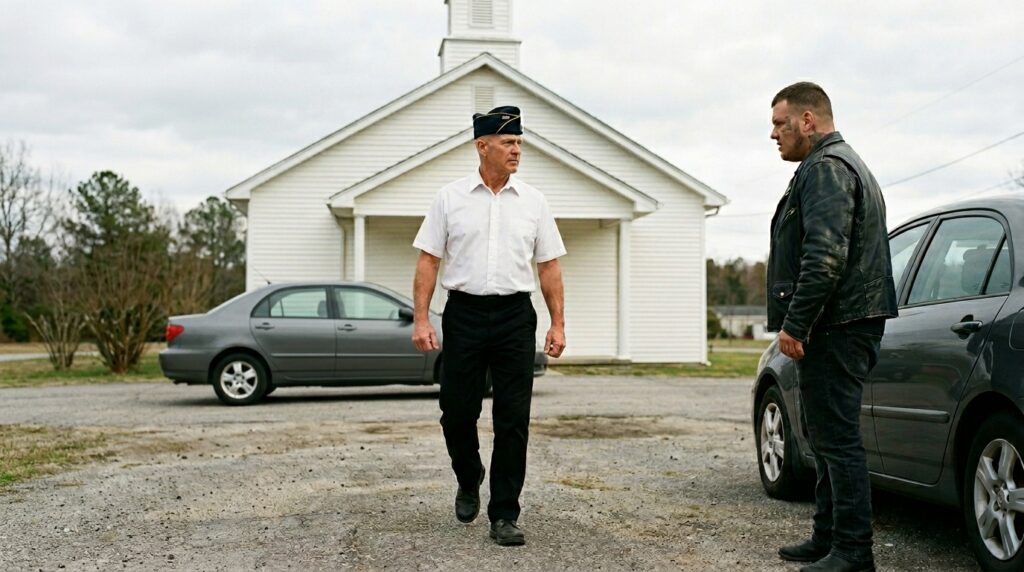
The Iron Boundary: A Story of Dust, Scars, and the High Cost of Sanctuary
CHAPTER 1: THE WEIGHT OF THETHRESHOLD
“You’re an expensive mistake, old man,” the heavy set one said. He didn’t spit, but his jaw stayed low, loose with the unearned confidence of thirty years and a black leather jacket that smelled of stale tobacco and cheap vinyl. He stood right where the asphalt rotted into sand, blocking the rusted iron gate of the parish. Behind him, the engine of the dark sedan gave off a rhythmic, ticking heat.
David didn’t shift his weight. The white fabric of his dress shirt was hot across his shoulder blades, stiff with starch and the dry wind coming off the scrub oak flats. He could feel the small iron tractor bolt in his right trousers pocket—heavy, blunt, biting into his thigh.
“The gate is closed to vehicles,” David said. His voice was flat, dried out by decades of sand and routine. “Move the car.”
“The car stays. The parish pays,” the younger man replied, a crooked grin spreading across facial tattoos that looked like blue mold under the midday sun. He took a heavy step forward, his boots stirring up a pale cloud of lime dust. “We’re rewriting the lease on this county, uncle. Your name isn’t on the ledger.”
The distance closed before the dust could settle.
It wasn’t the roaring anger of the old days; it was the cold, unblinking math of an engine that knew exactly how much fuel it had left. When the leather jacket swung—a clumsy, wide right hook designed to terrify shopkeepers—David simply stepped inside the arc. The air left the younger man’s lungs with a wet whuff as David’s forearm caught him flush across the sternum, followed by a short, functional sweep that used the enforcer’s own bulk against him.
The heavy man hit the gray dirt with a thud that vibrated through David’s heels.
David stood above him, his dark veteran cap shadow-casting his eyes into total obscurity. His hands stayed down, fingers hooked slightly, checking the horizon for a second vehicle. Nothing but the heat haze and the white glare of the church wall. Beneath him, the enforcer groaned, a red smudge beginning to ruin the blue ink on his jawline.
David reached into his pocket, turning the dry iron bolt once, twice, against his thumb. The victory felt like ash. He had broken the silence of the valley, and the valley never forgot a noise.
He looked down at the dazed man, then toward the sedan’s dashboard. Sitting right there in the open passenger seat, partially obscured by a greasy baseball cap, was a leather-bound military logbook with David’s own old unit stencil fading across the corner.

CHAPTER 2: THE CORROSION OF SACRED GROUND
“You shouldn’t have laid hands on him, David.”
The voice didn’t come from the gravel where the enforcer had crawled back into his dark sedan, leaving a slick of black oil and a pair of deep tire ruts in the parched earth. It came from the shadow of the white church doors. Deacon Thomas stood there, his fingers tucked into the pockets of an oversized wool cardigan despite the sweltering valley heat. The wool was fraying at the cuffs, the gray threads thin and caked with the fine, microscopic silt that blew off the abandoned lime kiln up the road.
David didn’t look up from the well-pump. He pressed his weight down on the iron handle. The metal was pitted, rough with patches of red scale that scraped against the palm of his hand with a sharp, dry screech. It took three heavy strokes before the pump bit, spitting a violent, rusty brown stream into the dust before clearing into something lukewarm and transparent. He held his knuckles under the stream, watching the thin pink ring of another man’s blood dissolve and sink into the thirsty ground.
“He was on church property,” David said. His voice carried the dull weight of a grinding stone. “The gate was closed.”
“Property lines don’t keep the rain off, and they don’t stop the bank,” Thomas said, stepping down onto the cracked concrete apron. His boots made a dry, scraping click against the grit. He looked toward the county line, where the highway vanished into a shimmering lake of heat distortion. “That boy belongs to Miller’s crew. They don’t lose arguments, David. They just buy the judge who handles the eviction.”
“Let them try.” David pulled his hand from the water, wiping his palm across the thigh of his trousers. The fabric was coarse, stiff with salt and old sweat. He turned his attention to the roadside where the sedan had been idling. A small puddle of transmission fluid was already baking into the gravel, iridescent and toxic. But it wasn’t the oil that kept his eyes fixed; it was the memory of the leather-bound logbook he’d glimpsed through the glass. The corner of the cover had been scarred by a distinct three-line stencil—the marking of the 4th Logistics Battalion. His old branch. An outfit that hadn’t deployed a logistics unit in thirty years, let alone sent one to rot in a dying agricultural basin.
Thomas let out a dry, rattling cough that sounded like pebbles in a tin can. “You think because you wore that uniform you can just draw a line in the sand and call it a fort? Look around you, David. Look at the paint on these walls.”
David looked. The stark white exterior of the church was peeling in long, curling ribbons, exposing the gray, weathered pine beneath like old skin coming off a bone. The sun was eating the structure piece by piece, just like the predatory loans were eating the smallholdings along the creek. Every fence line in the parish was sagging; every tractor was being run on bootleg agricultural diesel and prayer.
“The church is paid for,” David said, his fingers tightening around the rusted iron pump handle until the metal bit into his skin. “We cleared the mortgage back in ’24.”
Thomas didn’t answer right away. He reached out, his hand settling on the church’s wooden door frame, his thumb tracing a deep fracture in the timber where the foundation had settled an inch into the limestone shelf. There was a strange, guarded stiffness in the old man’s shoulders—the posture of a sentry who knew the password had changed but hadn’t been told the new one.
“Leases change, David,” Thomas murmured, his eyes tracking a crow that circled low over the dry irrigation ditch. “Sometimes the people who hold the paper don’t live in the county. Sometimes they don’t care about the name on the door.”
“Who holds it, Thomas?” David stepped away from the well, the distance between them shrinking until he could smell the mothballs and old tallow on the deacon’s sweater. “The boy said the parish pays. Who are we paying?”
A heavy, transactional silence settled over the courtyard. A gust of wind caught the rusted iron gate, swinging it an inch until the latch ground against the post with a dull, metallic groan. Thomas looked down at his shoes, his mouth working silently as if he were calculating the exact cost of every word before letting it cross his teeth.
“You go digging in the dirt around here,” Thomas whispered, his voice catching on the dry air, “and all you’re going to find is old iron and teeth. Go home, David. Wash that shirt. Come back for Sunday service and leave the road to the people who own it.”
The deacon turned, the heavy oak doors groaning on their hinges as he retreated into the cool, dark belly of the sanctuary, leaving David alone with the heat and the smell of sulfur from the well. David stood still for a long moment, his hand resting on the pocket where the iron bolt lay cold against his skin. He didn’t go home. He walked toward the highway, his boots sinking into the soft tar of the shoulder, his mind locked on the stencil in that dark sedan. The enforcer would come back, or someone bigger would take his place. He needed to find that car before it reached the county line.
CHAPTER 3: THE PERIMETER TRUTH
The night didn’t bring relief; it just turned the heat brittle. A dry, cold draft crept down from the high ridges, carrying the scent of parched sagebrush and alkaline dust that settled over the church roof like fine gray flour. David moved along the eastern boundary fence line where the parish property bumped against the county road easement. Every step was silent, his boots testing the loose gravel before taking his weight. In his right hand, the rusted tractor bolt felt cold now, a dead piece of iron absorbing the midnight chill.
He stopped where the five-strand barbed wire dipped across a seasonal wash. The iron T-posts were heavily scaled with corrosion, their orange-red flakes rubbing off onto the parched weeds below.
David knelt. His thumb found the second wire strand. The metal gave too easily.
Someone had clipped a clean, heavy-duty tactical zip-tie around the wire, pulling it tight against the next post to create an artificial gap wide enough for a man to slide through without snagging his coat. The nylon of the tie was matte black, unweathered, completely smooth against the rough, pitted zinc of the fence. A professional cut. It wasn’t the work of a local scrapper or a desperate drifter looking for a bench to sleep on. It was a marker.
A sudden, rhythmic click broke the silence from the county road.
David sank into the dry shadow of an elderberry bush, his eyes narrowing as he scanned the black line of the asphalt. Headlights weren’t on. The vehicle was coasting down the gentle incline from the north, its tires giving off a soft, granular hiss against the gravel shoulder. It stopped fifty yards out, precisely where the white wooden sign marking the parish limits sat peeling in the dark.
The driver’s side door didn’t slam. It clicked shut with the heavy, dampened thud of a modified frame. A single figure stepped out, silhouetted against the faint, desaturated glow of the valley floor. The man didn’t move like the heavy enforcer from the afternoon. This one carried himself with a rigid, disciplined posture that David recognized instantly—the symmetrical, calculated weight distribution of a person who had spent thousands of hours wearing body armor and carrying a sidearm on a tactical sling.
The stranger walked directly to the fence gap, his boots making no sound at all in the soft sand of the wash. He didn’t look left or right. He reached the zip-tied wire, stopped, and struck a match.
The yellow flame flared, illuminating a lean, scarred jawline and a dark gray baseball cap devoid of any insignia. The light caught the man’s chest, reflecting off a high-grade nylon utility vest.
“You’re late checking the lines, Sergeant,” the man said. His voice was low, clear, and perfectly modulated, carrying the flat cadence of a drill field. He didn’t look toward the elderberry bush, but he held the match steady, letting the flame burn down toward his calloused fingertips.
David didn’t move. His breath stayed slow, pushed deep into his diaphragm to eliminate the sound of his chest expanding against the stiff canvas of his jacket. “The perimeter belongs to the parish,” David replied, his voice emerging from the dark like grinding shale. “You’re trespassing across a closed boundary.”
The stranger let the match drop. It hissed once in the damp sand and went out, plunging the wash back into a heavy, monochromatic gray. “A boundary is only as good as the concrete holding the posts, David. And right now, the deacon is selling the cement out from under your feet.”
“Thomas handles the books,” David said, his grip on the iron bolt tightening until his knuckles clicked. “He doesn’t handle the land.”
“He handles whatever Miller tells him to handle,” the man countered. He took one step closer to the wire, his hands resting easily on his hips, just inches away from the clean vertical line of his jacket split. “That boy you broke this afternoon? He’s a local animal. He doesn’t see the big picture. He thinks he’s collecting tax for a gambling house across the river. But you know better, don’t you? You saw the logbook in the sedan.”
David’s mind raced, calculating the distances, the angles of approach, the physical layout of the wash. The mention of the logbook confirmed the link. The enforcer wasn’t an isolated problem; he was a scout for a larger, highly structured apparatus that was systematically dismantling the county’s smallholds.
“Who sent you?” David asked.
“An old friend who doesn’t like loose ends,” the stranger said. He reached into his vest pocket, his movements slow, deliberate, ensuring David could see he wasn’t pulling a weapon. He tossed a small object across the wire. It landed with a dull thunk in the dry weeds near David’s boot. “Miller is bringing four trucks across the creek tomorrow night to clear out the parish storage sheds. The deacon already signed the authorization form. You can stay inside the white doors and pray, or you can get on the road and keep driving until you hit the state line.”
“The storage belongs to the community,” David said.
“The community belongs to whoever pays the diesel bill,” the stranger replied smoothly. He turned back toward the coasting vehicle, his silhouette blending into the gray dark of the asphalt. “Don’t be there, David. The man running this ledger doesn’t like to audit the same account twice.”
The car door clicked open and shut. The engine cranked once—a clean, muffled turn—and the sedan vanished into the desaturated expanse of the highway, leaving David alone in the ditch. He reached down into the weeds, his fingers brushing against the object the man had thrown.
It wasn’t a weapon or a warning note. It was a heavy brass brassard clip, oxidized to a dull greenish-brown, stamped with the unmistakable raised crest of the 4th Logistics Battalion Headquarters.
CHAPTER 4: THE AUDIT OF ASHES
The brass clip lay heavy in David’s left palm, its oxidized edges cold against his skin as he approached the rear equipment shed. The structure was an eyesore of corrugated iron, situated three hundred yards behind the church burial ground where the limestone shelf fractured into raw shale. The iron sheeting had rotted through at the base, flaking away in jagged, orange-brown scalloped patterns that looked like teeth growing out of the dry dirt.
He didn’t use the main sliding bay door. The rollers were rusted solid into their overhead tracks, locked in place by a decade of silt and dried grease. Instead, he slipped around to the side bypass entrance.
The brass padlock hanging from the hasp was brand new, its polished golden surface a stark, offensive violation against the surrounding patina of decay. David didn’t bother looking for a key. He inserted the blunt end of the old iron tractor bolt into the curve of the hasp, braced his shoulder against the rotting cedar frame, and threw his weight into a single, downward lever stroke.
The dry timber gave way with a sharp, splintering crack that sounded like a bone snapping in an empty room. The lock swung free, still attached to a chunk of dead wood.
Inside, the air was trapped, thick with the chemical stench of low-grade fuel oil and the damp, chalky smell of old grain sacks. David stood in the doorway for three heartbeats, letting his eyes adjust to the desaturated gray light bleeding through the gaps in the corrugated roof. He expected to see the parish’s shared tractor, maybe a few bundles of winter fencing wire or sacks of seed donated by the cooperative.
The floor was empty of tools. Instead, four heavy oak pallets sat precisely spaced across the oil-stained concrete floor.
Stacked on top of them were rows of olive-drab logistics crates, their edges reinforced with steel banding that showed zero signs of rust. These weren’t agricultural supplies. David approached the nearest crate, his hand moving over the stencil work on the lid. The marking was identical to the one on the brass clip in his pocket: 4th Logistics Battalion.
He pried the heavy canvas tarp back from the rear pallet. Hidden behind the military crates sat a battered steel filing box, its green paint scratched down to the dull gray primer. The drawer wasn’t locked. When David pulled it open, the metal rollers shrieked, a high-pitched rasp that echoed off the iron walls.
Inside were thousands of paper vouchers, fuel receipts, and deeds to parish smallholdings, all held together by thick rubber bands that had begun to rot and stick to the paper.
Right at the front of the drawer sat a black ledger notebook. David picked it up, the cardboard cover stiff and warped by the humidity of the shed. He opened the first page. The handwriting was unmistakable—the neat, cramped, old-fashioned cursive of Deacon Thomas.
The columns weren’t records of church tithes or charity donations. They were lists of names—every farmer, every widow, every veteran living within thirty miles of the county line. Next to each name was a dollar figure, followed by two dates: a payment deadline and a foreclosure transfer.
The final column was titled Liquidation Destination. In every single entry, the destination was the same three-word phrase, repeated over and over until the ink blurred: Sovereign Supply Corps.
“I told you not to look in the dirt, David.”
The voice was hollow, flattened by the corrugated iron walls. Deacon Thomas stood in the doorway of the shed, his frame silhouetted against the gray pre-dawn light. He wasn’t wearing his cardigan now; he wore a faded black suit jacket that was too large across his thinning shoulders, the hem frayed and dusted with white lime. In his right hand, he carried an old double-barreled shotgun, the barrels pointed at the floorboards, his grip loose but trembling.
David didn’t drop the ledger. He turned it toward the old man, his thumb pressing into the center of a page containing his own neighbor’s name. “You signed the transfer papers, Thomas. You’ve been running their collection house right from the altar.”
“The church owes three hundred thousand to the state utility board, David,” Thomas said, his voice cracking as he took a step inside, his boots crunching on the dry chips of cedar wood. “They were going to cut the water across the whole parish by the end of winter. If the pipes go dry, the people leave. If the people leave, the town dies. I didn’t have a choice.”
“There’s always a choice,” David said, his voice dropping into the cold register of an executioner’s log. “Who is Miller working for? Who owns Sovereign Supply?”
“You don’t understand,” Thomas whispered, the shotgun barrel shaking as he lifted it an inch, then lowered it again, his strength failing against the weight of the iron. “Miller is just the hand that holds the paper. The man who bought the debt… he knows you, David. He’s known you since the river crossings in ’94. He didn’t buy this county for the land. He bought it because he knew you wouldn’t leave a sanctuary once you built one.”
A cold spike of adrenaline hit David’s chest, sharper than the midday sun. He looked down at the ledger, then back at the green military crates stacked along the wall. The decoy secret was gone; the local financial corruption was just a skin, a layer of common rot designed to look like simple greed. The infrastructure wasn’t being dismantled to build a pipeline. It was being cleared like a firing lane.
Before he could speak, the distant, unmistakable drone of heavy diesel engines rolled over the shale hills from the north—four distinct power-plants, running without mufflers, closing the distance from the county line.
CHAPTER 5: THE DUSTY RECKONING
“They’re crossing the creek wash,” Thomas whispered. The old shotgun barrels clicked against the corrugated iron siding, his hands shaking so violently the metal rattled like dry teeth.
David didn’t look at him. He stood by the broken side door, his boots planted firmly in the lime dust. The vibration came through the concrete floor first—a deep, low-frequency tremor that made the ancient grease-cans on the shelves dance and ping against each other. Then came the smell. It was the heavy, sulfurous stench of unrefined diesel, burning hot and dirty through the rusted manifolds of work trucks that had seen too many miles on backroads.
The four vehicles emerged from the heat haze like gray iron beetles. They weren’t standard commercial rigs. They were old five-ton military flatbeds, their civilian paint jobs peeling away in sheets to reveal the drab, matte-olive undercoats beneath. The lead truck had a massive steel push-bumper welded onto the frame, covered in orange-red oxidation that flaked off in long, bleeding streaks as it bounced over the ruts.
The convoy ground to a halt right at the church gates, their air brakes letting out a synchronous, deafening shriek that sounded like metal being torn apart on a lathe.
David stepped out into the open courtyard. The wind had picked up, sweeping across the shale hills, carrying a stinging grit that pelted his face and left a gray layer on his white dress shirt. He watched the lead truck’s cabin door groan open.
A man climbed down from the high seat. He wasn’t Miller. This man was older, his face lined with the sharp, deep creases of a person who had spent his life under canvas and high-altitude sun. He wore a faded, oil-stained utility coat, but his posture was flawless—rigid, unyielding, a perfect mirror of David’s own reflection. On his shoulder was a weathered patch, the thread frayed down to the backing, but the outline remained clear: the three-bar standard of a Colonel.
“Thirty years, David,” Colonel Vance said. His voice was a quiet rasp, easily cutting through the low rumble of the idling diesel engines. He stopped ten paces out, his boots sinking into the loose gravel where David had dropped the enforcer the day before. “You always did have a habit of digging in where the soil was worst.”
David felt the cold weight of the brassard clip in his hand, his thumb tracing the green oxidation. “The battalion was deactivated in ’95, Vance. You’re running a graveyard shift.”
“The battalion is exactly where I left it,” Vance countered, his eyes tracking the peeling paint of the church walls, his expression completely devoid of warmth. “On the ledger books. Everything has a salvage value, David. The trucks, the storage sheds, the people. The state wanted this basin forgotten. I just bought the rights to do the forgetting.”
“You used Thomas to squeeze them dry,” David said, his fingers tightening around the old iron tractor bolt in his trousers pocket. The metal was dead, cold, and heavy.
Vance let out a short, mirthless laugh that sounded like dry husks scraping together. “Thomas is a pragmatic man. He understood that a roof needs pillars, and pillars cost iron. But you… you always were the one element I couldn’t balance on the spreadsheet. You walked away from the logistics depot with forty tons of non-inventory hardware in your head. I couldn’t let that asset sit out here in the dust.”
The trucks behind Vance revved simultaneously, a cloud of thick, black soot billowing from their vertical exhaust stacks, blotting out the pale morning sun. From the beds of the flatbeds, men began to drop down onto the gravel—disciplined, quiet, carrying heavy iron pry-bars and bolt cutters. They didn’t move like criminals; they moved like a reclamation crew clearing out a junked yard.
David looked past Vance’s shoulder, his gaze locking on the lead truck’s steering column. Hanging from the ignition loop was a set of rusted, military-issue identification tags—David’s own missing tags from his final tour, items that had disappeared from the base headquarters the night he took his discharge papers.
The reality hit him with the slow, crushing friction of a landslide. This wasn’t an expansion of a predatory enterprise. It was an extraction. Vance had spent months grinding the local parish into pieces for the sole purpose of creating an ignition point—a conflict loud enough to pull David out of his silent routine and back onto the grid where his past could be permanently audited and closed.
“The inventory is settled, Colonel,” David said, his voice dropping into a register that was completely flat, completely empty of fear. He took one step forward, his boots crushing a piece of fallen iron wire beneath his heel with a crisp, final snap. “The threshold stays exactly where it is.”
Vance didn’t draw a weapon. He simply raised his left hand, his fingers forming a sharp, decisive signal that the drivers behind him understood instantly. The lead truck’s engine roared, the transmission grinding with an iron shriek as the heavy tires began to churn through the gravel, heading straight for the white church doors.
CHAPTER 6: THE IRON BOTTLENECK
The iron gate didn’t break cleanly. It buckled with a wet, heavy screech, the rusted hinges tearing out from the cedar posts with a sound like ancient teeth being pulled from dry bone. The lead five-ton flatbed lurched forward, its oxidized steel push-bumper caked with white lime dust as it plowed three feet into the courtyard before the transmission caught, the heavy tires spinning in the loose shale and throwing a gray curtain of silt into the air.
David didn’t run. He shifted his weight behind the iron well-pump apron, his fingers locked around the heavy pry-bar he’d dragged from the storage shed. The world had narrowed to the space between the truck’s front axle and the stone wall of the old baptismal pool.
“Thomas, get inside the basement,” David barked, his voice flat, cutting through the grinding rattle of the diesel engine. “Now.”
The deacon didn’t answer, but the hollow sound of his boots scrambling across the splintered porch steps signaled his retreat.
The flatbed’s driver—a thick-necked man wearing a grease-stained headset—slammed the stick into reverse, intending to back out and clear a wider path for the trucks behind him. But David had already calculated the machine’s turning radius in the confined courtyard. The well-pump framework wasn’t just old plumbing; it was an anchor of solid, four-inch cast iron sunk six feet into the limestone shelf.
David drove the wedge end of the pry-bar directly into the steering knuckle of the truck’s front left tire, jamming the steel bar between the tie-rod and the rusted chassis frame.
The driver slammed the throttle down. The five-ton truck surged backward, but the steering wheel ripped out of his hands as the tire caught the iron leverage of the pump apron. There was a loud, metallic ping—the sound of a high-tensile tie-rod snapping under six thousand pounds of mechanical force. The front tires instantly splayed inward, locking the vehicle’s steering mechanism in a permanent, cross-eyed bind.
The truck stalled out with a violent shudder that made the olive-drab hood rattle against its latches.
“Vance!” David shouted into the swirling gray dust, his boots planted on the cracked concrete apron. He didn’t lift the iron bar; he kept it low, his body angled to minimize his profile against the truck cabin. “The lane is blocked. Your trucks aren’t reaching the storage bays.”
Across the broken gate, Colonel Vance stood by the hood of his command sedan, his gray baseball cap pulled low against the morning glare. He didn’t look angry; his face remained perfectly desaturated, a ledger clerk watching a minor error appear on a spreadsheet. He glanced at the jammed flatbed, then at the two trucks idling on the highway shoulder behind it.
“A bottleneck only works if you have the personnel to hold the flanks, David,” Vance said, his voice carrying clearly over the ticking heat of the stalled engine. He pointed a gloved finger toward the eastern fence line, where the tactical zip-ties had been cut the night before. “The property has three entries. We don’t need the road.”
Two men from the second truck dropped over the tailgate, carrying heavy-duty wire cutters and steel chains. They didn’t approach the bottleneck; they headed directly for the side of the parish hall where the main electrical conduit ran down from the utility pole into a rusted gray junction box.
David felt the friction of the old tractor bolt in his pocket, its blunt edges pressing into his thigh as he watched the men move. They weren’t there to salvage the grain or the fuel. They were setting the perimeter for a prolonged extraction. If they cut the main lines, the pump would go dead, the well would dry up, and the white church would become nothing more than a dry oven in the middle of the scrub flats.
He didn’t wait for Vance’s next command. David turned, his boots kicking up gray sparks from the shale as he ran toward the rear of the parish house, his mind mapping the local power grid he had memorized decades ago. The Colonel wanted a tactical engagement; he was going to get it in the dark.
CHAPTER 7: THE BLACKOUT ARCHITECTURE
The electrical alcove beneath the parish hall’s north foundation smelled of dead wasps and cold slate. David pressed his back against the rough limestone wall, the coarse lime dust scratching through the cotton of his shirt as he slid toward the main commercial disconnect box. Outside, the rhythmic snip-snip of high-tensile wire cutters chewing through the overhead lines vibrated through the structure’s structural iron beams.
He reached out in the absolute blackness. His fingers, calloused and mapped by years of physical maintenance, found the cold vertical handle of the three-phase industrial breaker. The iron casing was thick with orange corrosion that flaked off under his fingernails, leaving a bitter, metallic powder on his skin.
This grid wasn’t a standard public service link. It was an old industrial feeder line left over from the defunct limestone quarry project of ’94, routed through a heavy oil-cooled step-down transformer bolted straight into the church’s sub-floor. David didn’t pull the switch yet. He waited, his ears tracking the heavy, rhythmic thud of boot heels directly on the floorboards above his head.
Vance’s reclamation crew had entered the parish office.
“Check the floor vents,” a muffled voice commanded from above. The wood groaned under a heavy, disciplined stride. “The Colonel wants the archive crates from the ’95 inventory. If the old man didn’t bury them in the cemetery, they’re under the floorboards.”
David took the iron tractor bolt out of his pocket. He didn’t use it as a weapon; he used it as a shim. He jammed the blunt iron threads deep into the mechanical interlock sleeve of the transformer housing, locking the manual bypass armature in the closed position. Then, with a single, short thrust of his heel, he slammed the main high-voltage disconnect handle downward.
The contactors separated with a deafening, metallic clack that sounded like a rifle shot inside the stone vault.
A blue, blinding arc of electrical fire flashed within the steel cabinet, illuminating the damp corners of the foundation for a fraction of a second. The smell of hot copper and bitter, scorched ozone filled the alcove instantly. Upstairs, the sudden, violent surge pulled eighty amps of current directly through the auxiliary generator link Vance’s men had tried to hook up, shattering the portable unit’s voltage regulator with a loud, wet pop.
The entire church perimeter went black. The low-frequency rumble of the office light fixtures died, replaced by a dense, unyielding silence that smelled of dead oil.
“Power’s down!” a voice shouted from the hall above. “The transformer blew out from the inside! Get the flashlights up!”
David didn’t wait for the beams to penetrate the floor vents. He moved through the darkness of the crawlspace, his hands guiding him along the rusted iron water mains that fed the baptismal pool. He knew every structural failure in this foundation; he knew which joists were soft with dry rot and which iron supports could bear weight.
As he reached the narrow access hatch leading into the rear vestry, his hand brushed against the transformer’s mounting plate. Even in the dark, his fingers registered the shape of a stamped brass serial tag bolted to the iron sleeve. It wasn’t a public utility identification marker. His fingers traced the raised letters, reading the crisp, unweathered stamping by touch alone: PROPERTY OF US ARMY LOGISTICS COMMAND – FOURTH BATTALION DESIGNATION.
The cold grit in his throat felt like sand. The church hadn’t been built on simple public land; the foundation itself had been anchored onto a de-registered military fuel depot framework from thirty years ago. The deacon hadn’t just laundered cash; he had been paying the maintenance fee on a sealed government asset that Vance had spent three decades trying to erase from the federal ledger.
David shoved the hatch upward, the dry pine boards creaking as he stepped into the pitch-black corridor behind the altar. Outside, the glare of tactical flashlights began to cut through the stained glass windows, throwing jagged, desaturated patterns of blue and red light across the white wooden pews.
He could hear Vance’s boots on the exterior gravel, slow and unhurried, moving toward the front doors. The dark wasn’t an obstacle to the Colonel; it was an environment he had spent his entire life management-tracking. David tightened his grip on the pry-bar, his body heat rising against the cold starch of his collar as he stepped out from behind the pulpit to meet the sound of the iron latch clearing the door frame.
CHAPTER 8: THE SECRATED RECKONING
“You always did know how to budget your shadows, David.”
Colonel Vance’s voice didn’t echo. The heavy cedar beams overhead, soft with dry rot but dense enough to swallow sound, held the words flat against the floorboards. The front doors of the sanctuary hung open behind him, framing a narrow rectangle of desaturated gray dawn. The blue beam of a high-grade tactical flashlight sliced through the dark, tracking the rows of peeling wooden pews before settling squarely on the center pulpit where David stood.
David didn’t shield his eyes from the glare. His left hand rested on the altar’s edge, his fingers feeling the deep, splintered grain of the oak where decades of oil and grease from working hands had left a slick patina. In his right pocket, his knuckles ground against the blunt iron tractor bolt.
“The inventory under the floor belongs to the state, Vance,” David said, his voice coming out slow, regular as a grandfather clock. “The state closed the ledger in ’95. You’re holding a dead balance sheet.”
“The state doesn’t have an automated extraction protocol for assets they forgot they owned,” Vance replied. His boots made a wet, rhythmic crunch against the grit on the center aisle carpet as he advanced. He held the flashlight low now, its peripheral spill illuminating the gray lines of his face and the brass crest on his lapel. “Forty tons of specialized hardware from the 4th Logistics reserves doesn’t vanish because someone checked a box in Washington. It sits in the dark until someone with a crane comes to claim it.”
“You didn’t bring cranes,” David murmured, his gaze shifting to the side aisle where the stained glass windows showed the dark, idling silhouettes of the five-ton flatbeds. “You brought a clearing crew.”
“Because you were still here.” Vance stopped five paces from the altar rail, right where the floorboards had buckled from old rain leaks. He lowered the light completely, letting the room plunge back into a dark, suffocating gray. “Thomas thought he was saving the roof. He’s a small man; he thinks in terms of shingles and fuel oil. But you and I know that when an asset sits in a combat zone for thirty years without an audit, it becomes the property of the officer who kept it off the manifests.”
“I signed the final disposal manifest,” David said. His hand came out of his pocket, his thumb turning the iron bolt over in his palm. The rust flakes fell away, dry and sharp against his skin. “I listed every pallet as scrap iron. It was melted down, Colonel.”
Vance’s hand dropped to his side split jacket. “Then why did you anchor your church to the concrete cap of the secondary fuel bunker? Why did you spend thirty years checking the fence wire every Tuesday morning if there was nothing but old iron in the dirt?”
The silence that followed was heavy with the smell of sulfur from the well below and the cold, mineral scent of ancient limestone. It was the emotional weight of a thirty-year siege, a quiet war between two men who had spent their youth calculating the exact cost of human life in terms of gallons and tons. Vance wasn’t here for profit; he was here because his entire professional reality was built on the absolute necessity of a clean ledger, and David’s survival was the only unverified debit left on his sheet.
“Because the land needed a boundary,” David said simply. He stepped down from the pulpit, his boots making a dry, deliberate scrape against the altar rail. “If I didn’t hold the line here, the whole basin would look like your trucks—stripped down to the gray primer and sold by the pound.”
Vance didn’t monologue. He didn’t give a command to the men outside. With the efficient, unthinking precision of an old soldier whose muscle memory had outlived his uniform, he pulled the heavy sidearm from his coat. The steel slide cleared the leather with a clean, metallic clink.
But David had already calculated the distance. He didn’t drop to the floor; he didn’t swing the pry-bar. He slammed his heel down onto the loose floorboard at the base of the altar rail—the exact point where he had bypassed the manual interlock to the transformer below.
The mechanical connection, held under extreme spring tension by the iron tractor bolt he’d jammed into the housing earlier, snapped with a violent, concussive crack.
The backup battery banks in the vestry didn’t explode; they shorted out through the iron water mains, sending a sudden, brilliant flash of electrical arc-light through the floor registers right beneath Vance’s feet. The sudden glare was blinding, throwing massive, distorted shadows across the white altar cloth. In that split second of visual overload, David closed the gap.
His hand caught Vance’s forearm, his thumb pressing into the nerve cluster behind the wrist with the precise, functional leverage of his old MP training. The sidearm clattered onto the tarnished silver communion tray sitting on the rail, landing with a sharp, clear ring that sounded like a coin dropping into an empty offering plate.
David didn’t strike. He held the Colonel’s arm pinned against the oak rail, their faces inches apart in the returning dark. He could feel the heavy, ragged breath of the older man—not the breath of a mastermind, but the tired, dry rasp of an obsolete engine running out of oil.
“The ledger is closed, Colonel,” David whispered, his grip tightening until the brass insignia on Vance’s sleeve pressed into his own palm like a brand. “Go back across the creek.”
Vance stayed still for a long heartbeat, his fingers twitching against the oak rail. Outside, the low, rhythmic drone of the flatbeds began to stutter as the secondary fuel pumps, starved of the regulated current from the parish junction box, choked on the dirty diesel and died one by one. The silence returned to the valley, vast and indifferent, leaving nothing but the sound of the wind scraping the lime dust against the white wooden doors.
CHAPTER 9: THE SCRAP REMAINS
The extraction didn’t end with a battle; it ended with the slow, unglamorous friction of old iron being dragged through the dirt.
David stood at the threshold of the shattered gate, his hand resting on the fractured cedar post. The white paint came away in dry scales under his palm, dusting his knuckles like lime. Fifty yards down the road, the lead five-ton flatbed was hooked to the back of the command sedan by a pair of heavy-duty logging chains. The links were bright with fresh, silver scoring where they strained against the dead weight of the snapped steering linkage.
Vance’s men didn’t look back. They moved with the silent, sullen discipline of a supply unit that had miscalculated its fuel reserves.
The heavy diesel engines chugged black, greasy smoke into the clean morning air, the exhaust settling over the scrub oak flats like soot on a sheet of tin. As the caravan cleared the parish line, the broken front tires of the lead truck ploughed two deep, parallel gouges into the soft asphalt of the county road, leaving raw black tracks that would fill with sand before the week was out.
“They’re gone, David.”
Deacon Thomas stepped out from the shadow of the parish hall. He looked smaller in the full glare of the sun, his oversized wool cardigan hanging loose from his thinning shoulder blades. He held an old burlap sack containing the green ledger books and the green filing box from the shed, his fingers hooked into the twine tie like a man holding a bucket of wet ashes.
“They won’t stay past the river,” David said, his voice flat, drained of anything but the hard grit of routine. “Vance isn’t an enforcer. He’s an auditor. Once the cost of reclaiming the asset exceeds the salvage value on the sheet, he crosses out the line item.”
“The state board is still going to look at the books,” Thomas said, his voice trembling as he looked down at the deep ruts in the churchyard gravel. “The water debt doesn’t leave with the trucks.”
“The books are in the well, Thomas,” David said.
The deacon looked up, his jaw dropping slightly. David didn’t look back at him. He turned toward the well-pump apron, where the rusty water had already dried into a dull orange stain on the concrete. Beneath that concrete lay six hundred feet of unlined limestone shaft, feeding from a prehistoric aquifer that smelled of sulfur and dead stone. The ledger, the vouchers, and the green military stencils were three hundred feet down by now, turning to gray mush in the dark.
“You can’t just bury a debt, David,” Thomas whispered.
“In this basin, you can bury anything if you put enough gravel over it,” David replied. He reached into his trousers pocket, his fingers settling on the old iron tractor bolt. The metal was warm now, heated by his own body through the coarse canvas of his trousers. “Go inside. Clean the wax off the pews. The wind is going to bring the lime dust in through the broken gate all afternoon.”
David walked away from the road, his boots making a dry, crunching sound in the shale. He didn’t check the perimeter fence lines today. He didn’t need to. The tactical zip-ties were gone, replaced by the raw, jagged ends of rusted barbed wire that he would have to splice with his own hands before the winter cattle drifted down from the northern ridges. He had saved the walls, but the boundary was gone, and the town would be looking toward the white church doors by sunrise to see who was standing in the gap.
CHAPTER 10: THE RUSTED PULPIT
“The hymnals are ruined, David.”
Deacon Thomas didn’t look at the pulpit when he spoke. He was down in the third row, his small, blue-veined hands sorting through the water-logged pages of the old cloth-bound books. The heavy copper wires David had blown in the crawlspace had sweated through the floorboards, leaving a damp, iron-scented mist that had warped every timber in the nave. The pine pews were cold, slick with a fine coating of gray soot from the auxiliary generator’s brief, catastrophic failure.
David adjusted the stiff collar of his white dress shirt. The fabric felt restrictive, tighter than it had on Friday. He looked out over the assembly—twenty-eight people, fewer than half the standard congregation, their faces desaturated by the grey light filtering through the cracked stained glass. They sat in small, isolated clusters, their shoulders hunched into heavy canvas work coats, their boots caked with the white lime mud of the courtyard.
They weren’t looking at the altar. They were looking at David’s hands.
The skin across his right knuckles was dark, a purple-black bruise where the steering knuckle of the five-ton truck had kicked back against his pry-bar. It was an unvarnished marker of violence on a day meant for clean linen, a hard debit line visible to every family that had spent the last three months watching their property deeds disappear into Vance’s ledger.
“We will use the old texts,” David said, his voice dropping into the empty spaces of the sanctuary like shale sliding down a chute. “Page forty-two. The psalm for the boundary.”
No one turned a page. The silence in the room wasn’t the silence of prayer; it was the quiet, calculated stillness of an outpost waiting for the secondary perimeter to collapse.
At the back of the room, near the shattered entry doors that had been hastily blocked with two cross-braced pine planks, sat an empty bench. Someone had carved a series of jagged, vertical marks into the seasoned timber near the aisle seat—not a local name, but the long, nine-digit federal serial code that Vance’s logistics battalion had used to mark surplus infrastructure before the deactivation. The wood around the scratches was fresh, the white pine stark against the dark stain of the bench.
“David,” a man in the fourth row called out. It was Miller’s uncle, an old dry-land farmer whose tractor had been sitting in the equipment shed under a lien for six weeks. His fingers were stained with transmission fluid, the black grease permanently worked into the cracks of his skin. “Vance’s flatbeds are parked down by the rail spur across the river. They aren’t loading gravel, David. They’re waiting on the county surveyor to sign the public easement.”
“The easement is closed,” David said, his hand resting flat on the unvarnished oak of the pulpit. He felt the iron tractor bolt in his pocket click against his keys as he shifted his weight. “The property line was verified by the district court in ’24.”
“The district court doesn’t have an engineer on the payroll,” the farmer countered, his voice rising, scraping against the damp rafters. “Vance has two rigs sitting on the county bridge right now, checking the weight limit on the structural iron. If he drops those trucks across the river, the cooperative can’t haul the winter wheat to the mill. We’re locked in our own yard, David.”
Thomas stood up slowly, the water-damaged hymnal dropping back onto the pew with a dull, wet thud. He looked at David, his mouth working silently, his eyes wide with the frantic, exhausting calculation of a clerk who knew the final balance was already short. “We have to sign the temporary authorization, David. If we give them the storage sheds, they leave the bridge open. That’s what the surveyor told me at the crossroads.”
David looked down at the deacon, then at the twenty-eight pairs of eyes waiting for a tactical retreat. This was the true friction of the sanctuary—not the kinetic impact of the trucks against the iron gate, but the slow, corrosive willingness of a community to compromise its boundaries one inch at a time just to keep the heaters running for another month. They wanted him to be the sovereign protector, but they wanted the protection to be clean, to cost nothing more than a few signatures on a piece of official paper.
“The storage stays,” David said. His voice didn’t rise, but it carried the absolute, unyielding density of a concrete bunker cap. “If you give them the sheds today, they’ll ask for the well-pump on Tuesday. By next winter, you’ll be buying your own water out of the back of Vance’s tankers at two dollars a gallon.”
He stepped down from the pulpit, his boots making a hard, rhythmic strike against the floorboards that echoed through the dark nave. He walked down the center aisle, past the rows of soot-stained wood, straight toward the back row where the fresh serial code was cut into the bench. He didn’t look back at the altar or the deacon. He reached the pine planks blocking the door, shoved his shoulder against the timber, and stepped out into the blinding white glare of the courtyard, his mind tracking the sound of a strange, high-idle gasoline engine coming up the highway from the south.
CHAPTER 11: THE AUDIT HORIZON
The high-idle gasoline engine didn’t rumble like Vance’s flatbeds; it hummed with the thin, synthetic whine of a late-model state fleet vehicle. The sedan was a desaturated, generic gray, its lower panels caked with the fine white dust of the basin road until the door handles looked as if they had been dipped in dry mortar. It came to a stop inches from the shattered remains of the iron perimeter gate, its radiator fan continuing to pull the hot, dry air through the grill with a sharp, mechanical hiss.
David stood his ground on the cracked concrete apron. The sun had cleared the ridge now, cooking the lime courtyard until the heat rose in visible, shifting bands against the white siding of the sanctuary. His white dress shirt was heavy with old salt, the left cuff slightly frayed where it had scraped the rusty interlock armature beneath the floorboards.
A single woman climbed out of the gray car. She wore a sharp, dark gray linen suit that looked completely unsuited for the gravel flats, though her leather oxfords were old, the soles thick and worn flat at the heels. She didn’t carry a clipboard or a tactical vest. She held a single, faded manila accordion file secured by a thick, perished rubber band that left a brown stain across the cardstock.
She walked directly to the well-pump, her eyes tracking the orange rust scales on the handle before settling on the bruise across David’s knuckles.
“You’re a difficult man to locate on a map, Mr. Vance,” she said. Her voice had the flat, dry cadence of a federal record repository. She reached into her jacket, her fingers coming away with a heavy brass identification badge that she clipped to her pocket line with a precise, metallic snap. “Department of Federal Asset Reclamation. My name is Miller, but not the one your neighbors are complaining about.”
David didn’t look at the badge. He looked at the clip holding it—the steel spring was stamped with an old, obscure ink logo from the 4th Logistics Dispatch Branch, identical to the stencils rotting down in the well shaft.
“The asset was scrubbed from the ledger thirty years ago,” David said, his fingers tightening in his pocket around the warm iron tractor bolt. “The property belongs to the parish.”
“The parish owns the surface timber and the top six inches of topsoil,” she said, tapping the manila file against her thigh. The sound was thin, like a dry shingle snapping. “The underlying concrete structure—the reinforced fuel repository designation 40-B—remains the property of the defense liquidation authority. I have the original ’95 manifest here. It’s missing a final verification signature from the logistics sergeant on duty.”
She opened the file. The paper inside was yellowed, the edges brittle and smell of old cellar damp. At the bottom of the ledger sheet was a single empty line beneath the name Sergeant David Vance.
“Colonel Vance came through here two days ago,” David said, his voice dropping into the cold, level register of an asset audit. “He brought four flatbeds to clear the inventory.”
“Colonel Vance is a private citizen running a scrap metal liquidation company,” she replied, her eyes unblinking, tracking a low lizard that darted across the dry limestone apron. “His company has been targeting deactivated depots from the ’90s across three states. He has the vouchers, but he doesn’t have the authority to release a sealed federal bunker without a verified signature from the custodian of record.”
She pulled a heavy, tarnished silver ink pen from her pocket and laid it flat on the wooden top of the church well-frame, right next to the dry rust stains where the ledger books had been dragged.
“If you sign the release, the state board pays off the utility debt for this parish within forty-eight hours,” she said, her voice remaining perfectly regular, a transactional machine working in the middle of the desert. “The trucks come back, they pump out the old storage lines beneath the nave, and this valley stays on the regional water grid for another twenty years. If you don’t sign, the property is designated an unverified military hazard zone by noon tomorrow. The gates get chain-locked, and the county cuts the road easement at the bridge.”
David stood under the burning glare of the church roof, the desaturated gray sedan idling behind her like an open valve. The cycle had completed its turn. Vance’s physical siege had failed, but the corporate infrastructure was right behind him, using the exact same ledger lines to squeeze the sanctuary into submission. The choice wasn’t between peace and violence anymore; it was between two different ways of being erased from the map.
He reached out, his calloused thumb sliding over the cold, heavy silver of the pen, his eyes looking past her toward the white doors where twenty-eight people were still waiting inside the dark nave to see if they still had a place to pray.
CHAPTER 12: THE BALANCE RUN
“The nib is dry, Mr. Vance.”
Investigator Miller didn’t shift her boots on the shale grit. She watched David’s hand—thick, raw-knuckled, and gray around the fingernails with old iron scale—as he held the heavy silver pen above the yellowed margin of the ’95 manifest. The paper was so thin from decades of damp storage that the glare of the noon sun shone right through it, revealing the ghosted lines of logistics numbers on the reverse side like veins under old skin.
David didn’t press down. He could feel the small iron tractor bolt through the canvas of his trousers, its blunt edge a cold reminder of the alignment he’d chosen when he dropped the enforcer by the road.
“The ink isn’t dry,” David said, his voice dropping into the flat, hollow space between the well-frame and the gray sedan. “It’s just heavy.”
He brought the silver point down. The line he drew wasn’t a signature; it was a single, deep strike through the section titled Sub-surface Infrastructure Release. The paper tore slightly under the sharp steel tip, exposing the rough, unpainted pine of the well-cover beneath.
Miller’s jaw tightened, the dry skin around her temples twitching once before she pulled the manila file back toward her jacket. “That’s an obstruction on a federal asset sheet. It carries a mandatory quarantine on the district easement.”
“The asset sheet was settled when the unit turned in its guidon,” David said. He laid the pen down on the concrete apron, its polished silver surface catching the glare of the white church wall until it looked like a shard of broken mirror. “The 4th Logistics didn’t leave a fuel bunker under this limestone, Miller. They left an empty cistern. I know. I’m the one who ran the wash-out crew before the cement was poured.”
A sharp, metallic click echoed from the interior of the gray car. The radio dispatch was looping—a low, rhythmic sequence of automated numbers from the county seat, checking the status of the regional grid monitors.
Miller looked at the torn ledger page, then at the church doors where the shadow of Deacon Thomas remained frozen against the white pine planks. Her demeanor didn’t shift into anger; she remained an auditor facing an irregular entry that refused to balance.
“The regional utility board isn’t going to look at the historical logs, David,” she said, using his name for the first time with the quiet, transactional weight of a collection agent. “They see three hundred thousand dollars in arrears on a non-rated parish line. If I don’t log this signature into the terminal by three o’clock, the digital disconnect order goes through automatically. The software doesn’t care about your unit history.”
“The software runs on the copper line that follows the rail spur,” David said, his hand sliding back into his pocket, his fingers settling on the warm iron bolt. “The same line Vance’s trucks are tracking across the creek.”
He turned away from her, his boots crunching heavily through the loose lime dust as he headed toward the side of the parish house where the old iron water main emerged from the limestone. He had spent thirty years maintaining a sanctuary by keeping his mouth shut and his lines straight, but the ledger was out in the open now, and the only way to protect the boundary was to take the machinery apart before the state could claim the salvage.
CHAPTER 13: THE SEVERED INTERLOCK
The sub-floor beneath the parish office didn’t contain documents; it held the physical geometry of an unyielding choice.
David squeezed through the narrow masonry opening where the stone foundation met the old limestone shelf. The space was tight, forcing his chest against the rough, hand-cut joists that smelled of ninety years of dry rot and cedar pitch. A fine, white dust rained down into his eyes with every movement, mixing with his sweat until his forehead was streaked with pasty gray lime.
He reached out, his calloused palm tracing the horizontal line of the main water main. The iron pipe was three inches thick, covered in thick patches of dark orange scale that came away under his fingers like dried scabs. This pipe didn’t just feed the parish kitchen; it ran straight into the core cooling sleeve of the sealed sub-surface cistern—the asset Miller called Designation 40-B.
“You’re running out of dial-tone, Sergeant,” a voice drifted down from the trapdoor behind him.
Investigator Miller wasn’t climbing down into the dirt, but her leather shoes made a clear, rhythmic tapping on the floorboards above the hatch. The sound was dry, precise, a metronome counting down the minutes until the automated state disconnect order hit the regional node.
David didn’t answer. He took the heavy iron tractor bolt out of his pocket and jammed the blunt, threaded end into the ancient mechanical gate valve that controlled the flow to the underground repository. The iron wheel was frozen, locked by three decades of mineral scale and stagnant grease. He used the flat of his palm like a mallet, striking the bolt with three short, heavy blows.
The valve gave way with a deep, iron groan that vibrated through the limestone shelf beneath his knees.
A dark, foul stream of stagnant water began to weep from the packing nut, smelling sharply of old sulfur and wet rust. But it wasn’t the leakage that caught his attention; it was the structural frame holding the valve in place. Bolted directly into the limestone wall behind the pipe was a heavy, military-issue brass junction box. The cover had been sealed with green lead wire, but the wire had rotted through long ago, leaving the loose plate hanging by a single rusted screw.
David pulled the brass plate free. Inside sat no electrical switches or data cables. It contained a single, heavy mechanical key made of dull, unpolished nickel, its shaft stamped with a series of vertical notches that matched the specific layout of the secondary gate locks on the rail spur bridge five miles south.
Vance hadn’t been waiting for an audit. He had been waiting for this key.
The infrastructure wasn’t a passive asset; it was a physical circuit. If the gate valve remained open, the water pressure from the parish well kept the internal balancing tanks of the lower repository from collapsing under the weight of the shale hills. If David turned the valve all the way to the stop, the well would fill the local storage tanks twice as fast, but the sub-surface vault would begin to fill with lime silt from the aquifer, sealing Vance’s old logistics hardware under forty tons of wet cement before his trucks could even clear the river crossing.
“The terminal is updating, David,” Miller called down, her voice smaller now, muffled by the rising drone of her car’s cooling fan outside the window. “Thirty minutes until the line goes dark.”
David gripped the nickel key, the cold metal biting into his bruised knuckles as he gave the valve a final, unyielding turn. He wasn’t going to sign the paper, and he wasn’t going to let Vance audit the bones of this valley. He crawled backward through the lime dust, his boots finding the rungs of the wooden ladder as he hauled himself out of the dark, his mind locked on the rail spur where the flatbeds were idling in the midday heat.
CHAPTER 14: THE FINAL COMPILATION
“The line is dead, David.”
Miller didn’t lift her eyes from the accordion file as he pulled his shoulder out of the trapdoor casing. Her dark gray suit jacket was completely coated in the fine white lime dust that had blown through the office window floor vents, turning the crisp wool charcoal into the faded gray of an old headstone. Outside, the generic sedan’s cooling fan gave one final, high-pitched rattle and cut out, leaving the afternoon silence thick, massive, and smelling of parched shale.
David laid the unpolished nickel key flat on the table, right over the line he had torn through the infrastructure manifest.
“The line isn’t dead,” David said, his hand sliding over the coarse canvas of his knee to rub away the damp rust sludge from the sub-floor valve. “The balance sheet just caught up with the location.”
Miller picked up the key. Her fingers traced the deeply notched vertical bits, her thumb catching on the rough edge where the brass stamping had been cut back in the depot bay. She turned the file folder flap over, revealing an old, purple ink stamp hidden inside the cardstock pocket: LEASE STATUS: TERMINATED BY ORDER OF LIQUIDATION OFFICE — OCT 1996.
She didn’t pack her file. She left the manila folder sitting open on the sun-bleached desk, the brittle pages fluttering slightly in the hot draft coming through the door planks. “You didn’t just wash the tanks out, Sergeant. You cut the drainage interlock to the rail spur. The surveyor just called the mobile unit. The bridge gate locks aren’t picking up the hydraulic signal from the node.”
“The node runs on the water pressure from the lower line,” David said. He pulled the dark veteran cap from his belt line and set it squarely on his head, the shadow cast by the brim dropping his eyes into total obscurity. “Vance can leave his flatbeds on the county road until the tires rot into the gravel. He isn’t turning the lock without the head-pressure.”
The silence that settled over the parish house was structural—the heavy, unmoving weight of thirty years of compartmentalized history finally grounding itself into the foundation timber. Through the window, the white church walls looked starker under the horizontal glare of the setting sun, the peeling paint ribbons standing out like dry scabs against the grey pine beneath.
Deacon Thomas sat in the low corner chair, his old hands resting empty on his knees, his face completely gray in the desaturated room light. He didn’t look at the files, and he didn’t look at David. He looked at the floorboards, listening to the slow, rhythmic drip-drip-drip of the stagnant aquifer water leaking from the valve below into the lime dust of the cellar.
“The cooperative will have to haul through the north cut,” Thomas whispered, his voice thin as a dry weed. “It’s twelve miles longer on the tires, David. The smallholders won’t make the winter interest on that fuel bill.”
“They’ll make the winter because they still own the storage,” David said, his voice carrying the final, absolute density of an unyielding gate post. “Vance isn’t buying the lease, and the state isn’t chain-locking the road. The basin stays exactly as dirty as it was on Friday.”
Miller stood up, the manila file tucked firmly under her arm. She didn’t offer her hand, and she didn’t pick up the silver ink pen she’d left on the well-cover outside. She walked out to the sedan, her leather shoes making a sharp, final crunch in the gravel ruts before the cabin door slammed shut with a muffled, unyielding thud.
David walked out onto the porch after the gray car had vanished past the lime kiln ruins. The air was dropping its temperature fast now, the cold ridge draft beginning to stir the dry elderberry leaves along the western fence line. He reached down into his trousers pocket, his fingers settling around the old iron tractor bolt. It was cold again, the metal having shed his body heat the moment he stepped out into the open basin wind.
He looked down at his white shirt—the starch was gone, the chest ruined by gray lime streaks and the pink smudge of another man’s blood on the cuff. He didn’t go back inside to wash. He walked toward the broken iron gate, his boots finding the familiar ruts in the shale as he began the slow, unglamorous labor of splicing the rusted barbed wire back onto the posts before the dark could take the flats.
CHAPTER 15: THE NORTH CUT MODIFICATION
The iron sledgehammer hit the anvil block with a dry, concussive clink that traveled straight through David’s elbows and into his teeth. Beneath the chassis of Miller’s uncle’s grain truck, the dirt was cold, smelling of ancient crankcase leakage and parched shale that had never seen a winter rain.
“Hold the pry-bar steady, Thomas,” David muttered, his voice muffled by the low clearance of the oil pan.
The deacon didn’t answer with words. The iron bar in his thin hands gave a rhythmic, metallic chatter against the leaf-spring hanger. Thomas’s face was inches from the rusty frame rail, his gray wool cardigan already ruined, dark with streaks of black grease that had dripped from the truck’s auxiliary transmission housing. He was breathing hard, his chest rattling like a loose fan-belt under his shirt.
David adjusted his stance in the dirt. He was wearing an old, oil-soaked denim jacket today over his gray work trousers, the white dress shirt from Sunday tucked away in the church vestry like a uniform from a war that had moved across the river.
The task wasn’t standard vehicle maintenance. The old three-ton farm trucks of the cooperative had been built to run on the flat, hard-packed asphalt of the county highway. To clear the twelve miles of unpaved limestone shelf along the north cut—where the ruts were deep enough to high-center a tractor—the front axles needed to be raised two inches, and the steering knuckles had to be shimmed with whatever scrap iron could survive the impact.
David picked up a thick steel washer he’d cut from the hinges of the storage shed bypass door. It was pitted, rough with red zinc oxidation, but the thickness was right. He drove it into the steering column gap with three short, functional blows of a ball-peen hammer.
“The clearance is up,” David said, sliding out from under the oil pan, his boots dragging through the shale dust. “Tighten the U-bolts until the threads bottom out, then wedge a second nut behind them.”
The farmer, old man Miller, was standing by the truck’s rear duals. He didn’t look at the raised frame; he was turning a heavy, weathered hydraulic jack over in his grease-stained hands. The steel cylinder was stamped with a row of five vertical notches—the identical marking David had found on the nickel key inside the church vault.
“This didn’t come from the cooperative store, David,” Miller said, his thumb tracing the notch work. “My boy found three of these jacks in the back of the town fire shed last winter. They were locked in a grease-crate with the state road stamps.”
“They’re standard supply items,” David said, his hand sliding into his pocket to find the iron tractor bolt. “They function the same regardless of who stamped the ledger.”
“They don’t function the same when the county sheriff is sitting at the crossroads with an inspection log,” Miller countered, pointing a grease-blackened finger toward the northern ridge where the shale road twisted into the scrub flats. “The sheriff doesn’t care if the wheat reaches the mill, David. He cares about the weight-limit on the bypass. He’s already turned back two rigs from the lower creek because their identification tags didn’t match the agricultural cooperative listings.”
David looked down at the brass serial tag on the jack cylinder. It wasn’t an agricultural tool; it was a high-capacity field lift from the ’95 logistics reserve—the same inventory Vance had tried to extract with his flatbeds. The enterprise hadn’t just infiltrated the church books; its hardware had been distributed throughout the parish for ten years, woven into the very machinery the town used to harvest its bread. The town was running on the salvage of its own executioner, and the audit was moving closer to the gate with every mile they hauled.
“Load the trucks to eighty percent capacity,” David said, his voice dropping into the flat, final cadence of a logistics sergeant on a supply route. “If the sheriff checks the springs, tell him the balance is logged under the parish emergency fuel lease. If he wants the manifest number, tell him to come to the white gate and ask me.”
He didn’t wait for Miller to answer. He turned back toward the tools, his calloused fingers picking up a rusted adjustable wrench that had been sitting in the dirt since the morning shift began, his mind tracking the dust cloud rising from the county ridge where the first state vehicle was clearing the river bend.
CHAPTER 16: THE BARTER ACCOUNTING
“You can’t pay a water main with barley, David.”
The match flared, casting a harsh, orange glow across Deacon Thomas’s face before dying down into a thin blue line on the sulfur tip. He was sitting on a low wooden bench in the dark vestry room behind the altar, his fingers buried deep in the unraveled wool of his sleeve. Beside him on the bare stone floorboards lay three canvas grain sacks, their mouths tied off with rough hemp twine that smelled of raw jute and stale warehouse dust.
David didn’t strike a second light. He stood by the small, arched window, his shoulder pressing against the pine frame where the old putty had dried into white, crumbly crystals. Outside, the dusk was turning the shale ridges into a single, desaturated line of gray.
“The mill across the county line doesn’t take federal credit sheets either,” David said, his voice level and dry. “They take thirty percent of the bushel at the hopper. That’s enough to keep the parish bakery running through October without touching the town fund.”
“The town fund is empty,” Thomas muttered, his voice dry as a dead leaf scraping across concrete. He reached behind the loose pine wainscoting near his heel, his hand coming away with a small, heavy object that clicked against the stone floor. It was an old brass-capped tallow jar, its surface green with copper rust, used decades ago by the depot maintenance crews to seal the hydraulic valves against the limestone moisture. “I found this behind the collection plates, David. Vance didn’t leave it here for the church. He left it for you. There’s forty-eight hundred dollars in old treasury vouchers inside. All stamped with your battalion logistics code.”
David didn’t reach for the jar. He kept his hands low, his fingers tracking the square head of the iron tractor bolt in his trousers pocket.
“The vouchers were canceled when the gate valve was turned, Thomas,” David said. “They’re nothing but scrap paper now. If you try to pass them at the county seat, the sheriff logs the serial numbers and the surveyor pulls the road easement before sunrise.”
“Then we have nothing,” Thomas whispered. He leaned his head back against the white-washed wall, his throat clicking as he swallowed the dry air. “We have twenty-eight people who can’t buy fuel for their tractors and a well that smells like an open oil pit. You broke Vance’s steering trucks, but you didn’t fix the interest on the debt.”
“The debt belongs to the infrastructure, not the parish,” David said. He walked across the narrow room, his boots making no sound on the seasoned timber. He knelt by the grain sacks, his calloused thumb slicing through the twine of the nearest bag. He pulled out a handful of the winter wheat—the kernels were small, hard as pebbles, gray with the fine lime silt that blew off the north cut bypass. “This is what stays here. We don’t trade on Vance’s ledgers anymore. If the sheriff blocks the bridge, we haul the grain through the wash-outs by hand. We pay each other in labor until the state crosses the county off the tax map.”
Thomas looked up, his eyes wide in the dark, reflecting the faint blue glare of the horizon through the high window. “That isn’t a parish, David. That’s a siege.”
“It’s what’s left when the salvage crew finishes the audit,” David said, his grip on the grain tightening until the hard husks bit into the bruise across his knuckles. He stood up, leaving the brass tallow jar sitting untouched on the stone floor, his ears already picking up the high-pitched hum of a belt-driven alternator moving slowly along the southern perimeter fence line.
CHAPTER 17: THE BORDER PERIMETER
“Turn the engine off, Sheriff.”
David didn’t raise his hand to block the red and blue strobe light bouncing off the peeling white planks of the church eaves. He stood precisely where the rusted iron gate latch had been ground into the gravel by Vance’s trailing trucks. The night had turned sharp, the high valley wind cutting through his denim jacket, bringing the bitter, dry scent of alkaline dust and elderberry sap from the dry creek bottom.
The lawman didn’t move his hand from the wheel of his four-wheel-drive cruiser. The vehicle sat idling, its exhaust pipe spitting a sour, pale mist that dissolved instantly into the freezing dark.
“I have three duplicate manifest sheets from the county clerk’s office, David,” Sheriff Briggs said, his voice coming through the cracked window like gravel shifting in a tin pan. He reached across the console, pulling a single white paper slip from a metal citation book. The corner was marked with a wet, fresh municipal tax-lien stamp, the purple ink dark under the dashboard dome light. “Vance’s salvage outfit filed an injunction at the district court before they crossed the river. They aren’t claiming the hardware under the floorboards anymore. They’re claiming the right-of-way on the water line.”
David took two steps forward, his boots making a dry, crunching click against the limestone grit. He could see the duplicate manifest through the glass—the column headings were a precise, carbon-copy match of the ’95 logistics ledger sheets he’d dropped down the well shaft.
“The water line follows the public easement,” David said, his voice dropping into the flat, unyielding register of an outpost guardian. “The county signed the maintenance lease back when the lime kiln went dry.”
“The county sold the lease to Sovereign Supply three hours ago to cover the regional node deficit,” Briggs countered, shoving the car door open. The iron hinge gave a long, high-pitched scream that cut through the whistling wind. He stepped onto the road shoulder, his leather belt creaking under the weight of his sidearm and heavy flashlight. “I’m not here to pull your fence posts, David. But I have an order to gate-chain the well-head until the state inspector verifies the inventory volume. If the valve is turned down in the cellar, the county considers it property destruction.”
“The valve stays exactly where I set it,” David said. His hand went into his pocket, his knuckles grinding against the hard, square edges of the iron tractor bolt. The metal was cold now, completely dead to his touch.
Thomas emerged from the side alcove of the parish house, his wool cardigan pulled tight across his chest, his boots shuffling through the gray dust. He didn’t look at the sheriff; he looked at the purple ink stamp on the white paper slip in Briggs’s hand.
“They’re going to block the grain trucks at the bridge anyway, aren’t they, Briggs?” the deacon asked, his voice shaking until his teeth clicked on the cold air.
The sheriff didn’t answer right away. He looked past David toward the darkened windows of the sanctuary, where the red light of his cruiser’s strobes painted the glass like wet ink. “Vance has two heavy wreckers parked at the rail spur. If the well doesn’t feed the lower repository tanks by morning, the pressure drop is going to cave the old limestone vault under the north road. If the asphalt drops six inches, the county closes the bypass for structural hazard. Nobody hauls wheat across the line then.”
The equation was complete, every balance line checked and verified. Vance hadn’t lost his footing when his flatbeds were turned back; he had simply used the state’s own infrastructure bureaucracy to force David into a corner where his restraint was the very tool destroying his sanctuary. If he held the boundary, the town starved on its own side of the river. If he gave up the well, the old logistics battalion inventory became Vance’s property, and the white church would be nothing more than a private salvage depot.
“We haul on foot then,” David said, his voice carrying the final, absolute weight of an anchor dropping into shale. He didn’t look at the sheriff’s order. He turned his back on the red strobe glare, walking toward the equipment shed where the iron pry-bars were stacked against the wall. “Thomas, get the grease-buckets out of the hall. We have twelve miles of wire to splice before the sun hits the ridge.”
Briggs didn’t pull his sidearm, and he didn’t drive his cruiser into the courtyard. He stood by the open door of his car, his leather belt creaking in the wind as he watched the old sergeant walk into the shadows of the broken gate, the desaturated gray landscape of the basin swallowing the outline of the white church until nothing was left but the sound of the wind scraping the lime dust against the timber.
CHAPTER 18: THE HAND RECLAMATION
The dry seasoned ash of the barrow shaft split with a short, clean thwap that sounded like a small-caliber rifle firing into an empty grain bin.
David didn’t let the load drop. He caught the weight of the hundred-pound jute sack against his thigh, his gray canvas trousers taking the blunt force of the shifting grain until the coarse weave of the burlap rasped a layer of skin from his shin. The white lime dust, ground fine by the mountain wind, boiled up from the wash-out bed, coating his boots and the split wood in a pasty, alkaline gray.
“Keep the line moving,” David barked into the gully. His voice didn’t rise above the wind, but it had the flat, percussive density of an iron pipe hitting stone. “Don’t let the barrows pile up in the dry creek.”
Below him, six smallholders from the lower parish stood frozen in the gray pre-dawn shadows of the north cut wash-out. Their faces were desaturated by the cold, their skin looking like old parchment under their grease-stained caps. They weren’t using trucks; they were using two-wheeled hand-barrows salvaged from the defunct cooperative depot. The axle pins on the barrows were bright with red primer, each one stamped with the raised, vertical notches of the 4th Logistics reserve—the exact same hardware David had buried in the ledger sheets.
Deacon Thomas was down in the ditch, his old wool cardigan pulled high around his neck, his thin fingers hooked into the twine ties of a second sack. He was shaking, the cold wind off the limestone ridge whistling through the gaps in his teeth as he breathed.
“The sheriff’s cruiser is still sitting at the bridge approach, David,” Thomas said, his words catching on the dry air. “He has the orange transit barriers across the asphalt. He’s logging every vehicle weight into the county radio link.”
“We aren’t on the asphalt,” David said. He hauled the burlap sack onto his shoulder, the coarse fibers biting through his denim jacket and into his collarbone. “The gully is public drainage. He doesn’t have an entry order for the wash-out.”
He climbed the steep bank of the cut, his boots sliding back an inch in the loose shale before finding purchase on the exposed limestone shelf. At the top of the ridge, three miles north of the white gate, the three-ton farm trucks sat idling in a desaturated line under the scrub oaks, their auxiliary lights turned down to a faint orange glimmer to save the batteries. They were empty, waiting for the hand-line to clear the half-mile bypass where the road had caved over Vance’s lower vault.
Old man Miller stood by the lead truck’s fender, his thumb tracing a fresh, deep crack that had opened in the hard mud of the shoulder. The earth here was settling, the subterranean stone groaning as the pressure in Designation 40-B continued to drop.
“The road is breathing, David,” Miller said, pointing a grease-blackened wrench toward the center line of the bypass. “The culvert dropped two inches since midnight. If we put another forty sacks on the bank, the whole shelf is going into the creek bed.”
David looked down at the hand-barrow line. The men were moving like mules, their shoulders hunched against the biting cold, their labor the only currency left that Vance couldn’t freeze with a corporate injunction. It was a primitive accounting, a slow, grueling tally of muscle and iron against the state’s digital ledger. The sanctuary wasn’t behind the white wooden doors anymore; it was here in the dirt, held together by six hundred pounds of winter wheat and the absolute refusal of twenty-eight people to let their boundary be marked by a surveyor’s pen.
“Keep the loads at eighty pounds,” David said, his fingers tightening around the iron tractor bolt in his pocket until the metal left a deep, gray impression in his palm. “We cross the shelf one man at a time. If the limestone cracks, you drop the bag and clear the line to the north side.”
He turned back down into the ditch, his boots kicking a spray of red scale from an old culvert pipe as he went to fetch the next sack, his ears tracking the distant, high-pitched whine of an un-muffled gasoline engine starting up from the direction of the rail spur.
CHAPTER 19: THE SHIFTING FOUNDATION
The dry pine beams overhead didn’t just creak; they let out a short, hollow bark that sounded like an old dog jumping down from a high wagon.
David stood in the center aisle of the nave, his boots balanced on the seam where the center runner carpet met the rough limestone chancel steps. The vibration didn’t come from the road; it rose straight out of the bedrock, a slow, greasy grinding of stone on stone that made the heavy cast-iron floor registers ping inside their iron sleeves.
He knelt, his calloused palm flattening against the floor boards. The timber was cold, but the iron register grate near his knee was hot, vibrating with a high-frequency buzz that smelled sharply of stale sulfur water and burnt oil from the crawlspace below.
With a sharp, metallic clink, the iron register grate snapped neatly across its center line, a fresh, silver hairline fracture splitting the molded floral pattern right down the middle.
“David! The baptismal pool is empty!”
Deacon Thomas was shouting from the rear vestry door, his voice thin, rattling against the high rafter joists. He held an old kerosene hurricane lamp, the glass chimney blackened on one side by a high, dirty flame. The light threw jagged, jumping shadows across the white-washed walls, illuminating the long ribbons of peeling paint that had begun to drop from the ceiling like dead leaves.
David didn’t go to the pool. He stepped down into the electrical crawlspace hatch behind the pulpit, his boots finding the rungs of the ladder by habit alone.
The air inside the foundation vault was thick, pressurized, smelling of wet mortar and old lime that had been trapped under the floorboards since the ’95 deactivation. The oil-cooled transformer casing was dead, but the sub-surface stone wall behind it—the heavy limestone bulkhead that capped Designation 40-B—was weeping. A thick, grey slurry of liquid lime and sand was bubbling from the mortar joints, running down the stone face in pale, iridescent tracks that collected in a pool around his ankles.
The pressure drop in the lower balancing tanks was pulling the well water out of the limestone shelf faster than the pump could supply the head-pressure. The hill was settling into the empty cistern spaces Vance had tried to clean out.
David took the heavy iron tractor bolt out of his jacket pocket. The metal threads were choked with grey paste now, the red scale completely rubbed away by the constant friction of the sub-floor gate valve. He braced his shoulder against the rotting cedar frame of the main main, his fingers locking onto the manual armature handle he’d jammed into the housing on Sunday.
The valve wouldn’t turn backward. The internal gates had buckled under the weight of the shifting shale above the vault, locking the mechanical linkage into a single, permanent distortion.
“It’s settling from the south side, Sergeant.”
The voice didn’t come from the ladder. Colonel Vance stood at the edge of the masonry opening, his gray baseball cap missing, his hair silver and flat against his skull in the dim spill of the deacon’s lamp. He wasn’t carrying a sidearm or a manifest folder. He wore a heavy, grease-covered canvas work coat, his sleeves rolled up to reveal forearms that were thick with old scar tissue and white lime dust.
David didn’t lift his pry-bar. He kept his weight on the jammed armature, his breath slow, his eyes tracking the fresh cracks spreading across the limestone bulkhead behind the Colonel’s shoulder. “The bridge is still locked, Vance. Your trucks aren’t moving the iron across the creek.”
“The trucks are uncoupled,” Vance said, his voice level, carrying the flat cadence of an officer who had already accounted for the loss on the spreadsheet. He stepped down into the gray water around the transformer base, his boots making a heavy, wet splash that echoed off the stone vault. “The surveyor pulled the easement at noon, David. The state isn’t chain-locking the gate; they’re declaring the entire ridge a structural subsidence zone. By tomorrow morning, the county road doesn’t exist on the state maintenance map. We’re both sitting on a junked ledger.”
David looked at the brass serial tag on the transformer housing, the raised letters of the 4th Logistics Battalion fading under the grey coat of lime slurry. The final layer of the mystery was bare. Vance hadn’t targeted the parish to clear the old inventory; he had been trying to drain the lower vault before the structural failure of the ’95 cement cap dragged his own private scrap operation down into the shale shelf. They were two old men holding opposite ends of a broken lever, trying to balance a debit that had been written into the stone before the town had even run out of water.
“The line stays turned down, Colonel,” David said, his fingers tightening around the rusted iron bolt until his knuckles clicked in the dark. “If the road goes into the creek, the smallholders use the north cut bypass. We aren’t opening the valve to clear your yard.”
Vance didn’t reach for the linkage. He stood in the gray mud, his hands dropped into his coat pockets, his eyes fixed on the silver fracture running through the iron register grate above their heads. “The north cut is already sliding, David. The culvert dropped another three inches while you were hauling the sacks. We have twelve hours before the church wall follows the pipeline down into the wash.”
CHAPTER 20: THE UNRUSTED BALANCE
The limestone bulkhead didn’t burst; it sheared with a dry, grinding scream that forced a cloud of grey mortar dust through the gaps in the floor ventilation grates. Above them, the church floorboards gave a sharp, splintering pop as the center aisle settled another two inches into the limestone shelf.
David didn’t pull his hands from the jammed armature. His boots were buried to the ankles in the cold, thick lime slurry rising from the subterranean floor, the watery mud smelling heavily of sulfur and rotten zinc. Across the flooded crawlspace, Colonel Vance stood motionless, his heavy canvas coat soaked through at the hem, his eyes tracking the gray tracks of liquid mortar running down the structural iron beams.
“The inventory is locked, Colonel,” David said, his voice level, carrying the flat cadence of an executioner’s log. “The pressure is gone.”
Vance took a slow step forward, his feet making a wet, heavy splash in the gray mire. He didn’t look at the jammed valve; he looked at David’s hands, where the purple bruise across the knuckles was white under the pressure of his grip. “The structural cap was rated for twenty years, David. We both knew the ledger was running on borrowed cement when we turned the keys over in ’95.”
“The parish stayed on the land,” David said. He reached down into the mud, his calloused fingers wrapping around the square head of the old iron tractor bolt. The threads were stripped bare now, the red scale completely replaced by a smooth, grey coat of lime paste. “They didn’t buy your surplus, and they didn’t run your collection house. They grew the wheat.”
“They ran on the scrap we left in the fire shed, Sergeant,” Vance replied, his voice dropping into the quiet, rhythmic register of an old field officer whose logistics lines had been cut at the border. “Every axle pin they used to haul the sacks came out of the 4th Logistics surplus. You didn’t build a sanctuary, David. You built a salvage pen, and you used my manifests to keep the fence posts from sagging.”
A sudden, concussive crack traveled through the limestone shelf beneath their knees.
The sub-surface water main, jammed into the mechanical interlock sleeve, buckled completely under the weight of the settling hill. The iron pipe split length-wise, a violent, lukewarm spray of sulfuric water hitting the stone wall with a loud, hissing roar that instantly filled the crawlspace with grey mist. The water level rose three inches in a dozen heartbeats, swirling around the base of the dead transformer.
David didn’t reach for the ladder. He braced his shoulder against the iron water main, using his own weight to hold the splitting timber joint against the shifting wall. Through the rising steam and mortar dust, he could see the underside of the main well ledger cover hanging from the joist above Vance’s shoulder. The wood was rotten, but the stamped metal indentation remained visible—the canceled federal reclamation lease number from 1996, matching the numbers on the files Miller had left on the desk.
The final accounting was clear. The baseline truth wasn’t an extraction or a defense; it was a mutual containment. Vance had spent three decades trying to reclaim the inventory to hide the structural failure of the ’95 cap before the state discovered his private salvage line. David had spent thirty years patching the wire to keep the town from finding out that the white church was the only thing stopping the hill from sliding into the irrigation ditches. They were both targets on the same ledger, tied to the same rotten timbers by a common scar.
“The line is closed, Colonel,” David shouted through the hiss of the water. He pulled the nickel key from his pocket and threw it into the gray silt around the transformer base. “Get your men off the bridge.”
Vance didn’t pick up the nickel. He stood in the gray darkness, the light from the deacon’s lamp above casting his long shadow across the white lime mud like a vertical slash. He gave a single, rigid nod—the formal, unyielding signal of a commander acknowledging a terminal report. He turned toward the masonry exit, his boots making a heavy, drag-shuffling sound through the rising water as he crawled out into the yard, leaving the dark below to the old sergeant and the water.
David stayed by the valve until the grinding in the stone stopped. The water didn’t rise further; it began to drain out through the floor fractures, sinking deep into the limestone aquifer where the old ledger mush was already turning to silt. When he finally climbed out of the trapdoor into the parish office, the noon sun was cutting a sharp, desaturated rectangle through the door planks.
Deacon Thomas was gone from the corner chair. The office desk was empty, the manila folders and the green filing box missing from the sun-bleached wood. Through the open window, the sound of the gasoline engine had died away, replaced by the low, regular rumble of the three-ton farm trucks moving slowly along the northern bypass road, their gears grinding with a heavy, productive iron clatter as they hauled the first load of winter wheat toward the mill.
David walked out onto the porch, his boots leaving gray, pasty tracks on the dry cedar boards. He didn’t wash his hands, and he didn’t adjust his cap. He reached into his trousers pocket, his fingers settling around the empty space where the tractor bolt had been. His hand came out empty, his palm rough, grey with lime, and lined with old scars that would never clean out. He walked toward the western fence line where the barbed wire was still sagging, his eyes locked on the horizon where the road met the sand.
CHAPTER 21: THE QUARRIED ALIGNMENT
The cold iron chisel didn’t ring; it gave a dull, frozen thud as the winter frost turned the limestone blocks into brittle plates that cracked along their natural bedding planes.
David didn’t stop to wipe the white stone dust from his eyelashes. He swung the short-handled drilling hammer with his right hand, his bruised knuckles stiff and purple under the gray wool mittens he’d cut the fingers out of. The morning air coming off the scrub flats was sharp enough to freeze the breath inside his nostrils, leaving a silver rime across the collar of his old denim coat.
“Set the wedge lower, Thomas,” David said, his voice level and flat, carried away instantly by the whistling northern draft.
Behind him, the church foundation sat propped on four temporary oak cribbing blocks. The white wooden siding was gone from the lower two courses, exposing the raw, weathered pine sills that had been hidden since ’94. The sills were caked with the dry, powdery remains of the gray lime slurry that had dried during the autumn subsidence, the old watermark visible as a thin, crusty ridge two inches above the current stone line.
Deacon Thomas didn’t look up from the gully. He was kneeling on a sheet of frozen corrugated iron, his small hands bracing a two-foot block of raw limestone they’d hauled up from the north cut wash-out on a hand-barrow. His face was a sharp, desaturated mask of cold, his skin looking like old ledger paper that had been left out in the rain.
“The cooperative trucks can’t haul another load of stone this week, David,” Thomas whispered, his breath coming in short, white plumes that vanished into the rafters. “The north cut is frozen solid. Old man Miller says the tires are splitting on the shale ruts before they can reach the ridge.”
“We have enough on the bank to finish the corner,” David said. He struck the chisel again. A clean, three-inch flake of limestone sheared away, exposing a fresh, gray vertical face that smelled faintly of ancient sea bottom and sulfur brine. “The corner holds the sill. If the corner is plumb before the ground heaves in January, the floorboards won’t pop when the trucks use the bypass.”
He stepped back from the footing, his boots making a dry, granular crunch in the frozen shale dust. He didn’t have his dark veteran cap on today; he wore a thick wool watch cap pulled low, shading his eyes into a cold, dark crease.
Across the road, where the iron gateposts had been cleared away, the county asphalt was empty. The deep, parallel ruts Vance’s flatbeds had gouged into the road shoulder were filled with gray ice now, the surface hard as iron and slick with frozen silt. The world had gone quiet, the large machines and the state sedans having pulled back across the river before the first frost, leaving the valley to its own geometry.
David reached into his pocket, his fingers tracking the square head of a new iron bolt he’d found in the cooperative scrap bin—not the old tractor bolt he’d lost under the floorboards, but a blunt, heavy piece of structural iron that smelled of cold machine grease. The sanctuary was smaller now, stripped of its white paint and its official leases, reduced to thirty feet of raw limestone and twenty-eight people who had to cut their own stone just to keep the roof from sliding into the ditch.
“Grab the iron bar,” David said, his hand coming out of his pocket to take the weight of the sledge again. “We have three more blocks to set before the light leaves the flats, and the frost is already locking the mortar.”
He didn’t wait for the deacon to pull himself up from the iron sheet. He turned back to the footing, his boots planted in the gray mud of the ditch, his mind tracking the slow, regular thud of a distant ax cutting firewood along the creek line.
CHAPTER 22: THE RETROACTIVE DISPOSAL
“The road isn’t on the terminal anymore, David.”
The words didn’t wait for him to climb down from the timber joists. Investigator Miller stood by the corner of the parish office wood-shed, her dark gray linen suit replaced by a heavy, unbuttoned oilskin coat that had been faded to a pale canvas color by high-desert salt. She didn’t have her state sedan; she had walked up the county road shoulder from the bridge, her oxfords leaving shallow, crisp impressions in the frozen lime crust that had formed over the old truck ruts.
David didn’t lay down his wire-twister. He pulled the loop of zinc-coated fence wire tight against the cedar post, his bare thumb pressing into the metal until the cold iron drew a thin line of white skin without drawing blood.
“The county closed the bridge gate on Tuesday,” David said, his voice coming out flat, regular as a fence line. “The easement doesn’t need a terminal designation to hold the wheat.”
Miller reached into her coat pocket, her movements deliberate, regular as an auditor pulling an account statement. She didn’t offer a manila file this time. She held out a single, narrow strip of thermal paper—the kind used by the automated telegraph nodes in the state capitol before the digital transition. The paper was scorched along the top margin, the black ink lettering faint, desaturated, and gray against the cheap wood-pulp stock.
“The reclamation lease was pulled from the regional index at midnight,” she said, her voice dropping into the flat, hollow tone of an office directory. “Vance’s salvage firm was liquidated by the state tax court to pay the county’s water line receivership. The asset sheet for Designation 40-B has been cleared. It doesn’t show a balance, David. It shows a deletion code from the 4th Logistics archive node.”
David took the thermal slip. The paper was cold, brittle between his mitten-less fingers. At the bottom of the column, where his name had been stenciled for thirty years, was a single stamped sequence of vertical characters: DISPOSAL BY COMPILATION EXTRACTION — ACCOUNT CLOSED.
It wasn’t a state court order; it was a retroactive military logistics command. Vance hadn’t been fighting to reclaim the iron to pay off a mortgage or save his firm; he had been running a forced audit to pull the final custodian records out of the basin before the federal computer network merged the old deactivated battalion ledgers into the public tax domain. The entire conflict had been a backend compilation run, a way to burn the paper trail from ’95 by forcing David to destroy the lower valve interlock with his own hands.
“Vance didn’t go back across the river, did he?” David asked, his gaze tracking the cold gray skyline where the rail spur bridge sat propped against the winter clouds.
“He signed the corporate assignment form in the county jail on Wednesday morning,” Miller said, her hands sliding back into her pockets as the northern wind rattled the loose iron sheets on the woodshed roof. “He didn’t list an address for the remainder of the machinery. He listed this parish as an unrated scrap yard. The state isn’t chain-locking the gate, David. They’re just leaving the county line where the asphalt ends.”
David turned the paper slip over, his thumb finding a faint indentation on the underside of the thermal coating—the distinctive circular shape of a military logistics desk stamp from his final tour, its ink long faded but the physical mark pressed deep into the fibers. The emotional ledger was balanced. The Colonel hadn’t beaten him, and he hadn’t beaten the Colonel; they had simply used the same obsolete structural mechanics to drop each other off the grid, leaving the basin to rot on its own terms without an official number on the door frame.
“The parish has its own ledger now,” David said, his voice carrying the final, unyielding weight of an iron anchor grounding into the shale. He tossed the thermal slip into the cold wind, watching it swirl twice before snagging on the rusted barbed wire of the boundary line. “Thomas is waiting in the hall. We have two more tons of stone to set before the freeze takes the mortar.”
He didn’t wait for her to walk back down the gully shoulder. He picked up his sledge, his boots making a dry, granular crunch through the frozen lime crust as he went back to the corner footing, his ears locked on the heavy, rhythmic thud of a farm truck engine starting up from the direction of old man Miller’s barn.
CHAPTER 23: THE RUSTED BOUNDARY
“The surveyor’s line doesn’t cross the low-water mark, David.”
The voice came through a thick woolen scarf, muffled by the bitter northern wind that was driving plates of gray frost across the river ice. The regional surveyor stood three paces back from the concrete footing of the county bridge, his metal transit tripod planted directly into the hard, cracked mud of the bank. His fingers were stiff inside his leather gloves, the yellow brass vernier dial on his instrument fogged with his own breath every time he leaned down to look through the glass.
David didn’t move from the center beam. His boots were wedged between the iron grid plates of the decking, right where the rusted iron infrastructure met the raw limestone shelf of the parish line. In his right hand, he held the heavy steel splicing tongs, their jaws clamped tight around a double strand of twelve-gauge fencing wire he was stretching across the structural gap.
“The easement was locked when the highway department pulled the maintenance trucks,” David said, his voice coming out flat, regular as a grinding stone. “The county line doesn’t move because the terminal went dark.”
“The county line is fixed by the center pier, David,” the surveyor countered, his hand coming down to tap the rusted iron girders with a small aluminum scale. The metal gave off a short, dry clink that traveled through the ice sheets below like a cracking whip. “Vance’s liquidation firm left the balance sheets with the road receivership. They didn’t leave an exemption code for this bridge. If the clearance is under fourteen feet when the ice heaves, the state board lists the lane as a junked asset by noon tomorrow.”
David didn’t check the scale. He looked down through the iron grid at the center pier. The massive concrete column was scarred, pitted with patches of orange scale where the old river debris had ground against the base for thirty years. But it wasn’t the erosion that kept his eyes fixed; it was the brass center rivet of the old survey benchmark set into the top of the stone block.
Someone had used a cold chisel to cut a sharp, geometric alignment mark right across the seal—not a standard surveyor’s cross, but the vertical three-line stencil of the 4th Logistics Battalion.
Vance hadn’t left the basin; his markers were built into the very pins that determined where the county ended and the parish began. The entire territory was a single, compiled structure, an old ledger written in iron and concrete that could never be erased by a court clerk’s pen because the lines were holding the bridge up.
“Thomas,” David called out toward the bank.
The deacon stepped out from the shadow of the truck cab, his wool cardigan buttoned to the chin, his fingers hooked into the twine ties of an empty grain sack he was using to keep the wind off his hands. He didn’t look at the transit or the surveyor; he looked at the raw limestone block they’d set under the bridge sill before the frost took the mud.
“Tell Miller to bring the lead truck up,” David said, his fingers tightening around the splicing tongs until the zinc coating on the wire groaned under the leverage. “The weight limit is verified by the stone, not the registry terminal.”
The surveyor didn’t pull his tripod down. He stood by the concrete apron, his hands dropped into his pockets, his desaturated gray coat flapping in the freezing wind as the three-ton farm truck shifted into low gear behind the wood-shed. The heavy diesel engine gave off a thick, black cloud of soot that settled over the ice sheets like carbon dust on an old map sheet, its regular, percussive roar cutting through the whistling gale with the absolute certainty of an iron machine running on its own fuel.
David released the tongs. The double wire snapped tight against the cedar post with a clean, metallic ring that traveled across the gray flats until it hit the limestone ridge, its echo flat, short, and final. He didn’t look at the surveyor’s ledger, and he didn’t check the bridge clearance. He stepped off the iron grid onto the raw shale of the parish side, his hand sliding back into his denim coat to find the cold structural iron bolt, his face turned toward the north cut where the next load of winter wheat was already clearing the line.







