
The Weight of Salt on Polished Concrete, a Study in the Failure of Ordinary Silence
CHAPTER 1: THE FRICTION OF CONSUMPTION
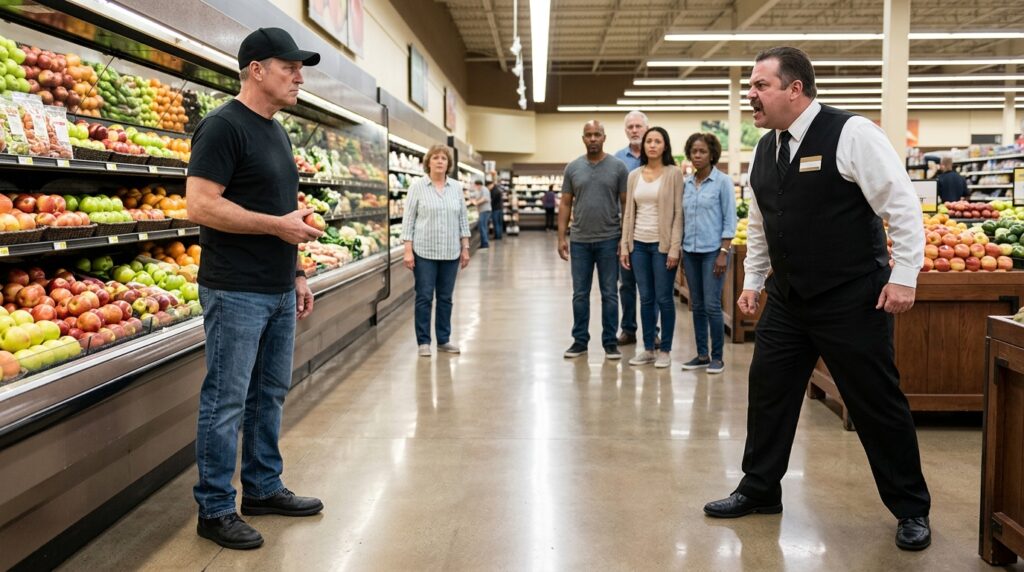
“You can’t stand here acting tough, get out of my aisle now!”
The words didn’t have the weight of a soldier’s command; they carried the thin, scratching rattle of a man whose salary depended on the neatness of cardboard displays. The store manager’s breath smelled of cheap chicory coffee and cold adrenaline. He was leaning too far forward, his polyester vest straining against a stocky torso, his name badge ticking like a loose valve against his white shirt.
John didn’t look at the face. He looked at the triangle between the collarbones—the soft target where the civilian structure lacked reinforcement. His right hand was still holding a single, unblemished Gala apple. The skin of the fruit was cool, coated in the micro-waxy film of industrial preservation.
The manager lunged. It was an awkward, uncoordinated surge born of small-scale authority and local panic.
The floor was polished concrete, desaturated gray under three thousand lumens of fluorescent light. When John pivoted, his boot didn’t slide; it bit into the salt and grit tracked in from the afternoon heat outside. The movement was small—four inches of lateral clearance—but it was enough to catch the manager’s forward momentum. John’s left palm took the man under the armpit, redirecting the mass with the flat, unfeeling geometry of an iron lever.
The manager went down hard. The impact was a wet, heavy thud that rattled the plastic dividers in the organic green section. A cascade of loose lemons broke free, rolling across the gray tile like oversized yellow dice.
At the end of the lane, three shoppers in faded denim froze. One woman had her fingers hooked into the plastic handle of a shopping cart; the small metal wheel on the left side kept spinning with a dry, rhythmic hiss. No one spoke. The silence was the thick, heavy kind that follows a tire blowout on an empty highway.
The manager didn’t stay down. His pride was too brittle for the concrete. He scrambled up, his hands grayed by floor dust, his mustache twitching with a wet smear of saliva near the corner of his wide mouth. He charged again, his arms swinging wide like a man trying to catch an animal in a pen.
John’s reaction was a reflex older than the store itself. He didn’t drop his center of gravity; he simply brought his hands up to the high-guard position, his shoulders absorbing the rattle of his sixty-year-old joints. He met the rush with two short, compact strikes to the ribs—the sound like someone beating an old rug with a wooden paddle—and followed through with a low, straight kick that caught the manager’s shin.
The energy collapsed. The manager fell backward, his boots sliding three feet through the spilled citrus before coming to a dead stop against the baseboard of the produce cooler.
John stood over the lane, his black cap tilted forward just enough to blur his eyes under the glare. His breath was level, a steady draw through the nose that kept his chest from rising too fast. He looked down at his right hand.
The apple was gone. It had split perfectly along the core during the second strike, its white flesh already turning a dry, rusted brown under the heavy lights.
Beside the manager’s hip, the plastic name badge lay face up. The clip had snapped off in the tumble, leaving a small gray tooth of metal stuck to the polyester vest, while the printed name itself was half-covered by the crushed skin of a rolling lemon.
John lifted his gaze from the floor, his attention settling on the frozen shoppers. One of them had a smartphone held flat against their chest, the black circle of the lens pointed directly at his belt.

CHAPTER 2: THE BACKROOM AUDIT
“Pick up the lemons, Miller.”
The voice came from the threshold of the employee-only corridor, flat and scrubbed of any regional accent. The man standing there wore a gray utility jacket that lacked a store logo but had the reinforced stitching of an executive protection detail. His skin was the color of skim milk, his fingers long and grease-free as he held open the swinging stainless-steel door.
John didn’t move from the center of Aisle 4. His boots remained planted in the grit, his center of gravity low, his eyes tracking the new arrival while keeping Miller—the manager—within his lower peripheral vision. Miller was still groaning against the baseboard, his hand clutching his ribs where John’s two compact strikes had turned the white polyester fabric into a bruised, wrinkled mess.
“I said pick them up,” the man in gray repeated, his eyes not once shifting toward John. He was looking exclusively at Miller’s broken form. “The corporate audit requires a clean floor state before the county transit units arrive. You know the metrics.”
Miller scrambled up with a wet gasp, his face a mottled plum color. He didn’t look at John either. The arrogance that had fueled his stride three minutes ago had vanished, replaced by a frantic, submissive haste that looked far more dangerous than his initial anger. He began grabbing the rolling lemons, his thick fingers shaking as he stuffed them back into the green plastic racks. As he bent over, a heavy, rubber-armored tablet shifted within the internal pocket of his black vest. It didn’t look like an inventory scanner; it was twice as thick, its screen dead-black but vibrating with the dull, persistent pulse of an encrypted data sync.
John watched the vibration through the frayed fabric of Miller’s vest pocket. “Who’s the transit unit?” John asked. His voice was low, the tone raspy from years of salt air and deliberate silence.
The man in gray finally looked at John. His eyes were small, pale, and entirely devoid of curiosity. “Loss prevention. We handle asset discrepancies within the suburban franchise sectors. You’ve exceeded your standard dwell time in this lane, sir. We need to clear the log.”
“The woman at the end of the aisle,” John said, his chin tilting toward the shopper with the smartphone. “She’s still recording.”
“She isn’t,” the gray-jacketed man said simply.
John looked past his shoulder. A second store employee, younger and wearing a blue utility apron, was already standing over the woman with the cart. He wasn’t reaching for her phone. He was holding a small, matte-black diagnostic wand—the kind used to test automated checkout frequencies—six inches from her purse. The screen of the woman’s phone flickered once, the green recording dot twisting into a gray line before the display died completely, leaving her staring at a blank sheet of Gorilla Glass with a look of confused, soft-jawed helplessness.
“Data scrub,” John muttered, his fingers tightening against the seams of his dark jeans. “That’s not retail policy.”
“Local compliance is changing,” the man in gray said, stepping forward until he was three feet from the split Gala apple John had dropped. He reached down, picked up the rusted half with two fingers, and tossed it into a gray waste bin attached to his belt. “Mr. Miller here has a tendency to over-correct when he encounters non-standard profiles in the aisles. But his instructions were clear. Create a disturbance, document the structural resistance, and clear the lane for the regional contract transition. You provided the resistance.”
Miller was on his feet now, his breath whistling through his nose, his hand pressed firmly against the heavy tablet vibrating in his vest. He looked like an animal that had successfully completed a trick but hadn’t been fed yet. “He attacked me,” Miller wheezed, his mustache twitching toward the gray-jacketed man. “I gave the verbal warning. It’s on the regional manifest. I told him to move.”
“You did your job, Miller. Go to the security cage and upload the incident log from the local unit,” the man in gray replied. His hand slipped into his own pocket, his knuckles forming a sharp angle under the fabric. “Sir, if you’ll follow me to the administrative office. We have a corporate release form that requires a physical signature before you leave the premises. It saves the county sheriff the trouble of an off-site filing.”
John didn’t answer. He looked at the floor between them—the gray concrete, the small white lines where the salt had dried into crusts, the broken plastic teeth of Miller’s name badge. Every instinct he had spent fifteen years burying was screaming that the gray jacket wasn’t local security. The man’s stance was too balanced, his weight distributed perfectly across his heels, his fingers positioned too close to his hip pocket where the outline of a compact nine-millimeter frame was visible only to someone who spent half a lifetime carrying one.
“I don’t sign corporate paper,” John said.
“This paper isn’t corporate, John,” the man said softly, using the name before John had ever produced an ID or spoken to anyone in the town. “It’s institutional. And the office is cooler than this aisle.”
John’s eyes locked onto the gray jacket’s collar. There was a small, three-digit number stamped onto the internal lining where the fabric had begun to fray from use—a contract identifier from a defense logistics firm that hadn’t existed on public record since the winter of 2018.
CHAPTER 3: THE DESATURATED ZONE
The automated glass doors parted with a stale, pressurized hiss that smelled of synthetic floor wax and hot refrigeration coils. John didn’t walk toward the administrative corridor. He went left, past the rows of inactive self-checkout stations, his strides measuring the distance to the perimeter with a fluid, animalistic economy that left the gray-jacketed man exactly two paces behind.
“The perimeter layout isn’t standard,” John said as his boots hit the external concrete.
The heat of the afternoon sun slammed down like a hot sheet of zinc. The parking lot was an expanse of desaturated blacktop, the white parking lines faded to a chalky, salt-rimmed gray. Near the edge of the property, far from the civilian sedans, sat a non-descript white utility van with heavy-duty commercial racks and darkened security glass.
“It doesn’t need to be standard,” the gray-jacketed man replied, his hands resting loose near his utility pockets as he maintained the spacing. “The suburban sectors are under-secured. Local law enforcement response times have degraded by forty percent since the municipality restructured the county tax margins. This property is ours to clean.”
John stopped at the fender of his old F-150. The paint was oxidized, a rough layer of industrial primer showing through the blue lacquer like dried skin. He didn’t reach for his keys. He looked across the roof of the truck toward the white van. Miller was already there, leaning against the side panel, his fingers frantically typing into the heavy rubber-clad tablet he had pulled from his vest pocket. The screen cast a blue, sickly glow across his thick mustache.
“You let him carry the transmitter,” John observed. His hand dropped onto the rusted latch of his truck door, the iron hot enough to leave an imprint against his calloused skin. “A civilian manager who over-corrects under minor spatial pressure. That’s a liability.”
“Miller is an implementation tool,” the man in gray said. He stopped near the front bumper, his weight shifted onto his heels, his eyes scanning the empty spaces between the vehicles. “The company requires a documented baseline of escalation before the private security contracts can legally override local municipal zoning. If a customer responds with defensive posture, the metrics validate the implementation. The board receives the threat assessment report, the insurance premium adjusts, and we deploy the tactical tier.”
John let out a dry, rattling breath through his teeth. It was the laugh of a man who recognized the corporate rebranding of an old operational dirty trick. “A manufactured hot-zone. You pick a target with a specific profile, tell Miller to push him until something breaks, and then use the recording to sell the town an armored response package.”
“It’s efficient,” the man said. “And the legal team clears it before the first fruit is stocked. You should sign the waiver, John. It registers your encounter as a standard civilian disturbance rather than an operational interference.”
“The woman’s phone,” John said, his knuckles whitening against the hot iron latch of the truck door. “The data wand your boy used didn’t just clear her local video cache. It used an active EMP pulse designed for short-range electronic suppression. That’s commercial logistics equipment, old tier-two hardware. It doesn’t belong in a suburban market lane.”
The man in gray didn’t blink. The small, desaturated lines around his eyes tightened, a subtle signal that the casual conversation had reached its structural boundary. “The hardware belongs to the asset protection firm that bought the franchise holding company three months ago. Everything is integrated now.”
John moved his thumb down onto the latch mechanism. The metal clicked—a sharp, distinct sound of worn gears slipping into place—but he didn’t pull the door open. Instead, his gaze caught a detail inside the utility van across the lane. Miller had turned to face them, and as he shifted his weight, the vehicle’s sun visor dropped a fraction under the vibration of the heavy sliding side door.
Clipped to the vinyl surface of the visor was a thick sheaf of legal paper, its edge marked by a vivid purple distribution bar. It wasn’t a standard corporate incident form or a county sheriff’s report. Even from twenty feet away, through the desaturated reflection of the heat waves, John’s eyes locked onto the exact layout of the header: a three-letter federal routing code followed by an eight-digit tracking sequence. It was an unredacted operational audit file from a naval logistics directory—the specific command that had decommissioned his own task force six years ago.
The realization hit him not as an intellectual discovery, but as a cold, heavy lump in his stomach. The store manager’s frantic escalation wasn’t a localized corporate strategy to sell security systems to a panicked suburb. It was a decoy layer. The entire scenario had been engineered to flush him out of his anonymity, to measure his response times, and to verify if the silent man in the black cap was the same operational asset whose records were currently being systematically scrubbed from the active registry.
“You’re checking the file,” John said softly, his voice dropping below the steady, dull hum of the store’s rooftop HVAC units.
The gray-jacketed man took a half-step back, his hand finally dipping completely inside his utility jacket, his fingers wrapping around an object that didn’t have the shape of a pen or a corporate badge. “The office is closed, John. We’re moving the administrative audit to the secondary facility now.”
Behind him, the sliding door of the white van groaned on its tracks as it began to open.
CHAPTER 4: THE LIQUIDATION MANIFEST
The white utility van didn’t sway on its springs when the sliding rail clicked. It moved with an oiled, pneumatic precision that spoke of heavy reinforcement—ballistic panels layered behind ordinary commercial tin.
John didn’t wait for the occupant to clear the frame. His right hand, still resting on the scorched iron latch of his F-150, pulled down with a short, single jerk. The truck door didn’t drop; it swung wide, its heavy rusted bottom edge striking the gray-jacketed man across the left forearm just as his fingers cleared the lining of his coat.
There was no shout. The impact was an unglamorous rattle of bone against old Detroit sheet metal. The man in gray went sideways, his heel catching an oil slick on the pitted asphalt, his balance fracturing just enough to draw his hand away from the concealed nine-millimeter frame.
“Miller, dump the log!” the man in gray hissed, his boots dragging through the dry dirt as he forced his center of gravity back over his knees.
Across the lane, Miller wasn’t looking at the truck. His face was gray under his dark side hair, his thick mustache slick with sweat as he punched a terminal command into the rubber-armored tablet. The screen flickered from deep blue to an industrial amber, a series of data strings cascading downward like oil slipping through a sieve. On the van’s visor, the thick document with the purple distribution bar caught the backdraft of the opening door, its pages fluttering to reveal a stamped corporate logo: Vanguard Logistics Systems. Beneath it, the secondary routing line read: Task Force Safeguard Audit – Non-Compliant Profile Resolution.
John didn’t pursue the man in gray. He didn’t check the spacing. He lunged across the radiator core of his truck, his fingers hooking into the open driver-side window of the white van before the passenger tier could deploy. His grip found the edge of the mounted dashboard console—the local security monitor that was tracking the store’s static-heavy security feed.
The display didn’t show Aisle 4. It didn’t show the rolling lemons or the stunned shoppers.
The screen was divided into three horizontal diagnostic lanes. The top lane was a real-time tracking grid indexing the exact spatial coordinates of his suburban bungalow three miles north. The second lane was a scanned copy of his thirty-year-old active-duty service record, the red “REDACTED” watermark digitally overridden by a green corporate clearance code. The third lane was a live, static-heavy dashcam feed from the regional transit vehicle that had been idling at the county intersection since noon—its manifest already designating his legal name as an unvouched domestic liability to be integrated upon local provocation.
The whole thing had been a ledger entry. The store manager’s brittle arrogance, the corporate security directive, the spilled fruit—they were simply the mechanical components of a targeted compliance audit designed to verify if his tactical reflexes were still functional enough to warrant immediate liquidation.
“The log is clear,” Miller wheezed from the rear fender. His voice was high, empty of the petty authority he had used to rule the produce aisle. “The sync is at one hundred percent. It’s routed to the central registry.”
The man in gray stood four feet away, his arm hanging slightly loose where the truck frame had caught him, but his right hand was steady now. The compact pistol was clear of the coat lining, its matte-black slide catching the desaturated glare of the afternoon sun. He didn’t point it at John’s chest; he kept it low, the muzzle indexed toward the gravel near John’s left boot.
“The local record is gone, John,” the man in gray said. The dry heat seemed to swallow the resonance of his voice, leaving only the flat, mechanical click of the pistol’s external safety dropping into place. “The town doesn’t have a file on Aisle 4. The shopper with the phone is currently being issued a corporate voucher for a device replacement. By five o’clock, you’re just an old man who had an uninsured medical episode in a parking lot.”
John looked at the static-heavy console, then down at the broken plastic name badge that had somehow remained caught in the tread of his dark boot. The white flesh of the broken apple on his floorboard had turned entirely black now, withered by the blistering temperature within the cab. His house was on the grid. His past was unredacted. The quiet life he had spent fifteen years building out of silence and routine had been dismantled by an automated inventory update.
“You should have signed the paper,” the man in gray whispered. “It would have kept the audit civilian.”
John didn’t reach for a weapon. He didn’t adjust his cap. He slowly stepped back from the van’s console, his boots crunching against the dry, salted asphalt as the shadow of the white vehicle stretched out to swallow his own. The sliding door behind him gave a final, heavy click as the secondary tier stepped onto the concrete.
CHAPTER 5: THE RETROGRADE TRACK
The F-150’s starter didn’t whine; it caught with a heavy, industrial cough that rattled the loose mounting bolts in the steering column. John threw the lever into reverse before the oil pressure needle could clear the red baseline. The transmission engaged with a sharp, metallic clunk that sent a shudder through the rusted floorboards, the rear tires spitting dry gravel against the white van’s ballistic bumper as he backed out of the slot.
The man in gray didn’t fire. He remained standing in the desaturated glare of the blacktop, his matte-black pistol still indexed toward the gravel, his pale eyes tracking the truck’s exit arc with the cold detachment of a surveyor recording a boundary line. Beside him, Miller was still hunched over the amber screen of the tablet, his thick mustache grayed by the dust kicked up from the spinning rubber.
John slammed the lever into drive, his boot burying the throttle pedal until the old V8 engine roared against its mounts. The truck lunged toward the northern exit lane, its oxidized blue hood slicing through the heat waves rising from the pitted asphalt.
In the rear-view mirror, the white utility van didn’t pursue immediately. Instead, its hazards flashed twice—a designated signaling sequence for the secondary transit units already positioned along the residential grid.
“Three miles,” John muttered. His voice was a flat rasp against the wind rushing through the unsealed window frame.
He didn’t look at the instrument cluster, but his eyes caught the small, unlit digital clock on the dashboard dashboard. The liquid crystal display was cracked, but a tiny, rhythmic pulse was visible in the lower corner—a low-frequency interference pattern that hadn’t been there when he drove into the parking lot. The transponder in the manager’s tablet had already pinned his vehicle’s signature to the regional manifest.
He turned right onto the perimeter road, bypassing the main commercial avenue for the residential bypass that skirted the drainage canal. The setting was transitioning from the corporate symmetry of the shopping plaza to the frayed edges of the suburban expansion—rows of identical two-story tract houses with sun-faded vinyl siding and parched front lawns that smelled of dry rye grass and municipal fertilizer.
The mirrors showed the white van had reached the intersection behind him, its speed regulated to match the suburban limit, maintaining a clean four-hundred-yard spacing that prevented a direct engagement while keeping his tailgate within its optical tracking array. They weren’t trying to run him off the road. They were driving him back toward his own address—shaping his retreat path until the tactical tier could secure the perimeter around his property line.
John reached down with his right hand, his fingers slipping beneath the worn foam of the passenger seat cushion until they hit the rough nylon webbing of an old tie-down strap. He didn’t pull it. He simply verified the tension.
The house at the end of the cul-de-sac was more than an anonymous retirement anchor; it was a containment vessel. The concrete foundations had been poured in forty-eight-hour blocks while the county records office was undergoing an automated digital migration in the winter of 2019. If Vanguard Logistics was auditing the defunct task force files, they knew the name on his mailbox, but they didn’t know what was cured into the aggregate six feet beneath his kitchen linoleum.
He glanced at the cracked side mirror. A second white vehicle, an identical utility model with commercial roof racks, had just cleared the canal bridge to the west, its front bumper pivoting smoothly into the lane behind the lead tracker. The box was closing.
John’s thumb pressed the manual lock button on the driver’s door, the mechanical latch dropping into the gray plastic frame with a final, unyielding click.
CHAPTER 6: THE SUBTERRANEAN BASELINE
The truck’s brakes groaned, a long metal-on-metal squeal that died the moment the rear bumper cleared the overgrown privet hedge blocking the cul-de-sac’s view. John didn’t kill the engine. He let the V8 idle, its rough vibration keeping the transponder signal pinned to a static location while he dropped out of the high cab, his boots sinking two inches into the sun-baked dust of the side yard.
The white utility van was already at the mouth of the cul-de-sac, its tires crunching onto the asphalt header, its headlights unlit but its chassis leveled by heavy payload springs. They were setting the cordon. He had precisely four minutes before the secondary vehicle closed the southern lane behind the wood-framed garage.
John didn’t go through the front door. He moved to the rear porch where the foundation concrete was exposed—a low, desaturated slab pockmarked by the aggregate he had mixed himself under the winter rain of 2019. The access hatch was hidden behind a rusted iron wood-box. He kicked the frame aside, the dry pine boards splitting with a loud snap, and reached into the dark cavity of the crawlspace.
The air inside smelled of damp lime and old lime-wash, cold and entirely insulated from the three-digit heat of the suburban afternoon. He slid in headfirst, his shoulder blades scraping the rough joists of the kitchen floor overhead. The linoleum above him gave a slight, familiar groan as the weight of his old home settled into his spine.
“Three blocks down,” he muttered, counting the pillars by touch.
His fingers, slick with grease from the truck latch, found the corner of the fourth structural support. It looked like solid poured masonry, but when his knuckles tapped the center, the sound wasn’t the flat thud of granite; it had the faint, hollow ring of reinforced plate.
The lock cylinder was a corroded zinc plug countersunk into the mortar joint. It had been salvaged from a scrap yard in a naval shipyard three hundred miles away, its internal pins worn down until they required a specific, double-turn sequence that only a heavy, notched brass key could actuate. John didn’t use a key. He pulled a short, four-inch length of hexagonal steel rod from his dark jeans pocket—the ground-down remnant of a structural bolt—and jammed it into the keyway.
He twisted with his whole wrist, his knuckles scraping the jagged edge of the concrete block until the skin split, leaving a dark, wet smear across the lime-wash. The cylinder gave—a heavy, rusted click that echoed through the narrow crawlspace like a pistol shot.
The front face of the block swung inward on an internal sleeve hinge. Inside the dry cavity sat a olive-drab transit case, its fiberglass skin scarred by old salt-water pitting and the black stencil of a logistics task force that had been officially disbanded before the turn of the decade. The latch mechanism was covered by a layer of yellowed cosmoline that smelled of heavy mineral oil and dead mechanics.
John dragged the box into the dirt between his knees. His breath was shallow now, his ribs aching from the compact strikes he had taken in Aisle 4. Overhead, the floorboards gave a sudden, sharp creak—not the natural expansion of wood under the heat, but the distinct, rhythmic press of a heavy boot crossing the kitchen threshold directly above his head.
They were inside the perimeter. The gray-jacketed man hadn’t waited for the legal waiver or the transit units; they had initiated the clearing protocol the moment his truck’s tires stopped rotating in the yard.
He popped the case’s primary latches. The fiberglass lid came away with a dry suction pop, exposing the grey foam lining. Inside lay a short-barreled carbine, its receiver finished in a matte gray parkerization that lacked any manufacturer markings or commercial serial numbers, and three aluminum magazines bound together by faded green sniper tape.
Beneath the weapon’s barrel, tucked into a small recess in the lower foam tier, sat a secondary object: a small, silver-plated data drive with a cracked glass display. The drive was active, its tiny red LED indicator blinking three times every six seconds—a self-contained transponder that was drawing power from an internal lithium cell that should have died five years ago.
John didn’t pick up the gun first. He reached for the drive, his thumb rubbing the cracked glass until the small digital manifest appeared through the dust. It wasn’t his service record. It was an active tracking manifest showing forty-seven identical profiles across seven suburban counties—all of them former members of the same naval task force, all of them currently flagged by Vanguard Logistics as inventory items scheduled for structural liquidation before the end of the fiscal quarter.
The store manager hadn’t been the hunter. He had been the sensor. And the file wasn’t an audit; it was a harvest log.
Overhead, the footsteps stopped directly above the foundation vault, followed by the dull, metallic click of a nine-millimeter slide chambering a round.
CHAPTER 7: THE CULMINATING LEDGER
The floorboard didn’t split upward; it collapsed downward in a shower of dry oak splinters and white plaster dust. The tactical boot that came through the ceiling of the crawlspace was heavy, reinforced with steel lace-plates that caught the dim light from John’s unshielded working bulb.
John didn’t slide backward. He rolled toward the concrete pier, his shoulder absorbing the impact of the gravel floor as his right hand drove the matte-gray receiver up into the gap. He didn’t look for a target profile. He tracked the silhouette of the knee joint through the dust, firing a single, unglamorous string of three rounds that sounded like a hammer hitting a sheet of corrugated roofing inside the narrow space.
The boot vanished. A heavy, armored torso struck the joists above with a dull groan, followed by the dry metallic slide of a weapon dropping onto the kitchen linoleum.
John scrambled out of the access hatch within three seconds, his cap gone, his gray hair coated in lime-wash. The kitchen was desaturated by the afternoon sun cutting through the grease-filmed window pane. On the floor by the sink, the secondary operator lay motionless, his gray utility jacket torn along the rib line where the low-velocity rounds had spent their kinetic force against his internal trauma plates.
Through the open rear door, the low-frequency hum of the white van’s engine was growing louder. A regional transit unit—an armored carrier with county municipal plates but Vanguard Logistics markings on the wheel hubs—had just cleared his driveway, its tires chewing through his parched lawn to block the southern escape route.
John didn’t reach for his truck keys. He stepped over the downed operator, his boots sticky with spilled chicory coffee from a mug that had shattered during the breach. His target was the operator’s wrist terminal—a hardened communication node that was still blinking with the amber light of the regional data sync.
The interface wasn’t a corporate security log. It was an unredacted tactical ledger.
The topmost data column displayed a map of the local county intersection, but the secondary node was anchored to an industrial coordinate three hundred miles east—the central archiving warehouse of the privatized defense firm that had absorbed his old unit’s logistics files. Below the map, a running text feed displayed a series of administrative actions dated within the last forty-eight hours.
The entry for Aisle 4 was already marked with a blue compliance check. Beneath it, a secondary line read: Target profile verified via mechanical response. Physical asset liquidation authorized under emergency suburban zoning variance.
But it was the next line that turned his grip on the terminal cold. It was a list of names—not forty-seven, but three hundred and twelve—all cross-indexed by their old naval task-force payroll numbers. The system wasn’t executing a regional security transition. The parent corporation had bought the supermarket chain, the local transit contracts, and the municipal zoning rights for the sole purpose of establishing a low-signature infrastructure to locate, test, and liquidate the surviving members of his specific task force before an impending congressional oversight audit could unseal the 2018 operational manifests.
The store manager, Miller, had been nothing more than a cheap tripwire. His manufactured rage in the produce aisle was the standard corporate protocol to trigger a defensive response that could be legally classified as civilian non-compliance, giving the tactical tier the authorization to clear the lane.
Outside, the heavy iron door of the transit carrier gave a sharp, pressurized click as the liquidation team stepped into the dry heat of the yard.
John didn’t drop the terminal. He jammed it into his dark jeans pocket, his fingers catching the rough nylon strap of the old tie-down webbing beneath the passenger seat of his memory. He looked around the kitchen—the faded counters, the small plastic clock on the wall that had stopped at noon, the desaturated white light reflecting off his own blood on the floorboard. The quiet life he had spent fifteen years building hadn’t been invaded by a corporate entity; it had been an inventory item on their balance sheet since the day he took the retirement voucher.
He gripped the matte-gray carbine with both hands, his thumb flicking the safety selector down through the grease and lime dust until it clicked against the lower stop. He didn’t look for an exit. He stepped toward the open threshold where the shadow of the carrier was already reaching across his porch.
CHAPTER 8: THE PORCH ENGAGEMENT
The screen door didn’t swing; it shattered inward as a heavy ballistic shield struck the lightweight aluminum frame. The impact threw a cloud of dry, gray cedar splinters across the kitchen linoleum, each shard catching the desaturated glare of the afternoon sun like tiny lead teeth.
John didn’t step back into the shadow of the pantry. He kept his boots planted in the spilled coffee and plaster dust, his weight thrown forward into the buttstock of the matte-gray carbine. He fired two rounds into the viewport of the shield—the distinct clack-clack of the muzzle blast swallowed instantly by the narrow confines of the rear entry. The reinforced laminate glass spiderwebbed into a milky, opaque disk, stalling the lead operator’s advance at the lip of the concrete step.
“Clear the lane!” a voice shouted from the yard, flat and mechanical over the low, rhythmic idle of the carrier’s diesel engine.
The second operator didn’t use the stairs. He came over the low railing of the porch, his gray utility jacket catching on a rusted nail head as he brought a short-frame weapon to bear on the window frame. John didn’t track the muzzle. He noticed the white plastic tag dangling from the operator’s tactical vest pocket—a warehouse inventory label printed with the exact same logistics task-force tracking manifest he had pulled from the store manager’s tablet.
John dropped his weight four inches, his shoulder checking the edge of the old oak refrigerator cabinet. The wooden panel split with a dry scream as three rounds from the porch tore through the thin tin backing, peppering the drywall behind him with white chalk. He didn’t return the fire toward the window. Instead, he reached down with his left hand, his fingers hooking into the heavy iron handle of the kitchen wood-stove.
He didn’t pull it to stoke the flame. He threw his whole torso against the cast-iron frame, sliding the hundred-pound block three feet across the slick linoleum until it jammed against the bottom edge of the swinging rear door, locking the ballistic shield into the doorframe.
The operator behind the shield grunted, his boots sliding through the grit on the porch as he tried to force the obstruction. In the gap between the door and the jamb, a tactical smoke canister dropped from his gloved fingers, rolling across the threshold until it clinked against John’s boot. It wasn’t standard civilian tear gas; the canister was finished in an olive-drab lacquer, its side stamped with a navy logistics lot number from his own deployment year—part of a surplus shipment that had been officially marked as destroyed during the 2018 decommissioning review.
The capsule hissed, a thick, white cloud of burning lithium and zinc filling the kitchen with a smell like scorched copper and wet sulfur.
John squinted through the gray haze, his eyes burning as he tracked the silhouette of the second operator clearing the window sill. The man’s boots hit the sink basin with a loud metallic ring. John didn’t overcommit; he brought the carbine’s barrel up in a short, vertical arc, catching the operator beneath the chin with the flat of the steel flash-hider before the short-frame weapon could level.
The impact was a wet, heavy click. The man toppled backward out of the window frame, his gray utility jacket billowing like a shroud as he struck the parched lawn below.
Through the white fog of the kitchen, the terminal in John’s pocket vibrated twice—a sharp, high-frequency alert indicating that the regional data sync had just initiated its secondary verification sweep. The countdown on the screen was down to eighteen minutes before the local unit’s asset tracking log would hard-lock into Vanguard’s central directory, pinning his coordinates to every tactical transit unit within forty miles.
He looked at the wood-stove blocking the door, the heavy concussions of the lead operator’s boots kicking against the cast-iron block from the exterior side. The house was no longer a baseline. It was a recorded target, and the perimeter was completely red.
John turned his back on the sink, his fingers adjusting the green sniper tape around his secondary magazine as he moved toward the narrow cellar stairs behind the hallway door.
CHAPTER 9: THE CONDUIT SEGMENT
The steel grate at the baseline of the cellar wall didn’t yield to a pry-bar; it gave way when John dropped his entire body weight into the rusted copper grounding line he had leveraged through the sleeve joints. The iron bars sheared with a dry, metallic crack that was instantly buried by the sound of the flash-bang canister detonating in the hallway directly above his head.
He slid down through the rupture, his boots splashing into six inches of stagnant sewer runoff that coated the concrete floor of the municipal overflow conduit. The air down here was a cold, dense soup of iron scale, old laundry soap, and the faint, sweet rot of marsh gas. He didn’t use a light. He kept his left hand hooked into the strap of the olive-drab transit case, his right fingers tracking the slick, slimy brickwork of the wall as he moved south toward the main drainage canal.
Behind him, the narrow light from the cellar window was cut in half by a gray silhouette. A tactical torch swept the water, its blue beam catching the white flakes of lime-wash peeling from his cap-less head.
“Transit log is active,” a voice rattled down the pipe, muffled by the thick masonry. “Target is in the infrastructure lane. Alert the perimeter vehicles to cover the junction at the wash.”
John didn’t quicken his stride. He maintained the long, rhythmic crawl-step he had learned in the tidal flats of the delta, his knees slightly bent to absorb the uneven texture of the silt-covered floor. Every hundred yards, the brickwork changed—transitioning from the hand-set clay of the old municipal core to the modern corrugated iron pipes of the suburban expansion. Each seam gave a low, hollow ring as the weight of the residential traffic passed over the asphalt three feet above his head.
The terminal in his jeans pocket gave three short, sharp vibrations against his hip. He didn’t pull it out until he reached the confluence point—a wider brick vault where the residential overflow spilled into the open concrete channel of the county canal. Under the dim gray light filtering through the iron street-level storm drain, he squinted at the amber screen.
The countdown had dropped to nine minutes.
The sync indicator was no longer tracing a straight line to the white utility van. It had branched into a regional network tree, its primary trunk rooted to a secondary server node located within the administrative office cage at the rear of the very supermarket where Miller had challenged him. The data wand used on the shopper’s phone hadn’t just scrubbed her local memory; it had established a localized network mask across the entire commercial block, turning Aisle 4 into a passive signal collector that was currently gathering every piece of unredacted metadata his tracking drive was emitting.
“They aren’t hunting the house,” John whispered, his breath leaving a faint frost on the silver-plated casing of the drive. “They’re using the house to drive the signal back to the store node.”
He looked at the utility map displayed on the terminal’s lower quadrant. The sewer line beneath his boots didn’t just circle the subdivision; its main collection branch ran straight under the northern freight lane of the plaza, terminating exactly twenty feet below the supermarket’s rear loading dock. The privatized defense firm hadn’t just integrated the security contract—they had mapped their tactical architecture onto the existing physical grid of the town.
To kill the tracking sync, he couldn’t run for the county line. The corporate manifest would simply update the transit units along his route. He had to carry the old task-force drive back into the store, through the very lane where the fruit was turning brown on the concrete, and terminate the network at its physical root.
He pulled the matte-gray carbine tighter into his armpit, his fingers checking the green tape on his spare magazine through the layer of cold black slime that had settled over his knuckles.
A hundred yards ahead, where the open canal cut through the parched rye grass of the community park, the sound of a diesel engine rose over the hum of the HVAC units. A white utility van had just climbed the gravel bank of the wash, its front wheels pivoting smoothly to block the tunnel exit, its unlit headlights staring into the dark mouth of the brick archway like two blind silver eyes.
John didn’t stop. He turned left, into the dark, narrow pipe that marked the intake line for the store’s commercial drainage system.
CHAPTER 10: THE ROOT COMPLIANCE
The corrugated iron intake pipe didn’t widen; it terminated at a heavy, bolted cast-iron sump flange directly beneath the supermarket’s northern freight lift. John didn’t waste time on the bolts. He drove theGrounding steel bar between the iron rim and the wet masonry of the shaft wall, throwing his shoulder into the lever until the rusted seal cracked with a wet, flat pop that smelled of sour milk and old cardboard pulp.
He hauled himself up into the grease-filmed dark of the elevator pit. Above him, through the gaps in the steel safety mesh, the dull, rhythmic thrum of the store’s primary electrical transformers rattled his teeth. The air was thick, suffocatingly hot, and saturated with the ozone sting of overloaded server stacks.
The countdown terminal in his pocket gave one long, continuous vibration that died instantly. Zero.
The screen didn’t go dark. It transitioned to a solid, desaturated white display with a single line of black text pulsing across the top: Sync Intercept Complete. Regional Ledger Locked.
John pulled himself through the trapdoor of the administrative floor, his boots leaving dark, oily streaks across the pristine gray linoleum of the back corridor. He was directly behind the security cage—a narrow, floor-to-ceiling vault enclosed by heavy wire mesh and locked behind a corporate security keypad. Inside, three columns of industrial processing blades were humming, their cooling fans exhausting a steady blast of parched, metallic air toward the low ceiling.
Miller wasn’t there. The office was empty, but a half-filled paper cup of cold chicory coffee sat on the edge of the desk, its surface skin wrinkling under the steady draft from the servers.
John walked to the primary terminal rack at the end of the aisle. He didn’t check the diagnostic screen; his eyes locked onto a physical, recessed cavity hidden behind the main circuit breaker box—a small, solid iron wall-safe that predated the store’s modern corporate renovation. The safe’s door was finished in a rough, desaturated zinc plating, its center stamped with the original, raised insignia of his defunct naval task force.
It wasn’t a standard corporate infrastructure node. The privatized defense firm hadn’t just built a data network over the town; they had repurposed his old unit’s forward tactical staging vault—the subterranean communications depot that had been buried beneath the regional logistics hub before the suburb was ever gridded out.
“The store was the cover,” John whispered, his hand catching the cold edge of the zinc door.
He jammed the silver-plated data drive into the safe’s secondary maintenance interface. The small red LED didn’t blink three times; it went solid, the cracked glass screen turning dark as the internal lithium cell finally discharged its final reserve into the store’s terminal architecture.
On the main processing rack, the columns of amber lights didn’t flicker; they dropped instantly to a dead, unblinking gray. The rhythmic hum of the cooling fans died with a long, wheezing rattle that left the back corridor entirely silent under the glare of the unshielded fluorescent tubes.
Through the glass panel of the rear security door, the parking lot was visible—a flat, desaturated sheet of asphalt under the late afternoon sun. The white utility van was still idling by the drainage canal, its hazards flashing, but the secondary transit carrier had stopped fifty feet from the curb, its pneumatic brake lines hissing as the automated network dropped the vehicle’s transmission into emergency lockdown mode.
The local ledger was dead. The three hundred and twelve profiles on the harvest manifest wouldn’t sync to the central directory; the unredacted files had been overwritten by the task force’s original, hard-coded decommissioning sequence—the digital self-destruction protocol he had carried in his crawlspace for six years.
John didn’t wait for the gray-jacketed man to clear the fence. He turned away from the dead servers, his fingers releasing the warm plastic grip of the matte-gray carbine, letting the weapon drop onto the linoleum with a heavy, metallic clink that echoed down the empty corridor. He adjusted the brim of his black cap, his boots slow and deliberate as he walked past the silent self-checkout lanes toward the front glass doors.
The produce aisle was still empty, the split Gala apple still sitting in the gray waste bin near the cooler wall, but the silence hanging over the lanes no longer felt like a containment vessel. It was just the ordinary, heavy stillness of a small town grocery store at five o’clock on a Wednesday afternoon.
John pushed through the automated doors, his face tightening as his skin hit the dry, natural heat of the exterior sidewalk. He didn’t look at the white van or the frozen transit carrier. He walked toward his truck, his strides steady, his mind entirely clear of the ledger as he reached into his pocket for his keys.







