
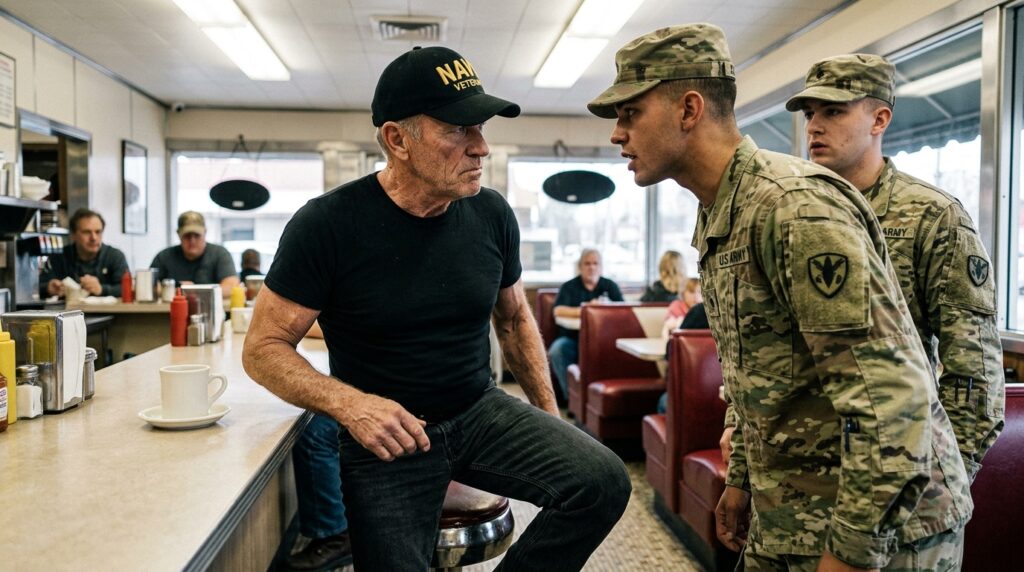
The Slow Decay of Quiet Men Facing the Rusted Edge of Tomorrow
CHAPTER 1: THE WEIGHT OF THE NAPKIN
The linoleum was the color of dried grease, cracked in long, branching veins where the foundation of the diner had settled into the dust.
Mac leaned heavily against the laminate counter, his knuckles white against the formica. His lungs burned—a dry, rasping heat that tasted of old copper and the cheap tobacco he’d quit twelve years ago. The young man on the floor wasn’t moving yet, just groaning through a broken nose, his camouflage blouse dark with spilled mud and lukewarm coffee. The other one was still wedged between the vinyl booths, eyes wide and tracking Mac with the stupid, slow surprise of a steer behind the stunning pen.
“Get up,” Mac said. His voice didn’t have the volume it used to, but it had the weight. It sounded like gravel shifting under a heavy boot.
The boy in the booth didn’t move. He just clutched his collarbone, where Mac’s palm strike had driven the clavicle down into the meat of his shoulder.
Mac didn’t look at the counter girl. He knew what she’d look like—staring from behind the pie case with her mouth open, the silver studs in her ears catching the yellow fluorescent light. He reached down with fingers that wouldn’t stop shaking and pinched a single paper napkin from the chrome dispenser. It was thin, cheap paper. It tore twice before he got it free.
He wiped a smear of grease from the back of his thumb—not his blood, but the grease from the primary aggressor’s hair where Mac had taken his head and introduced it to the edge of the napkin holder. The metal had made a sharp, clean tink sound. Like a firing pin dropping on an empty chamber.
“You’re deploying in three weeks,” Mac said, looking down at the one with the broken nose. He spoke to the grease stain on the boy’s shoulder template. “I know the patch. Third Battalion. You think you’re iron because they gave you a haircut and a pair of boots that don’t leak yet.”
He dropped the soiled napkin into the cold remnants of his hash browns. The porcelain plate was chipped at the rim, a grey line of raw clay showing through the white glaze.
“You don’t know the weight of it,” Mac muttered. He wasn’t looking at them anymore. He was looking at his own hands. The skin across his knuckles was translucent, spotted with the liver marks of a man who spent his mornings waiting for the sun to clear the highway pines just so he could feel the heat on his shins.
He reached into his pocket, his fingers searching for the brass compass. His thumb slid across the cracked glass face, feeling the tiny, frozen shudder of the needle underneath. It didn’t move. It hadn’t moved since the Mekong delta had filled the casing with silt fifty years ago. But the metal was warm from his thigh, and it kept his fingers from curling into a fist again.
The bell above the diner door didn’t ring, but the draft did. The smell of hot asphalt and diesel exhaust rolled over the threshold, cutting through the scent of burnt bacon.
A shadow fell across the checkered floor, long and narrow, stretching all the way to the base of the juke box. It wasn’t the sheriff. The sheriff drove a cruiser with a bad manifold that could be heard two miles down the ridge. This car had been silent.
Mac turned his head three inches. Through the grease-filmed window, parked right behind his rusted F-150, sat a black sedan with government plates and a thin coating of red clay dust along the rocker panels.
The man standing in the doorway wasn’t wearing a uniform, but he had the stance—the slight cant of the hips to clear a sidearm, the eyes that checked the corners before they checked the bodies. He looked at the two soldiers on the floor, then at Mac.
He didn’t look surprised. He looked like a man who had just found a missing receipt.
“The unit thought you died in San Diego, Mac,” the man said. He reached inside his coat, his hand disappearing into the dark lining. “But the supply logs for this county have been short three crates of ordnance since ninety-four. We finally found the leak.”

CHAPTER 2: THE STAINS OF THE STATE LINE
“You always did have an eye for inventory, Miller,” Mac said. He didn’t turn his body to face the doorway. Instead, he took a slow, deliberate sip of his lukewarm coffee, letting the bitter taste sit on the back of his tongue like iron slag. The heat of the mug was the only solid thing left in the room.
The man in the suit—Miller—didn’t flinch at the name. He stepped further into the diner, his leather-soled shoes making a dry, scratching sound against the grit on the floorboards. The draft from the open door carried the unmistakable smell of sun-baked pine and the sulfurous rot of the nearby salt flats.
“The Colonel doesn’t like loose ends, Mac. Especially not the kind that leave three crates of heavy hardware sitting in a barn behind a tractor that hasn’t run since the Bush administration,” Miller replied. His voice was flat, dried out by years of reading manifests in windowless offices. He didn’t look at the two active-duty soldiers groaning on the floor. To him, they were just spilled oil on a garage floor—an inconvenience to be cleared away.
“Those crates were empty when I hauled them across the state line,” Mac said. He finally set the mug down. The porcelain base scraped against the formica with a small, grating shriek. “They were filled with gravel and scrap iron to balance the manifest weight. You know it. The Colonel knows it.”
“The paper says otherwise,” Miller said. He reached into his breast pocket and pulled out a small, yellowed slip of carbon paper. The edges were frayed and soft from years of handling, the purple ink faded to a faint, bruised smudge. He laid it on the counter right next to Mac’s grease-stained napkin. “And in our line of work, the paper outlives the man.”
Mac looked down at the slip. His eyes didn’t track the numbers—he knew them by heart—but his gaze locked on the bottom corner. There was a thumbprint there, dark and rusted into the fiber of the paper. It wasn’t ink. It was the hydraulic fluid from the crane they’d used to load the sealed containers back in Subic Bay before the world turned over.
The micro-mystery wasn’t the paper, though. It was the mud on Miller’s shoes. It was the same thick, iron-red clay that coated the rocker panels of the sedan outside. This wasn’t the gray silt of the local riverbed or the pale sand of the highway expansion. It was the deep, bloody clay from the southern valley—the area around the old tactical storage depot that had been decommissioned and welded shut back in the late nineties.
Miller hadn’t come from the regional headquarters up north. He had been down in the dirt, digging through the old foundations.
“The boys were a nice touch,” Mac murmured, nodding toward the soldier who was currently trying to wipe the blood from his mouth with a sleeve. “A bit loud, though. You used to use professionals.”
“They aren’t mine,” Miller said, and for the first time, a small crack appeared in his gray mask. His eyes flicked to the diner window, scanning the shimmering heat waves rising off the highway asphalt. “They’re Third Battalion. Local boys out on a weekend pass from the fort. They just happened to be looking for a fight, and I happened to tell them an old man at the counter was talking trash about their deployment.”
Mac leaned back, his spine popping with a dry, wooden sound. “A decoy.”
“A gauge,” Miller corrected. “The Colonel wanted to see if your hands were still steady. If you could still drop a man without looking him in the eye. They are. So now we can talk about the real problem.”
Mac’s hand remained deep in his pocket, his thumb tracing the cracked glass of the rusted compass. He could feel the friction of the metal casing, the tiny ridges of corrosion that had eaten into the brass over fifty years of damp storage. The needle inside remained dead, locked toward a horizon that didn’t exist anymore. But the weight of it kept him anchored while the air in the diner grew thick with the smell of old frying oil and impending rain.
“I don’t have anything left to say to the Colonel,” Mac said. His voice dropped an octave, the gravel hardening into flint. “I took my retirement in the woods. I don’t draw a pension, and I don’t look at the news. That was the trade.”
“The trade changed when the storage depot down in the valley went up for private auction last Tuesday,” Miller said. He leaned down, his face inches from Mac’s profile. The smell of peppermint gum and stale coffee came off him. “The buyers found the false floor in the logistics office, Mac. The ledger isn’t there. The one with the signatures for the asset liquidation.”
Mac didn’t move a muscle, but inside, the gears of his mind shifted with a cold, heavy clunk. The ledger. That was the decoy Miller was dangling. They thought he had taken the paper trail that proved the Colonel had been selling off surplus communication arrays to foreign syndicates. They thought he was holding a knife to their throats from his cabin in the pines.
But Mac knew the real truth—a truth so heavy it had kept him silent for thirty years. The ledger wasn’t a list of equipment. It was a roster of names. Names of men who had been left behind in the gray zones of the map so the budget lines would balance out to zero.
“I don’t have your book, Miller,” Mac said softly. He stood up, his height forcing the younger man to take a half-step back to clear his perimeter. The movement was old, practiced, and entirely devoid of heat. “And if I did, it would have been ash before the turn of the century.”
“We’re going to have to verify that,” Miller said. He didn’t draw a weapon, but his hand stayed tucked inside his coat, his fingers locked on something heavy and dark. Outside, the sky was turning the color of an old zinc tub, the first heavy drops of summer rain hitting the hot roof with the sound of falling gravel. “The Colonel’s waiting at the crossroads. You can come in the sedan, or we can let the local sheriff handle the assault charges for these two boys. Either way, you’re leaving the diner.”
Mac looked past Miller’s shoulder, out through the scratched glass of the door. The red clay on the sedan’s wheels was beginning to run, dissolving into long, pink streaks under the downpour, exposing the pitted, gray steel beneath the illusion of travel.
“The sheriff won’t come,” Mac said, his hand tightening around the brass compass until the metal bit into his palm. “His manifold finally gave out ten minutes ago. I heard it pass my ridge before I came down here.”
He took a step forward, his boot coming down inches from the fingers of the soldier on the floor.
CHAPTER 3: THE COLD NORTH BRASS
The rain didn’t fall so much as it drilled into the cedar shakes of the cabin roof, filling the small room with a constant, drumming vibration that rattled the loose glass in the western window frame. Mac sat at the oilcloth table, the yellow light of a kerosene lamp throwing his long, angular shadow against the exposed pine logs behind him. The air smelled of woodsmoke, damp wool, and the bitter tang of gun oil.
On the table laid the brass pocket compass.
His truck was parked three miles down the loggers’ grade, hidden beneath an overgrowth of wild blackberry brambles. He had walked the rest of the way in the dark, his boots sinking three inches into the rotten leaf mold with every step. Miller’s sedan hadn’t followed him up the ridge—the heavy frame of the government car wasn’t built for old fire roads—but Mac knew the clock was ticking. Men like Miller didn’t lose a trail because of a little mud. They simply looked harder at the map.
Mac picked up a small jeweler’s screwdriver, its rusted steel shaft thin as a darning needle. His right hand was steady now, the tremor from the diner gone, replaced by the rigid, familiar paralysis of situational focus. He jammed the blade into the hinge of the compass casing.
The metal groaned. It was old marine brass, pitted by sea salt and dark with thirty years of human sweat. He applied pressure, his thumb whitening against the tool. With a sharp, dry snap, the internal mounting ring popped free.
The needle didn’t float. It dropped into the palm of his hand like a dead insect.
Mac leaned closer to the flame of the lamp, his eyes narrowing. Underneath the painted dial face, where the tiny iron pivot should have been brazed directly to the casing, there was something else. A circle of green fiberglass, no wider than a nickel, etched with copper lines that caught the lamplight like a spider’s web. It was a transmitter. Not modern—not the cellular tracking units the deputies used—but an old military beacon, the kind they used to drop from transall transports to mark supply zones in the canopy.
And there, wedged deep into the rusted hinge pin to act as an antenna grounding wire, was a tiny strip of gold-plated alloy. It wasn’t standard military hardware. It was commercial grade, precision-cut, the kind used in high-end medical equipment or corporate mainframes before the tech sector went global.
Mac picked up the gold strip with the tip of his knife. It didn’t belong to the army. It belonged to the builders.
“Thirty years,” Mac whispered into the empty room. The sound of his own voice was dry, like dead leaves scraping across stones.
The compass hadn’t stopped working because of Mekong silt. It had been gutted before it was ever handed to him. The unit had known his exact coordinates every morning he sat on his porch, every afternoon he walked down to the creek to check his crawfish traps. His exile hadn’t been a quiet agreement between old soldiers; it had been a penned pasture. The fence had just been too wide for him to see the wire.
The floorboard behind him groaned. It wasn’t the wind. The wind made the cabin creak from the rafters down. This was a localized weight, a ninety-pound shift on the third joist from the door.
Mac didn’t turn around. He didn’t reach for the Winchester leaning against the woodbox. He kept his eyes on the green disk on the table.
“You’re late, Sheriff,” Mac said.
“The manifold didn’t give out, Mac,” a voice replied from the dark near the woodstove. It wasn’t the local sheriff’s booming drawl. It was soft, reedy, and accompanied by the distinct clicking of a wet raincoat being unbuttoned. “I just took the belt off the fan so you’d think I was stranded. I needed you to come up here alone. Miller’s people are checking the motels along the interstate, but they’ll be at the gate by dawn.”
Mac looked at the reflection in the window glass. The man standing there was small, his hair gray and thinning, his uniform trousers soaked through at the knees. Deputy Vance. The one who spent his days checking hunting licenses and delivering court summonses for unpaid property taxes.
“You’ve got red mud on your cuffs, Vance,” Mac said, his thumb flicking the gold alloy strip into the palm of his hand. “The kind from the valley depot.”
Vance stepped into the light of the lamp. He didn’t have his sidearm drawn, but his hand was resting on the leather flap of his holster, his fingers tapping a nervous, erratic rhythm against the brass snap. “The Colonel’s moving the inventory out of the lower vaults tonight, Mac. All of it. The buyers from the coast brought their own trucks. They aren’t waiting for the auction paperwork to clear.”
“What’s that got to do with me?” Mac asked. “I told Miller I don’t have the book.”
“They don’t want the book, you old fool,” Vance said, his voice rising slightly before he checked himself, his eyes darting toward the door. “They want the clearance code. The one stamped into the frame of the logistics terminal before the concrete was poured over the access shaft. You’re the only officer left alive who signed the sealing order.”
Mac turned his head slowly, his eyes locking onto the deputy’s pale face. The decoy secret—the ledger Miller had been chasing—was just smoke. The real prize was the physical hardware underneath the mountain, the deep-site assets that were never meant to see the sun again.
“The Colonel told you that?” Mac asked.
“He said if I brought you in, I’d get my name back on the active service registry,” Vance said, his hand finally gripping the butt of his revolver. His knuckles were raw from the cold rain. “I’m tired of writing tickets for broken tail-lights, Mac. I spent twenty years in the service to end up as a county clerk with a tin badge.”
Mac looked down at the dead compass on the oilcloth. The rusted brass housing seemed smaller now, less like a relic of his youth and more like a lock that had finally been picked.
“The Colonel lied to you, boy,” Mac said softly. “The active registry was shredded in ninety-eight. There’s nothing to go back to.”
He didn’t wait for the deputy to process the words. Mac’s left hand caught the edge of the oilcloth table and flipped it upward, sending the kerosene lamp and the heavy oak top directly into Vance’s chest as the room plunged into absolute blackness.
CHAPTER 4: THE GRINDING OF THE GEARS
The kerosene lamp shattered against the log wall with a dull, hollow thud. The flame died instantly as the fuel spread thin across the damp timber, leaving only the choking, chemical stench of smoking wick and wet soot. In the absolute dark, the sound of the oak table hitting Deputy Vance was wet and heavy—a sudden crunch of synthetic raincoat and the sharp exhalation of compressed lungs.
Mac didn’t slide toward the doorway. The door was the first space an amateur would lock his eyes on. Instead, he dropped his weight, his old knees popping like dry pine twigs under the strain, and rolled toward the iron woodstove. His fingertips scraped across the floorboards, tracking the rough, splintered wood until they brushed the cold, pitted zinc of the floor plate.
A heavy metallic click echoed from the center of the room. Vance was scrambling up, his boots slipping on the oilcloth. The dry rattle of a revolver cylinder spinning in the dark was too fast, too desperate.
“Mac!” Vance rasped. His breath was ragged, coming in shallow, whistling gasps. “Don’t do this. There are three more cars coming up from the state line. Miller didn’t come alone. They’ve already closed the road at the creek bridge!”
Mac didn’t answer. He used the Sovereign Protector’s economy of motion—no sound, no breath, no heat. His right hand reached behind the woodbox and found the iron poker. The handle was cold, rusted rough along the grip where the condensation from the logs had eaten into the metal over three winters. It had a blunt, hook-edged tip meant for turning heavy oak splits.
A flash of orange light tore through the blackness. The revolver report was deafening inside the small cabin, a flat, concussive slap that blew the smell of burnt gunpowder straight into Mac’s face. The bullet punched through the pine logs two feet above his head, showering the back of his neck with dry wood shrapnel.
Vance was firing at the sound of his own movement.
Mac rose from the floor behind the woodstove like a shadow separating from the wall. He didn’t swing the iron poker like a club. He used it as an extension of his forearm, driving the blunt tip forward in a short, linear thrust. The iron bit into the meat of Vance’s forearm. There was a sharp, clicking impact as the metal struck the deputy’s gun hand, followed by the heavy clatter of the revolver dropping onto the zinc plate.
Before Vance could scream, Mac’s left hand caught the slick nylon of the deputy’s collar, twisting it tight until the whistle in the younger man’s throat turned into a dry gurgle. He dragged him down, slamming his back against the side of the iron stove. The structure gave a low, metallic ring that vibrated through the floorboards.
“You said three cars,” Mac whispered, his mouth inches from Vance’s ear. The smell of the deputy’s terror was sharp—sour sweat and the synthetic tang of mint throat lozenges. “Who’s in the lead vehicle?”
“Miller…” Vance choked out, his fingers clawing at Mac’s iron grip on his collar. “Miller and the engineers from the rail yard. They brought the acetylene kits. They don’t need your signature anymore, Mac. They just wanted to make sure you were accounted for before they cut the vault door.”
Mac let go of the collar. Vance slid down the side of the stove, his knees shaking as he clutched his bruised forearm.
In the dark, Mac reached into the deputy’s open raincoat. His fingers didn’t check for a wallet or a badge. They searched the inner utility pockets until they hit something cold, rigid, and heavy. He pulled it free. It wasn’t a standard law enforcement tool. It was a thick, rectangular industrial key card made of zinc-plated composite, heavy enough to sink a fishing line. By the faint grey light filtering through the rain-slicked window, Mac could see a seven-digit code stamped directly into the metal face: 714-B-09.
The clearance code wasn’t stamped into the concrete of the vault frame down in the valley. It was already out. The Colonel hadn’t sent Miller to find a code; they already had the keys to the warehouse. They were here to sanitize the valley of the only witness who knew exactly what—and who—was supposed to be inside those sealed logistics containers.
“The rail yard,” Mac said, the realization settling into his gut like a cold stone. “They aren’t cutting the vault in the valley. They’ve already moved the containers to the old junction.”
“They’re loading them onto the midnight freight,” Vance whispered, his voice cracking. “The whole site is being cleared. If you go down there, Mac, you’re a dead man. There are eight operators from the old logistics cadre at the switch-house. They have the perimeter locked down with thermal scopes.”
Mac didn’t reply. He walked over to the overturned table, his boots stepping over the broken glass of the lamp without a sound. He picked up the dead brass compass and the tiny gold-plated circuit strip from the floor, pocketing them beside the zinc key card. The weight in his trousers was heavy now—the physical remnants of a life he had tried to bury beneath thirty years of pine needles and silence.
He reached down, grabbed his Winchester from the woodbox, and checked the lever action by feel. The mechanical click of the brass carrier lifting a round into the chamber was smooth, the only piece of machinery in his life that didn’t feel rusted through.
“Stay on the floor, Vance,” Mac said toward the shadow by the stove. “If I see your headlights in my mirror when I down the ridge, I won’t use the poker.”
He stepped out into the downpour. The rain hit his face like needles, cold and clean, washing away the smell of the soot. The valley below was an abyss of black timber, but three miles south, where the abandoned rail yard cut a gray scar through the hills, a single cluster of halogen lights cut through the storm like yellow teeth.
The decoy was finished. The confrontation wasn’t about his survival anymore; it was about the ledger of names currently sitting in a steel container on a rusted flatcar, waiting to be wiped from the world’s inventory. He strode toward his truck, his boots sinking deep into the mud of the fire road, driving himself straight into the escalation.
CHAPTER 5: THE LAST JUNCTION
The iron ribs of the abandoned switch-house groaned as the wind sheared off the ridge, driving sheets of rain through the shattered window panes. Mac lay prone on the rusted steel grating of the elevated catwalk, his cheek pressed against the rough, flaking iron scale. The metal tasted of cold rust and ancient oil. Below him, the diesel engine of the midnight freight idled with a heavy, rhythmic thrum that vibrated straight through his collarbone.
The halogen floods illuminated the yard in high-contrast slashes of yellow and black. Miller stood near the open door of the third flatcar, his gray suit dark with rainwater, his face masked by the rim of a dripping umbrella held by one of his operators. Two men in slickers were using an acetylene torch on a secondary security housing, the blue hiss of the flame throwing long, erratic shadows across the gravel ballast.
Mac shifted the Winchester, its stock cold against his shoulder. He adjusted his grip, his thumb sliding across the receiver where the gray finish had worn down to raw, silver steel. He didn’t have thermal optics, but he had thirty years of knowing exactly how shadows moved across this specific track layout.
“Get that seal off!” Miller’s voice cut through the thrum of the engine, thin and sharp. “The main line dispatcher isn’t going to hold the signal block for more than ten minutes.”
The torch hissed louder, a shower of white-hot sparks bouncing off the wet iron frame of the flatcar. With a heavy, metallic clunk, the outer lock plate fell into the mud. The operators dragged the heavy sliding door open.
Inside the dark square of the car sat three olive-drab shipping containers. They weren’t filled with surplus communication arrays or crated ordnance. As the yellow floodlights hit the interior, Mac saw the stenciled lettering on the sides of the steel hulls: PERSONNEL RECOVERY – DIVISIONAL ARCHIVE – REGION 4.
Mac’s breath caught in his throat, a dry rasp that burned his lungs. The ledger wasn’t a list of hardware Miller wanted to liquidate. It was the containers themselves. They were the physical dead-file repositories of the men who had been crossed off the payrolls during the ninety-four restructuring—men who had been left behind in foreign holding areas so the black-budget balances would show a perfect zero to the oversight committees. The Colonel wasn’t selling weapons; he was selling the silence of an entire generation of abandoned personnel records to a private security syndicate that needed clean identities for its gray-market operators.
He looked down at his own hand, still holding the zinc key card 714-B-09 he’d taken from Vance. His number wasn’t a logistics code. It was a section block in the graveyard.
“Miller!” Mac called out. His voice didn’t carry loud, but it had the hollow, metallic resonance of an iron pipe striking concrete. It cut straight through the engine idle.
The operators moved with professional efficiency, three muzzles snapping toward the catwalk before the sound had even faded from the rafters. A burst of automatic fire tore through the corrugated siding above Mac’s head, the sharp spat-spat-spat of high-velocity rounds tearing through the decayed zinc sheets like paper.
Mac didn’t squeeze the trigger from the catwalk. He slid backward, his boots finding the iron ladder rail by feel, dropping six feet onto the gravel below as another volley chewed the steel grating where he’d been lying. The impact jarred his lower back, a sharp, white-hot line of pain flaring through his hips. He didn’t slow down. He used the Sovereign Protector’s knowledge of the terrain, weaving between the rusted wheels of a string of decommissioned ore cars, his silhouette swallowed by the desaturated gray margins of the yard.
He came out from beneath the shadow of a water tender twenty feet from the flatcar. Miller was already backing toward the sedan, his eyes wide, his gray mask entirely gone.
“Mac!” Miller shouted, his hand pulling a compact automatic from his coat. “It’s over, Mac! The manifest is already signed off by the state office! You’re an unlisted variable! You don’t exist on the books anymore!”
“Then I don’t have anything to lose by clearing the inventory,” Mac said.
He leveled the Winchester. Time dilated, turning the scene into a slow-motion landscape of flaking iron and falling water. He saw the individual drops of rain shattering against the hot barrel of his rifle. He saw the exact millisecond Miller’s operator adjusted his stance to clear his field of fire.
Mac squeezed. The rifle barked—a sharp, flat crack that had no echo in the downpour. The operator’s knee buckled as the round took him in the joint, his weight collapsing into the red clay mud between the ties.
Before the second man could swing his weapon, Mac was already moving forward, using the heavy steel frame of the ore car as a shield. He didn’t look for a secondary target. He drove the zinc card into the slot of the main container’s electronic release box on the flatcar. The unit gave a low, grinding click of internal gears turning against decades of rust. The heavy latch threw itself back with the sound of an axe striking a wet log.
Inside the lip of the steel door, welded directly to the interior reinforcement rib, was a corroded silver identification tag. Mac’s thumb ran across the raised lettering in the dark. It didn’t hold a serial number for a generator or a radio. It held his own name, misspelled in the way the navy clerks always did, stamped right above the date he was supposed to have crossed the border in ninety-four.
He was looking at his own coffin.
A headlight flared behind the switch-house—the bright, twin beams of an unmarked vehicle clearing the ridge road. The sound of a heavy V8 engine roared down the grade, its manifold pristine, its speed unchecked by the mud. The Colonel’s secondary unit had arrived, and they weren’t here to negotiate an asset recovery. They were here to bury the yard.
Mac didn’t look back at Miller, who was currently scrambling into the passenger seat of the black sedan as it sprayed gravel, its tires spinning in the red clay before finding traction on the ballast. Mac grabbed the handle of the container door, his body weight pulling the heavy steel shut until the lock clicked home again, sealing the dead back into the dark.
He turned toward the tree line, his Winchester held low against his thigh, his hand searching for the dead brass compass in his pocket. His exile was completely broken. The town wasn’t a refuge anymore; it was a grid coordinate that had been illuminated by a foreign light. He had to move before the cars cleared the switch-house perimeter, heading toward the deeper, unmapped gray of the state line where the paper trail couldn’t follow.
CHAPTER 6: THE BLACK WATER LINE
The truck didn’t die with a roar; it gave a low, liquid cough as the swamp water finally reached the air intake. The engine sputtered once, the dashboard lights flickering like dying fireflies behind the scratched plastic lens, and then the cabin went entirely dark. The sudden silence was heavy, broken only by the rhythmic tick-tick-tick of cooling iron and the relentless drumming of the storm against the cab’s dented roof.
Mac sat in the dark, his hands still wrapped around the cracked vinyl of the steering wheel. The water was already rising through the floorboards, cold and thick with the smell of rotting vegetation and ancient tannic acid. It soaked into the cuffs of his trousers, a heavy, dead weight that tasted of the marsh line.
He didn’t try the ignition again. A man who understands machinery knows when the metal has surrendered to the element.
Through the rear window, the swamp was a gray maze of drowned cedar trunks, their branches hung with long, ghostly beards of moss that caught the occasional sweep of a high-beam headlight two miles back on the ridge. The Colonel’s pursuit units were still on the high ground, their heavy utility vehicles moving with a slow, mechanical caution along the logging grades. They had the numbers, but they didn’t have the clearance for the deep mire. They were waiting for him to stall out.
Mac reached into the passenger seat and pulled his Winchester from its canvas scabbard. The oil on the receiver felt slick against his wet palm, a thin barrier against the moisture that was trying to claim every exposed surface. He tucked the stock under his arm and reached down into the flooded floorboards to retrieve his small canvas kit bag.
Inside, beneath a spare set of wool socks that were already damp, his fingers found a secondary object he’d pulled from Vance’s patrol vehicle—a waterlogged leather map case. The leather was soft, almost spongy from the rain, its brass snaps green with verdigris. As he dragged it into the dim gray light of the windshield, he noticed a tiny discrepancy: a single unpunched copper eyelet near the bottom seam. It wasn’t an air vent. When he pressed his thumbnail against it, the metal didn’t give. It was a solid plug of lead, sealing a compartment that the county logistics office had never listed on the inventory manifest.
He didn’t have time to pick the seal. Not here, with the water graying around his shins.
Mac pushed the truck door open against the resistance of the rising bog. The hinge gave a loud, metallic shriek—the sound of unlubricated iron tearing at its own pin—before the swamp swallowed the noise. He stepped out into the black water, his boots sinking six inches into the soft, treacherous peat before hitting the solid corduroy of an old loggers’ road buried forty years ago beneath the moss.
The cold hit him like a physical blow, a sharp ache that traveled from his ankles straight up into his lower back. His joints felt like rusted gears being forced to turn without grease. He canted his head, his ears tuning out the sound of the rain to catch the specific pitch of the marsh.
To the east, a mile through the dense canopy, the high-pitched whine of a light-bore diesel engine was cutting through the timber. They weren’t using the trucks anymore. They had unloaded the tracked swamp-buggies from the flatbeds at the crossroads.
Mac didn’t run. A man his age doesn’t run through a flooded cedar swamp if he intends to have enough breath left to use his rifle at the end of the line. He moved with a heavy, rhythmic stride, his boots finding the submerged logs of the corduroy road by the sheer memory of how this valley had been shaped before the state dammed the lower fork.
He looked down at his left hand, his thumb unconsciously rubbing the gold-plated circuit strip inside his pocket. The gold was smooth, a sterile, manufactured surface that felt entirely foreign against the rough, flaking skin of his knuckles. It was a fragment of the system that had marked him for deletion—a system that didn’t care about the mud or the thirty years he’d spent trying to wash the salt out of his eyes.
The shadow of a massive, dead cypress rose before him like an iron pillar, its bark stripped away by decades of lightning strikes, leaving only the pale, petrified wood beneath. At its base, hidden within the hollow of the root flare, sat an old iron survey marker—a rusted spike driven into the limestone bedrock back when the state border was first surveyed.
Mac stopped, his breath coming in short, controlled plumes of white mist. He laid the Winchester across a dry root ridge and pulled out the zinc key card. The seven-digit code 714-B-09 seemed to pulse in the gray dark, the numbers a direct link to the containers back at the junction.
The tracked buggy was closer now, the sound of its steel cleats clanking against the submerged stones like a hammer striking an anvil. The headlights were cutting through the cedar needles, long, white fingers of light that turned the swamp water into a sheet of silver glass.
They weren’t looking for a trail. The transmitter inside his dead compass—the one he’d left on the dashboard of his stalled truck—had given them his terminus. They thought he was still in the cab, waiting out the storm like an old man who had run out of road.
Mac reached down and wedged the lead-sealed map case into a crevice between the iron marker and the petrified root. He didn’t take the map with him. He needed the weight of the paper to stay right here, at the exact intersection where the law of the county ended and the gray margin of the state line began.
He picked up his rifle, his thumb resting on the cold hammer, and stepped backward into the deeper black of the channel as the first yellow searchlight washed over the hood of his abandoned truck.







