Chapter 1: The Sound of Breaking Wood
The first fence panel exploded into splinters at 2:17 on a Tuesday afternoon.
Seventy-four-year-old Walter Bennett heard the crack from his kitchen, where he had been washing the same blue coffee mug his late wife had given him for their fortieth anniversary. At first, he thought a large branch had fallen. Then came the grinding roar of a diesel engine, followed by another terrible crack.
Walter set down the mug and hurried toward the front window.
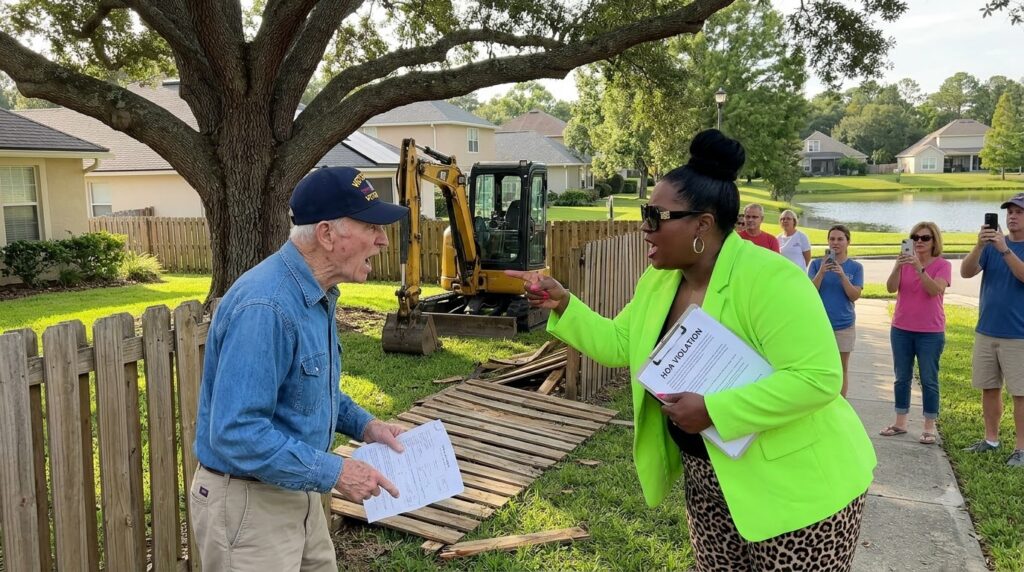
A yellow excavator stood in his yard.
Its steel bucket had torn through the cedar privacy fence that separated his property from the street. Broken boards lay scattered across the grass. A section of fencing that Walter had built with his own hands twenty-three years earlier hung crookedly from a surviving post.
Behind the destruction stood his oak tree.
It was enormous now, with a trunk nearly four feet across and branches spreading over the lawn like protective arms. Walter and his wife, Margaret, had planted it thirty-eight years earlier, shortly after moving into their lakeside home in Georgia.
Margaret had been gone for six years.
The tree was still there.
And someone was about to destroy it.
Walter pushed through the front door so quickly that he nearly forgot his cane.
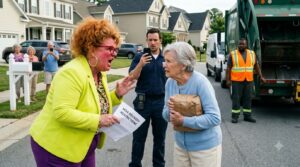
Standing beside the excavator was Patricia Whitmore, the fifty-six-year-old president of the Willow Creek Lakeside Homeowners Association.
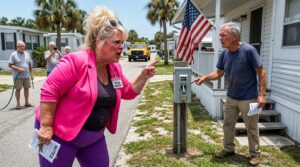
Patricia was an imposing woman with a large frame, towering jet-black hair piled into a high bun, oversized purple sunglasses, and a neon-green blazer stretched tightly across her shoulders. Her leopard-print trousers and heavy silver jewelry made her impossible to miss.
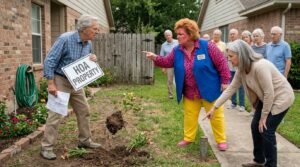
She held a white clipboard marked HOA LANDSCAPING VIOLATION.
With one hand, she pointed at Walter’s oak tree. With the other, she slapped the clipboard against her palm.
“Rip it out! I don’t care whose property it is!”
The excavator operator, a bearded construction worker named Daniel Price, hesitated.
Walter stumbled down his porch steps.
“Stop! My dead wife planted that tree! Get off my property!”
Daniel immediately stopped the machine.
Five neighbors had gathered along the sidewalk. Three were recording with their phones. Mrs. Eleanor Hayes, a retired schoolteacher who lived two doors down, stood with one hand pressed against her mouth.
Walter crossed the damaged section of his lawn, holding a folded property survey.
“This is my land,” he said, struggling to control his breathing.
Patricia stepped toward him and pressed her clipboard against his chest.
Walter did not move.
For thirty-one years, he had served in the United States Army, retiring as a command sergeant major. He had stood in places far more frightening than his own front yard.
But he had never imagined needing to defend his wife’s tree from a neighbor.
Patricia turned toward her enormous white house across the street.
Its second-floor balcony faced the lake, but Walter’s oak blocked part of the view.
“Your dead wife isn’t my problem!” she screamed. “You’re blocking my million-dollar view!”
For a moment, nobody spoke.
Even the excavator seemed unusually quiet.
Walter looked past Patricia toward the tree. A small wooden birdhouse hung from one of its lower branches. Margaret had painted it yellow during the final spring before her diagnosis.
He remembered her standing beneath those branches, laughing because a stubborn bluebird refused to enter the little house.
Now Patricia was talking about Margaret as though she were an inconvenience.
Walter slowly lowered the survey.
“You’ve made a terrible mistake,” he said.
Patricia laughed.
She told him the HOA had authorized the removal and that he would receive a bill for the work.
Then she ordered Daniel to restart the excavator.
Daniel refused.
He climbed down from the cab, removed his hard hat, and examined the broken fence.
“I was told this was association property,” he said.
Walter handed him the survey.
Daniel studied the boundary lines. His expression changed.
Patricia snatched the document away and waved it dismissively.
“That map is outdated.”
But Daniel had already seen enough.
The excavator remained still.
Patricia pulled out her phone and threatened to call the construction company’s owner.
Walter watched her make the call while his neighbors continued recording.
He felt a deep, familiar ache in his chest—not the sharp pain of illness, but the quiet emptiness that had followed Margaret’s death.
She had loved that tree.
She had watered it through two terrible summers, wrapped its young trunk against winter frost, and measured its growth against their children’s heights.
Walter had promised her he would take care of it.
He had kept that promise through cancer treatments, hospital visits, and six lonely winters.
He intended to keep it now.
When Patricia finally marched back across the street, Walter stood among the broken fence boards.
Daniel approached him quietly.
“Sir, I’m sorry. I didn’t know.”
Walter nodded.
Then Daniel said something that made him look up.
“The work order didn’t come from the HOA office.”
Walter frowned.
Daniel reached into his truck and retrieved a folded sheet of paper.
“It came directly from Mrs. Whitmore. And according to this, the association already paid a twelve-thousand-dollar deposit.”
Walter stared at the document.
The destruction of his fence was no longer just a dispute over property.
Someone had used association money to finance it.
And Walter had a feeling the broken boards on his lawn were only the beginning.