Chapter 1: The Chair in the Water
The folding chair scraped across the wooden pier with a sound that made Walter Bennett turn before he understood what was happening.
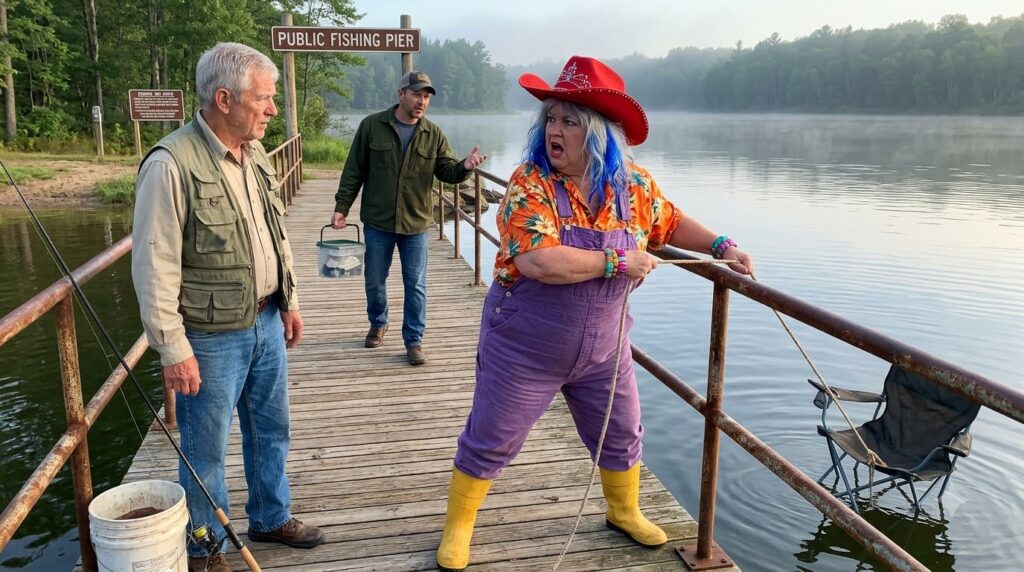
At sixty-eight, Walter had spent enough mornings fishing Wisconsin lakes to recognize trouble when it came. But he had never expected to see a woman in a rhinestone cowboy hat dragging his chair toward the water with a rope.
“Your spot belongs to boat owners!”
The woman shouted as she pulled with both hands.
She was enormous, dressed in a bright orange tropical shirt beneath purple denim overalls, with yellow rubber boots planted against the weathered planks. Silver-gray hair streaked electric blue spilled beneath her oversized red hat. Colorful bracelets clattered against her wrists.
Walter caught the chair just as its front legs reached the edge.
“Then why does the sign say public?”
He pointed toward the entrance, where a wooden sign clearly read PUBLIC FISHING PIER.
The woman barely glanced at it.
Instead, she leaned backward and pulled harder.
Walter felt the chair twisting beneath his hands. His fishing rod stood against the railing a few feet away, its line extending into the still morning water. As the chair lurched sideways, one of its metal legs struck the railing and sent the rod wobbling.
Walter released his grip to catch the rod.
That was all the woman needed.
She gave another furious yank.
The chair skidded across the planks, struck the edge, tipped sideways, and disappeared into the lake with a tremendous splash.
Water erupted against the pier supports.
The woman stumbled backward, still gripping the rope.
For several seconds, nobody moved.
Walter stared at his chair floating upside down beside the pier. The blue canvas seat was soaking up water, and one aluminum leg had bent where it struck the railing.
The woman stared too, apparently surprised that pulling something toward the lake had actually sent it into the lake.
Then footsteps sounded behind them.
A man in a dark green jacket approached carrying a plastic tackle bucket. He was about forty-five, with a baseball cap pulled low over his forehead.
He looked at the floating chair.
Then at the rope.
Then at the woman.
“You paying for that chair?”
The question hung in the morning air.
The woman’s face turned a deep, furious red.
“Absolutely not! That man was trespassing!”
The newcomer looked past her at the public pier sign.
Walter recognized him immediately.
Daniel Mercer had been fishing this lake since he was a teenager. His father had taught him to cast from these same planks, back when the pier was little more than a narrow platform with a rusty railing.
Daniel set down his bucket.
“Walter,” he said quietly, “what happened?”
Walter took a slow breath.
“She decided I wasn’t allowed to fish here.”
The woman stepped between them.
“My name is Patricia Whitcomb. My family owns a boat at the marina, and I know exactly who belongs on this dock.”
Daniel studied her.
He had seen her before.
Patricia had recently begun appearing at the nearby private marina, loudly introducing herself as a representative of the boat owners. She drove a spotless white SUV and frequently complained about visitors using the public parking area.
Until that morning, Daniel had considered her an irritation.
Now Walter’s chair was floating in the lake.
Patricia pointed toward the water.
“That chair was blocking access. I was removing an obstruction.”
Walter looked at the empty pier around them.
There was enough room for several people to walk past without difficulty.
His chair had been tucked beside the railing, exactly where he had placed it for nearly twenty years.
It was not expensive.
The aluminum frame had been repaired twice, and the blue canvas had faded almost gray. One armrest was wrapped with black electrical tape.
But Walter’s late wife, Ellen, had given him that chair for Father’s Day seventeen years earlier.
She had stitched his initials into the backrest herself.
He had brought it to the lake every Saturday after her death.
Patricia could not have known any of that.
Walter realized that she probably would not have cared.
Daniel stepped toward the railing and reached for the rope.
“Let’s get it out before it sinks.”
Patricia jerked the rope away.
“Don’t touch my property!”
Daniel stopped.
“Your property?”
“The rope is mine.”
Walter stared at her.
His chair was in the water, attached to her rope, and she was arguing about ownership.
Daniel reached into his jacket pocket and took out his phone.
He photographed the chair, the rope, the damaged railing, and the sign at the entrance.
Patricia noticed immediately.
“You cannot photograph me without permission!”
Daniel lowered the phone.
“We’re standing on a public pier.”
Something changed in Patricia’s expression.
For the first time, she seemed less angry than concerned.
Her eyes moved toward the parking lot.
A white SUV was parked near the marina gate.
On its rear window was a large gold decal:
LAKEVIEW PROPERTY OWNERS ASSOCIATION.
Walter followed her gaze.
And suddenly, he wondered whether this confrontation was about more than one fishing chair.