
Chapter 1: The Garage That Wasn’t Hers
The blue bicycle hit the concrete driveway with a violent metallic crash.
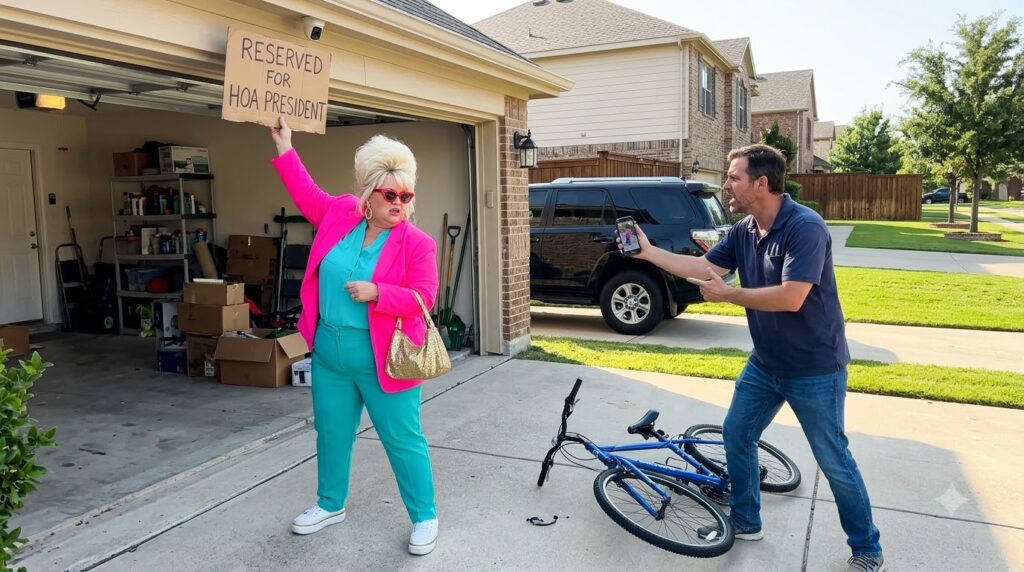
Its handlebars twisted sideways, the front wheel spinning helplessly as a woman in a neon-pink blazer dragged the rest of it out of the garage.
“HOA authority! This garage is reserved!”
Karen Whitmore, the 56-year-old president of the Oakridge Estates Homeowners Association, planted a homemade sign beside the garage entrance. The sign, painted in bold black letters, announced:
RESERVED FOR HOA PRESIDENT
Behind her sat a large black SUV, its engine still running.
The garage belonged to Daniel Mercer.
And Daniel had never given Karen permission to enter it.
He came running from the sidewalk, where he had been unloading supplies from his pickup truck. At 41, Daniel was a broad-shouldered electrician with short dark-brown hair, light stubble, and the tired expression of a man who had spent too many years working overtime.
He wore a faded navy work polo, jeans, and worn sneakers. His hands were rough from twenty years of electrical work, but they trembled when he saw his bicycle lying on the driveway.
It had belonged to his father.
Daniel’s father, Robert Mercer, had died eighteen months earlier after a long struggle with heart disease. The blue touring bicycle was one of the few possessions Daniel had kept exactly as his father left it.
Now its front wheel was bent.
Daniel lifted it carefully, checking the frame for damage.
Karen stood in front of the garage, her enormous platinum-blonde bouffant glowing in the afternoon sunlight. Her red cat-eye sunglasses, gold hoop earrings, turquoise blouse, bright teal trousers, and glittering handbag made her impossible to overlook.
She pointed toward the open garage.
According to Karen, Daniel’s two-car garage was being improperly used for storage. She had decided that the association president deserved access to unused parking space.
Her own garage, she explained, was filled with furniture, seasonal decorations, and boxes from a decorating business she had operated years earlier.
Daniel’s garage was closer to the neighborhood entrance.
It was also conveniently empty of cars.
Therefore, Karen had decided to use it.
Daniel stared at her.
He had lived in Oakridge Estates for eleven years. He had paid every association assessment, maintained his property, and never received a serious violation notice.
His garage contained tools, gardening equipment, household storage shelves, cardboard boxes, and his father’s bicycle.
Nothing about it belonged to the homeowners association.
Karen stepped forward, blocking the entrance.
She insisted that the board had granted her temporary parking privileges.
Daniel knew that was impossible.
He had attended the last board meeting.
No such proposal had been discussed.
Then he remembered the camera.
Mounted above the garage door was a small security camera connected to a recording system inside his house. Daniel had installed it after several packages disappeared from neighboring porches.
He pulled out his phone and opened the security application.
The recording was already there.
Karen entering his garage.
Karen grabbing his father’s bicycle.
Karen dragging it across the concrete.
Karen throwing it outside.
Daniel turned the screen toward her.
“You’re trespassing! I’ve got it on camera!”
For the first time, Karen stopped talking.
Her expression changed from smug satisfaction to alarm.
She looked at the phone, then toward the camera mounted above the garage.
Without another word, she grabbed her reservation sign.
She raised it above her head and pressed it directly against the camera lens.
The sign covered the camera’s view.
Karen appeared satisfied.
Daniel could hardly believe what he was watching.
The recording had already been saved.
And the camera had captured her attempting to hide what she had done.
Across the street, a neighbor named Evelyn Brooks stood on her front porch holding a watering can.
Evelyn was 68, a retired elementary school principal who had lived in Oakridge Estates since the neighborhood was built.
She had seen the bicycle hit the driveway.
She had heard Karen claim authority over Daniel’s garage.
And she had quietly begun recording the confrontation on her own phone.
Daniel lowered his damaged bicycle onto the grass.
He told Karen to leave his property.
She refused.
Instead, she threatened him with HOA fines, legal expenses, and disciplinary action for interfering with association business.
Daniel took a slow breath.
He had spent years avoiding neighborhood politics because he believed most disputes could be resolved through patience.
But patience did not mean surrender.
He called the police nonemergency number and reported an unauthorized person inside his garage who was refusing to leave.
Karen laughed when she heard him give the address.
She claimed she knew people at City Hall.
Then she climbed into her SUV, shut off the engine, and waited.
Twenty minutes later, a patrol vehicle turned onto the street.
Karen stepped out of her SUV wearing the confident smile of someone expecting the police to take her side.
What she did not know was that Daniel’s security camera had recorded something else.
Something that would turn a ridiculous parking dispute into a much larger investigation.








