Chapter 1: “You Don’t Get the Whole Sidewalk”
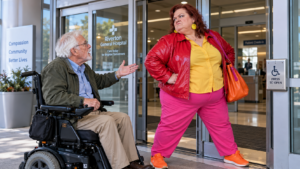
The front wheels of Harold Bennett’s mobility chair rolled toward the striped access lane and stopped so suddenly that the small grocery bag hanging from its side swung forward.
Karen stood directly in his path.
Not beside the lane.
Not near it.
In the middle of it.
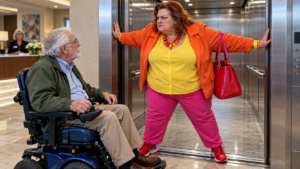
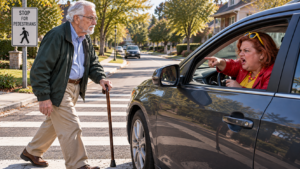
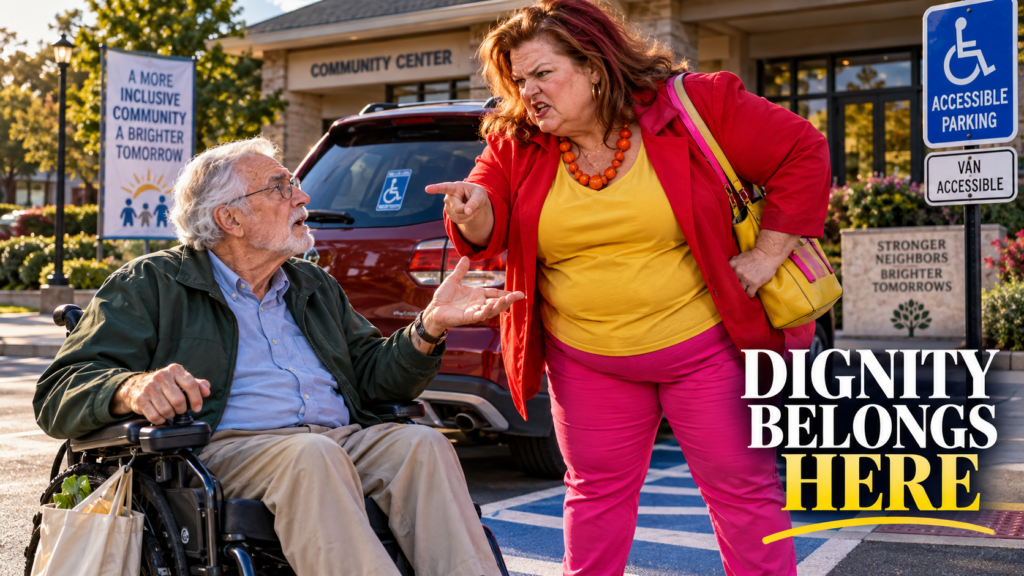
Her bright cherry-red jacket, yellow blouse, hot-pink trousers, and orange sneakers made her impossible to miss. She had parked her large crossover SUV in the accessible parking space beside the clubhouse, and now she had planted herself across the striped access aisle as though she owned that patch of pavement too.
Harold pressed the brake controls.
Click.
The chair stopped inches from her shoes.
Karen looked down at him with a crooked smile.
“Are you seriously blocking my access too?” Harold asked.
Karen folded her arms.
“Yes,” she said. “Because you don’t get to turn every empty space into your personal driveway.”
Harold stared at her for a moment.
He was seventy-eight years old, and he had learned over the years that some arguments became worse when fed with anger. He pointed toward the painted stripes beside him.
“This isn’t a parking spot. It’s the access lane for my chair.”
Karen gave a short laugh.
“Then go around.”
There was nowhere to go around.
Her SUV occupied the accessible space. Her body occupied the access aisle. The curb ramp was on the other side of her.
Harold slowly looked past her toward the sidewalk.
“Ma’am, just step aside.”
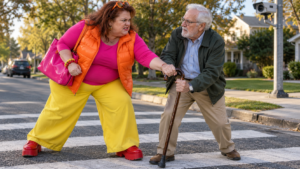
Instead, Karen moved closer.
Harold tried to angle his chair around the front of her SUV.
Karen noticed immediately.
She stepped sideways.
Blocked him again.
Harold stopped.
“You’re following me just to block me.”
“I’m teaching you something,” Karen replied. “Access doesn’t mean entitlement.”
Harold’s jaw tightened.
He had not come to the community clubhouse to argue. He had come to pick up groceries and attend a short meeting with the homeowners’ association about repairs to several aging sidewalks.
He tried once more to find an opening.
Karen shifted with him.
It was no longer an accident.
It was deliberate.
Then Harold noticed something through the windshield of her SUV.
A blue accessible parking placard rested on the dashboard.
He looked at it.
Then at Karen.
“You have an accessible placard?”
Karen’s smile disappeared.
“Don’t you dare question me.”
Harold pointed toward the placard, then toward the access aisle.
“Then you know exactly what this lane is for.”
Karen’s face hardened.
“I know exactly what it’s for—and it doesn’t give you permission to demand anything from me.”
Harold slowly moved forward.
His front wheels stopped just inches from her orange sneakers.
He did not touch her.
He simply held his position.
“You’re the one standing in my way.”
Karen looked down at the chair.
Then at Harold.
Her eyes narrowed.
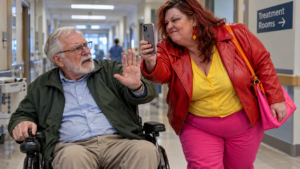
“If you can maneuver that chair well enough to chase me around this parking lot,” she said coldly, “maybe the problem isn’t access. Maybe you just expect everyone to serve you.”
For a second, neither moved.
Harold felt something heavier than anger settle in his chest.
It wasn’t the insult.
It was the casualness of it.
The assumption that his need for access was an inconvenience created by him.
He looked at the painted stripes beneath his wheels.
Then he looked at Karen.
“I’ll wait,” he said quietly.
Karen smirked.
She thought that meant she had won.
She had no idea how long Harold was willing to wait.
And she had no idea who was about to walk through the clubhouse doors.