The Line We Draw: When Suburban Rule Enforcers Meet the Cold Steel of Real Proof
CHAPTER 1: THE WEIGHT OF A BARRICADE
The front bumper of Brenda Albright’s wire shopping cart slammed into the metal display rack with the sharp, hollow crack of stressed steel, wedging three feet of chrome directly across the exit corridor.
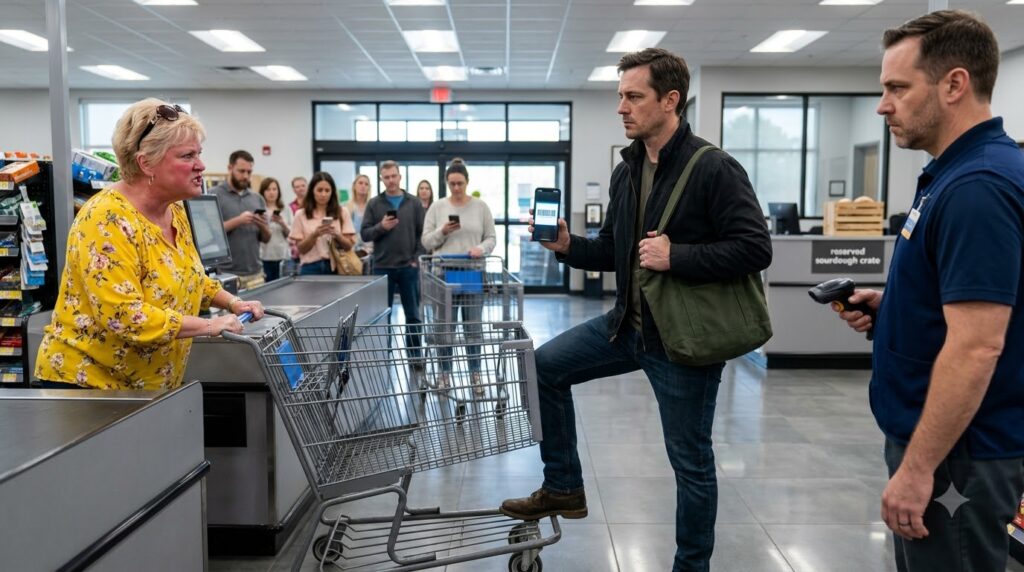
“He didn’t pay for that heavy iron skillet in his bag!” Brenda’s voice cut straight through the hum of the weekend rush, sharp as shattered glass against the polished terrazzo floor. She planted both palms on the cart’s handlebar, her knuckles turning chalk-white under the harsh overhead fluorescent grids. Her bright yellow floral blouse practically vibrated against the drab gray linoleum, her oversized sunglasses perched like a plastic crown in her short, sprayed hair. “I watched him bypass register three while the girl was looking down! Don’t let him walk out those doors!”
Marcus Holloway stopped two inches short of the cart’s wire mesh. The heavy canvas strap of his dark green tote pressed firmly into his shoulder, the thick cast-iron Dutch oven resting like an anchor against his hip. He didn’t jump. He didn’t reach for the bag. He simply shifted his boots on the tile, letting his breath settle into a steady, measured rhythm.
Around them, the rhythmic beep-beep-beep of register scanners stuttered to a sudden halt. Cashiers froze mid-reach. Two shoppers at register four, their arms weighed down with cereal boxes and gallon jugs, turned slowly. Phones rose in quiet, practiced unison across the checkout line.
“My receipt is already cleared on the monitor right behind you, Brenda,” Marcus said. His voice was low, flat, and stripped of heat. He tapped the glowing screen of his phone once, keeping his wrist level. “Move the cart.”
Brenda let out a short, barked laugh that carried no humor. She didn’t budge; instead, she leaned her full weight against the handle, forcing the rubber wheels to grind against the floor and seal the gap completely against the register divider. “You think you can just wave a screen around and walk out?” She gestured wildly with a French-manicured index finger, pointing straight at his chest. “I know how people like you operate. You pretend to scan, you pretend to pay, and then you act like you belong here. Security is on their way, young man. You aren’t taking another step.”
Marcus looked at her finger, then at the thick steel bar of the cart blocking his path. He felt the familiar, old tightness in the back of his neck—the quiet friction of living in a world where standing still was always read as suspicious if you didn’t smile enough. But he didn’t raise his hands in surrender, and he didn’t pull back. He let his thumb rest against the brass buckle of his canvas strap, feeling the cold, scratched metal under his skin.
“The register chimed green two minutes ago,” Marcus said, his eyes locking onto hers with a calm that seemed to irritate her more than a shouted insult ever could. “Check the screen, or step aside before you make this harder than it needs to be.”
Brenda’s chin jerked upward. “I’m not checking anything. I know what I saw.”
Across the narrow aisle, Cashier Elena hovered behind register three, her face pale as she looked between Marcus’s phone and Brenda’s rigid back. A murmur rustled through the five people stuck behind Marcus’s shoulder, a mix of impatience and cautious speculation. Nobody stepped in. Nobody moved to clear the steel bar. The air in the front corridor grew heavy with the smell of floor wax and stale coffee, stretched taut like a wire pulled just past its limit.
Marcus didn’t turn around. He kept his eyes fixed on Brenda’s face, waiting for the sound he knew was coming from down the central aisle.

CHAPTER 2: THE FRICTION OF THE FLOOR
The rubber tread on the cart’s front wheels groaned against the terrazzo tile as Brenda wedged her shoulder harder against the register divider. The scent of her artificial lavender perfume hit Marcus first—sharp, cloying, and altogether fighting against the heavy smell of floor wax and stale coffee that hung near the front doors.
“You think playing quiet makes you look innocent, don’t you?” Brenda’s voice pitched higher, deliberately reaching for the ears of the three people now queuing up behind register four. “I’ve lived in Cedar Falls for twenty-two years. I know every face that comes through this market, and I know when someone’s trying to slip something past the scanner.”
Marcus didn’t shift his feet. He felt the cold iron weight of the Dutch oven inside his canvas tote, its iron handle pressing a dull, familiar ache into the side of his thigh. He kept his right hand loose at his side, thumb lightly tracing the scratched brass buckle of his strap.
“You’re blocking an exit, Mrs. Albright,” Marcus said. His voice was a flat, low rasp, calculated to stay well beneath the frequency of panic. “And you’re making a scene for an audience that just wants to pay for their groceries and go home.”
“I am protecting this store!” she barked, her hands tightening on the cart’s handlebar until the plastic grips squeaked. “Elena!” she called out, swinging her head toward register three. “Tell him. Tell him you didn’t scan that skillet in his bag!”
Behind the plastic splash-guard, Cashier Elena shrank back an inch, her fingers hovering over the register’s gray rubber keys like she was holding a hot wire. She looked at Brenda’s flushed, floral-clad shoulders, then at Marcus’s quiet, unblinking posture. “I… Mrs. Albright, I was processing the coupon stack for Mr. Henderson when he passed the endcap. I didn’t see—”
“See?” Brenda snapped back to Marcus, her chin thrusting forward like a blade. A folded strip of thermal register paper stuck out from the top pocket of her yellow blouse, the thermal ink already turning faint gray in the fluorescent glare. “She didn’t scan it. Which means that pot in your bag is unpaid property.”
A tall man in a faded flannel shirt two registers over stopped placing his milk cartons on the belt. He leaned over his cart, eyes shifting between Marcus’s dark jacket and the steel grid of Brenda’s barrier. A woman with a toddler in her arms took two steps back, pulling her child away from the aisle mouth as if the tension might snap physically into the open air.
Marcus didn’t argue with Elena, nor did he offer his phone screen to Brenda a second time. He knew the mechanics of a public trap; the moment you start waving proof at someone who isn’t looking for facts, you’re just providing them with fresh wood for the fire. Instead, he took one slow step closer to the front bumper of her cart—not an aggressive surge, but a deliberate encroachment on her personal boundary.
“You have three options, Brenda,” Marcus said softly, his voice carrying straight over the metal wire mesh between them. “You can pull this cart back six inches and let me walk out. You can ask Elena to look at her terminal screen right now. Or you can stand here until Assistant Manager Vance-Kemp walks around that corner.”
Brenda’s eyelids flicked once at the mention of the manager’s name, a micro-reaction that didn’t escape Marcus. But rather than stepping back, her lip curled into a thin, tight line. She reached into her blouse pocket, her French-manicured nails rustling against the paper, and whipped out the folded thermal receipt.
“Oh, David will come,” Brenda sneered, snapping the receipt open with a sharp clack of her fingernails. “And when he gets here, I’m going to show him this. I bought a cast-iron skillet at register one twenty minutes ago, Mr. Holloway. Exact same model as the one sitting in your bag. And I know for a fact there were only two on the floor display.”
She thrust the paper within three inches of Marcus’s nose, the dark thermal print blurred by her trembling hand. “You didn’t just bypass the register. You took the tag off my duplicate item or you swapped bags while the clerk had her back turned. I’ve got the paper proof right here. So tell me—whose pot is in that canvas tote?”
The air around register three went entirely brittle. The murmurs from the crowd died instantly as people leaned in to process the sudden shift in the claim. A tag swap. A pre-planned switch.
Marcus stared at the jagged print on the slip of paper waved before his face. His eyes didn’t track the total or the item code; instead, his gaze dropped to the bottom corner of the receipt, where a faint, stamped red ink mark read: SPECIAL ORDER – BAKERY / COUNTER HOLD.
He didn’t pull back. He let the quiet stretch out between them until the faint sound of dress shoes squeaking against the wet tile near the customer service desk signaled that Manager David was finally approaching.
CHAPTER 3: THE DECOY ON THERMAL PAPER
The squeak of leather soles against wet tile grew distinct as Assistant Manager David Vance-Kemp rounded the corner of register two. He wore a dark blue uniform vest zipped over a crisp white shirt, a sleek black inventory scanner strapped to his right palm with a thick elastic band.
“What’s the hold-up at three?” David asked. His voice was practiced—flat, efficient, born of ten years dealing with spilled milk, broken glass, and coupon disputes. He took in the scene with a single sweeping glance: Brenda wedged sideways against her cart, her manicured hand holding the thermal receipt like a weapon; Marcus standing motionless, heavy canvas tote resting against his hip; and the six-deep queue of impatient customers craning their necks.
“David! Thank God,” Brenda blurted before David could even stop moving. She smoothed the front of her yellow floral blouse with her free hand, her posture instantly shifting from aggressive barricade to aggrieved defender of store order. “I caught this man attempting to walk out with unpaid merchandise. When I confronted him, he tried to intimidate me into moving my cart.”
David didn’t react to her drama. He turned his head toward Cashier Elena. “Elena?”
“I… I didn’t see him scan the item, David,” Elena stammered, her hands gripping the edge of her rubber register counter. “I was processing Mr. Henderson’s digital coupons. But Mr. Holloway tapped his phone at the quick-scan terminal right after.”
“He tapped his phone to fake a scan,” Brenda interrupted, stepping forward until her knee pressed against the front grate of her cart. “Look at this receipt, David. I bought the exact same cast-iron skillet at register one twenty minutes ago. There were only two on the floor shelf. He didn’t just bypass the lane—he swapped the barcode tags off my item or switched the bags when the shelf was being restocked! The proof is right here in my hand.”
She thrust the thermal paper toward David’s face.
David took the paper, his thumb covering the lower corner as he scanned the line items. “A cast-iron skillet. Paid in cash at 1:42 PM.” He looked over at Marcus, his brow furrowing slightly under the fluorescent glare. “Mr. Holloway, do you have a receipt for the cookware in your tote?”
Marcus didn’t touch his bag. He didn’t shuffle his feet or raise his voice. He kept his eyes locked on David’s face, catching the precise moment the manager’s thumb shifted across the thermal slip.
“The receipt for my purchase is on my phone screen,” Marcus said calmly. “And if you look at the paper Mrs. Albright just handed you, you’ll see a red ink stamp at the bottom margin.”
David paused. He adjusted his grip, pulling the receipt closer to his eyes. The red ink stamp was faint, smudged by the moisture of Brenda’s palm, but the block lettering remained legible: SPECIAL ORDER – BAKERY / COUNTER HOLD.
David looked from the receipt to Brenda, then back down to the paper. “Mrs. Albright, this receipt wasn’t generated at register one for cookware. This is a claim ticket from the back bakery counter for a reserved sourdough shipment.”
A quiet ripple passed through the onlookers. A man holding two crates of seltzer near register four let out a sharp scoff.
Brenda’s jaw tightened, her cheeks flushing a deep, mottled red under her makeup. She snatched at the paper, but David held it firmly between his fingers. “That’s—that’s a printing error!” she insisted, her voice rising an octave, rattling against the metal grid of her cart. “The cashier handed me the wrong slip! That doesn’t change the fact that he has an unverified item in that canvas bag! He swapped the tags, David! Check the tag on his pot!”
David turned back to Marcus, the professional composure of his management training fighting against the obvious absurdity developing in front of a dozen customers. “Mr. Holloway, for the sake of store protocol and clearing this lane, may I scan the item code on your phone or check the bag?”
Marcus met David’s gaze. This was the trap of the decoy—the moment where a false claim forced a legitimate customer to act like a suspect just to restore peace. If he allowed David to rummage through his bag without verifying the register log first, he validated Brenda’s right to police the aisle with false accusations.
“No, David,” Marcus said, his voice dropping into a register of hard, quiet iron. “I won’t open my bag for a public inspection based on a claim ticket for bread. You have a live terminal attached to register three. You have an overhead camera pointing straight at the quick-scan belt. Scan my phone screen from where you’re standing, or pull the camera timestamp from 1:58 PM. But Mrs. Albright moves her cart now.”
Brenda let out a shrill laugh, grabbing the steel handlebar of her cart and planting her heels into the tile floor. “He’s refusing a search! That’s an admission! You see that, everyone? He’s refusing to open the bag!”
David held up a hand, silencing Brenda with a sharp, downward gesture. He raised the black inventory terminal strapped to his palm, pointing the red laser emitter directly at the glowing barcode on Marcus’s phone screen.
CHAPTER 4: THE SYSTEM STRIKES BACK
The narrow red line of the scanner laser flickered across the glass face of Marcus’s phone, painting a thin crimson thread over his knuckles. For a long, suffocating second, the handheld terminal remained dead quiet in David’s grip. The high-pitched whine of the overhead cooling fans was the only sound left in register lane three.
Then, the terminal issued a double chirp-beep and emitted a bright green flash across its digital readout.
“Transaction #4092 verified,” David read off the glowing liquid-crystal screen, his voice carrying the deliberate, clinical weight of a court ruling. “Cast-iron Dutch oven, 6-quart, dark enamel. Paid via mobile wallet at 1:58 PM. Register three terminal log matches the digital receipt.”
A collective, audible exhale swept through the line behind Marcus. The man in the faded flannel shirt chuckled under his breath and adjusted his grip on his milk cartons, while a woman two registers over openly turned her back on Brenda to resume unloading her cart.
Marcus didn’t smile. He didn’t let his shoulders drop. He kept his eyes fixed on Manager David. “Check the camera feed if you need second-party confirmation, David. Otherwise, clear the exit.”
Brenda’s face went from flushed red to a mottled, pasty white. Her hands trembled on the cart’s handlebar, the plastic grip squeaking loudly under the pressure of her palms. But instead of letting go, she yanked the cart back two inches, jammed her foot behind the wheel, and planted her body even deeper into the gap.
“No!” she screeched, her voice cracking against the glass doors. “It’s a duplicate code! He took a photo of someone else’s receipt from the recycling bin outside! David, you know how these people operate—they share digital barcodes on forum boards! Check the physical tag inside that tote!”
David’s jaw tightened. The diplomatic composure of an assistant manager was wearing thin against the sheer friction of her stubbornness. “Mrs. Albright, the timestamp on the transaction matches the live register log from three minutes ago. Elena was at this terminal. The item was processed.”
“Elena said she was looking at coupons!” Brenda shot back, her manicured finger whipping around to point at the trembling cashier. “She admitted she didn’t see him scan it! You are letting a thief walk right out the front door because you’re too lazy to look inside a canvas bag!”
She turned toward the crowd of waiting shoppers, her voice soaring into full-throated performance. “Is this how Crestview Market protects its paying customers? We pay four dollars a loaf for bread, and they let people walk out with fifty-dollar iron pots without showing physical proof?”
The word bread hung in the air like a heavy particle of dust.
Marcus’s gaze shifted from Brenda’s wide, desperate eyes down to the customer service counter thirty feet behind her. Sitting on the lower shelf of the bakery pick-up desk was a pale wooden crate labeled CRUMBLE & CRUST – ARTISAN SOURDOUGH (RESERVED). Standing right beside it was a teenage clerk holding a clipboard, looking nervously toward the commotion at register three.
The pieces clicked together with the cold, grating precision of iron gears mesh-locking.
The claim ticket in Brenda’s pocket wasn’t a mistake from register one. She hadn’t accidentally received the wrong receipt. She had spent fifteen minutes at the bakery counter demanding a reserved crate of artisan sourdough that had already been allocated to another account—an account that Marcus had paid for online along with his Dutch oven. She didn’t want to search his bag for a skillet. She was delaying him at the checkout exit long enough for the bakery clerk to give up waiting and release the reserved crate to the next person in line.
Marcus took one slow, deliberate step forward, reducing the distance between his boots and Brenda’s front bumper to less than an inch. The brass buckle on his tote strap gleamed under the overhead lights.
“You don’t care about the skillet, Brenda,” Marcus said, his voice dropping into a razor-thin rasp that carried only to her, David, and Elena. “You’re holding me at this gate because my name is on that sourdough crate at the service desk, and your order was canceled at noon.”
Brenda froze. The color drained from her lips so fast it left her face looking gray under the harsh fluorescent grid. Her fingers loosened on the cart handle for the first time in ten minutes.
David’s head snapped toward the service counter, his eyes instantly tracking Marcus’s line of sight to the wooden crate. The manager’s expression hardened into something cold, professional, and entirely unyielding.
“Mrs. Albright,” David said, his tone dropping an octave as he stepped directly into the narrow gap between the cart and the display rack. “You are physically obstructing a customer who has verified his purchase through our register system. You are using false accusations to resolve a personal dispute over bakery inventory.”
“I… I was just trying to ensure proper procedure—” Brenda stammered, her voice suddenly shrinking into a reedy, defensive whine.
“You have five seconds to pull this cart back to the main aisle,” David interrupted, reaching for the silver walkie-talkie clipped to his vest pocket. “If this wheels-up barrier isn’t cleared immediately, security will escort you off the premises, and I will personally file a formal notice of trespass banning you from all Crestview Market locations.”
CHAPTER 5: THE CLEAR LINE
The silence that followed Manager David’s threat was heavy, suffocating, and absolute.
For two long seconds, Brenda stood paralyzed. Her hand stayed suspended half an inch above the silver antenna of David’s walkie-talkie, her eyes wide, staring at the small, black plastic radio as if it were a primed explosive. Under the cold, unforgiving glare of the overhead lighting grids, every sharp angle of her face seemed to flatten out. The loud, theatrical rhythm she had built over the last ten minutes evaporated, leaving behind only the hollow, frantic breathing of someone whose leverage had snapped clean in half.
Behind her, the crowd didn’t roar or cheer. They simply watched with cold, unblinking clarity. The man in the faded flannel shirt let out a low, gravelly grunt, stepped past her cart, and pushed his way through register four’s open lane without looking back. Two other shoppers shifted their weight, their eyes fixed on Brenda with a quiet, lingering disgust that cut far deeper than any shouted argument ever could.
“I… you can’t be serious,” Brenda whispered, her voice barely carrying over the hum of the cooling units. Her manicured fingers twitched against the plastic handle of her cart. “I’ve shopped at Crestview for twenty years, David. I know the owner. I sit on the neighborhood—”
“The cart, Mrs. Albright,” David said, his voice flat, razor-sharp, and stripped of a single grain of customer-service deference. “Right now.”
Brenda’s lower lip trembled once. She looked at Marcus, searching his face for a flicker of smug triumph, a smirk, or a mocking comment—anything she could grab onto to reignite the scene.
Marcus gave her nothing. He stood grounded on the terrazzo tile, his posture relaxed, his dark green canvas tote resting steadily against his hip. His thumb remained rested over the scratched brass buckle on his strap, unmoving, cold, and entirely untroubled. He didn’t offer her an exit line, and he didn’t lower his gaze. He simply let the weight of her own public failure crush whatever authority she had tried to fabricate out of thin air.
With a sharp, violent jerk, Brenda yanked her shopping cart backward. The front rubber wheels shrieked against the polished floor, leaving two dark, jagged scuff marks across the gray tile. She swung the heavy metal frame around, nearly clipping the display rack, and shoved her way blindly down the central aisle toward the rear of the store, her floral blouse disappearing into a sea of towering cereal boxes and paper towel displays.
Nobody followed her. Nobody spoke.
David turned to Marcus, exhaling a slow, quiet breath that signaled the end of an official shift. He reached out and tapped the top of the mobile-pay scanner once. “Mr. Holloway, I apologize for the delay. Your transaction is cleared. Have a good afternoon.”
“Thanks, David,” Marcus said. His voice was steady, smooth, and unchanged from the moment the confrontation began.
He adjusted the canvas strap on his shoulder, feeling the solid, reassuring iron weight of the Dutch oven settle against his thigh. Without rushing, he walked past register three, stepping cleanly over the fresh rubber marks left by Brenda’s cart.
As he reached the customer service desk near the front doors, the young clerk holding the clipboard looked up nervously. Sitting on the counter right behind him was the small wooden crate containing two round, dark-crusted loaves of artisan sourdough, labeled clearly with Marcus’s name and order number. The clerk quickly handed the paper bag over, murmuring a quiet, embarrassed apology on behalf of the store.
Marcus accepted the bag, slid the warm, fragrant bread into the top of his tote beside the iron pot, and stepped toward the exit.
The automatic sliding glass doors glided open with a soft, mechanical hiss, releasing him into the bright, warm sunlight of the afternoon parking lot. The air outside smelled of dry asphalt, exhaust, and summer grass—a stark, clean contrast to the sterile floor wax and stale air of the market corridor.
Marcus walked across the concrete pavement toward his truck, his boots clicking in a steady, unhurried cadence. He didn’t look back at the glass storefront, nor did he search the lot for Brenda’s car.
He unlocked his tailgate, set the heavy canvas bag onto the bed, and paused for a second, his fingers lingering on the cool, worn metal of the truck’s latch. In a world full of people eager to push boundaries, claim unearned space, and weaponize noise, he knew this wouldn’t be the last time someone tried to block his lane.
He climbed into the cab, turned the key, and pulled smoothly out into the quiet suburban traffic, leaving the noise of register lane three behind him.