CHAPTER 5: THE CLEAR LINE
The silence that followed Manager David’s threat was heavy, suffocating, and absolute.
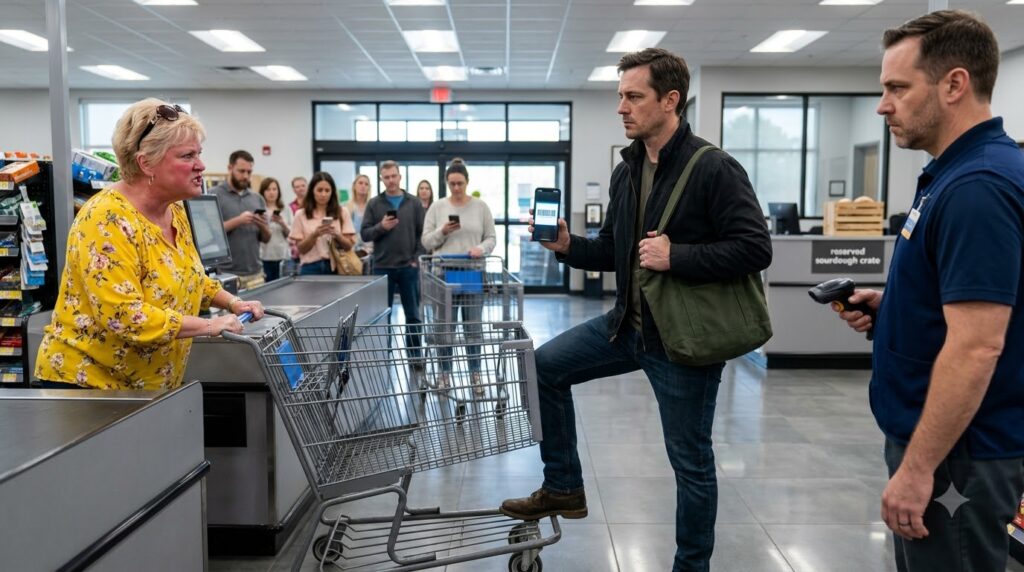
For two long seconds, Brenda stood paralyzed. Her hand stayed suspended half an inch above the silver antenna of David’s walkie-talkie, her eyes wide, staring at the small, black plastic radio as if it were a primed explosive. Under the cold, unforgiving glare of the overhead lighting grids, every sharp angle of her face seemed to flatten out. The loud, theatrical rhythm she had built over the last ten minutes evaporated, leaving behind only the hollow, frantic breathing of someone whose leverage had snapped clean in half.
Behind her, the crowd didn’t roar or cheer. They simply watched with cold, unblinking clarity. The man in the faded flannel shirt let out a low, gravelly grunt, stepped past her cart, and pushed his way through register four’s open lane without looking back. Two other shoppers shifted their weight, their eyes fixed on Brenda with a quiet, lingering disgust that cut far deeper than any shouted argument ever could.
“I… you can’t be serious,” Brenda whispered, her voice barely carrying over the hum of the cooling units. Her manicured fingers twitched against the plastic handle of her cart. “I’ve shopped at Crestview for twenty years, David. I know the owner. I sit on the neighborhood—”
“The cart, Mrs. Albright,” David said, his voice flat, razor-sharp, and stripped of a single grain of customer-service deference. “Right now.”
Brenda’s lower lip trembled once. She looked at Marcus, searching his face for a flicker of smug triumph, a smirk, or a mocking comment—anything she could grab onto to reignite the scene.
Marcus gave her nothing. He stood grounded on the terrazzo tile, his posture relaxed, his dark green canvas tote resting steadily against his hip. His thumb remained rested over the scratched brass buckle on his strap, unmoving, cold, and entirely untroubled. He didn’t offer her an exit line, and he didn’t lower his gaze. He simply let the weight of her own public failure crush whatever authority she had tried to fabricate out of thin air.
With a sharp, violent jerk, Brenda yanked her shopping cart backward. The front rubber wheels shrieked against the polished floor, leaving two dark, jagged scuff marks across the gray tile. She swung the heavy metal frame around, nearly clipping the display rack, and shoved her way blindly down the central aisle toward the rear of the store, her floral blouse disappearing into a sea of towering cereal boxes and paper towel displays.
Nobody followed her. Nobody spoke.
David turned to Marcus, exhaling a slow, quiet breath that signaled the end of an official shift. He reached out and tapped the top of the mobile-pay scanner once. “Mr. Holloway, I apologize for the delay. Your transaction is cleared. Have a good afternoon.”
“Thanks, David,” Marcus said. His voice was steady, smooth, and unchanged from the moment the confrontation began.
He adjusted the canvas strap on his shoulder, feeling the solid, reassuring iron weight of the Dutch oven settle against his thigh. Without rushing, he walked past register three, stepping cleanly over the fresh rubber marks left by Brenda’s cart.
As he reached the customer service desk near the front doors, the young clerk holding the clipboard looked up nervously. Sitting on the counter right behind him was the small wooden crate containing two round, dark-crusted loaves of artisan sourdough, labeled clearly with Marcus’s name and order number. The clerk quickly handed the paper bag over, murmuring a quiet, embarrassed apology on behalf of the store.
Marcus accepted the bag, slid the warm, fragrant bread into the top of his tote beside the iron pot, and stepped toward the exit.
The automatic sliding glass doors glided open with a soft, mechanical hiss, releasing him into the bright, warm sunlight of the afternoon parking lot. The air outside smelled of dry asphalt, exhaust, and summer grass—a stark, clean contrast to the sterile floor wax and stale air of the market corridor.
Marcus walked across the concrete pavement toward his truck, his boots clicking in a steady, unhurried cadence. He didn’t look back at the glass storefront, nor did he search the lot for Brenda’s car.
He unlocked his tailgate, set the heavy canvas bag onto the bed, and paused for a second, his fingers lingering on the cool, worn metal of the truck’s latch. In a world full of people eager to push boundaries, claim unearned space, and weaponize noise, he knew this wouldn’t be the last time someone tried to block his lane.
He climbed into the cab, turned the key, and pulled smoothly out into the quiet suburban traffic, leaving the noise of register lane three behind him.