The Concrete Line at Willow Creek: Property, Proof, and the Price of Peace

CHAPTER 1: THE NOTICE ON THE PORCH

The brass nozzle felt heavy and cold against Clara’s palm, the brass threads slightly oxidized where the hose coupled to the side spigot. She had turned the valve twice counterclockwise, expecting the familiar thrum of pressurized water coursing through the fifty-foot green coil snake-nested across the lawn, but nothing came. Just a dry, hollow hiss of trapped air dying in the pipe.

Clara knelt in the damp fescue near the corner of her porch, her rust-colored sweater pulled tight against the crisp morning breeze. She glanced toward the iron spigot handle. It was turned flush against the foundation wall—completely closed.

She hadn’t closed it.

Rising, her white canvas sneakers left shallow indentations in the soft morning soil. She walked around the porch steps toward the front entry, where a rectangle of heavy white bond paper caught the light, taped at eye level against the restored cedar siding.

The tape was blue painter’s blue—industrial grade, pulled straight and smooth so no edge curled.

Clara didn’t tear it down immediately. She stood on the second step, her breath misting slightly in the cool shade, and read the crisp, courier-font lines centered on the page:

NOTICE OF MUNICIPAL EASEMENT VIOLATION & HAZARD CREATION

LOCATION: 1422 Willow Creek Lane

OCCUPANT: Vance, C.

VIOLATION: Unpermitted surface utility line deployment across public pedestrian walkway. Uncontrolled water runoff hazard potential.

STATUS: CITATION PENDING. NON-EMERGENCY DISPATCH NOTIFIED.

At the bottom, where a city official’s signature ought to sit, there was only a stamped red box reading PRE-COMPLAINT NOTICE, accompanied by a handwritten date and timestamp from twenty minutes prior.

Clara took a slow, deliberate breath, letting the cold air settle the sharp prickle of frustration in her chest. She reached out, peeled the blue tape from her painted cedar, and folded the heavy paper into fourths. She didn’t crumble it. She smoothed the creases with her thumb, feeling the cheap, heavy tooth of the paper Evelyn bought in bulk from the office supply store in town.

Thirty feet away, across the strip of scalped, hyper-manicured Kentucky bluegrass that marked the property line, a slat in the vinyl porch blinds twitched.

It was a barely perceptible movement—the shadow of a beige sleeve catching the morning reflection on the double-pane glass. Evelyn was standing just inside her dark living room, her reading glasses likely resting on her chest, waiting to see if the young woman in the rust sweater would scream, drop the paper, or run inside.

Clara didn’t give her any of those things. She slipped the folded notice into her jeans pocket, walked back to the side of the house, and reached down to the brass valve.

She gripped the wheel, her knuckles turning white against the cold metal, and turned it wide open. Water surged through the green hose with a sudden, dull thrum, popping the rubber coils straight against the edge of the concrete walkway.

At the edge of the lawn, embedded right where the grass met the curb, a small brass disk glinted in the dirt—the 1978 municipal survey pin, its stamped crosshair filled with dry dirt. Clara stared down at that tiny brass anchor, listening to the water hum in the pipe, knowing the peace she had paid her life savings for was already gone.


CHAPTER 2: COFFEE AND COUNTERMEASURES

“You’re wasting good water on bad grass,” a voice rasped from the fence line.

Clara didn’t drop the hose. The brass nozzle hummed in her grip, spraying a crisp, fanning arc across the roots of her hydrangeas, where the dark soil swallowed the moisture with a thirsty hiss. She turned her head slowly, letting her eyes trace the rusted iron lattice of the property fence until they locked onto Evelyn’s face.

Evelyn was leaning over the top rail, her fingers wrapped in yellow dishwashing gloves. Up close, in the harsh glare of the mid-morning sun, the beige jacket showed fraying threads along the lapels, and her short blonde hair was stiff with hairspray that smelled faintly of old roses and chemical bleach.

“It’s nine in the morning, Evelyn,” Clara said, her voice flat, stripped of the polite cadence she had spent the last three months trying to maintain. “The watering restriction doesn’t start until noon.”

“Section 4-B of the civic charter says water runoff across secondary property boundaries constitutes a public nuisance,” Evelyn replied without missing a beat. Her eyes, magnified behind the rimless lenses resting on her chest chain, darted down to Clara’s white sneakers, then to the green hose resting in the grass. “I have the ledger. I have every violation logged since you took key-possession in May. You think because you signed a mortgage, you own the air you breathe out here?”

“I own the deed,” Clara said, turning the nozzle slightly so the spray moved away from the fence line, hitting the foundation stones with a rhythmic thwack-thwack-thwack. “And the survey pin at the curb says this grass belongs to 1422.”

Evelyn let out a thin, dry sound—half-laugh, half-cough. “Surveys change, dear. Deeds have exceptions. Ask anyone who lived on this block before the city re-zoned the creek easement in ninety-four.”

She didn’t wait for Clara to answer. She pulled her hands back from the fence, the yellow rubber scraping against the rusted iron with a sharp screech, and turned toward her side door, her steps deliberate and heavy on her concrete path.

Clara stood in the shade of her porch for a long minute after the side door clicked shut. The thrum of the water in her hands suddenly felt less like a chore and more like a fuse burning down.

She turned off the spigot, unhooked the brass coupler, and carried the hose around to the back. Inside the cool, dim kitchen, the smell of stale coffee and fresh paint hung in the air—the lingering scent of a house she was still trying to make hers.

She walked past the unpacked cardboard boxes stacked against the kitchen counter and went straight to the pantry. On the second shelf, behind a sack of flour, sat a dented Folgers coffee tin she’d found tucked in the cellar joists during her first week of renovations.

Clara pulled the tin down, the rusted lid popping off with a hollow plink.

Inside, beneath a handful of rusted deck screws and old brass keys, was a strip of yellowed ledger paper glued to the tin’s bottom. It was written in faded graphite, dated August 12, 1994, in a cramped, precise cursive: EASEMENT CLAIM – SECTOR 3 – VOID PER COUNTY AUDIT.

Clara ran her thumb over the rough, graphite-smeared paper. She had assumed it was garbage left behind by the previous owner, a retired mechanic who had died in a nursing home three years back. But the date matched Evelyn’s offhand remark. Ninety-four.

Outside, the high-pitched whine of a power edger suddenly roared to life along the property line, the steel blade biting viciously into the dirt right along the edge of Clara’s driveway.

Clara closed the coffee tin, her jaw setting into a hard, rigid line. Evelyn wasn’t just checking code books. She was hunting a phantom that had been buried thirty years ago, and she was willing to drag the whole street down to dig it up.

Clara walked to the front window, pulling the curtain back an inch. Across the driveway, Evelyn stood behind a sputtering gasoline edger, thick plumes of blue exhaust curling around her beige jacket as she forced the spinning blade deep into the turf, inches from the brass survey pin.

Clara reached for her phone on the counter, her thumb hovering over the screen. The fight wasn’t coming down to who had the better lawn. It was coming down to who had the receipts.

CHAPTER 3: THE BORDER CROSSING

The edger’s high-pitched screech bit deep into the turf, spraying a fan of pulverized black dirt and grass roots across the concrete apron of Clara’s driveway. Exhaust fumes, thick and gray with unburned oil, drifted through the open kitchen window, stinging Clara’s nostrils as she stood by the sink.

She didn’t grab her phone to record from behind the glass. She walked straight to the back door, pushed through the screen, and stepped down onto the gravel path.

Evelyn was leaning heavily into the edger’s handlebars, her yellow-gloved hands trembling with the engine’s vibration. The spinning steel blade had moved past the faint line of weeds dividing their lots and was now grinding a four-inch trench straight through Clara’s fescue, steering toward the brass spigot on the side of the house.

“Evelyn!” Clara called out. The engine drowned her voice completely.

Clara closed the distance in four long strides, her canvas sneakers crunching hard on the driveway gravel. She didn’t touch Evelyn. She stepped into the path of the machine, three feet ahead of the steel blade, and planted her feet directly over the green hose where it lay coiled near the foundation.

Evelyn jerked the handlebars back. The engine sputtered, coughing out a ball of dark smoke before dying with a metallic clatter. The silence that settled over the yard was heavy, broken only by the heat-pinging of the cooling muffler and the distant hum of a lawnmower two blocks over.

“You’re trespassing,” Clara said, her voice dropping into a low, controlled register.

Evelyn wiped a fleck of dark dirt from her cheek with the back of her yellow glove, leaving a smudge of grime across her beige jacket. Her eyes behind the rimless lenses were sharp, fixed on the green rubber coil beneath Clara’s shoes.

“This isn’t your grass, girl,” Evelyn said. Her voice didn’t rise; it was dry and brittle, like old newspaper left in an attic. “The thirty-foot setback from the street centerline is municipal right-of-way. You’ve got an illegal fixture attached to a secondary line.”

“The spigot was installed when the house was built in nineteen-seventy-eight,” Clara replied, her eyes narrowing as she watched Evelyn’s right hand slide into her jacket pocket. “It’s on my deed map.”

“Deeds are drawn by clerks who don’t live on the street,” Evelyn said. She pulled her hand from her pocket, holding a heavy pair of iron shear-cutters, the blades rusted at the pivot hinge. “When the city ran the new water mains through the cul-de-sac in ninety-four, this entire corner strip was designated a shared maintenance lane. Your predecessor knew it. He kept his tools in his cellar and kept his mouth shut.”

Clara remembered the brass-tagged key she’d found lodged in the cellar joist near the main shutoff valve two weeks after moving in—a key stamped with a three-digit municipal utility code. She hadn’t thought about it until now. The memory flickered like a spark in dark brush, but she kept her face completely motionless.

“You touch that hose with those shears, Evelyn, and we’re done talking about civic codes,” Clara said softly.

Evelyn didn’t hesitate. She took a half-step forward, the rubber soles of her walking shoes grinding into Clara’s lawn. She bent at the waist, her beige jacket straining across her back, and reached for the thick green rubber body of the hose.

Instead of cutting it, she hooked the iron blade under the curve of the line and yanked it upward with surprising strength. The brass fitting at the spigot groaned under the sudden tension. With a violent jerk, Evelyn dragged thirty feet of heavy, water-filled rubber across the grass, hauling it over the curb line and dropping it squarely down the middle of the public sidewalk.

“There,” Evelyn breathed, her chest heaving as she stood upright, tossing the rusted shears into the tray of her edger. “Obstructing a public walkway. Unpermitted utility deployment across a municipal foot-lane.”

She pulled a heavy silver flip-phone from her pocket, flipped it open with a practiced snap of her wrist, and pressed a speed-dial button without looking at the keypad.

“Dispatch?” Evelyn spoke into the receiver, her tone transforming instantly from sharp hostility to panicked civic alarm. “This is Evelyn Reed at fourteen-twenty-four Willow Creek. I need an officer at fourteen-twenty-two immediately. The new resident has run an unshielded water line across the main sidewalk, and there’s a severe trip hazard blocking pedestrian access.”

Clara stood by the side of her house, watching the green hose snake from her spigot, across her lawn, and onto the sun-baked concrete of the street walkway. Across the lane, Mr. Henderson paused on his front porch, a pair of hedge clippers hanging limp in his hand as he stared at the confrontation unfolding in the morning light.

Clara didn’t reach for the hose to pull it back. She walked slowly toward her front porch steps, reached into her pocket, and pulled out her smartphone.

“Call whoever you want, Evelyn,” Clara said quietly as she tapped the screen, opening the live feed from her door camera. “Just make sure they bring a notebook.”

CHAPTER 4: THE WITNESS GALLERY

“You can put the phone away, Clara,” Evelyn called out over the expanse of scorched grass. Her voice was too loud, clearly pitched for the porch across the street where Mr. Henderson stood leaning over his wooden railing. “Video doesn’t override municipal code. A hazard on public concrete is a hazard regardless of who pulled the line.”

Clara didn’t answer. She kept her thumb resting over the cold glass of her phone screen, watching the live door-cam buffer through three seconds of pixelated grain before settling into crisp 1080p clarity.

On the four-inch display, she watched the wide-angle lens capture everything that had happened over the last ten minutes: Evelyn walking up her porch steps, reaching into the shadows to turn the water spigot off, and then grabbing the body of the green garden hose to drag it deliberately across the sidewalk.

“You really believe you thought of everything, don’t you?” Clara said softly, stepping down from the porch onto the concrete walkway.

“I’ve lived on Willow Creek Lane for thirty-two years,” Evelyn said, smoothing the lapels of her beige jacket with a swift, snapping motion. She turned toward the street, her eyes tracking the slow approach of an ice cream van two blocks down, its tinny melody echoing off the suburban rooftops. “I was here when they poured these sidewalks. I was here when the city council signed the access agreements. You think you’re the first young person to buy a starter house, put up a bird feeder, and act like the world started the day you closed escrow?”

Clara walked slowly toward the curb, stopping two feet short of the heavy green hose resting across the concrete.

To her left, the garage door of fourteen-sixteen creaked open, and Mrs. Gable stepped out onto her driveway holding a pair of yellow garden shears, her eyes fixed entirely on Clara’s yard. Down the cul-de-sac, a teenager on a bicycle slowed his pedaling, coasting along the gutter while watching the two women stand off beside the idling gasoline edger.

The neighborhood was tuning in. Willow Creek Lane had its rhythm—lawn mowers at eight, mail delivery at eleven, trash bins out on Thursday nights—and Evelyn Reed had spent three decades acting as the conductor. Now, the orchestra was watching to see if the new instrument would play out of key.

“Mr. Henderson!” Evelyn called out suddenly, turning her head toward the porch across the street. “Did you see this line stretched across the foot-lane when you came out for the mail?”

The old man across the street shifted his weight from one foot to the other. He looked down at his hedge clippers, then at Evelyn, then at Clara standing quietly near the curb in her rust-colored sweater.

“Looked pretty low to the ground when I saw it, Evelyn,” Henderson called back, his voice scratchy from years of pipe smoke. “Didn’t look like nobody was tripping.”

Evelyn’s jaw tightened, a sharp muscle twitching beneath her ear. “The law doesn’t wait for someone to break an ankle, Arthur,” she snapped back, her tone clipped and authoritative. She turned her glare back onto Clara. “Public safety isn’t an opinion. It’s a standard.”

“Then let’s let the police apply the standard,” Clara said.

She tapped her phone screen, sliding the video clip into her local storage folder and locking the file. As she did, her eyes fell on the cellar window beneath her porch—the small, iron-barred frame that led down to the stone basement where the old water main joined the foundation wall.

In her mind, she saw the brass-tagged key resting in the joist. MUNI-UTIL 1994-B.

If Evelyn was so certain the 1994 municipal code gave her the right to dictate what happened on this dirt, why had the previous owner kept a master utility key hidden in the dark above the joists instead of handing it over to the city? Why had he left a handwritten note glued inside an empty coffee tin calling the easement void?

Evelyn noticed Clara’s gaze shifting toward the basement window. Her eyes narrowed behind her reading glasses, a subtle shadow of unease crossing her face before she quickly masked it with another adjustment of her jacket.

“They’ll be here in five minutes,” Evelyn said, her voice dropping lower, intended only for Clara now. “When Officer Miller gets out of that cruiser, he isn’t going to look at your phone. He’s going to look at that hose lying across public concrete, and he’s going to look at the municipal record book I have sitting on my kitchen counter. You can save yourself a civil court summons if you wind that rubber up right now and apologize for the disruption.”

Clara looked down at the brass survey pin in the curb, then up at Evelyn’s rigid, unyielding posture.

“I’m not winding up a single inch,” Clara said.

A low, familiar rumble echoed from the entrance of the cul-de-sac. A black-and-white Ford Police Interceptor turned slowly onto Willow Creek Lane, its tires crunching quietly against the loose gravel scattered along the asphalt gutter.

CHAPTER 5: THE ARRIVAL ON THE CONCRETE

The black-and-white Ford Interceptor rolled to a halt against the concrete curb, its front tires coming to rest six inches from the brass survey pin embedded in the dirt. The driver’s side door swung open with a dull, heavy latch-click, and Officer Marcus Miller stepped out into the mid-morning heat.

He didn’t hit his overhead lights. He didn’t adjust his radio. He stood tall beside the driver’s door for three quiet seconds, his dark police uniform immaculate despite the rising temperature, taking in the full geometry of the street with a single, slow sweep of his eyes.

He saw Mr. Henderson leaning hard over his porch rail across the lane. He saw Mrs. Gable standing motionless on her driveway with her yellow shears. He saw Evelyn Reed positioned like a sentry beside her sputtering edger, holding a thick Manila folder against her beige jacket. And he saw Clara Vance standing near the front steps, her rust-colored sweater draped loosely over denim jeans, her phone held loosely at her thigh.

Finally, his eyes rested on the green garden hose snaking across the sun-baked sidewalk.

“Morning, Evelyn,” Officer Miller said. His voice was low, resonant, and entirely stripped of theater as his heavy police boots crunched against the gutter gravel. “Morning, Miss Vance.”

Evelyn didn’t wait for him to establish the center lane. She took two swift strides toward the cruiser, her yellow-gloved hands gripping the Manila folder so tightly the cardboard bowed in the middle.

“Officer Miller,” Evelyn began, her voice carrying that practiced, official cadence she used for HOA quarterly reviews. “I’m glad dispatch sent someone who knows the history of this street. As you can clearly see, we have an unpermitted, unshielded secondary line deployed directly across the primary pedestrian foot-lane.”

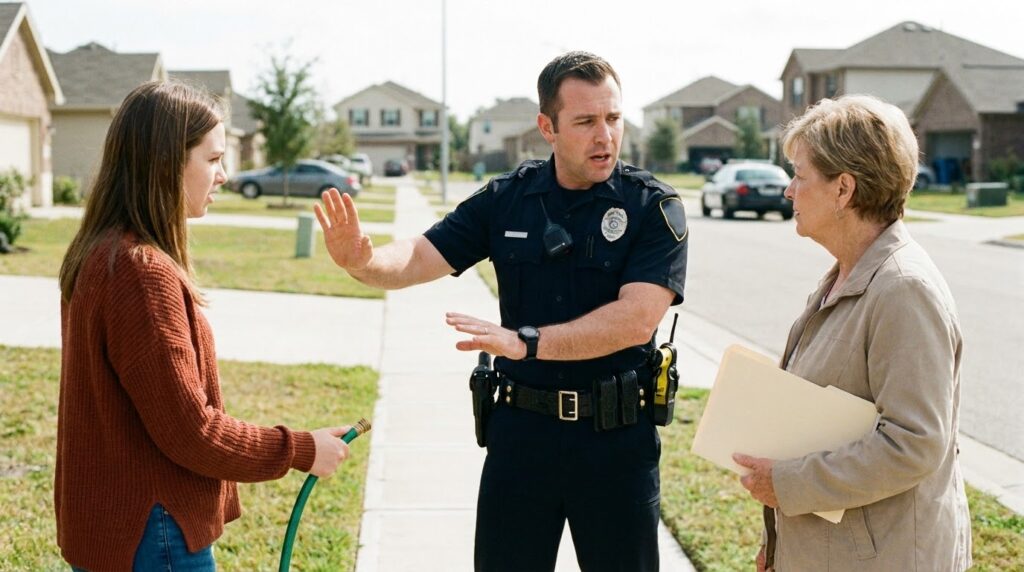
Miller didn’t look at the folder. He stepped past Evelyn, taking a deliberate position right on the sidewalk line between the two women. He placed one hand lightly on his duty belt, his thumb resting near the radio clip, and raised his other open hand waist-high—a simple, physical wall that halted Evelyn’s forward momentum.

“I understand the concern, Evelyn,” Miller said, his eyes scanning the green rubber hose resting on the concrete, “but we need the facts before making a decision.”

“The facts are right here in municipal black-and-white!” Evelyn insisted, stepping closer to his shoulder and flicking the Manila folder open with a sharp rustle of heavy paper. “Section 4-B of the 1994 Access Accord! I have the signed agreement right here!”

She thrust a yellowed, multi-page document toward Miller’s chest.

Clara stepped closer, her eyes fixing on the top header of the document exposed in the sunlight: TOWN OF WILLOW CREEK – MUNICIPAL EASEMENT ACCORD – DRAFT B (1994). Stamp-signed in dark blue ink at the bottom was a seal bearing the name H. REED – ASSISTANT COUNTY CLERK.

Clara’s breath hitched in her throat. H. Reed. Evelyn’s late husband.

The code stamped across the top of the notarized document matched the brass tag on the key tucked in her cellar joists line-for-line: MUNI-UTIL 1994-B.

For a sharp, sickening second, the ground felt unstable beneath Clara’s canvas sneakers. The document in Evelyn’s hands wasn’t just a collection of self-typed notes or printed blog complaints. It was a formal, notarized municipal easement draft granting the neighboring parcel shared access rights to the utility path—signed and sealed by a county official thirty-two years ago.

Evelyn looked over Miller’s shoulder at Clara, a cold, triumphant smile touching the corners of her thin lips. “The nineteen-ninety-four accord explicitly designates this front three-foot strip as a shared utility corridor under neighboring supervision. The former owner signed off on it. It’s on file.”

Clara stared at the heavy blue ink signature of her house’s previous owner sitting right below Harold Reed’s official clerk seal. The decoy secret sat exposed in the daylight, heavy and suffocating: according to the paper in Evelyn’s hands, Clara didn’t even own the dirt under her spigot.

Officer Miller looked down at the notarized signature, his brow furrowing slightly under the brim of his cap. He didn’t issue a citation. He didn’t order Clara to coil the hose. He lowered his hand slowly, his gaze shifting from the yellowed document to Clara’s pale, composed face.

“Let’s review everything together,” Officer Miller said softly.

Clara took a slow, deep breath, her fingers tightening around her phone as the weight of the document pressed down on the quiet sidewalk.

CHAPTER 6: THE PAPER FORTRESS

Evelyn snapped the Manila folder wide open, the stiff cardstock making a noise like a dry branch snapping in the quiet morning air. She didn’t hand the pages to Officer Miller; she held them high at chest level, her yellow-gloved thumbs pinning the corners so the afternoon sun struck the crisp blue ink signatures.

“Read Section Three, Marcus,” Evelyn commanded, her voice dropping into the smooth, rehearsed cadence of a former county recording clerk. “Nineteen-ninety-four. Designated utility easement. Signed by Harold when he was assistant clerk and countersigned by Arthur Vance’s father before the lot was subdivided. It grants neighboring access rights to maintain secondary water connections.”

Officer Miller tilted his head, his dark cap casting a sharp shadow over his brow. He didn’t reach for the paper. He adjusted his duty belt with a slow, heavy clack of leather and brass, his eyes moving methodically across the text.

“I see the header, Evelyn,” Miller said quietly. “I see Harold’s stamp.”

“Then you see that this young woman has no legal right to block access or complain about property lines,” Evelyn said, her shoulders squaring as she turned her chin toward Clara. “She’s built a narrative out of ignorance. She thinks buying a house means she gets to ignore thirty years of established civic covenants.”

Clara stood motionless on the edge of the turf. The sun beat down on her rust-colored sweater, but inside her chest, a cold, calculating stillness took over.

She looked at the yellowed document. It looked real. The blue ink had faded over three decades into a dull navy, and the embossed seal in the bottom left corner caught the light with unmistakable physical texture. If Officer Miller accepted that paper as active authority right here on the sidewalk, the entire dynamic would freeze in Evelyn’s favor. The police wouldn’t intervene in a civil easement dispute, and Clara would be forced to wind up her hose, accept the citation threat, and spend months fighting in county records offices just to use her own lawn.

The decoy trap was sprung, pinned to the cardboard folder in Evelyn’s hands.

“May I see the third page, Officer?” Clara asked. Her voice was remarkably steady, lacking the tremor Evelyn clearly expected.

Evelyn’s grip tightened on the folder. “This is an official record copy. It doesn’t leave my hands.”

“It’s a photocopy of a draft,” Clara said, stepping forward until her sneakers rested an inch from the concrete expansion joint. She pointed directly to the top right corner of the yellowed sheet. “Look at the document ID number in the header, Officer. DRAFT-B-1994. It doesn’t have a county volume or page stamp. Real municipal covenants recorded at the courthouse have a book and page number stamped in red ink along the right margin.”

Officer Miller leaned in two inches closer. His eyes narrowed as he traced the empty right margin where only blank, aged paper sat.

“Miss Vance is right about county filing formats, Evelyn,” Miller noted, his tone remaining strictly neutral. “Where’s the recording stamp?”

Evelyn’s face didn’t crumble, but her throat moved in a hard, involuntary swallow. Her fingers shifted on the cardstock, pulling the folder back half an inch toward her beige jacket.

“This is the neighborhood covenant copy kept on file since the re-zoning,” Evelyn snapped, her defensive edge sharpening into outright hostility. “Harold brought this home from the hall of records himself the day the accord was finalized! The original is vaulted at the county seat.”

“Then why did Harold write VOID across the master ledger in ninety-four?” Clara asked quietly.

The silence that hit the sidewalk was absolute. Across the street, Mr. Henderson shifted his grip on the wooden porch rail, the wood creaking softly in the quiet. Mrs. Gable lowered her yellow shears by her side, her head tilting as she listened.

Evelyn’s eyes widened behind her rimless glasses, a flicker of genuine shock piercing through her rigid composure before she forced her lips into a tight, pale line. “What nonsense are you talking about?”

“The old Folgers tin in my cellar joists,” Clara said, keeping her eyes locked on Evelyn’s pale face. “The previous owner kept the original line logs. August twelfth, nineteen-ninety-four. Easement Claim – Sector 3 – Void Per County Audit.”

Clara didn’t actually know if the document in Evelyn’s hands was an outright theft or merely an unratified draft—she only knew that the ledger entry existed and that the key in her cellar matched the code. But watching the sudden, microscopic drop in Evelyn’s right shoulder, Clara knew her arrow had found the mark.

Evelyn pulled the folder back against her chest, snapping it shut with a sharp, defensive slap.

“A scrap of paper in a dirt cellar doesn’t override a notarized signature,” Evelyn said, her voice rising in pitch as she turned back to the officer. “Marcus, I didn’t call you here to debate thirty-year-old clerk archives! I called you because there is a physical trip hazard lying across public concrete right now! Look at it!”

She pointed a yellow-gloved finger down at the green garden hose resting across the sidewalk.

Officer Miller looked at the hose, then at Evelyn’s white-knuckled grip on her folder. He didn’t look flustered. He reached into his breast pocket, pulled out a small black notepad and a silver pen, and clicked the point into place with a clear, sharp snap.

“We’re going to address the hose right now, Evelyn,” Officer Miller said smoothly. “And then we’re going to talk about what you’ve been doing on Miss Vance’s porch.”

CHAPTER 7: THE REVEAL ON THE SCREEN

“What I was doing on her porch?” Evelyn repeated, the color draining from her cheeks so fast the pale smudges of lawn dirt across her jaw stood out like bruises. “I was inspecting a municipal violation! I was attempting to notify the resident before calling dispatch!”

“You were on private property without permission,” Officer Miller said, his tone flat and unyielding. He turned his body three inches to the left, positioning himself fully between Evelyn and Clara. “Miss Vance, you mentioned a recording.”

Clara didn’t hesitate. She stepped forward, the heels of her canvas sneakers clicking on the concrete, and held her smartphone toward the officer. The dark glass screen reflected the harsh midday sun for a fraction of a second before the video interface loaded, its bright timeline runner glowing red across the bottom.

“This was recorded forty-two minutes ago,” Clara said. Her voice carried clearly across the sidewalk, reaching Mr. Henderson on his porch and Mrs. Gable standing frozen by her driveway. “It’s from the smart camera mounted above my front door.”

She tapped the play icon.

The speaker on the small phone clicked, and then the crisp, ambient hum of Willow Creek Lane filled the narrow space between them—the rustle of wind through oak leaves, the distant drone of a cicada, and the crunch of footsteps on porch steps.

On the wide-angle 1080p feed, Evelyn appeared in sharp focus.

The video clearly showed her marching up Clara’s steps in her beige jacket, her yellow-gloved hand reaching around the cedar corner post to grab the iron spigot handle. The camera caught the deliberate, forceful twist of her wrist as she shut the water off. Then, the lens recorded Evelyn stepping down, grabbing the body of the green garden hose, and physically hauling it thirty feet across the grass until she dropped it squarely over the public sidewalk.

Officer Miller watched the screen in absolute silence. He didn’t blink. His dark eyes followed every second of the clip, taking in the deliberate, methodical staging of the hazard.

“That’s enough,” Miller said quietly, raising a gloved finger to pause the video.

Evelyn’s hands trembled against the Manila folder. “That… that camera is an invasion of privacy! It’s capturing the public right-of-way without a permit!”

“It’s capturing her private porch, Evelyn,” Officer Miller corrected, his voice dropping an octave into a low, stern register that admitted no rebuttal. “And it shows you stepping onto private land, tampering with private utility fixtures, and intentionally creating the hazard you called nine-one-one to report.”

“It’s a shared corridor!” Evelyn cried, her composure fracturing as she clutched the yellowed 1994 draft to her chest like a shield. “Harold filed the paperwork! The county clerk’s office—”

“Harold was an assistant clerk who brought home an unapproved draft that was annulled thirty years ago,” Clara interrupted softly.

Evelyn froze. Her mouth opened slightly, but no sound came out.

Clara took a step closer, pointing her finger down toward the curb where the brass survey pin sat embedded in the dirt.

“I went to the county recorder’s digital portal last night, Evelyn,” Clara said, her voice steady and relentless. “I pulled the final approved map for Sector Three. The nineteen-ninety-four draft Harold brought home was rejected by the county auditor on August twelfth, nineteen-ninety-four. It was never recorded. It has no legal standing. This property line goes straight to the curb, and you knew it.”

Evelyn’s eyes darted frantically from Clara’s face to the police officer’s stern expression. The paper fortress she had built out of old folders, typed notices, and thirty years of neighborhood intimidation was dissolving in the hot summer air.

Across the street, Mr. Henderson slowly shook his head, letting out a long, audible sigh. Down the driveway, Mrs. Gable turned her back, walking toward her front door and leaving her yellow garden shears sitting forgotten on the grass.

Officer Miller snapped his notepad shut with a sound like a pistol shot.

“Evelyn,” Miller said, his eyes locking onto hers with cold professional authority. “You’re going to put that folder away.”

CHAPTER 8: THE COLLAPSE AT THE CURB

Officer Miller took one slow, heavy step forward, his leather duty boots crunching into the dry dirt right beside the brass survey pin. The shadow of his wide shoulders fell over Evelyn’s beige jacket, blotting out the harsh glare of the midday sun.

“You’re going to take your folder, Evelyn,” Officer Miller said, his voice dropping into a register that was low, flat, and absolute. “You’re going to walk back up your driveway, step inside your house, and leave this young woman alone.”

Evelyn didn’t move for three long seconds. Her fingers remained locked around the Manila folder, the cardstock paper creasing under the pressure of her yellow-gloved thumbs. Her eyes flicked from Miller’s silver badge to Clara’s face, searching for a crack in the young woman’s quiet, steady posture.

There was none. Clara stood by the edge of her lawn, her sweater caught in the warm breeze, her phone held loosely at her side. She didn’t gloat. She didn’t smile. She simply held the line, rooted to the dirt she owned.

“Marcus,” Evelyn began, her voice thin and raspy, stripped of its practiced municipal rhythm. “You don’t understand the precedent this sets for the street—”

“I understand that you dialed nine-one-one to report a public hazard that you created yourself,” Officer Miller interrupted, his brow furrowing under the brim of his dark cap. “I understand that you trespassed on private property to shut off another resident’s water spigot. And I understand that if I am called back to fourteen-twenty-two Willow Creek Lane for another fabricated complaint, I won’t be taking notes. I will be issuing you a criminal citation for misuse of emergency dispatch services and official filing of a false report.”

A sharp, collective intake of air hissed across the street.

Mr. Henderson leaned out further over his porch rail, his knuckles white against the dark wood as he watched the scene unfold. Across the lane, two more neighbors had stepped out onto their lawn, standing motionless in the midday heat as the officer’s words echoed down the quiet suburban cul-de-sac.

Evelyn’s chest heaved. The rigid, imperious posture she had maintained for thirty-two years on Willow Creek Lane seemed to buckle inward. The Manila folder slipped an inch in her grip, the yellowed 1994 draft peeking out from the top edge—a useless stack of paper stripped of its phantom power.

“Do you understand me, Evelyn?” Miller asked, his tone unyielding.

Evelyn swallowed hard, the muscles in her neck tightening. She didn’t look at Clara. She didn’t look across the street at the neighbors watching her from their porches.

“I understand,” Evelyn whispered.

She pulled the folder against her side, turned on the heel of her walking shoes, and began the long, stiff walk back up her concrete driveway. Her steps were uneven, her yellow rubber gloves swinging limply at her sides as she passed her sputtering, abandoned gasoline edger.

When she reached her front door, the heavy oak frame clicked shut behind her with a sharp, echoing bang that reverberated down the block.

Officer Miller watched her door until the lock turned. Then, he turned back to Clara, the hard edge in his face softening into a weary, professional quiet. He looked down at the green garden hose resting across the sidewalk, then at the brass survey pin glinting in the grass.

“Save that doorbell footage to a flash drive, Miss Vance,” Miller said softly, reaching up to adjust the brim of his cap. “Keep a copy in your desk. If she tries to leave notes in your mailbox or step on your grass again, bring the drive straight down to the station.”

“I will, Officer,” Clara said. “Thank you.”

Miller offered a brief, two-finger salute from the brim of his hat, turned, and walked back to his patrol car. The heavy door clicked shut, the engine rumbled to life, and the black-and-white cruiser pulled smoothly away from the curb, leaving Willow Creek Lane in quiet, sun-baked stillness.

Clara stood alone on the edge of her lawn, listening to the cicadas humming in the high oak branches above her roof.

CHAPTER 9: THE WATER ON THE LAWN

The exhaust fumes from Evelyn’s abandoned edger hung thin and pale in the noon heat, dissipating against the brick foundation of Clara’s house.

Clara didn’t wait for the street to return to its usual routine. She walked straight to the curb, bent down, and wrapped her fingers around the reinforced heavy-duty rubber of the green garden hose. The sun had baked the outer casing hot to the touch, but beneath the surface, the trapped water held a residual chill from the underground main.

She hauled the thirty-foot coil off the public concrete, pulling it back across the strip of scalped fescue where Evelyn’s edger had gouged its shallow trench.

Across the lane, Mr. Henderson stepped down from his porch steps, holding a pair of wooden-handled shears. He walked to the edge of his driveway, looked toward Evelyn’s tightly shut front window, and then met Clara’s eyes across the asphalt.

“You’ve got good water pressure on this side of the cul-de-sac, Miss Vance,” Henderson called out, his voice rough but clear in the still afternoon.

“It holds up fine, Mr. Henderson,” Clara said, keeping her tone grounded.

“Harold Reed tried telling my late wife back in ninety-six that our maple tree was overhangin’ the municipal easement by four inches,” Henderson added, resting his shears against his thigh. He let out a low, dry chuckle. “Told her he had the filing in his desk. She told him to bring the chainsaw himself if he felt that strongly. He never showed.”

Clara offered a brief, quiet nod. “The line stays where the survey pin sits.”

“Good to know,” Henderson said. He gave a short wave of his hand, turned, and walked back up toward his porch steps, the tension that had gripped Willow Creek Lane for three hours finally evaporating into the summer air.

Clara carried the brass nozzle back to the side spigot. She inspected the threaded coupling where Evelyn had yanked the rubber line; the brass threads were slightly scuffed, gray dirt wedged into the grooves, but the seal remained tight. She took a rag from her pocket, wiped the threads clean, and threaded the coupling back onto the iron fixture, turning it until the rubber washer compressed tight against the seat.

She reached for the iron wheel and opened the valve three full turns counterclockwise.

The spigot hummed immediately. Pressure surged through the fifty-foot green line with a deep, muffled thrum, straightening the kinks along the grass until the brass nozzle hissed, releasing a fine mist of air before settling into a steady, pressurized stream.

Clara stepped back onto her front porch steps. She adjusted the nozzle head, setting the spray to a wide, gentle shower, and aimed it toward the thirsty hydrangeas lining her foundation wall.

The water struck the dark soil with a rhythmic, satisfying splash, washing away the dust and pulverized dirt that the edger had sprayed across the cedar siding. Drops of water caught the bright sunlight, glistening like small glass beads on the green leaves.

She looked down at her feet. On the second porch step, the small blue square of painter’s tape Evelyn had used to stick the typed violation notice was gone, leaving only a faint, clean rectangle on the fresh paint.

In her pocket, her phone vibrated once—a automated cloud notification confirming that the door-cam video had finished uploading to her secure backup server.

Clara didn’t pull the phone out to look. She shifted her grip on the brass nozzle, directing the spray along the edge of the turf, right down to the tiny brass survey pin embedded in the curb concrete. The water washed over the stamped crosshair, clearing away the dry silt and revealing the clean, unyielding gleam of the metal beneath.

The street was quiet again. The heat shimmered over the dark asphalt, the cicadas droned in the high oak canopy, and the craftsman house at fourteen-twenty-two Willow Creek Lane stood firm behind its line, peaceful, quiet, and entirely her own.

Similar Posts

Leave a Reply

Your email address will not be published. Required fields are marked *