
CHAPTER 2: COFFEE AND COUNTERMEASURES
“You’re wasting good water on bad grass,” a voice rasped from the fence line.
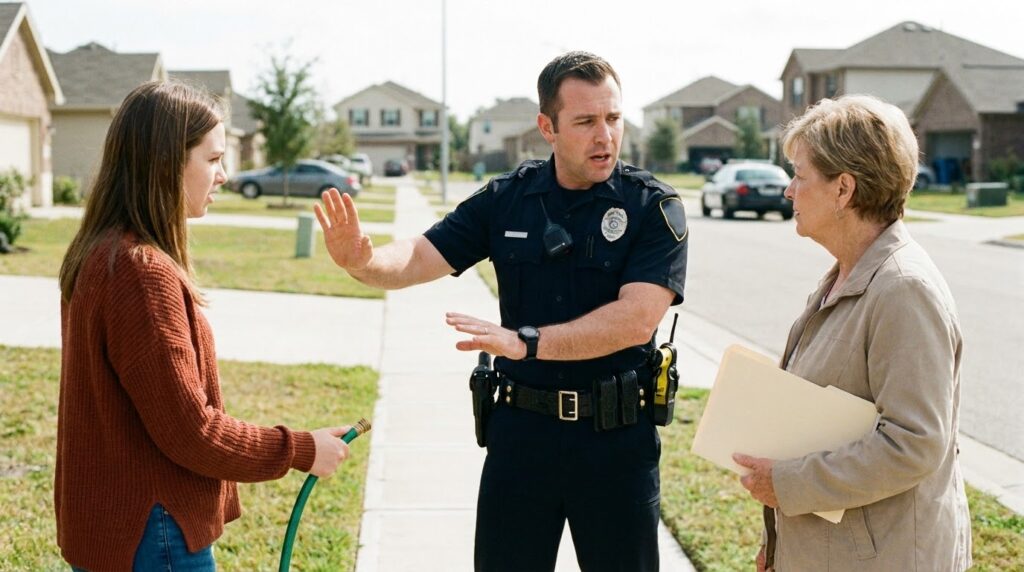
Clara didn’t drop the hose. The brass nozzle hummed in her grip, spraying a crisp, fanning arc across the roots of her hydrangeas, where the dark soil swallowed the moisture with a thirsty hiss. She turned her head slowly, letting her eyes trace the rusted iron lattice of the property fence until they locked onto Evelyn’s face.
Evelyn was leaning over the top rail, her fingers wrapped in yellow dishwashing gloves. Up close, in the harsh glare of the mid-morning sun, the beige jacket showed fraying threads along the lapels, and her short blonde hair was stiff with hairspray that smelled faintly of old roses and chemical bleach.
“It’s nine in the morning, Evelyn,” Clara said, her voice flat, stripped of the polite cadence she had spent the last three months trying to maintain. “The watering restriction doesn’t start until noon.”
“Section 4-B of the civic charter says water runoff across secondary property boundaries constitutes a public nuisance,” Evelyn replied without missing a beat. Her eyes, magnified behind the rimless lenses resting on her chest chain, darted down to Clara’s white sneakers, then to the green hose resting in the grass. “I have the ledger. I have every violation logged since you took key-possession in May. You think because you signed a mortgage, you own the air you breathe out here?”
“I own the deed,” Clara said, turning the nozzle slightly so the spray moved away from the fence line, hitting the foundation stones with a rhythmic thwack-thwack-thwack. “And the survey pin at the curb says this grass belongs to 1422.”
Evelyn let out a thin, dry sound—half-laugh, half-cough. “Surveys change, dear. Deeds have exceptions. Ask anyone who lived on this block before the city re-zoned the creek easement in ninety-four.”
She didn’t wait for Clara to answer. She pulled her hands back from the fence, the yellow rubber scraping against the rusted iron with a sharp screech, and turned toward her side door, her steps deliberate and heavy on her concrete path.
Clara stood in the shade of her porch for a long minute after the side door clicked shut. The thrum of the water in her hands suddenly felt less like a chore and more like a fuse burning down.
She turned off the spigot, unhooked the brass coupler, and carried the hose around to the back. Inside the cool, dim kitchen, the smell of stale coffee and fresh paint hung in the air—the lingering scent of a house she was still trying to make hers.
She walked past the unpacked cardboard boxes stacked against the kitchen counter and went straight to the pantry. On the second shelf, behind a sack of flour, sat a dented Folgers coffee tin she’d found tucked in the cellar joists during her first week of renovations.
Clara pulled the tin down, the rusted lid popping off with a hollow plink.
Inside, beneath a handful of rusted deck screws and old brass keys, was a strip of yellowed ledger paper glued to the tin’s bottom. It was written in faded graphite, dated August 12, 1994, in a cramped, precise cursive: EASEMENT CLAIM – SECTOR 3 – VOID PER COUNTY AUDIT.
Clara ran her thumb over the rough, graphite-smeared paper. She had assumed it was garbage left behind by the previous owner, a retired mechanic who had died in a nursing home three years back. But the date matched Evelyn’s offhand remark. Ninety-four.
Outside, the high-pitched whine of a power edger suddenly roared to life along the property line, the steel blade biting viciously into the dirt right along the edge of Clara’s driveway.
Clara closed the coffee tin, her jaw setting into a hard, rigid line. Evelyn wasn’t just checking code books. She was hunting a phantom that had been buried thirty years ago, and she was willing to drag the whole street down to dig it up.
Clara walked to the front window, pulling the curtain back an inch. Across the driveway, Evelyn stood behind a sputtering gasoline edger, thick plumes of blue exhaust curling around her beige jacket as she forced the spinning blade deep into the turf, inches from the brass survey pin.
Clara reached for her phone on the counter, her thumb hovering over the screen. The fight wasn’t coming down to who had the better lawn. It was coming down to who had the receipts.








