The Measured Line Between Broken Brick and the Open Asphalt Road

CHAPTER 1: THE CURB LINE

“You can’t block my spot and jam up everything here!”

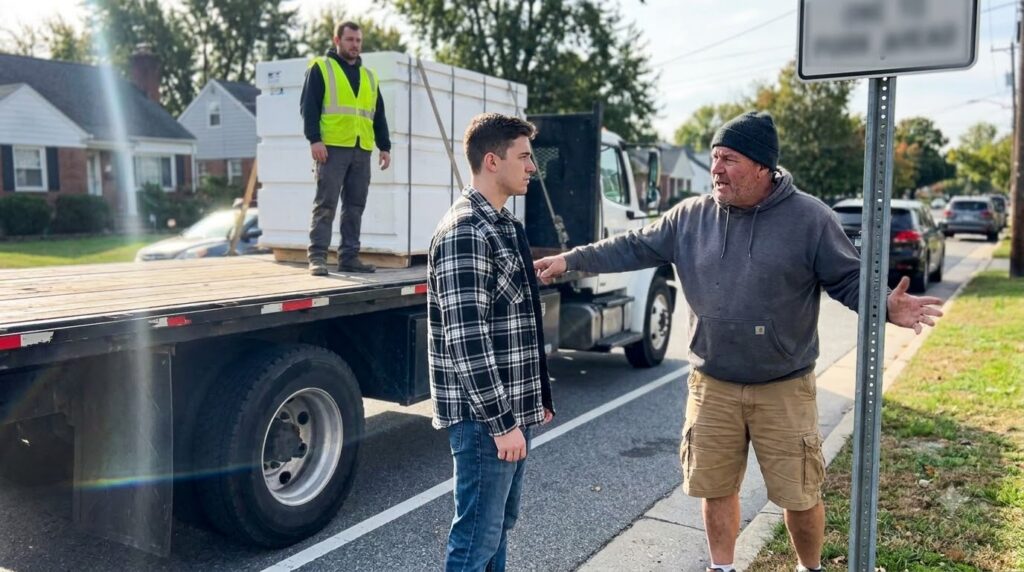
Arthur Vance planted his work shoes right against the cracked concrete of the curb, his stocky frame leaning forward like a fence post driven into bad soil. His dark knit cap was pulled low over his forehead, short gray stubble glinting in the harsh morning sun. One hand jabbed rhythmically toward the heavy rear duals of the flatbed, his gray hoodie bunched around his elbows from the force of the motion.

Mark Miller didn’t step back. He stood near the edge of the asphalt in his black-and-white plaid flannel, his work boots caked in dry yellow clay from the last job site. The diesel engine of the medium-duty rig idled behind him with a low, hydraulic thrum, sending tiny heat shimmers across the white powder-coated aluminum ramp sections secured on the bed.

Up on the flatbed, Dan stayed motionless. He held a ratcheting strap in one gloved hand, his high-vis vest a sharp orange wedge against the pale sky. He didn’t say a word. He knew better than to jump into a street fight before the paperwork came out of the cab.

“It’s a public street, Mr. Vance,” Mark said. His voice was flat, carrying the gravelly calm of a man who spent forty hours a week explaining municipal codes to angry homeowners. “We’re staging for three hours. The ramp has to be up before the transport van brings Mrs. Mercer back from the rehab center at two.”

“I don’t give a damn about the transport van,” Arthur snapped, stepping closer until his chest almost brushed the rusted steel post of the parking restriction sign. “This is my frontage. I maintain the turf strip. I mow it. I edge it. You park a ten-ton flatbed over my root systems, you compact the soil. You’re blocking the sightline for my driveway.”

Mark reached slowly into the chest pocket of his flannel, pulling out his reading glasses and unfolding them with one hand. He pointed toward the metal sign mounted on the post between them. The paint was faded, the red lettering chipped away by decades of road salt and summer heat, but the non-overnight restriction was clear enough.

“Sign says no parking two to six AM,” Mark noted, keeping his posture squared and arms loose. “It’s eight-fifteen in the morning.”

“That sign is for residents,” Arthur said, his jaw working under the stubble. He pulled a heavy leather-bound notebook from his hoodie pocket and slapped it against his palm. “I’ve logged every commercial vehicle that’s idling on this block since April. I’ve got the code enforcement officer on speed dial. You turn that key off and start unchaining that load, and I’m having the city hook this rig before your boots hit the grass.”

Mark didn’t reach for the truck door. He looked past Arthur’s shoulder, noticing the edge of a fresh white plastic binder poking out from the pocket of Arthur’s gray hoodie—a binder marked with the crest of the Elmwood Homeowners Association. But Mark knew for a fact that Elmwood Drive hadn’t operated an active HOA since the county annexed the road shoulder in ninety-eight.

Mark turned his eyes back to the signpost, catching the fresh silver glint of an unpainted hex bolt anchoring the steel to the concrete base—a bolt that hadn’t been stamped by the county road crew.

CHAPTER 2: STAGING THE LOAD

“Keep the straps tight until we get the outriggers down, Dan,” Mark called up, his voice barely cutting over the rattling cadence of the idling diesel.

Dan didn’t answer with words. He gave a sharp, single tug on the heavy yellow webbing, anchoring the ratcheting assembly to the flatbed’s steel frame before tossing the excess strap over the aluminum ramp sections. Up on the bed, six hundred pounds of high-grade modular aluminum sat bolted into transport crates, casting long, sharp shadows across the sun-bleached asphalt.

Mark stepped away from the curb, his boots crunching over tiny pebbles and dry leaf litter scattered along the gutter line. He kept his shoulder turned slightly away from Arthur Vance, maintaining a clear six-foot buffer while he unclipped the heavy fiberboard clipboard from the driver’s side door. The metal clip was rusted around the rivets, leaving a faint orange smudge on his thumb as he flipped through the laminated sheets.

Arthur hadn’t moved an inch from the curb line. His stocky frame remained planted like a wedge driven into the street, his gray hoodie damp with sweat along the collar despite the early morning chill. “You think having a clipboard makes you immune to city code, son?” Arthur shouted, the leather notebook in his palm thudding against his thigh with every word. “I know the district commissioner. I know the zoning supervisor. This whole street is designated C-1 light residential flow. You can’t stage a commercial rig for three hours without a dedicated traffic safety escort!”

“We’re not altering traffic flow, Mr. Vance,” Mark replied smoothly, his eyes scanning the header of the top document. “We’re parked flush with the curb. Six feet from the center line. Leaves fifteen feet of clear roadway for emergency vehicles and local passage.”

“Look at that tire!” Arthur jabbed his finger violently down toward the rear duals of the flatbed. “The sidewall is resting on the concrete gutter pan! That pan belongs to the property owner’s frontage responsibility under Section Fourteen of the municipal code! You’re crushing the drainage seam!”

“Section Fourteen covers structural alterations and unpermitted trenching,” Mark said, not looking up. “A pneumatic tire resting on a municipal gutter isn’t a structural alteration.”

He paused, his thumb stopping at the bottom of the second page. The city-issued right-of-way permit—stamped by the municipal clerk’s office three weeks ago—lay flat beneath the clear plastic sleeve. But where the digital authorization code was printed near the margin, a tiny offset misalignment in the ink caught his eye. The date stamp read July 21, 2026, while the secondary inspector signature line carried a manual pen-stroke date of July 19. A two-day clerical discrepancy. On a standard residential job site, it was a harmless administrative typo. On Elmwood Drive, with a man like Arthur looking for any loose thread to pull, it was an open tear.

Mark folded his reading glasses, tucking them back into his flannel shirt pocket before Arthur could track the direction of his gaze. He slid the clipboard under his arm, the hard fiberboard pressing firm against his ribs.

Across the street, a window blind twitched in the white ranch house with the overgrown hydrangeas. Old Mrs. Gable was standing behind the glass, her phone raised to her chest, recording the interaction with a slow, steady hand. Down the block, a riding mower engine sputtered and died as another neighbor, a guy in an oil-stained gray tank top, rested his hands on the steering wheel to watch the standoff.

“You’re real confident, aren’t you?” Arthur sneered, stepping off the curb and into the street shoulder, placing himself less than two feet from the flatbed’s rear bumper. He crossed his arms over his broad chest, his dark beanie pulled down so low his eyebrows were completely hidden. “You think because you’re installing something for old Clara, everyone on this block is just going to bow down and let you tear up the street. She hasn’t paid her HOA drainage dues in three years!”

“Mrs. Mercer’s personal finances aren’t part of my work order,” Mark said quietly. He walked toward the front of the truck, checking the distance between the front bumper and the neighbor’s low brick retaining wall.

As he passed the rusted parking sign, Mark’s knee brushed against the steel post. Near the base, buried beneath a clump of crabgrass and dried clay, a second metal plate was riveted to the post—an old, unpainted zinc tag stamped with a series of tiny numbers. It sat three inches lower than the standard municipal markers, almost hidden from view. Mark caught the glint of the zinc in the morning light, but he didn’t stop to clear the dirt away.

“You’re not dropping a single piece of metal on this street,” Arthur declared, taking two heavy steps to stay parallel with Mark, his voice booming down the quiet residential block. “I’m standing right here until the tow truck arrives. If your driver throws a lever, he’s operating heavy machinery with a civilian directly in the drop zone. Go ahead. Try it.”

Up on the truck bed, Dan looked down at Mark, his gloved hands pausing on the ratchet handle. The silence between the three men stretched taut, broken only by the steady, heavy thrum of the idling diesel.

CHAPTER 3: THE BARRICADE

Arthur stepped directly into the three-foot gap between the rear bumper of the flatbed and the curb, planting his heavy boots on the asphalt with a dull thud. His dark knit cap was pulled so low it grazed the bridge of his nose, his weathered jaw clenched until the pale stubble along his cheeks stood on end.

“I said hands off the straps, son!” Arthur roared, raising his arm to point a thick, calloused finger upward at the flatbed bed. “You drop a ramp section while I’m standing in this roadway, and it’s reckless endangerment with a commercial vehicle! You want to test that code with county dispatch?”

Up on the truck bed, Dan froze, his gloved fingers locked around the steel handle of the ratcheting winch. He didn’t look down at Arthur; his eyes shifted sideways to Mark, waiting for the signal. The diesel engine let out a rhythmic, throaty chug, vibrating the heavy steel bed beneath Dan’s boots and shaking loose a light shower of dry road dust onto the asphalt below.

Mark didn’t raise his voice. He took three deliberate steps toward the rear of the truck, the fiberboard clipboard held flat against his thigh. The sun-bleached asphalt radiated a dry, dusty heat that smelled faintly of old motor oil and baking tar.

“Dan, leave the straps pinned,” Mark said smoothly, keeping his voice leveled to a low, conversational tone that forced Arthur to stop shouting to hear him. “Kill the PTO drive. We’ll stay on the ground until we verify the curb line.”

Arthur let out a harsh, barking laugh, slapping his leather notebook against his thigh with a sharp crack. “Verify? There’s nothing to verify! Look at that curb! Look at that grass line! I’ve spent twenty years putting lime on that turf so it doesn’t die from street salt. I paid six hundred dollars out of my own pocket to have those landscape stones laid straight along the ditch! You think some kid in a flannel with a two-ton flatbed is going to roll in here and crush my grade?”

“The grade belongs to the county easement, Mr. Vance,” Mark said, leaning slightly against the rear corner stake of the flatbed. He let his arm rest against the steel body, feeling the vibration of the idling chassis travel through his forearm. “Three feet back from the flow line of the gutter. That’s public right-of-way under Section Nine.”

“Section Nine was amended in two-thousand-twelve!” Arthur snapped, his face flushing a dark, mottled red as he stepped even closer, his gray hoodie brushing against the steel corner post of the truck frame. “Neighborhood preservation districts carry explicit secondary rights for abutting property owners. You don’t know the code! You just read the glossy pamphlet they give you at the desk!”

Down the street, the man on the lawnmower dismounted, leaving the engine idling in a high-pitched whine as he walked toward the curb line with his hands thrust deep into his pockets. Two women from the cul-de-sac across the road stepped out onto their porch, their shadows stretching long across the manicured lawns in the sharp morning light.

Mark reached into his flannel chest pocket, pulling out a small steel measuring tape clipped to a brass ring. The metal casing was scratched down to the bare nickel, worn smooth by years of resting in toolboxes and belt loops.

“We can pull the tape right now,” Mark offered quietly, holding the silver casing out where Arthur could see it. “From the center line of the road to the edge of your stone wall. If my rear tires are sitting outside the utility corridor, I’ll crank the wheel and shift the rig six inches into the lane.”

Arthur’s eyes narrowed into tight slits. He didn’t look at the tape. His gaze snapped down to Mark’s chest, catching the white edge of the laminated permit sticking out from the top of the clipboard.

“You’re real quick with the tape, aren’t you?” Arthur said, his voice dropping into a tight, grating whisper that carried right over the rumble of the exhaust. “Let me see the secondary sheet. The green site clearance form. The one signed by the field inspector.”

Mark didn’t flinch, but his grip on the clipboard tightened by a fraction of an inch. Beneath the clear plastic sleeve, the two-day date discrepancy between the clerk’s stamp and the inspector’s pen stroke sat like a hairline fracture in a concrete foundation. If Arthur got his hands on the paper, he wouldn’t care about the easement or the wheelchair ramp; he’d use that forty-eight-hour gap to tie up city dispatch until the sun went down.

“The permit is posted in the cab window, where the municipal code requires it,” Mark replied, his voice unhurried.

Arthur smirked, taking a full step forward until he was standing directly between Mark and the cab door, his broad shoulders blocking the narrow path along the truck’s running board. He pulled his phone from his hoodie pocket with a flourish, his thumb hovering over the screen.

“We’ll see what dispatch says about missing field signatures,” Arthur sneered, raising the phone to his ear. “I’m calling the code supervisor right now. And I’m telling him we’ve got a commercial driver refusing to display his secondary clearance on an active work site.”

Behind Arthur, at the base of the rusted signpost, the tiny zinc tag remained half-buried in the dry dirt, its stamped serial numbers catching the light just beneath the weeds. Mark looked at the signpost, then at Arthur’s phone, his face completely unreadable.

“Go ahead and make the call, Arthur,” Mark said softly. “Ask for Inspector Miller.”

CHAPTER 4: THE WITNESSES

Arthur paused with the phone raised three inches from his ear, his thumb hovering motionless above the glowing screen. The glare of the morning sun bounced off the display, highlighting a web of fine scratches in the glass. His head turned slowly, his small eyes narrowing as he processed the surname.

“Inspector Miller?” Arthur repeated, a scoff catching in his throat before he could fully turn it into a laugh. “You’re trying to bluff me with a family connection? The district supervisor is Miller? Is that supposed to scare me off my own curb?”

“My brother Dave runs the county utility access compliance division out of the east office,” Mark said calmly. He reached for the driver’s side door handle, the painted steel of the cab hot beneath his palm. He pulled the heavy door open until the latch caught with a solid, metallic click. “He doesn’t issue the staging permits—that’s city zoning—but he audits every easement dispute between the highway department and private lot boundaries. Go ahead and dial. Ask him about the Elmwood corridor.”

Arthur’s jaw muscles twitched. He lowered the phone two inches, but he didn’t put it away. Instead, he jabbed his finger back toward the white ranch house down the block.

“I don’t need your brother,” Arthur growled, his voice rising in pitch to reach the growing circle of onlookers. “I’m calling the municipal dispatch desk. I’m filing an active roadway obstruction report under Code Nine-A.”

Across the street, Mrs. Gable stepped off her front porch, her vinyl house slippers making a dry, scuffing noise against her sweeping sidewalk. She didn’t cross the road, but she stopped right at the edge of her lawn, wrapping her faded floral cardigan tight around her shoulders.

“Arthur!” she called out, her voice thin and raspy from years of tobacco use. “Is that Clara’s ramp truck? They told us at the block meeting last month she was coming home today!”

“They don’t have the staging clearance, Evelyn!” Arthur yelled back without looking at her, keeping his posture squared squarely against Mark. “They’re staging a heavy commercial chassis over the ditch line! If they crush that culvert, the stormwater backs up straight into your south garden during the next downpour!”

Mrs. Gable paused, her hands tightening on the sweater. She looked from Arthur to the flatbed’s wide rear duals, then over at Mark, who stood by the open cab door with his fiberboard clipboard resting against his thigh.

Down the block, the guy in the oil-stained tank top had walked all the way to the edge of Arthur’s driveway. He stood with his arms crossed, his work boots kicking lightly at a tuft of crabgrass sprouting through a crack in the asphalt curb. “Art, come on,” the neighbor said softly, his voice low enough that it barely carried over the steady thrum of the diesel engine. “It’s just a flatbed. They’ll be out of here by noon.”

“It’s not about noon, Gary!” Arthur snapped, his head whipping around to glare at the neighbor. “It’s about precedent! You let one contractor set up an unpermitted staging zone on the curb line, and by next spring every flip-house crew in the township will be dumping gravel on our lawn edges! We have rules in this subdivision for a reason!”

Mark let out a slow, steady exhale through his nose, feeling the dry dust of the street settle in the back of his throat. He reached inside the open cab, pulling the secondary document folder from the glove box. The plastic sleeve was slightly yellowed at the edges, stiffened by heat and age.

He unclipped the top sheet of the permit stack on his clipboard, sliding the green site-clearance sheet into view. There it was—the inspector’s manual signature in faded blue ink. But beneath it, stamped near the bottom margin in purple ink, was the date stamp: July 19, 2026. Two days before the official municipal approval date printed on the city’s digital header.

If Arthur got his hands on the sheet and read the dates carefully, he’d realize the field inspection had been conducted before the formal work order was entered into the city registry—a minor clerical sequencing flaw, but enough to give a legal stickler like Arthur grounds to demand a formal stop-work order until the city desk reopened on Monday.

Mark folded the document packet back inside the fiberboard cover, clipping it tight. He looked down at the base of the signpost between them.

The small zinc plate buried near the roots of the crabgrass caught the light again. Mark knelt down on one knee, pretending to adjust the steel buckle on his work boot. As he leaned over, his rough thumb scraped a layer of dry, caked mud away from the zinc surface.

The numbers stamped into the soft metal weren’t county highway markers. They were county surveyor reference tags—a permanent benchmark set during the nineteen-ninety-eight road annexation.

Arthur watched him kneel, his brow furrowing as he took a half-step back, his boots crunching on the loose grit of the gutter pan. “What are you messing around in the dirt for?” Arthur demanded, his voice dropping its grandstanding tone, suddenly sharp and suspicious. “Get up off the ground and produce that secondary clearance form!”

Mark stood up slowly, wiping the yellow dust from his knee with a quick brush of his hand. He didn’t offer the clipboard. He looked Arthur straight in the eyes, his face completely calm.

“Dispatch isn’t going to care about the staging permit, Arthur,” Mark said softly, his voice carrying only to Arthur and Gary standing on the driveway edge. “Because when the deputy gets here, the first thing he’s going to do is pull the benchmark off that post.”

Arthur’s eyes darted down to the base of the signpost, then back up to Mark’s face, his chest rising and falling beneath his gray hoodie as he held the phone tight against his palm.

CHAPTER 5: THE STANDOFF AT THE TRUCK BED

“Dispatch, this is Arthur Vance,” Arthur blurted into the phone speaker, his jaw working violently as he raised his voice so the neighbors across the street could hear every syllable. He took two heavy steps toward the rear dual tires of the flatbed, planting his work shoes right in the gutter pan. “I have a commercial flatbed unit blocking the public thoroughfare at forty-two Elmwood. Driver refuses to move. He’s staging heavy equipment over a municipal drainage line without displaying valid site clearance.”

Mark didn’t move to stop him. He stood in the narrow gap between the cab running board and the rusted signpost, his hands resting loose on the edges of the fiberboard clipboard.

Up on the truck bed, Dan unclipped his safety lanyard from the headache rack, stepping down to the edge of the wooden sideboards. His tall, high-vis frame cut off the glare of the morning sun, casting a long, dark shadow right across Arthur’s gray hoodie.

“Dispatch says a patrol unit is en route,” Arthur said, snapping his phone shut and sliding it into his hoodie pocket with a sharp, victorious jab. He crossed his arms over his chest, his stocky frame leaning hard against the rear fender of the flatbed. “Two minutes, Miller. You’ve got two minutes to turn that key and back this rig out to the main collector road, or you’re getting cited for commercial obstruction.”

“We’re staying right here, Arthur,” Mark said. His tone was level, stripped of heat or anger, but his thumbs pressed firmly against the steel clip holding his document stack.

Arthur’s eyes drifted down to the clipboard, catching the green corner of the site clearance form sticking out from the plastic sleeve. A thin, mean smile tugged at the corner of his stubbled mouth. “You keep hiding that green sheet under your arm like it’s a poker hand. Why don’t you hand it over? Let Gary take a look at it. Let’s see what date the city stamped on that work order.”

Gary, standing five feet away on the edge of the driveway, shifted his weight from boot to boot, looking uncomfortable. “Art, leave the paperwork to the deputy,” Gary muttered, rubbing the back of his sun-reddened neck. “If they’ve got a permit, they’ve got a permit.”

“No, Gary, that’s where you’re wrong,” Arthur barked, turning his shoulder to keep Mark pinned against the truck frame while gesturing toward the crowd gathered along the sidewalks. “These regional outfits run on expired temporary passes all the time! They pull a three-day staging pass for one street, then reuse the same stamped copy across four different townships hoping nobody checks the date lines!”

Arthur lunged forward half a step, reaching out a thick, calloused hand to snatch the clipboard straight out of Mark’s grip.

Mark didn’t pull back. Instead, he let the fiberboard slide freely, unpinning his fingers so Arthur caught the full weight of the wooden board in his palm.

Arthur pulled the clipboard to his chest, his eyes light with triumph as he flipped open the clear plastic cover. “Here it is,” Arthur shouted, turning so the sun hit the page directly. “City of Oakland Public Works Staging Permit, issued July twenty-first!” He jabbed his thumb onto the blue ink signature at the bottom margin. “Look at the inspector’s sign-off! July nineteenth! Two days before the city registry even generated the document number!”

Arthur held the clipboard high above his head, turning in a full circle toward Mrs. Gable on her porch and Gary on the driveway edge. “It’s a defective permit! The field signature predates the authorization! This paper isn’t worth the laminated sleeve it’s printed in! He’s running an illegal work site on our curb!”

A low murmur rippled through the neighbors watching from the lawns. Mrs. Gable took a small step back toward her front door, her floral cardigan pulled tight over her collarbone, while Gary shook his head, looking down at his boots.

Arthur grinned, stepping right back into Mark’s personal space, thrusting the clipboard back against Mark’s chest. “You thought you had me, didn’t you? You thought you could slide an invalid, out-of-sequence permit past a guy who knows this district line inside and out! Your permit is dead, Miller. Game over.”

Mark took the clipboard back smoothly, slipping it under his arm without looking down at the ink stamps. His face remained as hard and unreadable as the iron frame of the flatbed idling behind him.

“You found the date discrepancy, Arthur,” Mark said softly, his voice cutting through Arthur’s gloating laugh like a cold blade. “You’re right. The clerk typed the wrong entry date on the secondary clearance sheet.”

Arthur’s smile widened, his shoulders puffing up beneath his gray hoodie. “So you admit it! You don’t have legal right-of-way!”

“I admit the city clerk made a typo,” Mark replied, stepping past Arthur until his boot touched the base of the signpost. “Which means when the deputy steps out of his cruiser, you’re going to force him to call out the county surveyor to verify the physical plat markers.”

Mark pointed his finger down at the tiny zinc tag buried at the root of the crabgrass. “And that’s where your real problem begins.”

CHAPTER 6: THE ARRIVAL OF AUTHORITY

A sharp, chirping siren blast split the sun-baked quiet of Elmwood Drive.

The white-and-blue municipal patrol cruiser turned slowly off the main collector road, its tires kicking up a fine spray of grit as it pulled alongside the flatbed. The driver’s side door swung open before the engine was fully cut, and Deputy Miller—no relation to Mark, though he wore the same weathered, methodical expression common to county public servants—stepped out onto the asphalt. His leather gun belt creaked softly under the weight of his sidearm and radio housing as he adjusted his peaked cap against the blinding morning glare.

Arthur didn’t wait for the officer to cross the yellow dividing line. He lunged forward from the curb, his gray hoodie bunched around his shoulders, holding his leather notebook aloft like a shield.

“Deputy! Over here!” Arthur bellowed, stepping directly into the patrol car’s path to force the officer to halt on the road shoulder. “I’ve got a commercial crew operating an unpermitted staging zone right over a municipal drainage easement. They’re blocking the roadway, compacting private lawn frontage, and refusing to move!”

Deputy Miller paused, his hand resting lightly on his utility belt as his eyes swept the scene. He looked at Arthur’s red, sweat-streaked face, then at the flatbed idling quietly with its rear tires parked neat against the gutter pan, then up at Dan, who remained motionless on the truck bed. Finally, his eyes settled on Mark, who stood by the rusted signpost holding the fiberboard clipboard against his thigh.

“Mornin’, Art,” the deputy said, his voice a low, dry drawl that carried the dust of a thousand routine traffic checks. “Who called dispatch?”

“I did,” Arthur declared, puffing out his broad chest and pointing a finger straight at Mark’s face. “And I’m demanding an immediate commercial tow under Code Nine-A! I inspected their staging clearance sheet myself—the field sign-off is dated two days before the municipal approval stamp! They’re running an invalid document on a restricted residential street!”

Deputy Miller turned his head toward Mark, nodding once. “That true, son? You got a date gap on your staging permit?”

Mark didn’t offer excuses or raise his voice. He took three steps toward the hood of the patrol cruiser, placing the clipboard flat on the warm, white enamel surface where the officer could see every page.

“The clerk in the city engineering office made an entry typo on the secondary clearance sheet, Officer,” Mark said, his voice flat and steady. “The master work order number is active. The staging clearance was approved by phone at seven-thirty this morning because we have a medical access ramp delivery for Mrs. Mercer at forty-six Elmwood.”

“I don’t care if it’s for the governor!” Arthur shouted, stepping up to the fender of the squad car and slapping his hand against his thigh. “A defective permit is a null permit! The law doesn’t make exceptions for medical ramps or clerk typos, Deputy! If that paper isn’t fully sequence-valid, this truck has no legal right to occupy six inches of this curb line!”

Deputy Miller leaned over the hood, flipping open the plastic sleeve on the clipboard with a gloved index finger. He studied the blue ink signature, then the purple date stamp, his brow furrowing slightly.

“Art’s got a technical point, son,” the deputy murmured, looking up at Mark. “If the city desk entered the clerk’s stamp after the field signature without an official override code, this staging permit is technically flagged in the computer until the desk supervisor clears the queue. If he insists on pressing an obstruction complaint right now, I have to ask you to shut down the rig and wait for the watch commander to verify the line.”

Arthur let out a loud, triumphant snort, turning toward Gary and Mrs. Gable with his arms raised. “You hear that? Flawed paperwork! The truck stops right now! Clear the street!”

Mark looked at the deputy, then at the clipboard, feeling the cold weight of a bureaucratic failure threatening to lock down the entire morning. The transport van carrying Clara Mercer was already on the highway from the rehab center. If the flatbed was forced to pull out now, the ramp wouldn’t be built by two o’clock, and a seventy-two-year-old woman with a fresh hip replacement would be left sitting in a wheelchair on a steep concrete driveway.

“The staging permit might have a clerical delay, Deputy,” Mark said softly, his voice dropping into a razor-sharp register that made Arthur’s arms drop back to his sides. “But the staging permit only applies to private street frontage.”

Deputy Miller looked up from the hood, his eyes narrowing. “Meaning what?”

Mark stepped away from the squad car, walking straight back to the base of the rusted signpost. He knelt down in the dirt, driving his fingers into the clump of crabgrass and pulling the weeds away from the steel post until the entire zinc tag was exposed in the bright sunlight.

“Meaning this sign isn’t a parking restriction sign,” Mark said, pointing to the stamped serial numbers on the unpainted metal plate. “It’s a County Highway Department easement marker. Placed here during the ninety-eight road annexation.”

Arthur scoffed, stepping toward the signpost with his fists clenched in his hoodie pockets. “So what? It’s a sign! My property line runs right up to the back of that concrete curb!”

Mark stood up, wiping the dry dirt from his palms, his eyes fixed on Arthur. “No, Arthur. It doesn’t.”

CHAPTER 7: THE PROOF ON THE HOOD

“What do you mean, it doesn’t?” Arthur snapped, his voice cracking as he took a quick, aggressive step off the curb pan. “I bought this property in two-thousand-four! I have the deed in my safe! Thirty-five feet of road frontage, straight from the center line to my front porch foundation!”

Mark reached into the back sleeve of his clipboard, pulling out a folded piece of heavy blue-line paper. The creases were worn soft from handling, yellowed around the margins where thumb pressure had flattened the paper a dozen times on hood tops and tailgate beds across the county. He unfolded it smoothly, spreading the county plat map over the warm, white hood of Deputy Miller’s patrol car right beside the permit folder.

“Deputy,” Mark said, his voice quiet, devoid of drama or grandstanding. “Run the serial tag on that zinc plate through county GIS. Benchmark number Four-Eight-Nine-C.”

Deputy Miller leaned over the hood, resting his gloved forearms on the metal. He tapped the radio on his shoulder, his eyes scanning the technical grid lines on the blue-line sheet while he spoke to the regional dispatcher. “Dispatch, unit four-seven. Run a property plat verification on Elmwood parcel forty-two. Reference benchmark Four-Eight-Nine-C.”

Arthur stood rooted to the street shoulder, his fists clenched tight in the pockets of his gray hoodie. Sweat was dark along his collar, glistening on his stubbled cheeks despite the dry morning breeze. “This is nonsense! A surveyor’s benchmark from thirty years ago doesn’t overturn a recorded residential boundary!”

The radio on the deputy’s shoulder crackled to life, breaking the quiet with a burst of static before the dispatcher’s voice came through, crisp and flat. “Unit four-seven, GIS confirms benchmark Four-Eight-Nine-C. Annexation ordinance ninety-eight-fourteen established a ten-foot public utility and drainage easement extending inland from the flow line of the concrete curb along the entire south side of Elmwood Drive.”

Deputy Miller didn’t look up from the map. He pulled a brass pocket rule from his vest, laying it flat across the scale line at the bottom of the page. “Ten feet from the curb pan, Art,” the deputy said softly.

Mark pointed a calloused finger at the hand-drawn red line marking the physical features of the lot. “And here’s your stone retaining wall, Mr. Vance. And your decorative brick border.”

Arthur’s mouth opened, but no sound came out. His eyes darted frantically between the plat map, the deputy’s calm face, and the neat row of stacked stone he had spent fifteen years mortaring and edging along the lawn.

“Your actual deeded property line doesn’t start at the curb,” Mark said, his voice entirely factual, devoid of victory or gloating. “It starts four feet behind your stone wall. That turf strip, the gutter pan, the ditch line, and the first four feet of what you call your front lawn belong to the county public right-of-way.”

Gary, standing on the edge of the driveway, let out a low, breathless whistle, looking down at the stone wall beneath his boots as if the earth had suddenly shifted six inches to the left. Across the street, Mrs. Gable leaned forward over her porch rail, her hand cupped behind her ear to catch every word coming off the patrol car’s hood.

“Which means,” Deputy Miller said, turning his head slowly to look Arthur straight in the eye, “Mr. Miller’s flatbed isn’t parked on your frontage, Art. It’s parked in the public utility corridor. They don’t even need a secondary municipal staging permit to occupy this shoulder for utility work, because county right-of-way clearance supersedes city light-residential parking codes.”

The silence that settled over Elmwood Drive was thick, heavy, and absolute, broken only by the steady, unyielding thrum of the flatbed’s idling diesel engine.

Arthur looked down at his own work shoes resting in the gutter pan, his face draining of color until the stubble on his cheeks looked gray and hollow in the harsh sunlight.

“The clerk’s typo on the city paper doesn’t matter, Arthur,” Mark said softly, folding the blue-line map back into its neat, worn squares. “Because you’ve been standing in the county’s driveway the whole time.”

Deputy Miller tapped his gloves against the hood, the sound flat and final. “Art,” the deputy said, his tone leaving no room for argument. “Step back onto your porch.”

CHAPTER 8: THE PUBLIC FLIP

“Step back, Art,” Deputy Miller repeated, his voice dropping into the quiet, heavy register of a man who didn’t intend to say a phrase three times. He didn’t unclip his holster, but his right thumb rested lightly against the leather strap at his hip. “You’re standing in the middle of a county utility corridor, actively obstructing a permitted road crew.”

Arthur’s mouth worked, his tongue dry against his teeth. He looked down at the concrete gutter pan beneath his work shoes, then at the low, mortared stone retaining wall he’d spent fifteen years pointing, washing, and defending against every weed that dared sprout between the joints. The stones sat four full feet inside the county boundary line—an illegal encroachment on public land that had only survived because nobody had ever bothered to pull the benchmark tag out of the crabgrass.

“Deputy,” Arthur rasped, his voice losing its booming resonance, shrinking into a thin, dry wheeze. “You can’t just… I built that wall. I laid those capstones myself.”

“And if county highway decides to widen this ditch or lay a culvert line next spring, Art, they’ll bring a backhoe through here and scrape those capstones straight into a dump truck,” Deputy Miller said bluntly. He took a single step toward Arthur, closing the distance until his shadow fell over Arthur’s gray hoodie. “Right now, this crew is putting in an accessibility ramp for a neighbor. You’re going to turn around, walk up your driveway, and stay off this shoulder until they finish their work.”

“And if I don’t?” Arthur’s chin twitched upward, a last, desperate spark of defiance flickering in his pale eyes, though his knuckles were trembling inside his hoodie pockets.

“Then I cite you under Section Twelve-B for interference with a public easement worker,” the deputy replied without missing a beat. “You can explain your retaining wall to the magistrate at nine o’clock on Monday morning.”

Gary took a slow step backward on the driveway, clearing the path between Arthur and his front porch. He didn’t look at Arthur. He looked across the street, where Mrs. Gable was already stepping down off her porch stairs, heading across the road toward Mark with a small, folded envelope in her hand.

“Come on, Art,” Gary murmured, his voice flat, stripped of the casual neighborly deference he’d given Arthur for years. “Let the guys do their job.”

Arthur looked at Gary, then at Deputy Miller’s steady, unyielding stare. Slowly, as if every joint in his stocky frame was filled with dry sand, Arthur turned his back on the flatbed truck. His boots dragged along the asphalt gutter pan, making a rough, scraping sound against the grit as he stepped up onto the grass—the grass that wasn’t his, on the land that didn’t belong to him.

He walked up his concrete driveway, his shoulders hunched tight under his gray hoodie, his dark knit cap pulled down almost to his collar. He didn’t look back when his front screen door slammed shut behind him, the brass latch catching with a hollow, echoing metallic click that carried all the way down the block.

Deputy Miller let out a slow breath, turning back to the hood of the squad car. He picked up his pocket rule and tapped it against the laminated surface of Mark’s clipboard before handing the file back across the white enamel hood.

“City clerk still needs to fix that date stamp on the digital log, Miller,” the deputy noted, though a faint, dry twitch of a smile touched the corner of his mustache. “Make sure your office runs the correction before you pull out this afternoon.”

“First thing after we anchor the landing pad, Officer,” Mark said, taking the clipboard and sliding it back into the driver’s side cab pocket.

Up on the truck bed, Dan didn’t waste a second. The moment the deputy turned back toward his cruiser, Dan grabbed the steel handle of the ratcheting winch. With a sharp, metallic clack-clack-clack, he freed the primary yellow strap, tossing the heavy webbing clear of the aluminum ramp crates. The diesel engine gave a deep, throaty thrum as the hydraulic PTO pump engaged, ready to swing the crane arm out over the curb.

Mark stepped up to the rear corner stake, his work boots planted firm on the asphalt edge. He looked up at the quiet windows of Arthur’s house, then down the long, sun-bleached line of Elmwood Drive, where the transport van carrying Clara Mercer was just turning the corner onto the block.

CHAPTER 9: THE OPEN ROAD

The silver-and-blue transport van slowed to a stop along the curb, its hazard lights blinking rhythmically against the sun-baked pavement. The driver killed the engine, leaving the soft hum of the street to be filled by the mechanical whine of Mark’s hydraulic crane.

Mark stepped away from the flatbed’s outriggers, his work boots leaving dusty prints on the asphalt. Up on the bed, Dan swung the crane boom smoothly out over the curb, lowering the first heavy aluminum ramp section onto the grass strip—the public utility easement that Arthur had spent fifteen years claiming as his private lawn.

The heavy aluminum tubing met the turf with a solid, hollow thud. It didn’t crush the soil; it sat level across the grade, anchored squarely by the steel footings Dan adjusted with a socket wrench.

Mrs. Gable walked up to the edge of the curb, holding her faded floral cardigan tight against the light breeze. She looked at the ramp sections, then over at the quiet front porch of Arthur’s house. The blinds in Arthur’s living room window were drawn tight, casting a dark, lifeless shadow across his manicured lawn.

“Mark,” Mrs. Gable said softly, her raspy voice barely carrying over the clinking of Dan’s socket set. “He’s been putting those orange traffic cones in the street since ninety-nine. Every time my daughter came to visit, Arthur would stand out on the porch with his stopwatch, threatening to call the county if her car stayed parked past four o’clock.”

Mark wiped his brow with the back of his sleeve, leaving a streak of grey road dust across his forehead. “Well, Mrs. Gable, the county benchmark says the street belongs to the street.”

He turned as the rear doors of the medical transport van swung open. The driver lowered the hydraulic lift, guiding a narrow wheelchair onto the driveway apron. Seventy-two-year-old Clara Mercer sat tucked under a light plaid blanket, her face pale from three weeks in the rehab ward, but her dark eyes sharp as she looked up at the front entrance of her house.

Four steep, concrete steps led to her front door—steps that had kept her trapped inside her own home before her hip gave out, and steps that would have kept her from coming home today if the flatbed had been turned away.

Mark stepped forward, unpinning the secondary support bracket from his tool belt. He aligned the top aluminum transition plate with the threshold of Clara’s porch, driving two heavy galvanized steel pins through the pre-drilled flange until they locked deep into the wood framing.

“Hold the level on the landing, Dan,” Mark called out, his voice steady, carrying the quiet rhythm of a job well done.

Dan adjusted the telescoping leg on the top section until the tiny green bubble in the spirit level sat dead center between the black lines. “Landing’s solid, boss. Grade is three-eighths per foot. Perfect ADA slope.”

Clara’s driver rolled her wheelchair smoothly onto the newly installed aluminum walkway. The rubber wheels glided over the powder-coated tread without a bump, the high safety rails offering a solid, metallic grip as she ascended the incline toward her front door.

As she reached the top landing, Clara paused, her hands resting on the smooth aluminum railing. She looked back over her shoulder, down the long, sun-lit stretch of Elmwood Drive. She saw the flatbed truck parked neat against the curb line, the deputy’s cruiser rolling slowly away down the block, and Gary standing on his own driveway, waving a brief, quiet hand of greeting across the lawn.

Mark folded his tape measure, slipping it back into the chest pocket of his black-and-white plaid flannel shirt. He walked back to the driver’s side of the flatbed, climbing up onto the running board to slide his clipboard back into the cab holder. The laminated permit pages rattled slightly in the breeze—the clerical date typo still printed in purple ink near the margin, completely irrelevant against the cold, unyielding reality of the county survey benchmark buried beneath the signpost.

He turned the ignition key. The heavy diesel engine purred to life, a steady, low vibration shaking the dust from the steel chassis. Dan hopped into the passenger seat, pulling his work gloves off with a sharp leather slap and tossing them onto the dashboard.

Mark released the air brake with a heavy, satisfying pfffft of pressure. He pulled the flatbed out into the center lane of Elmwood Drive, leaving the open curb behind him, clear and unobstructed under the bright afternoon sun.

Similar Posts

Leave a Reply

Your email address will not be published. Required fields are marked *