The Quiet Hand on the Latch: Finding Sanctuary Behind an Inherited Door

CHAPTER 1: THE WEIGHT OF WOOD AND BRASS

The fist didn’t hit the brass knocker; it rattled the hollow oak frame so hard dust sifted out of the transom above Maya’s head.

Maya froze on the bottom step of the foyer, a half-taped cardboard box heavy in her arms. The house still smelled of her uncle Arthur’s tobacco, faded linseed oil, and forty years of settled dust. Outside, the midday humidity hung thick across Oak Ridge, but inside the hallway, the air was cool, gray, and fragile.

Another sharp rap struck the door, followed by the dry click of acrylic fingernails tapping against the exterior paint.

Maya set the box down on the floorboards, her thumbs brushing the faded denim of her work pants. She rolled her shoulders back, feeling the ache of a three-hour drive and two days of loading furniture. When she pulled the heavy wooden door inward, she kept her palm flat against the inner brass latch, holding the opening to a narrow, four-inch gap.

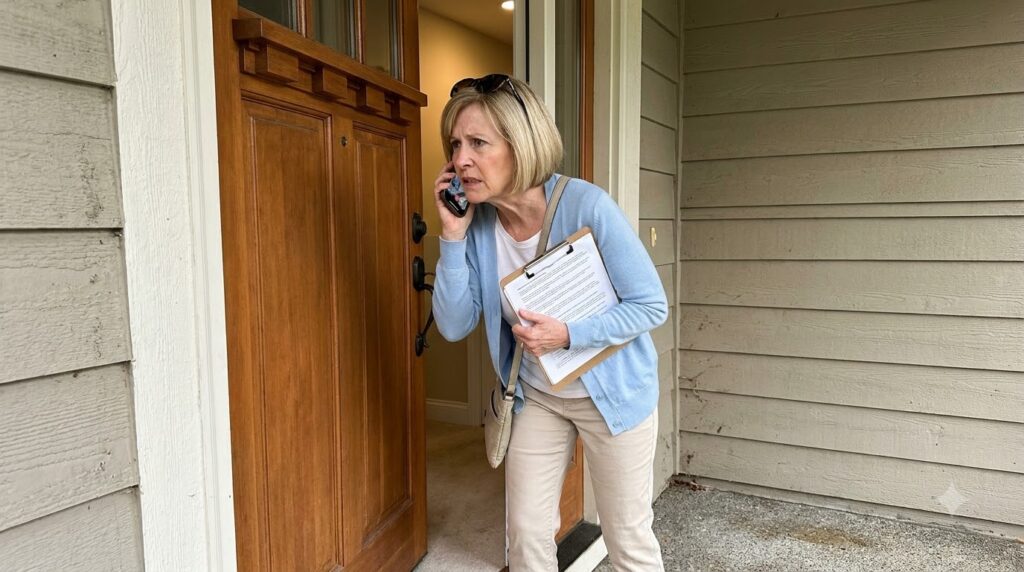
Standing on the porch mat was a woman in her early sixties, her short blonde bob perfectly styled despite the muggy air. A pair of oversized sunglasses rested on top of her head, catching the harsh white glare of the afternoon sun. She wore a light blue knit cardigan over a immaculate white blouse, a dark leather crossbody bag cutting diagonally across her chest. Locked firmly under her left elbow was a thick wooden clipboard, crammed with yellowing paper and printed template forms.

She did not offer a name. She did not look at Maya’s face. Her eyes swept immediately past Maya’s shoulder, probing the shadowed hallway as if searching for contraband.

“You’re blocking the driveway with that commercial van,” the woman said. Her voice was thin, clipped, and practiced, pitched just loud enough to carry past the hydrangeas toward the street. “And this property hasn’t been cleared for occupancy by the neighborhood committee.”

Maya kept her hand on the latch. “Good afternoon. The van belongs to the courier company. We’re unloading personal belongings.”

“It doesn’t matter whose van it is,” the woman snapped, leaning forward. Her stance was aggressive, her hip pressed against the wrought-iron porch railing as she wedged her foot inches from the threshold. She tapped the wooden clipboard against her chest with a dry, wooden thud. “This estate is under review. You can’t just step into this place and take over like this.”

Through the gap in the door, Maya caught sight of Greg, the parcel courier, pausing near the bumper of his truck at the curb, a wardrobe box balanced on his thigh. Across the street, a neighbor idling behind a riding mower turned off the engine, leaning over his steering wheel to watch the porch.

“I am Arthur Vance’s niece,” Maya said quietly, her tone dropping into a steady, measured cadence. “The deed was filed with the county clerk three weeks ago. If you have questions about the driveway, you can speak to me, but please step back from the door.”

The woman’s lips pressed into a thin, pale line. She didn’t retreat an inch. Instead, she slipped a smartphone from her cardigan pocket with her free hand, thumbing the screen with practiced speed before bringing the speaker to her ear.

“We’ll see what the county says about an unregistered occupant,” she said, staring directly into Maya’s eyes as the phone began to ring. “I’m calling Code Enforcement right now.”

As the call connected, the woman turned her head slightly into the mouthpiece, though her body remained wedged against the entry lane, blocking the door. “Yes,” she said sharply into the phone, her voice dropping into a tone of official urgency. “I’m still here at the door. I need an officer down here immediately—she’s holding a legal notice I served her late last year.”

Maya’s fingers tightened on the brass handle. Her uncle had been dead for six months, but the letter the woman was clutching at the top of her clipboard bore Arthur’s distinct, shaky handwriting right across the header.

CHAPTER 2: SIFTING THE ASHES

The stroke of the A was unmistakable. Arthur Vance had a tremor in his right hand for the last five years of his life, turning his capital letters into jagged, uncertain staircases. Seeing that jagged script pressed against the yellowed paper under Brenda’s thumb sent a sudden, cold jolt through Maya’s stomach.

Brenda didn’t notice the freeze in Maya’s posture. She was already speaking into the receiver, her voice pitched in that sharp, practiced cadence designed to sound like an authority figure managing an unruly child.

“I have a female, mid-thirties, refusing to clear the entryway,” Brenda informed the unseen operator, her eyes remaining fixed on Maya’s face like a pair of dull glass beads. “She’s claiming relation to the deceased owner, but there is no record of an approved transfer with the neighborhood committee. I am standing on the porch now.”

Maya didn’t raise her voice. She didn’t reach through the four-inch gap to snatch the clipboard, though every instinct honed by months of dealing with aggressive creditors and greedy distant relatives urged her to rip the paper free. Instead, she leaned her shoulder against the solid oak jamb, letting the weight of the door settle firmly against her palm.

“Brenda,” Maya said, her voice dropping into a quiet, deliberate rasp that cut straight through the woman’s phone dialogue.

Brenda paused mid-sentence, her eyebrows twitching upward beneath her blonde fringe. “I am on the phone with municipal dispatch.”

“You are holding a piece of paper with my uncle’s signature on it,” Maya said, keeping her gaze pinned to the worn wooden edge of the clipboard. “Arthur hasn’t lived in this house for six months. He spent his last ninety days in hospice. Where did you get that document?”

A tiny, almost imperceptible shift occurred in Brenda’s stance. Her forward lean faltered by a fraction of an inch, her elbow tightening against her ribs, pulling the clipboard closer to the light blue knit of her cardigan. For a half-second, the defensive posture cracked, revealing the sharp, defensive panic of a person caught reaching into someone else’s coat pocket.

“This is official neighborhood correspondence,” Brenda said into the phone, though her tone had lost its crisp edge, turning brittle and defensive. “She is attempting to intimidate an authorized representative. Please dispatch a unit.”

Down at the curb, the heavy clatter of Greg’s parcel truck died down as he shut off the diesel engine. The courier pulled his cap off, wiping his brow with the back of his forearm while eyeing the porch. Across the street, the neighbor on the riding mower hadn’t restarted his engine; he sat motionless, his arms resting on the plastic steering wheel, taking in every second of the standoff.

Maya stepped back just half an inch, pulling her smartphone from her back pocket with her left hand while her right remained anchored to the door latch. She unlocked the screen with her thumb, navigating directly to the encrypted folder containing the digital probate filings, the stamped land-deed transfer, and the municipal occupancy certificate issued by the county clerk three weeks prior.

“I’m not going to argue with you on this porch,” Maya said, holding the screen up against the glass pane beside the doorframe so the high-resolution county seal glowed clearly against the wood. “The county registered this deed on the fourth. The estate is settled. Whatever note you have on that board has nothing to do with property rights.”

Brenda glanced at the glowing screen for a brief, furious second before snapping her head back toward the driveway. “A digital image proves nothing. Anyone can edit a PDF on a home computer. The neighborhood standards agreement requires physical verification on site.”

She didn’t wait for a response. Turning her back slightly toward the doorway, Brenda took two deliberate steps toward the top of the porch stairs, keeping her body wedged just close enough to the handrail to block anyone from bringing more boxes up the concrete steps. She kept the phone pressed hard against her ear, repeating her location in a clipped, demanding bark.

Maya let the door swing closed just enough to engage the brass deadbolt with a heavy, metallic clack.

Inside the shaded hallway, the silence returned, thick and suffocating. Maya stood with her forehead resting against the cool, painted wood of the closed door for three long breaths, listening to the muffled cadence of Brenda’s voice outside.

Her mind raced back through the chaotic weeks following Arthur’s funeral—the endless cardboard boxes, the dusty filing cabinets in his study, the missing utility bills, and the strange, vague notes Arthur had left in his daily journal during his final year. B. came by about the hedge. Signed the paper so she’d leave the porch.

At the time, Maya had assumed it was a trivial dispute over landscaping. But looking at the sharp, aggressive way Brenda guarded that wooden board, a darker realization began to take root. Brenda wasn’t just enforcing arbitrary neighborhood rules. She had been coaxing an ailing, isolated old man into signing documents long before he passed away—and whatever was written on that top yellow sheet was the key to why she was fighting so desperately to keep Maya outside the threshold.

Outside, the distant whine of a siren echoed from the direction of the main avenue.

CHAPTER 3: SHADOWS IN THE GRAIN

The deadbolt’s metallic click still hummed in Maya’s hand as the siren shifted pitch two blocks away. It was a high, thin wail that cut cleanly through the quiet hum of Oak Ridge, reminding her that the outside world was closing in fast.

She didn’t stay pressed against the door. Instead, Maya turned back toward the foyer, her boots making a quiet, rhythmic thud against the wide-plank oak flooring. The house felt oversized around her, filled with the looming silhouettes of furniture wrapped in drop cloths and half-filled moving boxes. Every corner carried Uncle Arthur’s presence—the faint, bittersweet aroma of Pipeworks tobacco, the worn patch on the hallway runner where he used to pause to check his pocket watch, the quiet, dry stillness of a home that had lost its heartbeat months ago.

At the end of the long hall sat Arthur’s study. The door stood half-open, casting a narrow strip of golden afternoon light across the dust-mottled floorboards.

Maya stepped inside, her chest tightening as she approached the heavy mahogany desk resting against the far window. The desktop was remarkably clear, save for a brass desk lamp with a green glass shade and a small leather-bound ledger left lying flat near the blotter.

She opened the top right drawer. It was where her uncle had kept everything that mattered—his spare house keys, his prescription bottles, his pocketknife, and the small tin box where he stowed receipts.

Maya reached inside, her fingertips grazing the cool, bare mahogany. The metal tin was gone. So was the faded leather fob with the brass skeleton key that Arthur had carried for thirty years.

She frowned, pulling the drawer out further until the wooden runners groaned. In its place, tucked into the far corner against the dust lining, lay a single torn corner of yellow notepad paper.

Maya picked it up. Written in blue ballpoint ink was a short, hurried line in Arthur’s shaky, uneven script: B took the spare set. Said it was for the inspection. 11/14.

November 14th was two weeks before Arthur’s fall, six weeks before the hospital transferred him to hospice. It was the exact period when he had started forgetting whether he’d eaten breakfast, when he’d call Maya twice a day asking if she was coming to visit, even though she was sitting right beside his bed.

“Inspection,” Maya whispered, her thumb running over the fibrous tear of the paper.

Outside, the siren cut out abruptly, replaced by the heavy, idle thrum of a V8 engine pulling onto the gravel shoulder near the driveway. Through the sheer lace curtains of the study window, Maya saw the blue-and-red light bar of a municipal police cruiser flashing softly against the neighbor’s neatly trimmed hedge.

Brenda was already stepping off the porch stairs to meet the car before the driver’s door even opened. She held her clipboard high, her light blue cardigan fluttering in the mild breeze, her phone tucked away as she launched into an immediate, animated gesture toward Maya’s front door.

Maya folded the scrap of yellow paper, slipping it into the front coin pocket of her work pants alongside her phone. The grief that had been sitting like a dull stone in her chest for six months didn’t disappear, but it shifted, solidifying into something cold, clear, and uncompromising.

She turned away from the desk, leaving the drawer pulled open just an inch, and walked back down the long, dim hallway toward the heavy front door.

When she reached the threshold, she didn’t fling the door wide. She unlocked the deadbolt with a soft, deliberate turn, pulling the wood back just far enough to stand framed in the doorway, her palm resting flat against the jamb, her stance planted firmly on the private side of the threshold.

Through the porch screen, she watched Officer Hayes step out of the cruiser, adjusting his duty belt with a slow, weary sigh that suggested this wasn’t the first time he’d been summoned to this block on an afternoon call. Brenda was right at his elbow, her short blonde hair bouncing as she pointed her index finger directly at the front door.

“She locked herself inside, Officer,” Brenda’s voice rang out, crisp and carrying across the lawn. “She’s ignoring community notices, and she refuses to present valid authorization.”

Officer Hayes didn’t hurry up the walkway. He paused by the front bumper of his car, his eyes sweeping over Greg’s parked courier truck, the neighbors watching from their yards, and finally settling on Maya standing quiet and unyielding in the doorway.

CHAPTER 4: THE PAPER PAPERWORK SHIELD

Officer Hayes let his heavy leather boots take their time on the concrete steps, the hardware on his duty belt clicking softly in rhythm with his gait. He didn’t look like a man itching to write a ticket or make an arrest; he looked like an officer who spent half his summer shift mediating neighborhood hedge disputes and parking complaints.

Brenda stayed glued to his left shoulder, her clipboard held against her blue cardigan like a shield of state-issued bulletproof glass.

“She has locked the door twice now, Officer,” Brenda said, her tone pitched with manufactured urgency as she gestured toward Maya with her thumb. “She’s squatting inside Arthur Vance’s estate, ignoring committee notices, and disrupting the peace with that delivery truck.”

Officer Hayes stopped at the top step, resting his right hand casually on his belt buckle. He turned his eyes toward Maya, taking in the dust on her denim, the paint smudges near her cuffs, and the calm, unwavering posture she held behind the half-open wooden door.

“Afternoon,” Hayes said, his voice a low, gravelly baritone that instantly dialed down the volume on the porch. “Are you Arthur Vance’s niece?”

“I am,” Maya said, keeping her hand steady on the inner latch. “Maya Vance. My uncle passed away six months ago. I inherited the residence through probate, and the county deed was recorded three weeks back.”

“She’s producing unverified claims,” Brenda interjected sharply, stepping forward so her shoulder nearly brushed Hayes’s sleeve. “Arthur signed an agreement with the block committee authorizing oversight of the exterior and property maintenance until the estate was cleared by probate. I have his handwritten authorization right here.”

She snapped the wooden clip back, lifting the top yellow sheet just high enough for Hayes to see the jagged, tremor-marked signature at the bottom.

Maya’s eyes locked onto that page. From three feet away, she recognized the handwriting immediately—Arthur’s distinct, shaky slant, penned in the thick black ink of his favorite gel pens. But beside the signature, tucked beneath the metal clamp, sat three lines of dense, single-spaced typing that looked as though they had been printed off a home inkjet printer on fresh white paper, pasted onto the yellow pad before Arthur’s signature line was secured.

“Officer,” Maya said, her voice dropping into a razor-sharp, quiet cadence. “My uncle had a severe neurological tremor during his final year. He lived alone. I have his probate records and the stamped deed right here on my phone, linked directly to the county registrar’s portal.”

Hayes shifted his gaze from Brenda’s clipboard to Maya. He didn’t reach for the paper yet. Instead, he tilted his head slightly. “Ms. Vance, do you have physical identification matching the deed?”

“I do,” Maya said. She pulled her driver’s license from her pocket alongside her phone, keeping her body positioned inside the doorway so Brenda couldn’t crowd her space. She held both out toward the officer through the opening.

Brenda’s jaw tightened, her knuckles turning pale as she clamped both hands around the wooden edges of her board. “A driver’s license doesn’t override community covenants! He gave us physical guardianship of the grounds until the board voted on approval!”

“This property isn’t part of an HOA, Brenda,” Maya said, turning her eyes directly to the older woman for the first time since Hayes had arrived. “I spent four weeks reviewing the title search with the estate lawyer. This is an unplatted parcel from 1954. There is no neighborhood committee with legal standing over this threshold.”

Brenda’s face flushed a deep, blotchy pink beneath her short blonde fringe. “We have maintained the standards of this street for twenty years! You can’t just step onto this porch with a digital document and erase what your uncle agreed to!”

Officer Hayes took Maya’s ID, his thumb brushing the plastic as he compared the name to the digital county certificate displayed on the screen. He tapped his radio mic twice with his knuckle, speaking quietly to dispatch to run the deed reference number directly against the county land records database.

Across the lawn, Greg had pulled two more boxes onto his hand truck, watching the porch with silent attention. The mower across the street remained silent, its owner leaning over the handlebars, mesmerized by the collapse of Brenda’s unyielding authority.

“Dispatch says the title cleared three weeks ago, Ms. Miller,” Hayes said softly, handing Maya’s driver’s license back through the doorway gap. “Ms. Vance is the registered owner of record.”

Brenda froze, her phone half-lifted in her hand as if she were preparing to dial another supervisor. “That’s impossible. The committee has a signed paper document!”

“A paper document signed by a man with advanced cognitive decline doesn’t override a state land deed,” Maya said, her hand tightening around the brass door latch as she prepared for the next escalation. “And you know it.”

Hayes turned his body toward Brenda, taking one small step between her and the door frame. “Ms. Miller, I’m going to need you to step off the private porch while we clarify this.”

Brenda didn’t move her feet. Instead, she lifted her phone directly to her ear, her face contorting into a mask of pure, stubborn defiance as she wedged her hip tighter against the porch handrail.

“I am not stepping anywhere,” Brenda snapped into her phone screen as it connected. “Yes, I’m still here at the door.”

CHAPTER 5: THE THRESHOLD LINE

The words left Brenda’s mouth with the clipped, practiced precision of someone who believed that repeating an assertion into a speaker made it law. “Yes, I’m still here at the door.”

She didn’t glance down at Officer Hayes. She didn’t look at Maya. She remained planted on the painted porch floorboards, her hips braced firmly against the wrought-iron railing, her body forming a physical wedge in the entry lane. The light blue knit of her cardigan strained across her back as she pressed her shoulder closer to the door jamb, ensuring no one could squeeze past her with a box without making physical contact.

Maya didn’t pull the door wider, nor did she retreat into the hallway. She kept her right hand resting flat against the inner brass latch, her boots grounded behind the wooden threshold. The space between them was less than eighteen inches—a narrow ribbon of air thick with the smell of sun-warmed porch timber, dust, and Brenda’s sharp lavender perfume.

“Ms. Miller,” Officer Hayes said, his voice dropping an octave, losing every trace of casual neighborly patience. He stepped up onto the top landing, his leather belt creaking as he turned to face her directly. “Put the phone down.”

Brenda kept the receiver pressed to her ear, her short blonde fringe dusting her forehead as she nodded stiffly into the line. “I am currently updating municipal code enforcement on an ongoing obstruction—”

“Ms. Miller,” Hayes repeated, his palm coming down firmly on the iron top rail of the porch, framing her against the house. “You are standing on private property. The owner of record has asked you to leave the entryway. I have verified the deed through county dispatch. If you do not step down off these steps right now, you are actively interfering with a lawful resident and obstructing an officer.”

A strange, taut silence settled over the porch. Down at the curb, Greg paused with a heavy wardrobe box balanced against his knee, his eyes darting between the officer and the doorway. Across the street, the neighbor on the lawnmower leaned further over his handlebars, his hand resting motionless on the throttle.

Brenda’s chest rose and fell in short, shallow hitches. For a second, the mask of official composure fractured. Her jaw twitched, and her eyes flicked down to the wooden clipboard clutched beneath her elbow.

Maya watched the movement closely. From this angle, with the afternoon sun hitting the porch at a sharp thirty-degree slant, the top yellow page on Brenda’s board pulled slightly away from the wooden backing. Beneath the yellow pad, glued directly to the hardboard core, was a second layer of paper—a crisp white sheet with a dark purple notary stamp visible along the bottom edge.

It wasn’t an HOA violation form. It wasn’t a municipal maintenance order. It was an estate document bearing a official county archive seal.

“This entire street knows Arthur wanted the committee involved,” Brenda said into the phone, her voice cracking slightly before she finally pulled the device an inch away from her cheek. She didn’t lower it to her waist; she held it suspended near her collarbone like a weapon she wasn’t ready to holster. “He brought me the paperwork himself last autumn. He didn’t want the house falling into the hands of someone who would sell it off to developers.”

“My uncle had vascular dementia, Brenda,” Maya said, her voice quiet, steady, and carrying across the porch without a hint of tremor. “He didn’t bring you anything. You walked into his living room when he couldn’t remember what month it was, and you had him put his name on a piece of paper you printed at home.”

“That is a slanderous accusation!” Brenda snapped, her elbow tightening instantly, clamping the clipboard flush against her ribs as if trying to hide the purple notary stamp peeking out from beneath the pad.

“Then show the officer the whole document,” Maya said, stepping half an inch closer to the doorframe, her eyes pinned to the hidden white corner. “Not just the yellow signature page you clipped over the top. Turn the pad over.”

Brenda’s face drained of color, the blotchy pink on her cheeks turning a dull, chalky gray under the bright afternoon sun. She took a involuntary step backward, her heel catching the edge of the top step.

Officer Hayes saw the movement. He didn’t reach for his holster, but his posture straightened, his broad shoulders cutting off her angle toward the driveway. “Ms. Miller. Step down to the walkway. Now.”

Brenda looked at the officer, then at Maya, and finally toward the street, where two more neighbors had walked out onto their front lawn to watch. The public authority she had spent a decade building on this block—the neat blue cardigan, the clipboard, the unyielding phone calls—was evaporating in the humid air right in front of the people she had tried to rule.

“This isn’t over,” Brenda whispered, her lips barely moving as she lowered the phone to her side. Her knuckles were white where they gripped the wooden board. “Arthur signed it. It’s on record.”

“Step down, Ms. Miller,” Officer Hayes ordered again, pointing a gloved finger toward the concrete path leading to the road.

Brenda turned slowly, her shoulder dragging along the iron handrail as she finally yielded the entry lane. She took the three concrete steps one by one, her head held unnaturally high, though she refused to turn back to look at the porch.

As her boots hit the gravel walkway, Greg let out a long breath, shifting the wardrobe box on his hand truck and stepping up toward the house.

Maya remained standing at the open door, watching Brenda walk down the driveway. The physical boundary of the threshold was hers, but as she looked at the hidden notary stamp she had just caught a glimpse of, she knew the fight over Arthur’s house wasn’t about lawn codes or driveway parking at all.

CHAPTER 6: THE AUDIT AT THE CURB

Brenda’s shoes crunched over the dry gravel edge of the walkway with a stiff, brittle rhythm. She didn’t look back at the porch, but her arms remained clamped around that wooden clipboard as if a single relaxed muscle would cause the whole fragile structure to spill across the dirt.

Officer Hayes turned on the top step, his leather belt creaking as he looked at Maya through the half-open door. The tired, routine air he had carried up the steps was gone, replaced by the cool, methodical focus of an officer who realized a simple neighborhood dispute was sliding into something far heavier.

“Ms. Vance,” Hayes said softly, keeping his voice below the noise of the idling cruiser. “I need to take a formal statement regarding what you just observed.”

“Come inside, Officer,” Maya said. She pulled the door wide, yielding the entry lane for the first time.

Greg, watching from the curb, tilted his head in a silent query. Maya gave him a brief nod, and the courier hauled the hand truck up the concrete incline, wheeling the heavy wardrobe box through the open door and into the foyer. The hollow thud of the cardboard settling against the oak floorboards sounded like the first real anchor dropped into her new life.

Hayes stepped into the entrance hall, removing his cap and tucking it under his arm. His eyes flicked over the dust lines on the walls where Arthur’s framed landscape prints used to hang, noting the half-filled boxes lined up along the skirting boards.

“She carried an official county seal under that notepad,” Maya said, her hand resting against the doorframe. “It wasn’t an HOA violation form, Officer. It was a notarized estate document.”

Hayes pulled a small pocket ledger from his breast shirt, clicking a silver pen with his thumb. “She claimed your uncle signed a voluntary maintenance and access release with the block committee last November. If there’s a notarized paper circulating, it would explain why she felt comfortable making demands on this porch.”

“My uncle couldn’t sign a check without his hand shaking so badly the ink bled through the paper by November,” Maya said. Her voice remained even, but her chest tightened as the memory of Arthur’s last months pressed in—the quiet confusion, the way he would stare at his own hands in the afternoon light, trying to remember how to spell his own middle name. “He was in no condition to evaluate a legal agreement. And he certainly didn’t notarize anything at a bank.”

Hayes made a brief entry in his notebook, his pen scratching dryly against the paper. “Code enforcement gets called out here twice a month by Ms. Miller. She’s filed complaints on six different properties on this street over the last year. But if she’s holding an instrument that purports to grant property access or authority over an estate, that crosses out of civil code enforcement and into municipal fraud.”

“I want to see what she submitted to the city,” Maya said. “If she filed a document to stay on this property, there has to be an official copy in the municipal clerk’s portal.”

Hayes nodded once, resting his pen against his pad. “I’ll radio dispatch to request a digital pull of any affidavits or notices filed under this parcel number in the last twelve months. If there’s a notarized paper attached to her complaints, the city repository will have it scanned.”

Through the sheer curtains of the front window, Maya saw Brenda standing by the driver’s side door of her sedan parked down the street. She wasn’t driving away. She was leaning against the roof of her car, her phone pressed back against her ear, her face pale under the bright summer glare as she watched the cruiser parked in Maya’s driveway.

Down in her coin pocket, Maya’s thumb brushed the folded scrap of paper she’d found in Arthur’s desk drawer—B took the spare set. Said it was for the inspection.

A sudden, cold intuition clicked into place. Brenda hadn’t just bullied an elderly man on his porch; she had systematically gathered materials to build a paper trail of fake authority before Arthur died. But whatever was stamped beneath that yellow pad had a flaw—a gap that Brenda was currently trying to patch with frantic phone calls at the curb.

“Officer,” Maya said, her eyes fixed on the car down the street. “Look at her.”

Hayes turned toward the lace curtain just as Brenda opened her car door, threw her clipboard onto the passenger seat, and slammed the door shut with enough force to shake the frame. She didn’t get in. She marched back toward the edge of Maya’s driveway, her cell phone still glued to her cheek, her eyes blazing with frantic, desperate energy.

CHAPTER 7: THE REVEAL AT THE PORCH

Officer Hayes pushed the screen door open and stepped out onto the porch landing, his shoulder radio bursting into a brief, crackling spray of static before settling into the calm, mechanical voice of municipal dispatch.

“Unit Four,” the radio speaker rasped. “Checking parcel registry 88-02-A. We have a scanned county filing on record dated November twenty-eighth. Document is a notarized residential care and access affidavit.”

Brenda halted at the bottom of the concrete steps, her heels grinding into the gravel. She lifted her chin, her phone still clutched in her right hand like a talisman, her light blue cardigan shifting as she drew a sudden, sharp breath.

“You see?” Brenda called up to the porch, her tone instantly hardening back into its practiced, authoritative edge. “It’s on the county server! He signed it before the holiday!”

Officer Hayes didn’t answer her. He pulled a heavy handheld mobile terminal from his duty belt, tapping the screen with his thumb as the digital file opened from the county archive portal. Maya stepped onto the porch landing beside him, her work boots silent against the floorboards, her eyes pinned to the glowing glass in the officer’s hand.

On the screen, a high-resolution PDF scan loaded. The document was an informal residential care agreement, granting Brenda Miller limited access to oversee exterior home maintenance for Arthur Vance. At the bottom of the page sat Arthur’s jagged, tremor-marked signature, dated November 14th, accompanied by a purple notary seal stamped at a local credit union.

For a terrifying, hollow second, Maya’s chest seized. The document looked real. It carried the weight of an official filing, exactly as Brenda had claimed.

“There,” Brenda declared, taking one heavy step up onto the bottom porch stair. “That is a recorded instrument. It gives the committee legal oversight of the premises.”

“Keep scrolling down, Officer,” Maya said softly, her voice dropping into a razor-cold focus. “Look at the attachment pages.”

Hayes swiped his thumb upward across the glass.

Below the initial filing lay a second page—a formal, legally binding County Codicil and Power of Attorney Revocation, stamped and certified on December second, less than three weeks after Brenda had filed her paper.

The text was crisp, drafted by Arthur’s estate attorney. It explicitly revoked every prior power of attorney, informal access release, and care agreement signed by Arthur Vance during the preceding six months, citing documented cognitive impairment. Attached to the filing was a certified medical statement signed by Arthur’s neurologist, alongside a specific county warning flag placed on the parcel against any unauthorized third-party filings.

Officer Hayes stopped swiping. He stared at the screen, his eyebrows pulling down into a hard, dark line.

“Dispatch,” Hayes said into his shoulder mic, his voice flat and lethal. “Verify page two of the November twenty-eighth entry. Is the revocation flag active?”

The radio crackled instantly. “Unit Four, affirmative. The revocation was finalized and cross-indexed on December second. The November fourteen document was rendered null and void prior to the owner’s passing. The sole legal title belongs to Maya Vance.”

The silence that fell over the porch was absolute. The cicadas in the oak trees sounded suddenly deafening.

Brenda’s hand froze mid-air. Her mouth opened slightly, but no sound came out. The phone held against her collarbone looked suddenly heavy, useless, and ridiculous.

“Ms. Miller,” Officer Hayes said, his voice cutting through the thick afternoon heat like an iron blade. He turned his body toward the stairs, looking down at her from the top landing. “Did you know this document was revoked six months ago?”

Brenda’s eyes darted frantically from the officer’s glowing screen to Maya’s face. The rigid, self-righteous posture that had carried her up the driveway completely collapsed. Her shoulders slumped forward, her blue cardigan sagging around her frame as the truth hit the open air in front of the watching neighbors.

“Arthur… Arthur didn’t understand what he was doing when he called that lawyer,” Brenda stammered, her voice thin, high, and cracking. “We were trying to protect the street! We couldn’t let the yard deteriorate!”

“You knew,” Maya said, her hand resting flat against the porch railing as she looked down at the woman who had terrorized her uncle’s final months. “You took advantage of a sick man, you kept the key, and when he revoked your access, you hid the second page and tried to use a dead man’s signature to bully me out of my own home.”

Hayes stepped down the first concrete stair, his hand resting firmly on his duty belt. “Ms. Miller, you are going to hand over any keys in your possession to this property right now. And then you are going to walk back to your house.”

CHAPTER 8: THE COLLAPSE AT THE CURB

Brenda didn’t move for three long, agonizing seconds. The afternoon sun beat down on her short blonde hair, highlighting the tight, brittle lines etched around her mouth.

“Ms. Miller,” Officer Hayes repeated, his voice low and uncompromising. “The keys.”

Slowly, as if her limbs belonged to someone else, Brenda unzipped the front pocket of her dark leather crossbody bag. Her fingers fumbled inside before emerging with the faded leather fob. Dangling from the ring was Arthur’s brass skeleton key—the exact piece of history Maya had searched for in her uncle’s mahogany desk drawer an hour ago.

Brenda held it out. She didn’t look Officer Hayes in the eye, nor did she look at Maya. Her gaze remained pinned to the concrete tread beneath her white orthotic shoes.

Hayes took the key, the brass clicking softly against his palm, before turning to hand it across the railing to Maya.

“Thank you, Officer,” Maya said, her fingers wrapping around the cool, familiar metal. The weight of it in her palm felt like a missing piece of the house sliding back into its mortar.

Down at the curb, Greg hauled another heavy wardrobe box up the driveway on his hand truck, the rubber wheels crunching loudly over the gravel. Across the street, the neighbor on the lawnmower finally restarted his engine, the low hum resuming as he turned his machine away, the street’s collective focus dispersing now that the illusion of Brenda’s authority had shattered.

Brenda turned without another word. She walked down the driveway, her steps heavy, her clipboard clutched loosely against her side like dead weight. The Light blue cardigan that had looked so crisp and official forty minutes ago now seemed frayed, sagging off her shoulders as she reached her sedan parked at the curb.

Officer Hayes walked down the steps beside Maya, pausing near the edge of the porch landing. He pulled his notepad back out, making a final entry with his pen.

“I’m filing an official incident report for unlawful trespass and document concealment,” Hayes said, looking up at Maya. “I’ll also notify municipal code enforcement that all third-party complaints originating from her address regarding this parcel are flagged for review. She won’t be coming back up those steps.”

“I appreciate it, Officer,” Maya said, her voice steady, carrying the quiet relief of a long battle finally drawing to a close. “Truly.”

“You take care, Ms. Vance,” Hayes said, offering a brief nod before stepping toward his cruiser. “Welcome to the neighborhood.”

Maya stood on the porch as the police car pulled away from the curb, its tires rolling quietly down the sun-baked asphalt. Beside her, Greg set the last wardrobe box down in the entryway hall with a satisfied grunt, wiping his brow with his towel.

“Looks like you’re officially moved in,” Greg said with a warm, wry smile.

Maya looked down at the brass key resting in her palm, then out over the lawn toward the quiet street. “Yes,” she whispered, her fingers tracing the worn leather fob. “I am.”

CHAPTER 9: THE CALM BEHIND THE DEADBOLT

The rumble of Greg’s diesel engine faded down the avenue until the silence of the late afternoon returned, settling over Oak Ridge like a cool blanket.

Maya stood in the foyer, her boots planted on the wide oak floorboards. Through the lace curtains, she watched the street settle back into its quiet rhythm. Across the way, the riding mower was parked near the neighbor’s garage, its engine dark. Down the curb, Brenda’s sedan sat motionless in her own driveway, the front shades drawn tight.

Maya looked down at her right hand. The brass key felt solid, heavy, and cool against her palm, its leather fob worn smooth by decades of Arthur’s thumb rubbing against the grain.

She walked slowly down the long hallway, her steps unhurried. The dust motes floated lazily in the amber shafts of 5:00 p.m. sunlight stretching across the floor. Passing the doorway to the parlor, she looked at the stacked cardboard boxes—furniture covered in drop cloths, her uncle’s old books waiting to be shelved, her own restoration tools neatly organized in canvas totes. The house no longer felt like a crime scene or a disputed border; it felt like home.

She entered the study. The mahogany desk sat bathed in the warm, low glow of the setting sun. The top right drawer remained open just an inch, exactly as she had left it hours ago.

Maya pulled the drawer out fully. She reached into her coin pocket, drew out the folded scrap of yellow paper where Arthur had noted the missing keys, and smoothed it flat against the desktop. Beside it, she placed the brass skeleton key and the leather fob.

For the first time all day, Maya sat down in Arthur’s high-backed leather chair. The springs gave a familiar, creaking sigh. She leaned her forearms on the blotter, breathing in the lingering scent of pipe tobacco, dried lavender, and old paper.

Her mind drifted back through the grueling months—the sterile hospital corridors, the endless probate filings, the quiet fear that she was failing to protect Arthur’s legacy from the vultures circling his decline. Brenda had tried to weaponize his failing memory, turning his confusion into a trap designed to hollow out his independence. But Arthur had seen through it at the end. In his last lucid weeks, he had called his lawyer, signed the revocation, and anchored his house to his niece.

He had left her the threshold. She had held it.

Maya stood up, picked up the brass key, and walked back out to the front door. She slipped the key into the heavy mortise lock, turning it clockwise. The brass mechanism slid into place with a deep, crisp, resonant thunk that echoed cleanly through the empty hallway.

She pulled the heavy oak door completely shut, engaging the interior deadbolt.

Outside, the neighborhood was quiet, the shadows lengthening over the manicured lawns. Inside, the air was cool, peaceful, and entirely her own. Maya leaned her back against the solid wood of the door, closed her eyes, and let out a long, slow breath.

The threshold was quiet now. The door was closed.

Similar Posts

Leave a Reply

Your email address will not be published. Required fields are marked *