The Iron Anchor at the Edge of Maple Street: A Story of Unyielding Turf and Rusted Truth

CHAPTER 1: THE LINE AT THE EDGE OF THE GRASS

“Don’t step into my space and order me around!” Brenda’s voice cut through the damp morning air, sharp as a cracked whip, before her boots even stopped at the fence line.

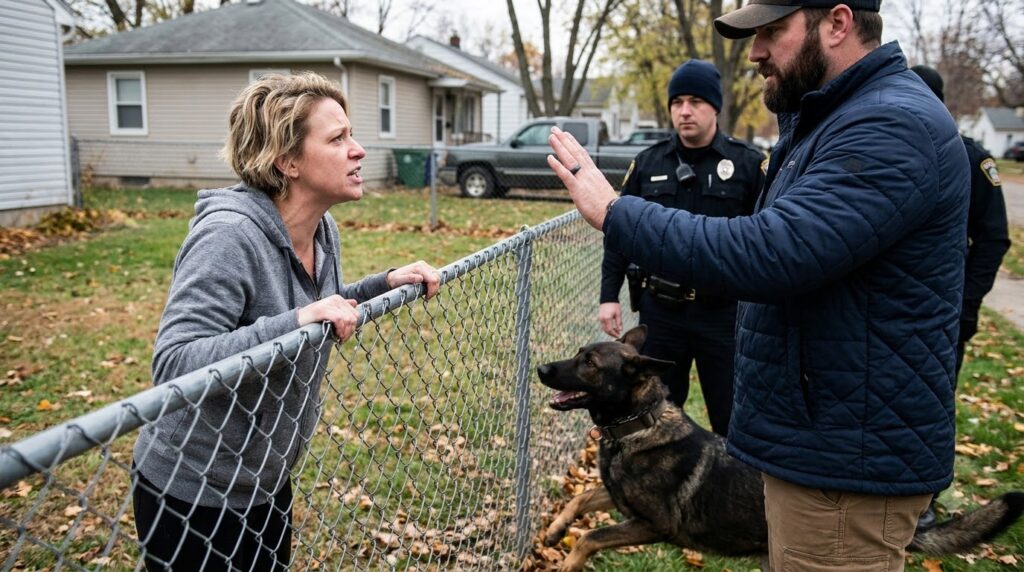
Mark didn’t flinch. He stayed anchored in the patchy grass of his side yard, his fingers resting lightly against the thick leather braid of Kilo’s short leash. The autumn chill carried the heavy smell of wet earth and dry leaves, but the only heat on the property line came from the woman gripping the galvanized rail of the waist-high chain-link fence.

Brenda’s gray hoodie was zipped tight to her throat, her short blonde hair windswept and stiff. Her knuckles were white where her fingers hooked over the steel wire, her body pitched forward at an unnatural angle, leaning straight into Mark’s space.

“I’m talking to you, Mark!” she snapped, her chest heaving against the cold. “You park that diesel truck two inches from the boundary, you run this animal along my property line until the mud churns, and you act like you own the block. This entire fence line is a designated common easement under county code, and I want that animal inside right now!”

Below the top rail, Kilo shifted his weight. The young shepherd’s dark muzzle rose, ears pricked forward like twin spears, his muscular frame poised on spring-loaded hindquarters. He didn’t bark; he didn’t surge. He simply waited, his working collar taut, sensing the sudden spike of adrenaline radiating across the thin metal mesh. When Kilo took one small step toward the fence, his paws pressed against the chain link, sending a low, metallic rattle through the posts anchored in the dirt.

Mark didn’t shift his stance. Clad in his navy quilted jacket and dark baseball cap, he looked like a piece of timber driven deep into the soil. His gaze remained level, settling not on Brenda’s flashing eyes, but on the place where her torso hung over the steel top rail—already six inches across the invisible vertical plane of his property line.

“You’re standing on my grass, Brenda,” Mark said, his voice dropping into a low, measured rumble that barely carried past the fence posts. He didn’t raise a fist; he didn’t point a finger. He simply took half a step forward, closing the distance until he was a arm’s length from the barrier, and brought his broad, right hand up—palm flat, fingers spread, held firmly in the open space between her chest and his chest.

It wasn’t a strike or a push; it was an iron wall made of bone and posture.

Brenda gasped, flinching slightly at the sudden solidity of his hand hovering inches from her jacket. “Are you threatening me?” she demanded, her voice straining into a shrill pitch designed to reach the neighboring porches down Maple Street. “You don’t touch me! You don’t tell me where I can stand on this street!”

“I haven’t touched you,” Mark replied smoothly, his palm remaining perfectly static, locking the boundary line like an unyielding bolt. “And you’re leaning over my fence.”

Behind Mark, near the corner of the small single-story house where a dark pickup truck sat in the shadows, a third figure moved into the light. Officer Davis—dressed in a black police uniform under a dark knit cap—stepped silently down the gravel path, his hands resting easily near his belt, his eyes fixed on the folded paper protruding from Brenda’s hoodie pocket.

CHAPTER 2: THE COLD IRON UNDER THE SOIL

The cold worked its way through the canvas knees of Mark’s work pants as he knelt near the corner post. Rain from three days prior had settled into the earth along the fence line, turning the dead grass into a slippery, dark mat that smelled of decaying sod and iron rust.

Behind him, Officer Davis stood on the gravel apron of the driveway. The officer’s black boots remained dry, planted firmly on the hardpack, but his eyes stayed locked on Brenda. She hadn’t moved back toward her porch; instead, her posture had stiffened, her hands thrust deep into the pockets of her gray zip hoodie as if holding something fragile against her ribs.

Mark cleared a patch of wet pine needles with his thumb, probing the mud at the base of the chain-link terminal post. His glove scraped against something flat and hard—not a rock, but the heavy, circular face of the brass surveyor’s pin driven into the ground thirty years ago when the plot was surveyed. It was cold enough to bite through the leather of his work gloves, a permanent, unyielding anchor buried four inches below the turf.

“It’s down there, isn’t it?” Brenda’s voice came sharp across the top rail, thin and brittle in the morning air. She took a half-step sideways, her sneakers squelching in the saturated grass along her side of the fence. “You can dig around in the dirt all morning, Mark, but a piece of brass doesn’t overwrite town ordinances. You’ve got a commercial breeding operation going on in a residential zone.”

Kilo didn’t bark. The shepherd remained sitting at Mark’s hip, his dark muzzle level with the top of the fence post, nostrils flaring as he caught the damp scent of the turning earth. Mark’s hand shifted from the buried pin to Kilo’s flat collar, feeling the steady, slow pulse in the dog’s neck. Discipline wasn’t about shouting across a fence; it was about momentum held in check.

“It’s not a breeding operation, Brenda,” Mark said, his voice flat as he stood up, wiping the mud off his knees with a slow, deliberate sweep of his hand. He didn’t look at her immediately; he looked at the galvanized wire running from the corner post to the house. “Kilo is a single certified working animal. The county registration was filed three weeks ago when I moved the trailer in.”

“And the fence?” She pulled one hand from her hoodie pocket, pointing a sharp, manicured fingernail at the rusted tension bar holding the wire tight. “That wire sits on what the developer marked as a five-foot utility corridor. You don’t own the dirt under that post, Mark. The HOA board met last Tuesday. We reviewed the original plot maps.”

Officer Davis shifted his weight, the leather of his duty belt creaking softly in the quiet street. “Brenda,” Davis said, his tone carrying the dry, unhurried cadence of a man who spent forty hours a week listening to neighborhood disputes. “If there’s an HOA complaint, it goes through the county clerk’s notice system. You can’t issue verbal warnings across a fence line.”

“I’m not issuing a warning, Officer,” she snapped, her head turning toward Davis with a quick, birdlike motion. Her short blonde hair caught the pale daylight, flat and unstyled. “I’m informing him of the documentation that’s already been processed. He thinks because he’s got a badge on his dog and a uniform in his closet he can bypass the rules everyone else follows.”

Mark stepped closer to the wire, his broad shoulders blocking her line of sight to Kilo. The brass pin under the mud was still cold in his mind—the physical truth of the boundary line that didn’t care about board meetings, vocal threats, or hurt pride.

“Show me the notice,” Mark said.

Brenda hesitated. Her fingers twitched inside her pocket, rustling the corner of a heavy paper stock. For a second, the bravado cracked, revealing a frantic, calculating light in her eyes—the look of someone who had built a wall out of cardboard and was trying to convince the wind not to blow.

“It’s being mailed,” she said, her voice dropping an octave as she pulled her hand back out, empty. “You’ll get your copy through official channels by Friday. And when you do, that dog needs to be off this property line.”

She turned on her heel, her sneakers leaving deep, tearing tracks in the soft turf of her yard as she marched toward her back porch. But as she reached the bottom step, she stopped, her back to them, her shoulders hunched against the damp wind.

Mark didn’t watch her walk away. He looked down at the mud near his boot where the brass pin lay hidden. A tiny sliver of white plastic—part of a broken zip-tie—was wedged beneath the bottom link of the fence on Brenda’s side, half-buried in the soil where someone had tried to string a temporary measuring tape late at night.

“She’s been out here with a tape measure,” Davis murmured, walking up to the fence and looking down at the mud. “Two nights ago, around eleven. My shift ended at ten; I saw her flashlight from my driveway.”

Mark bent down, plucked the piece of broken plastic from the mud, and rolled it between his fingers. “She’s not measuring the fence,” Mark said softly, his eyes fixing on the corner of Brenda’s newly poured concrete back patio, which sat suspiciously close to the utility line. “She’s measuring how much room she has left.”

CHAPTER 3: THE EMBOSSED MANIFESTO

The wind picked up off the northern ridge, whipping dry oak leaves across the asphalt of Maple Street with a sound like tearing parchment. Mark stood on the gravel apron, his thumb still rolling the brittle piece of broken zip-tie against his palm while Officer Davis adjusted his duty belt, his boots crunching methodically on the stones.

Before Mark could step back toward his porch to unclip Kilo’s working lead, the screen door on Brenda’s back porch slammed open. The spring caught with a high, metallic shriek that made Kilo’s ears pivot back, his body instantly stiffening into a low, attentive crouch.

Brenda wasn’t walking; she was striding. She held a thick, cream-colored envelope in her right hand like a hatchet. The paper didn’t match the cheap, lined notepad sheets she usually left under windshield wipers or jammed into mailbox slots. This was heavy, ninety-pound cardstock, unbent despite the damp gusting off the lawn, bearing a dark red embossed seal at its top corner that caught the pale autumn sun.

“I told you it was processed,” Brenda called out, her voice loud enough to vibrate off the aluminum siding of Mark’s garage. She didn’t wait at her back steps this time. She marched directly to the chain-link boundary, her sneakers digging sharp, triangular divots into the soft sod until her hips hit the top rail. “This was hand-delivered to my door by the HOA steering committee’s courier ten minutes ago. You wanted your formal notice, Mark? Here it is.”

She thrust the envelope over the galvanized steel bar, holding it precisely six inches into the airspace above Mark’s grass.

Kilo gave a single, low rumble—not a bark, but a vibration deep in his chest that resonated through the leather strap in Mark’s hand. Mark held the dog firm with a subtle shift of his weight, his eyes fixing on the heavy paper hovering between them.

“Read it,” Brenda demanded, her breath pluming in white clouds. “It’s a formal Cease-and-Desist and Demand for Immediate Vacation of Restricted Easement. Signed by the block safety chair and backed by the neighborhood charter. It states clearly—in black letter law—that the four-foot strip running parallel to this chain link was dedicated as a common pedestrian and utility bypass during the 1994 tract expansion. You have forty-eight hours to clear your equipment, dismantle your dog run, and pull back your boundary line.”

Officer Davis stepped up, his dark knit cap pulled low over his forehead. He extended a gloved hand toward the envelope, his posture neutral, professional, and entirely unhurried. “I’ll take a look at that, Brenda.”

Brenda pulled the envelope back two inches, her eyes snapping toward the officer. “This is a civil notice addressed to the property resident, Officer. I am serving it directly as an authorized neighborhood liaison.”

“You aren’t a process server, Brenda,” Mark said flatly. He didn’t reach for the paper. Instead, his eyes moved from the embossed red seal down to the bottom margin where a dense block of legalistic text was printed in crisp, dark ink.

The paper was heavy, expensive, and carried the stiff authority of a courtroom filing, but Mark’s eyes caught a single discrepancy—a tiny, physical error that no county recorder would ever make. The font used for the parcel identification number at the top of the header didn’t match the typewriter-style serif used by the municipal clerk’s office downtown; it was the sharp, immaculate laser print of a high-end desktop publisher.

“Where did you get this seal, Brenda?” Mark asked, his voice steady as a plumb line.

Her jaw tightened, the muscles along her neck contracting under the collar of her zip hoodie. “It’s the official mark of the Maple Street Neighborhood Protective Association. The board voted on the resolution on Tuesday night.”

“There is no Maple Street Neighborhood Protective Association,” Davis noted quietly, pulling a small pocket notebook from his vest. “This subdivision operates under a standard county agricultural-residential zoning overlay. The original developer went bankrupt in 1998, and the charter was dissolved by the district court in 2002. There’s no active HOA on this block, Brenda.”

For a fraction of a second, the color drained from Brenda’s cheeks, leaving her face pale and drawn against the cold wind. But her grip on the heavy paper didn’t loosen; if anything, her knuckles turned a mottled, bloodless white as her fingers dug into the cardstock, creasing the smooth surface.

“The charter was reactivated!” she insisted, her voice climbing into a strained, shrill frequency that made a dog two houses down begin to bark. “A supermajority of lot owners signed the petition last month after he brought that animal onto the street! We have the right to enforce common-sense boundaries! You don’t get to hide behind technicalities while your dog destroys our property values and threatens our safety!”

She leaned further over the fence, the wire groaning under the pressure of her stomach as she tried to force the document closer to Mark’s chest, her arm extending fully across the vertical plane of the property line.

“Take it!” she yelled, her fingers shaking with a mixture of rage and frantic desperation. “Take it and read what the neighborhood thinks of you!”

Mark didn’t reach for the paper. He didn’t step back either. He stood perfectly still on his damp grass, feeling the cold weight of the buried brass survey pin under his boot heels, while the fake manifesto rattled violently in the autumn wind between them.

CHAPTER 4: THE CROSSING AT THE GALVANIZED RAIL

The corner of the heavy cream cardstock brushed the quilted navy fabric of Mark’s jacket, its sharp paper edge stiff against his sternum.

Brenda’s shoulder was thrown forward, her knuckles locked around the paper so hard the joint bones looked like polished quartz under her pale skin. Her torso hung over the galvanized top rail at a forty-five-degree angle, her gray hoodie bunching up around her throat. She had committed her weight entirely to the push, using the top wire of the chain link as a fulcrum to project her authority into Mark’s yard.

Kilo didn’t lung. Trained on high-tension scenarios where restraint was the absolute baseline, the shepherd simply dropped two inches lower into his hips, his dark muzzle perfectly aligned with Brenda’s right wrist. His front paws planted squarely in the muddy grass, his working collar humming with the quiet, vibration-heavy breath building in his ribs.

Mark didn’t flinch back from the paper. He didn’t swiping it aside, nor did he snatch it from her hand.

Instead, Mark’s right arm came up in a single, fluid arc—his elbow locked, his forearm rising like a timber brace to sit six inches in front of his chest. His broad palm opened wide, fingers spread taut, creating a flat, immovable wall of flesh and bone in the exact midair gap between her reaching arm and his body.

He didn’t touch her skin. He didn’t strike the paper. He simply established the plane.

Brenda’s hand met empty air an inch short of his jacket, her forward momentum grinding against the sheer physical presence of his open hand. The top rail of the chain-link fence creaked beneath her ribcage, the galvanized diamond mesh groaning as the tension bars absorbed her weight.

“Ma’am, step back from the fence, please,” Mark said.

His voice didn’t carry anger, heat, or triumph. It was the same flat, unyielding tone he used when commanding a seventy-pound working animal to hold a line in high-stress tracking exercises. It carried the weight of an iron anchor dropped into deep water.

Brenda’s breath hitched, her eyes widening as she stared at the flat expanse of Mark’s palm hovering inches from her knuckles. “You… you can’t block me!” she shouted, though the volume lacked its previous sharp edge, fracturing into a thin, ragged gasp. “I am serving you a legal document! You are physically obstructing a neighborhood official!”

“You’re leaning over my fence line, Brenda,” Mark replied, his palm staying perfectly static in the air. “The fence sits on my side of the survey pin. You are physical in my yard.”

Behind Mark, Officer Davis moved. His heavy leather duty boots crunched deliberately over the wet gravel, coming up to stand shoulder-to-shoulder with Mark. Davis didn’t draw a baton or reach for his holster. He simply pulled a slim black digital tablet from his jacket pocket, its screen glowing with the blue-white light of a live county geographic information system map.

“Brenda,” Davis said, his voice cutting through her frantic breathing like a cold blade. “I’m looking at the real-time county parcel overlay right now. The parcel map was updated by the county engineer’s office two years ago when the water main was replaced.”

Brenda’s eyes darted sideways toward the blue screen, her grip on the cream cardstock wavering for the first time. “That… that map doesn’t reflect the neighborhood agreement!”

“There is no neighborhood agreement on file with the city or the county,” Davis stated coldly. He tapped the screen with a gloved thumb, zooming into the boundary grid that marked the exact property division between Lot 12 and Lot 13. “And more importantly, Brenda, this document you’re holding isn’t an HOA notice. It’s a template from an online legal self-help site. The seal at the top is a stock graphic.”

The wind died down for a fraction of a second, leaving the yard in a heavy, suffocating silence. The only sound was the rhythmic, steady breathing of the shepherd sitting at Mark’s knee.

Mark didn’t drop his hand. He kept his open palm held firm in the space between them, his eyes fixed on the trembling edge of the paper.

“You printed this yourself,” Mark said quietly.

Brenda’s mouth opened, but no sound came out. Her cheeks, previously flushed with rage, went entirely gray. The paper in her hand began to rattle—not from the autumn breeze, but from the uncontrolled tremor running through her forearm.

“The easement you’re talking about,” Davis continued, turning the tablet slightly so the high-contrast parcel lines were clearly visible in the pale daylight, “doesn’t run along Mark’s driveway at all. The four-foot municipal drainage easement sits entirely on the eastern edge of your lot, Brenda. Right beneath that concrete back patio you poured last spring without a city building permit.”

Mark felt a subtle shift in the air—the sudden, undeniable crack in the wall Brenda had spent weeks building. The fake notice, the claims of HOA rules, the frantic midnight measuring sessions with a tape measure—it wasn’t about his working dog, and it wasn’t about neighborhood peace.

It was about the three feet of unpermitted concrete sitting squarely on county land behind her house.

Brenda’s arm began to sink. Slowly, inch by inch, she pulled the crumpled cream cardstock back across the top rail of the chain link, her body retreating into her own yard as the weight of the truth settled over the fence line like iron weights.

CHAPTER 5: THE ANCHOR AT THE BOUNDARY

The crumpled, cream-colored cardstock dropped two inches, hovering limply near the top wire, but Brenda’s heels didn’t move. Her posture, locked in the cold morning wind, shifted from aggressive overreach to a brittle, defensive rigidity.

“That… that map is an administrative error,” she spat, her voice trembling as she clutched the fake notice against the gray zip of her hoodie. She took one short, sharp step sideways along her side of the chain link, her sneakers crushing a patch of yellowed clover. “The county contractor who poured that slab had the site plan approved by the county zoning clerk! I have the canceled checks! You think you can bring a digital tablet out here and rewrite twenty years of property lines?”

Mark didn’t drop his right hand immediately. He held the open-palm stop in the space between them for two full seconds after her paper lowered, ensuring the physical boundary hung in the air like a sheet of iron before he slowly let his arm return to his side.

Kilo remained seated at his hip, his working collar taut, dark ears pointed like twin wedges toward Brenda’s chest. The shepherd’s ears twitched at the distant whine of a delivery truck shifting gears on the main avenue, but his body remained entirely motionless—an unyielding forty-pound block of muscle anchored to Mark’s leg.

“The county recorder doesn’t work off canceled checks, Brenda,” Mark said, his voice dropping an octave, carrying the dry, unpolished rasp of a man who worked outdoors in all weather. He turned his head slightly toward Officer Davis. “And the drainage easement isn’t just a paper line.”

Davis tapped the glass of his tablet once more, the backlight casting a cold blue sheen across his dark knit cap and the black fabric of his uniform shoulder. “It’s a five-foot dedicated right-of-way for the storm overflow pipe running from the cul-de-sac down to the creek bed. If the county needs to access that pipe for maintenance or clearing, any permanent structure built inside that five-foot band is subject to immediate summary removal at the property owner’s expense.”

Brenda’s eyes darted frantically from Davis’s tablet to the low, grey concrete lip of her back patio, fifteen feet behind her. A faint hairline fracture ran down the edge of the fresh slab where it met the damp earth—a clear sign that the heavy concrete had been poured directly over loose, uncompacted drainage soil without an inspection stamp.

“You called them,” she whispered, her voice suddenly dropping into a venomous, hushed rasp that barely reached across the fence. “You had him pull those records before you even came out here today.”

“I didn’t call anyone about your patio, Brenda,” Mark said calmly. He reached down with his left hand, his thumb hooked into the heavy brass ring of Kilo’s short lead. “I requested a routine property line verification three weeks ago when I put the training posts in for the dog run. Standard procedure for any homeowner putting steel in the ground. The county surveyor flagged your encroachment on the public GIS grid before I even bought my fence wire.”

Brenda’s chest heaved. The wind caught a loose strand of her short blonde hair, blowing it across her forehead, but she didn’t brush it away. Her eyes searched Mark’s face, looking for a crack in his composure, a flicker of smug triumph, or a hint of anger she could leverage into an official complaint.

She found nothing. Mark stood on his damp grass in his quilted navy jacket and dark cap, his expression as flat and unreadable as the rusted brass survey pin buried beneath the mud at his boots.

“You knew,” she breathed, her knuckles turning white around the crumpled cardstock. “You knew the whole time I was talking about the driveway.”

“I knew where my land ended,” Mark said. “And I knew where yours began. That’s the only line that matters out here.”

Officer Davis folded the digital tablet against his thigh and stepped forward, his boots crunching on the gravel apron until he stood directly at the fence line, his presence completely shutting down any remaining space between the two properties.

“Brenda,” Davis said, his tone turning crisp and official, stripped of any casual neighborly leniency. “You are holding a forged legal notice on private property while making false claims of authority to intimidate a resident. I am advising you right now to step back to your porch, take that paper inside, and contact the county code enforcement office tomorrow morning to address your easement encroachment before a formal citation is issued.”

Brenda stared at the officer, then at Mark, her mouth working silently as if searching for a rule, a clause, or an HOA guideline that could save her from the cold reality of the boundary.

For three long seconds, no one moved. The only sound on Maple Street was the low, electric hum of the transformer mounted on the utility pole near the corner and the rustle of dry leaves scraping across the pavement.

Then, with a sudden, jerky movement, Brenda turned on her heel. She didn’t march this time; her steps were heavy, unsteady, her sneakers dragging through the wet sod as she stumbled back toward her porch steps, the fake notice clutched like a rag in her right hand.

Mark didn’t watch her reach the door. He turned to Officer Davis, offering a brief, silent nod of acknowledgment, before looking down at the young shepherd at his side.

“Free,” Mark commanded softly.

Kilo relaxed instantly, his ears lowering from their rigid working pitch as he gave a single, quiet huff of air and leaned his shoulder against Mark’s knee, his task complete.

CHAPTER 6: THE ARCHIVE OF STONE AND STEEL

The heavy wooden frame of Brenda’s screen door rattled against its jamb, the dull thud echoing off the damp siding of her garage before fading into the grey morning air.

Mark didn’t move. His boots remained anchored in the wet sod, the cold dampness of the earth seeping through the thick soles of his work boots. At his hip, Kilo leaned his broad chest against Mark’s knee, his breathing slow and rhythmic, the tension draining out of his shoulders as he watched the empty back porch of the adjacent house.

Officer Davis let out a long, quiet breath that misted instantly in the chill air. He slid the glowing digital tablet back into his tactical jacket pocket and reached into his leather side pouch, pulling out a folded, heavy-gauge sheet of blue laminated plastic. The paper rustled with a stiff, metallic snap as he unfolded it across the flat top rail of the chain-link fence.

“Official county surveyor’s map,” Davis said, his gloved index finger tracing the crisp white grid lines etched onto the blue background. “Certified by the regional land office six months ago when the county mapped the culvert network.”

Mark leaned forward slightly, resting his forearm on the cold steel rail. The blue plastic sheet was cold to the touch, smelling faintly of synthetic laminate and dry paper dust. His eyes followed the line of white ink representing the lot boundary—a razor-thin vector that ran straight as a plumb line from the street curb, passing exactly through the center of the brass pin buried beneath the mud at his boots, and terminating at the rear alley post.

“Look right here,” Davis pointed to a shaded hatch zone extending three feet east of the property line into Lot 13. “That’s the dedicated municipal drainage right-of-way. The county easement doesn’t touch your driveway, Mark. It sits entirely under her concrete slab. When the county crew comes out to clear the culvert intake next spring, that whole corner of her patio is going to have to be jackhammered out.”

“She knew,” Mark said softly, his voice dry as rust. He looked across the fence at the pale, unpainted edge of Brenda’s back patio where the fresh concrete met the yellowed grass. “She wasn’t trying to protect the neighborhood. She was trying to force me to shift my fence three feet west so she could claim my dirt to cover her encroachment.”

Davis folded the laminated plat map with a sharp, disciplined click of his wrists. “People construct elaborate fictions when they realise their own foundations are on soft ground. She built a whole HOA in her head to cover three feet of illegal concrete.”

Kilo shifted his weight, his dark muzzle nudging Mark’s hand. Mark reached down, his fingers burying into the thick, dense fur of the shepherd’s neck, feeling the solid, living warmth beneath the coat. There was no victory in the realization—only the cold, pragmatic clarity of a man who understood boundaries. Turf wasn’t defined by shouting, fake seals, or forged notices. It was defined by stone, steel, and the unyielding truth buried in the dirt.

A curtain twitched in the kitchen window of the neighboring house, a pale shape hovering briefly behind the glass before disappearing into the shadows of the interior.

“She won’t come back down to this fence line,” Davis noted, securing the blue map back inside his vest pocket. “Not today. Not with a county inspector coming out to tag that slab.”

“She won’t need to,” Mark replied, his eyes settling back on the rusted steel tension bar that held his fence taut against the corner post. “The line stays right where it is.”

He turned away from the fence, giving Kilo’s collar a light, guiding pressure. Together, the handler and the working dog walked steadily back up the gravel driveway toward the open bay of the garage, their footsteps rhythmic and even against the stones, leaving the chain-link boundary silent and unbroken behind them.

CHAPTER 7: THE BOUNDARY STAYS RIGHT WHERE IT IS

The gravel gave a low, dull crunch beneath Mark’s boots as he reached the mouth of the open garage bay. He stopped, his hand resting on the cool aluminum frame of the overhead door, and looked back down the length of the driveway.

The wind had shifted out of the north, carrying the sharp, clean scent of damp cedar and wet pine needles off the ridge. Down at the property edge, the waist-high chain-link fence sat perfectly straight—a silver grid of galvanized steel catching the pale, filtered sunlight. The top rail ran level and unbent from the street curb to the rear alley post, dividing the world into two distinct, unquestionable realities.

At the corner post, the dark patch of earth Mark had cleared with his boot remained exposed. Four inches beneath the damp sod, the heavy brass face of the thirty-year-old surveyor’s pin caught a sliver of grey light. It didn’t gleam; it sat dull, oxidized, and indifferent—a cold piece of metal anchored deep into the bedrock long before either house had been built, and bound to remain there long after the paint peeled from the siding.

Kilo sat unbidden at Mark’s left side, his dark muzzle level with Mark’s knee. The shepherd’s ears were forward, his dark eyes watching the quiet expanse of the yard. There was no tension in the dog’s shoulders now, no tight hum of adrenaline vibrating along his spine. The working collar sat loose against his coat, its heavy brass ring dull against the dark fur.

Across the fence line, Lot 13 was silent. The grey zip hoodie and short blonde hair were gone from the porch steps. The heavy cream paper with its fake red seal lay somewhere inside behind closed blinds, rendered useless by the cold blue geometry of the county plat map. Beyond the kitchen window, the edge of Brenda’s back patio sat half-buried under loose soil—three unpermitted feet of cracked concrete resting square on public drainage land, waiting for the inevitable arrival of a municipal inspector’s orange tape.

Officer Davis stood near his cruiser at the curb, adjusting his dark knit cap before opening the driver’s door. He offered Mark a brief, two-finger salute across the roof of the vehicle—a quiet, unspoken acknowledgment between men who understood that real authority required neither shouting nor performance. The cruiser door clicked shut, the engine turned over with a low rumble, and the car pulled smoothly away from the curb, leaving Maple Street in absolute stillness.

Mark looked down at Kilo, unclipping the short lead from his collar with a familiar, metallic snap. He looped the leather strap over his shoulder and rested his palm flat on the dog’s broad head.

“Good boy,” Mark murmured.

He didn’t check his phone. He didn’t write a note or look for a witness to validate what had happened at the fence line. A man’s life wasn’t measured by the noise he made when challenged, nor by the legalistic illusions others constructed to cover their own soft ground. It was measured by the quiet discipline of knowing where his boundaries lay, and having the fortitude to plant his feet when the wind blew against them.

Mark reached for the handle of the garage door and pulled it down. The rollers track-glided smoothly along the steel rails with a heavy, satisfying thud as the bottom rubber seal pressed flat against the concrete apron, sealing out the damp autumn draft.

Outside, the chain-link fence stood silent in the quiet neighborhood. The rusted brass pin remained buried in the mud, cold and unyielding beneath the turning leaves, holding the line precisely where it belonged.

The boundary stayed right where it was.

Similar Posts

Leave a Reply

Your email address will not be published. Required fields are marked *