The Weight of the Line: How Quiet Documentation and a Single Chain Broke an Association’s Manufactured Authority
CHAPTER 1: The Iron Link
The morning air smelled of wet asphalt and cut grass, the heavy, undisturbed scent of a Tuesday that had decided to go wrong before the sun cleared the rooftop chimneys. Julian held a lukewarm ceramic mug of black coffee in his left hand, his thumb resting against the rough clay rim. He did not look at Evelyn Smythe first. He looked at the padlock. It was a standard brass-body master lock with a hardened steel shackle, brand new, gleaming with an offensive sort of neatness against the dark, oxidized green of his gate’s original wrought-iron hardware.
“Mr. Vance,” Evelyn called out. Her voice had the thin, brittle edge of someone who rehearsed their morning announcements in front of a mirror with a stopwatch. She stopped three feet short of the property line, her oversized tortoiseshell sunglasses reflecting the empty street behind her like twin polished shields. “I must assume you didn’t check your community portal last night. Commercial freight transfers are strictly prohibited on residential access lanes prior to nine o’clock.”
Julian took a slow sip of the coffee. The liquid was bitter on his tongue, flat and grounding. He let his gaze drift past her shoulder toward the end of Maple Court, where a red lumber delivery flatbed sat idling with its hazard lights blinking an orange pulse against the dew-soaked hedges.
“That lane is a municipal right-of-way, Evelyn,” Julian said. His voice was level, pitched just loud enough to carry across the narrow strip of damp sod separating his property from the sidewalk. “It isn’t a community asset, and it certainly isn’t your driveway.”
Evelyn’s chin rose by precisely half an inch, the pearls at her throat catching the flat morning glare. She tapped her silver clipboard with a scarlet-tipped nail. A laminated neon orange sticker was paper-clipped to the top sheet, bearing a crude, self-printed emblem that looked suspiciously like a municipal crest photocopied at a lower resolution.
“The association executive committee voted unanimously last Thursday to reclassify all secondary side corridors as restricted easement zones,” she said, her tone dropping into that slow, dangerous cadence adults use when explaining simple rules to slow children. “Until you pay the five-hundred-dollar aesthetic compliance fee and submit your contractor’s manifest forty-eight hours in advance, that gate remains secured. And frankly, Julian, if you continue to make this difficult for the board, you might find that your upcoming porch expansion permits take somewhat longer to clear through municipal review.”
Across the street, a pair of crisp white curtains twitched at the edge of the Peterson family’s front window, then went perfectly still. Down the block, the low, steady rumble of the delivery truck engine continued to vibrate through the dry gravel under Julian’s boots. He felt the old, familiar weight settle behind his ribs—the dull, dense pressure of administrative friction he had spent twenty years dodging over drafting tables and city zoning boards. He did not blink. He set his coffee mug down on the top of the brick pillar by his front step, the ceramic making a sharp clink against the mortar.
“You’ve been very busy this month, Evelyn,” Julian said quietly, his eyes fixed on the small gold pen tucked into the spiral binding of her clipboard. “Tell me, does the town planning office know you’re issuing permits with a glue stick?”
Evelyn’s smile didn’t fade; it simply tightened around the edges, hardening into something brittle and white-hot. “Careful, Julian,” she whispered, stepping one inch closer to the invisible boundary line. “The people who write the rules are the ones who decide whose houses stay standing.”

CHAPTER 2: The Archive and the Blue Line
The basement records room of the Millbrook County Courthouse smelled of wet lime, vinegar-based microfilm fixer, and centuries of dried binding glue. Julian sat at a scarred oak table beneath a low-wattage fluorescent tube that hummed with a steady, high-pitched whine. Outside, the midday traffic of Main Street hummed against the frosted glass of the sidewalk-level windows, but down here, time moved at the speed of mold spreading across yellowed rag paper.
He did not rush. A man who spends twenty years checking load calculations learns that panic is just bad math.
Spread before him was a heavy linen-backed blueprint from November 1994, the original development plat for Elmwood Estates Phase Two. The paper was stiff, thick as canvas, and smelled faintly of copper sulphate. Julian’s thumb traced the eastern edge of Lot 14A—his lot. There, marked in a crisp, indelible indigo ink that had resisted thirty years of basement dampness, ran a dashed utility easement corridor. It was twenty-eight meters long, exactly one point two meters wide, and explicitly designated as a non-exclusive municipal access path for subsurface infrastructure.
Across from him, an elderly archivist named Mrs. Gable pushed a stack of metal filing boxes across the scarred wood with a soft thud.
“They don’t make them like that anymore,” she murmured, her voice like dry leaves scraping over concrete. “Everything’s digital now. You can’t trust digital. Pixels can be nudged six inches to the left before breakfast, and nobody notices until the bulldozer hits a sewer main.”
Julian looked up from the 1994 plat. “What about modern updates, Mrs. Gable? Community association revisions filed after two thousand?”
She let out a dry, rattling cough that might have been a laugh. “Revisions? An association can revise its own bylaws until the cows come home. They can vote to change the color of the mailboxes or fine you for planting marigolds instead of petunias. But a public right-of-way easement recorded under municipal statute seventy-four dash B? That takes a superior court judge and a three-fourths vote of the county transportation board to alter by even an inch. I haven’t stamped a legal corridor relocation for Elmwood since the bypass went in back in ’08.”
Julian nodded slowly. He reached into his coat pocket and slid out the laminated copy of the map Evelyn Smythe had handed to his delivery driver—the so-called Community Association Realignment Map of 2019.
He laid it flat over the 1994 linen plat.
The discrepancy was immediately, brutally obvious. The modern map showed the eastern boundary line shifted inward by exactly one point two meters, conveniently absorbing the entire utility corridor into the association’s common maintenance pool. But as Mrs. Gable had noted, there was a fatal omission. In the bottom right corner, where a county surveyor’s license number, a raised municipal seal, and a registry file stamp should have been embossed into the paper, there was only a blank white rectangle framed by a thin grey pixel-border.
It wasn’t a county filing. It was an internal memo printed on an office desktop inkjet, trimmed with scissors, and laminated at a local UPS store to look like a mandate.
Julian pulled a brass-bound pocket notebook from his briefcase, unclipped his mechanical pencil, and made a single, precise entry in the margin: No municipal seal. No registration number. Fabricated jurisdiction.
He didn’t feel a sudden surge of triumph. Triumph was for amateurs who thought a single good card won the game. What he felt was the cold, heavy certainty of a structural pillar finally settling onto a solid concrete footing. Evelyn Smythe hadn’t just overreached; she had built an entire administrative empire out of tissue paper and bluff, betting that nobody would ever walk down the stairs to check the basement archives.
As he began photographing the documents with his phone, his mind was already calculating the next variable. Evelyn wasn’t acting alone. A neighborhood association president doesn’t risk a municipal fraud charge just to push around an architect over a lumber delivery. There was a financial engine underneath the rules—a paving contract, a landscaping monopoly, or a preferred vendor kickback scheme tied directly to those restricted side corridors.
The micro-mystery sat right there in the margin of the 2019 memo: a small, handwritten notation in the corner reading V&S Paving – Phase 4.
Julian closed his notebook with a soft snap. The archivist didn’t look up from her stack of index cards. Outside, the fluorescent light above them flickered, hummed, and settled back into its steady, grinding rhythm. Julian gathered his papers, slid them into his leather portfolio, and walked out toward the stairs, knowing that the trap Evelyn thought she had set for him was about to close from the other side.
CHAPTER 3: The Board Meeting Theater
The community center conference room was designed to settle disputes before they even reached a voice. Julian felt it in the soles of his boots the moment he crossed the threshold—the subtle, intentional slope of the floorboards, or perhaps just the psychological architecture of the space. The board table sat elevated on a six-inch pine platform, draped in dark navy felt that absorbed the overhead fluorescent glare. The chairs on the executive side were high-backed, tufted leather affairs with pneumatic height adjustments. The chair assigned to the petitioner—his chair—was a standard folding metal unit with a dented seat pan that rocked slightly on the uneven commercial tile.
Evelyn Smythe sat precisely in the center, flanked by two middle-aged men whose names Julian hadn’t bothered to memorize yet. Her silver clipboard lay open like an altar cloth, the gold pen poised beside a stack of printed assessment notices.
“Mr. Vance,” Evelyn said, not looking up as he closed the double doors behind him. The latch clicked shut with a sharp, metallic finality that echoed off the bare acoustic tiles. “We noted your absence at the Monday morning committee orientation. The board appreciates punctuality when community compliance matters are under review.”
Julian did not take the folding chair immediately. He stood with his hands tucked into the pockets of his dark canvas jacket, his weight balanced evenly over his heels. The air in the room smelled heavily of industrial lemon floor wax and stale coffee from a urn in the corner.
“I received your notice regarding the Maple Court alley restriction,” Julian said. His voice was flat, devoid of the defensive edge Evelyn clearly expected. He walked forward, not toward the metal chair, but three paces to the left, standing squarely under the harsh tube lighting where his shadow fell long and sharp across the grey tile. “I also spent yesterday afternoon in the Millbrook County basement archives reviewing the 1994 development plat.”
Evelyn’s gold pen stopped moving. The silence that followed was thin, stretched taut by the hum of the ceiling vents. One of the flanking council members—a heavy-set man with a silver crew cut and a pale pink golf shirt—shifted his weight, causing his leather chair to groan softly.
“County archives are filled with obsolete iterations, Mr. Vance,” Evelyn said smoothly, her tortoiseshell glasses sliding down the bridge of her nose just enough for her eyes to lock onto his with clinical disdain. “Maple Court operates under our updated 2019 internal neighborhood boundary realignment map. Section nine of our association bylaws grants the executive committee full discretionary power over all secondary access routes for aesthetic and safety compliance.”
“Section nine requires a county-registered utility easement waiver to alter a designated right-of-way,” Julian replied, pulling a single, folded sheet of heavy linen-textured paper from his pocket. He didn’t slam it down. He laid it flat on the edge of the navy-draped table, right beside her silver clipboard. “Your 2019 realignment map lacks a county filing number, a licensed surveyor’s stamp, and a municipal seal. Legally speaking, Evelyn, it’s a decorative poster.”
The man in the golf shirt leaned forward, his face flushing a mottled pink. “Listen here, Vance—the association has a legal defense fund and a mandate from the majority of homeowners who don’t want commercial contractors tearing up our curbs at dawn. If you want to play legal games with community governance, you’ll find that your own property renovation permits tend to get stuck in administrative review for a very, very long time.”
The words hung in the stale air, distinct and unambiguous. A direct threat, delivered across a public table in front of witnesses.
Julian didn’t blink. He reached down, tapped his breast pocket where his phone rested on record, and let a slow, measured stillness settle over his features. “That is a fascinating administrative philosophy, councilman,” Julian said quietly, his eyes fixed on the man’s nervous fingers twitching against the leather armrest. “I’m sure the municipal planning commission will be deeply interested in how efficiently your board controls town permits.”
Evelyn’s expression didn’t crack, but the scarlet tip of her nail pressed so hard against her clipboard that the plastic backing gave a faint, sharp snap. She closed her folder with a deliberate, slow movement, her gaze narrowing into something cold and calculating.
“This meeting is adjourned,” she said, her voice dropping an octave. “Any further communications from you, Mr. Vance, will be handled exclusively by our association’s legal counsel.”
Julian turned on his heel without another word, the metal folding chair left untouched behind him. As he walked out into the corridor, the heavy doors swung shut, cutting off the sound of hurried whispers and the scrape of heavy leather chairs sliding back across the floor. He knew the threat wasn’t an empty one; they were going to double down. But as he stepped out into the crisp afternoon air, he could feel the structural weight shifting. They had threatened him out loud, and in the architecture of bureaucracy, a cornered opponent always makes the first fatal crack in their own foundation.
CHAPTER 4: The Delivery Blockade
The flatbed truck arrived at 7:15 on a Thursday morning, its diesel engine rattling the loose gravel at the entrance of Maple Court with a heavy, rhythmic thud. Julian stood on his front porch, a thick wool sweater pulled over his shoulders against the damp chill, watching the driver throw the hazard lights on. The amber pulses cut through the pre-dawn drizzle, casting long, fractured shadows across the manicured lawns.
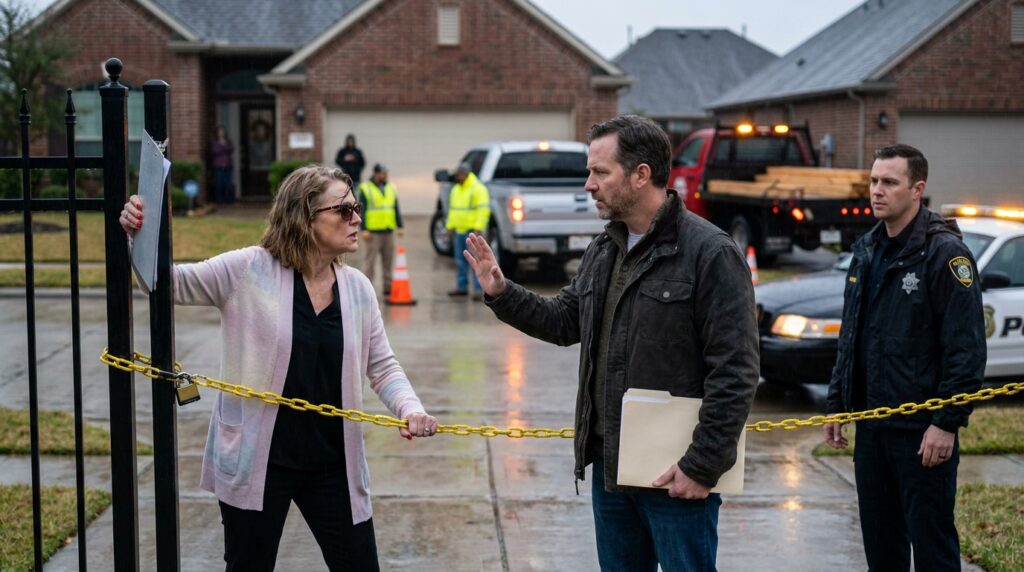
Before the driver could shift out of gear, a silver association pickup rolled out from the side lane and parked dead-center across the asphalt, blocking the cul-de-sac throat. Evelyn Smythe stepped out of the passenger side with a laminated sign clutched against her chest. Behind her, two maintenance workers in high-visibility vests climbed out of the truck bed, carrying orange plastic cones and a heavy yellow chain.
Julian walked down the steps, his boots crunching over the wet gravel. He didn’t rush. The physics of the situation dictated patience: every second Evelyn spent standing in the middle of a public street acting like a municipal magistrate was another second preserved on his phone’s cloud backup.
“You’re in violation of executive ordinance fourteen dash C,” Evelyn shouted over the idling diesel, her voice thin and shrill in the wet air. She pointed a scarlet-nailed finger at the flatbed’s cargo of custom oak timber. “Commercial freight distribution is barred from residential alleys before ten o’clock. Turn that truck around, Mr. Vance, or we impound the lumber.”
The truck driver leaned out of his window, spitting a stream of tobacco juice onto the curb. “Mister, I got a signed bill of lading and a municipal delivery permit stamped by the county clerk. I ain’t turning around for nobody carrying a clipboard.”
Evelyn’s face mottled to a dull crimson. She turned to her maintenance crew, gesturing wildly toward the side alley. “Chain the gate! Do it now! Lock them out of the corridor permanently!”
As the workers moved forward with the heavy steel links, Julian stepped past the property line, his voice cutting cleanly through the engine noise. “I wouldn’t touch that gate if I were you, gentlemen. That hardware is attached to private property, and interfering with it constitutes structural vandalism.”
Evelyn whirled around, her tortoiseshell sunglasses askew. “I have had enough of your obstructionism, Julian. I am calling the county police right now to have you and this trespasser cited for public disruption.” She whipped out her phone, dialing with aggressive, stabbing jabs of her thumb, her voice rising to a frantic pitch as she demanded an emergency dispatch.
Ten minutes later, the sharp chirp of a siren bounced off the brick facades as a Millbrook County patrol cruiser nosed into the cul-de-sac. Officer Miller stepped out, adjusting his belt against the drizzle, his face etched with the weary, pragmatic fatigue of a man who had mediated a hundred suburban turf wars over misplaced garbage bins and property lines.
Evelyn intercepted him halfway up the driveway, her hands fluttering over her clipboard in a simulated display of distress. “Officer Miller, thank goodness. This resident is running an illegal commercial staging operation, violating our executive association boundaries, and threatening our contracted maintenance crew.”
Miller listened for a solid thirty seconds, his expression completely flat. He looked past her at the idling flatbed, then at Julian standing calmly by his porch pillar with his hands in his pockets.
“Is that right, Mr. Vance?” Miller asked, stepping past Evelyn as if she were a mild annoyance on a sidewalk.
Julian didn’t speak. He simply reached into his coat and handed the deputy a single manila folder containing the certified 1994 town plat and the municipal easement register. Miller opened it, his thumb tracing the blue lines of the right-of-way map. He pulled a small penlight from his pocket, checked the county stamp, and radioed dispatch for a three-minute database confirmation.
The radio hissed back a flat, metallic confirmation: Easement active. Municipal public transit zone. No private association jurisdiction.
Miller clicked his radio off. The silence that settled over Maple Court was absolute, broken only by the steady dripping of rain off the pine branches. The deputy walked back toward Evelyn, his boots heavy and deliberate on the wet asphalt.
“Ma’am,” Miller said, his voice dropping into a low, official register. “You are currently obstructing a public right-of-way, interfering with a licensed delivery, and attempting to enforce non-existent regulations under a false municipal pretext. If you or your crew touch that gate again, you’ll be spending the morning filling out paperwork down at the precinct for impersonating public authority.”
Evelyn staggered back half a step, her fingers tightening around her clipboard until the plastic warped. “That’s—that’s impossible. The association map—”
“Your map’s a piece of office paper, lady,” Miller interrupted, turning his back on her. He looked at the truck driver and gave a short, sharp nod. “Clear the lane. You’re good to unload, sir.”
The flatbed’s air brakes hissed with a deafening roar as the truck reversed smoothly into Julian’s driveway. Around the cul-de-sac, three different front doors clicked open by a fraction of an inch, and the quiet murmurs of neighbors finally finding their voices drifted across the wet grass. But as Evelyn stood frozen in the middle of the street, her eyes burning with a desperate, trapped fury, Julian felt a cold spike of caution. She hadn’t surrendered; she had just been cornered into a space where her only option left was total escalation.
CHAPTER 5: The Legal Exposure
The conference room at Tom Elias’s law office smelled of old calfskin bindings, floor paste, and rain-soaked wool. The table was polished mahogany, wide enough that Julian had to slide a manila folder nearly three feet across the dark grain to reach the opposing side.
Evelyn Smythe did not touch the folder. She sat rigidly upright in her chair, her pastel cardigan buttoned to the collar despite the stifling heat of the radiator, her hands folded over a pristine yellow legal pad that remained completely blank. Beside her, Vincent Harlow—the association’s retainer counsel, a man whose sharp gray suit looked like it had been tailored from a tax ledger—kept his eyes fixed on the heavy brass corners of the desk.
“My client,” Harlow began, clearing his throat with a dry, professional click, “is prepared to recommend a modest administrative settlement. Five thousand dollars to cover disputed landscaping costs, and a joint petition to review the boundary alignments through an independent mediation panel.”
Tom Elias didn’t look at Harlow. He didn’t look at Evelyn. He was busy cleaning his tortoiseshell reading glasses with a small linen square, his movements slow and mechanical. When he finally set the glasses down, he didn’t offer a counteroffer. He simply opened a secondary binder and turned it toward them.
“Let’s look at the mathematics of your proposal, Vincent,” Tom said, his voice flat and devoid of theatrical warmth. “Under Millbrook municipal code section fourteen dash three, unpermitted permanent construction on a designated right-of-way carries a civil penalty of two hundred dollars per square meter per day. Your unpermitted fence covered thirty-four point two square meters for forty-seven days.”
Julian watched Evelyn’s fingers twitch against the yellow pad. A single, sharp line of red ink appeared where her fingernail dug into her palm.
“Furthermore,” Tom continued, sliding a second printed transcript across the mahogany, “we have a verbatim, timestamped audio record of a council member explicitly threatening my client’s independent home renovation permits during an open board session if he refused to drop his inquiries. That crosses the line from neighborhood dispute into municipal extortion, carrying potential corporate liability for every executive member who voted in favor of the blockade.”
Harlow leaned over, his eyes scanning the transcript lines. The color began to drain from his face, the easy, polished arrogance of a retained lawyer evaporating as he calculated the exposure. He didn’t look at Evelyn now. He looked down at his own legal pad, where he had written liability and underlined it twice with a heavy black pen.
Evelyn’s composure finally fractured. The tight, porcelain shell of her authority cracked down the middle. “We are the executive committee,” she snapped, her voice rising sharply against the quiet walls. “We represent one hundred and forty households who rely on our leadership to maintain property standards! We have a defense fund! We can sustain this litigation ten times longer than a single resident!”
Julian leaned forward, resting his forearms flat on the mahogany table. The wood was cold against his wrists. “You aren’t fighting for the neighborhood, Evelyn,” Julian said quietly. “You’re protecting V&S Paving, your brother-in-law’s contracting firm, which has held an unbid monopoly on every single asphalt and concrete repair project in Elmwood Estates for the last four years. Every gate you chain, every permit you block, is just a way to force homeowners to use your family’s services.”
The silence that dropped into the room was absolute. It wasn’t the polite quiet of a professional office; it was the heavy, breathless vacuum that follows an explosion.
Evelyn’s mouth opened, but no sound came out. Her gaze snapped from Julian to Harlow, searching the lawyer’s face for a denial, a counter-argument, anything to rebuild the wall. But Harlow was already sliding his legal pad into his briefcase, his movements precise and final.
“We will review these terms with the board this evening, Mr. Elias,” Harlow said, standing up and buttoning his suit jacket with mechanical stiffness. He looked down at Evelyn, his voice dropping to a cold whisper. “Get your coat, Mrs. Smythe. We have a very long board meeting ahead of us.”
Julian sat back in his chair as the heavy oak door clicked shut behind them. The room felt lighter, cleared of the dense fog of manufactured rules and paper threats. But as he looked down at his own notes, he knew the hardest part wasn’t breaking their defense—it was making sure the wall never went up again.
CHAPTER 6: The Steel Links
The jaws of the thirty-six-inch industrial bolt cutters clamped onto the shackle of the padlock with a dull, heavy clack.
Julian stood on his front steps in the cold six-o’clock air, his hands buried deep in the pockets of his canvas coat, watching two municipal public works technicians lever the long steel handles together. The technician on the right—a broad-shouldered man named Vance in a high-visibility yellow slicker—strained his boots against the wet gravel. The metal groaned, a flake of orange rust popped from the chain link, and then the hardened steel shackle sheared through with a sound like a small rifle shot echoing off the brick gables of Maple Court.
The padlock hit the wet driveway with a hollow thud, followed immediately by the heavy steel chain sliding off the wrought-iron gate handle and piling into the damp gravel like a dead snake.
Brenda stepped out onto the porch behind him, wrapping a faded wool shawl tightly around her shoulders against the morning mist. She didn’t say anything at first; she simply rested her palm against the small of Julian’s back, feeling the slow, steady rhythm of his breathing.
Down the driveway, the second technician unrolled a roll of heavy blue tape, covering the faded orange adhesive residue where Evelyn Smythe’s unauthorized notice had once been slapped against the fence post.
“That’s the last of it, Mr. Vance,” the man called up, wiping a smeared smudge of road grease from his forearm with a rag. “Easement’s completely clear. Town records have been updated in the county portal as of eight o’clock yesterday evening. No private locks, no private barriers.”
Julian walked down the three timber steps, his boots making a clean, firm crunch in the limestone dust. He knelt by the gate post and picked up one of the severed links of the chain. It was cold, heavy, and pitted with faint spots of oxidation where the protective galvanized coating had failed under the pressure of the steel jaws. He turned the metal over in his palm, feeling its rough, unyielding mass before dropping it back onto the gravel.
Across the cul-de-sac, a white envelope sat tucked inside every single mailbox on Maple Court. It was the court-mandated public disclosure notice—a two-page formal communication drafted by Tom Elias and signed under penalty of perjury by the interim executive board. The text contained no vague summaries about ‘strategic community alignment’ or ‘administrative restructuring.’ In plain, brutal black ink on twenty-pound bond paper, it stated that the association had constructed structures beyond its legal jurisdiction, attempted unauthorized enforcement on a registered municipal right-of-way, and was correcting the violation at its own direct expense.
Furthermore, the document formally announced the termination of all preferred-vendor agreements with V&S Paving, opening all future community maintenance contracts to competitive, public municipal bidding.
Julian looked toward the end house on the left. Evelyn Smythe’s silver sedan sat parked in her driveway, its windshield covered in a thin, undisturbed layer of pine needles. The heavy floral drapes of her front window remained pulled tight against the pale morning light. There would be no board meeting for her that evening. Her formal resignation notice had been received by the county clerk forty-eight hours prior, accompanied by a two-sentence statement citing personal health reasons. Her name would not appear on the annual neighborhood ballot, and for the first time in six years, no clipboard would be seen hovering near the hydrangeas at seven in the morning.
Ray Dominguez walked across the damp lawn from next door, carrying a steaming mug of dark coffee in a thick diner-style mug. He stopped near the open side gate, looking down at the pile of cut chain with a quiet, lingering scrutiny.
“They took the fence panels down over by the culvert yesterday afternoon while you were at the office,” Ray said, his voice low and gravelly in the damp air. “Whole job took them less than two hours. Truck loaded them up and drove straight out toward the county depot.”
Julian nodded, pulling his silver drafting glasses from his coat pocket and slipping them on to check the line of the property stake at the edge of the sod. “Structure built on a bad foundation never takes long to come down, Ray.”
Ray took a slow sip from his mug, his eyes drifting down the open, unobstructed side lane where the morning breeze moved freely through the damp cedar branches. “You know, when she put that chain up three weeks ago, three different folks on this street called me asking if they should just pay the five hundred bucks to keep the peace. Said it felt like fighting a city hall that had a key to your front door.”
“A title is just a piece of paper until somebody measures where it ends,” Julian said quietly. He walked over to the wrought-iron gate, pushed it wide open until the hinges clicked against the stop-block, and checked the swing. It moved without a sound, perfectly balanced, clearing the gravel by a clean three-quarters of an inch along its entire arc.
Down at the mouth of the cul-de-sac, the low, deep thrum of a heavy diesel engine signaled the arrival of the second lumber flatbed. The driver didn’t pause at the entrance this time. He didn’t look for a clipboard or check for an orange sticker. He swung the long truck smoothly into the lane, the heavy tires rolling straight down the cleared municipal easement, backing right up to Julian’s side yard where the new oak timber would be stacked before nightfall.
Julian stood on the edge of his land, his boots planted firmly on the cold, damp earth of his own lot line, watching the truck roll past. The air smelled of wet pine, diesel exhaust, and fresh earth—the clean, heavy scent of a place that belonged once again to those who lived there.