
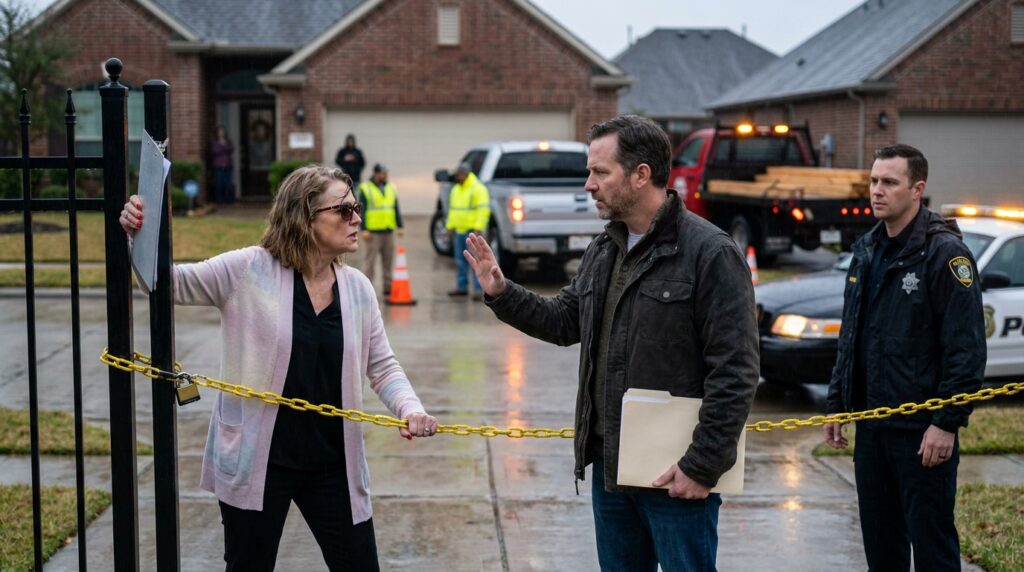
CHAPTER 5: The Legal Exposure
The conference room at Tom Elias’s law office smelled of old calfskin bindings, floor paste, and rain-soaked wool. The table was polished mahogany, wide enough that Julian had to slide a manila folder nearly three feet across the dark grain to reach the opposing side.
Evelyn Smythe did not touch the folder. She sat rigidly upright in her chair, her pastel cardigan buttoned to the collar despite the stifling heat of the radiator, her hands folded over a pristine yellow legal pad that remained completely blank. Beside her, Vincent Harlow—the association’s retainer counsel, a man whose sharp gray suit looked like it had been tailored from a tax ledger—kept his eyes fixed on the heavy brass corners of the desk.
“My client,” Harlow began, clearing his throat with a dry, professional click, “is prepared to recommend a modest administrative settlement. Five thousand dollars to cover disputed landscaping costs, and a joint petition to review the boundary alignments through an independent mediation panel.”
Tom Elias didn’t look at Harlow. He didn’t look at Evelyn. He was busy cleaning his tortoiseshell reading glasses with a small linen square, his movements slow and mechanical. When he finally set the glasses down, he didn’t offer a counteroffer. He simply opened a secondary binder and turned it toward them.
“Let’s look at the mathematics of your proposal, Vincent,” Tom said, his voice flat and devoid of theatrical warmth. “Under Millbrook municipal code section fourteen dash three, unpermitted permanent construction on a designated right-of-way carries a civil penalty of two hundred dollars per square meter per day. Your unpermitted fence covered thirty-four point two square meters for forty-seven days.”
Julian watched Evelyn’s fingers twitch against the yellow pad. A single, sharp line of red ink appeared where her fingernail dug into her palm.
“Furthermore,” Tom continued, sliding a second printed transcript across the mahogany, “we have a verbatim, timestamped audio record of a council member explicitly threatening my client’s independent home renovation permits during an open board session if he refused to drop his inquiries. That crosses the line from neighborhood dispute into municipal extortion, carrying potential corporate liability for every executive member who voted in favor of the blockade.”
Harlow leaned over, his eyes scanning the transcript lines. The color began to drain from his face, the easy, polished arrogance of a retained lawyer evaporating as he calculated the exposure. He didn’t look at Evelyn now. He looked down at his own legal pad, where he had written liability and underlined it twice with a heavy black pen.
Evelyn’s composure finally fractured. The tight, porcelain shell of her authority cracked down the middle. “We are the executive committee,” she snapped, her voice rising sharply against the quiet walls. “We represent one hundred and forty households who rely on our leadership to maintain property standards! We have a defense fund! We can sustain this litigation ten times longer than a single resident!”
Julian leaned forward, resting his forearms flat on the mahogany table. The wood was cold against his wrists. “You aren’t fighting for the neighborhood, Evelyn,” Julian said quietly. “You’re protecting V&S Paving, your brother-in-law’s contracting firm, which has held an unbid monopoly on every single asphalt and concrete repair project in Elmwood Estates for the last four years. Every gate you chain, every permit you block, is just a way to force homeowners to use your family’s services.”
The silence that dropped into the room was absolute. It wasn’t the polite quiet of a professional office; it was the heavy, breathless vacuum that follows an explosion.
Evelyn’s mouth opened, but no sound came out. Her gaze snapped from Julian to Harlow, searching the lawyer’s face for a denial, a counter-argument, anything to rebuild the wall. But Harlow was already sliding his legal pad into his briefcase, his movements precise and final.
“We will review these terms with the board this evening, Mr. Elias,” Harlow said, standing up and buttoning his suit jacket with mechanical stiffness. He looked down at Evelyn, his voice dropping to a cold whisper. “Get your coat, Mrs. Smythe. We have a very long board meeting ahead of us.”
Julian sat back in his chair as the heavy oak door clicked shut behind them. The room felt lighter, cleared of the dense fog of manufactured rules and paper threats. But as he looked down at his own notes, he knew the hardest part wasn’t breaking their defense—it was making sure the wall never went up again.








