The Mechanics of Restraint and the Cost of Unscanned Lines

CHAPTER 1: THE BLOCKED THRESHOLD

The cold iron grid of the shopping cart frame struck my left thigh precisely three inches above the knee joint, the impact muted by the heavy canvas of my jacket but rigid enough to lock my heel into the grout line of the floor tile.

I did not drop the reusable tote. My right hand remained hooked around the webbed strap, calculating the downward pull of three bags of dark roast and a pound of cold-storage produce. In my forty years as a structural inspector, failure always announced itself through these kinds of sharp vectors—an un-calculated weight shifting against a fixed barrier. Across the handle of the cart, Evelyn Vance’s knuckles were already turning the color of skim milk. Her chest heaved beneath a bright floral blouse, the synthetic fabric whispering against her skin as she leaned her entire silhouette into the metal basket, turning it into an impromptu barricade.

“You skipped the scale on the organic bin, sir,” she said. Her voice had the thin, piercing resonance of un-tempered glass, pitched to clear the white noise of the ceiling fans and the low, rhythmic thud of the compressor units under the meat cases. “I watched you from Register 3. You dropped the coffee directly over the produce bag to fool the weight sensors. I know exactly how the self-checkout loop works.”

I didn’t answer. I didn’t shift my weight away from the wooden magazine rack pinning my hip from behind. The air in the front lobby smelled faintly of industrial pine cleaner and the burnt, chemical tang of the automated checkout receipt printers. Behind her, at Register 2, a cashier’s hands hovered three inches above a head of iceberg lettuce, the laser scanner emitting a single, steady tone as the system timed out. Two shoppers in the queue lowered their gaze from the overhead digital monitors, their eyes tracking the hard, geometric lines of Evelyn’s posture.

“Ma’am,” I said, keeping my tongue flat against my teeth to level the tone. “The receipt is digital. If you step back three inches, we can let these people through the exit.”

“The rules don’t rewrite themselves because you have a phone, Mr. Pendelton,” she snapped, her chin rising as she pulled her oversized sunglasses down the bridge of her nose. The gold chain attached to the frames swung rhythmically, a tiny pendulum counting down the seconds of the silence that followed. She didn’t look down at my leg; she looked directly at the center of my throat, her eyes bright with the hyper-focused clarity of a self-appointed auditor who had finally found an un-permitted structure. “You’re going to wait right here until Craig brings the terminal down. Let’s see what the system says about the weight profile.”

Deep in my right pocket, my thumb rolled over the brass leveling tool I’d carried since the bridge contracts in ninety-two. It was cold, small, and entirely balanced. I watched her finger rise, pointing stiffly at the canvas bag in my hand, her silver rings catching the harsh white glare of the fluorescent tubes overhead. The crowd behind her was expanding now, their footsteps slowing as they reached the bottleneck, the low murmur of changing register lines sharpening into a distinct, waiting edge.

My phone remained dark in my hand, the screen reflecting the high, vaulted steel beams of the supermarket ceiling. I could feel the small micro-discrepancy of the situation—the way she knew my name without an introduction, the specific way her thumb was pressing into the leather strap of her handbag as if hiding a physical object inside the seam.


CHAPTER 2: THE SUMMONING OF THE TERMINAL

“Hold it right there, Craig.” Evelyn’s hand snapped out, her fingers hooked like a talon over the plastic bumper of the register station. “Don’t let him pocket that phone. That’s where he’s hiding the transaction spoof.”

Store Manager Craig didn’t look up immediately. He adjusted the rubberized grip of the wireless inventory terminal in his palm, his thumb clicking the scan trigger twice to clear a lingering network error. The red laser line sliced through the gray space between us, splashing briefly against the brushed steel buttons of my jacket before dying against the dark canvas bag. Craig’s face was the color of unbaked dough under the high-intensity lamps, his eyes narrowed into two dark slits as he calculated the precise administrative cost of a front-lobby scene during the Saturday peak shift.

I held the phone steady, the glass screen cool against my calloused palm. “The loyalty application logs everything to the store’s main frame at the moment of payment, Craig,” I said, keeping the pitch level, an unyielding beam under load. “Kiosk four. Check the terminal ledger for the 10:18 time stamp. The apples are recorded by weight, not unit count. You know the calibration on that lane has been dropping since the refrigeration line started leaking beneath the slab.”

Evelyn let out a sharp, rhythmic laugh that had no humor in it. She shifted her weight, her floral blouse catching the blue edge of the display kiosk light, making the printed petals look like bruised veins. “Listen to him. He talks like an engineer because he thinks it makes him look above suspicion. He’s been lingering by the organic bins for twenty minutes, Craig. Just look at the bottom layer of that tote. The coffee bags are intentionally arranged to alter the displacement profile on the bagging platform.”

Craig stepped into the narrow gap between the newspaper rack and the cart’s front wheel, his heavy leather shoes squeaking against the polished gray tile. The sound was sharp, a distinct structural failure in the room’s collective patience. Behind him, the queue at Register 2 had grown by four more carts, the handles clicking together like a train car coupling in a dark yard. A young man in a high-visibility work vest lowered his phone, his thumb tapping the edge of a plastic juice jug.

“Let me see the handheld, Craig,” Evelyn demanded, her hand extending toward the terminal. “I know the district manager. I know exactly what happens when local management lets these micro-losses slip through the monthly audit. It’s an operations failure.”

“Ms. Vance,” Craig said, his voice dropping into a low, transactional growl designed to keep the conversation from spilling over to the customer service desk. He raised the terminal, the small liquid crystal display throwing a pale green reflection across his cheek. “I run the logs, not the customers. Step back from the cart.”

He didn’t wait for her to clear the threshold. He swiped his supervisor badge through the terminal’s side slot, the magnetic strip making a dry, scraping sound. I watched his thumb move across the rubberized directional pad, entering the override sequence. The machine emitted three short, dull beeps—the diagnostic cadence of an internal system search.

I kept my eyes locked on the edge of the terminal casing. There was a scratch along the plastic bezel, deep and filled with white dust from the loading dock. But as the green screen refreshed, Craig’s thumb stopped mid-stroke. The lines of his forehead deepened, the skin tightening over the bridge of his nose until his eyebrows became a single, hard ridge.

He didn’t look at Evelyn. He looked directly at the scannable barcode still glowing on my phone screen, then back down at the terminal matrix.

“What is it?” Evelyn leaned over the metal lattice of her cart, her sunglasses slipping another fraction of an inch down her nose. “Is the transaction missing? I told you. It’s a spoofed screen capture.”

“The transaction is there, Mr. Pendelton,” Craig said slowly, his voice losing its retail exhaustion, replaced by something cold and calculated. He turned the device slightly away from Evelyn’s line of sight, but my angle was clean. The screen wasn’t showing the standard green approval matrix. It was pulsing with a solid amber block, and across the center of the display, four capital letters were locked in bold text: REST.

Beneath the restriction code, a single line of automated telemetry was scrolling: Corporate Loss Prevention Flag – Profile Identification Pending Account Freeze.

“Craig,” Evelyn said, her voice sharpening as she noticed the shift in his posture. “What does the screen say?”

“Arthur,” Craig said, ignoring her completely, his eyes fixed on my jacket pocket where my fingers still held the old brass leveling tool. “When was the last time you updated your commercial vendor profile with the regional office? The system isn’t just flagging the apples. It’s locked your entire loyalty identity out of the local server network. It says this account was deactivated at the corporate level forty-eight hours ago.”

The murmur behind us ceased entirely. The silence that followed was heavy, structural, the kind that precedes a major collapse. Evelyn’s lips parted into a small, cold smile, her fingers relaxing against the cart handle as she realized the machine had just handed her a larger hammer than the one she had brought into the lane.

I felt the brass tool in my pocket—solid, heavy, and perfectly level against my thigh. The decoy was live. The system hadn’t failed by accident; it had been configured to fail the moment I scanned the barcode at Kiosk 4.

CHAPTER 3: THE SYSTEMIC DISCREPANCY

The amber glow of the restriction warning didn’t just illuminate Craig’s face; it cast sharp, microscopic shadows across the keycaps of his handheld console. I watched the trailing edge of the code blink—a specific hexadecimal suffix, .047. It wasn’t a standard retail loss-prevention string. Standard store metrics used basic numeric tiers for inventory shrink. A decimal suffix like that belonged exclusively to regional land registry integration profiles, the exact technical notation used when municipal zoning parameters were tied to merchant business licenses.

“Let’s see you explain that one, Arthur,” Evelyn muttered. Her fingers uncoiled from the cart’s plastic grip, her long nails tapping a fast, rhythmic pattern against her designer leather bag. The gold chain on her frames rattled with a tiny, tinny vibration that scraped against my nerves. “Corporate doesn’t flag accounts for simple scanning errors. They flag them when there’s a pattern of systemic fraud. I knew your little morning walks through the commercial sector weren’t just for exercise.”

I didn’t let my gaze drift to her face. In my line of work, looking at the distraction instead of the stress point was how an inspector missed the sheer crack forming in a concrete column. I focused entirely on Craig’s thumb. It was hovering over the escape button, twitching with the slight, uneven pulse of a middle manager who had just realized he was standing under an un-reinforced roof.

“Craig,” I said, my voice dropping an octave, solid and unyielding. “Look at the localized routing code at the bottom of that alert. The one right next to the server timestamp. That’s not pulling from the regional distribution database in Chicago. It’s routing through an external third-party portal.”

Craig shifted his leather shoes, the squeak against the gray tile less authoritative now, more hesitant. He cleared his throat, his thumb finally pressing the pad down. The amber block flashed once, refusing to clear, remaining locked over the itemized list of my coffee and apples. “Mr. Pendelton, this terminal uses a closed corporate intranet. It doesn’t pull from external portals unless there’s a specialized compliance hold submitted through the legal department.”

“Exactly,” Evelyn leaned in, her scent—heavy, chemical lavender—cutting through the cold pine cleaner of the floor. “A legal hold. Because you’ve been squatting on corporate infrastructure parameters, haven’t you? The neighborhood association has been receiving complaints about the un-developed parcel behind the pharmacy for six months. Your name is all over the county non-compliance list.”

The puzzle pieces slid together with a cold, metallic click inside my mind. She didn’t care about the apples. She never had. The entire scene at the bottleneck was an engineered piece of theater designed to force a public, recorded interaction with store management while an automated script flag sat waiting on the server. The grocery chain’s parent company had been trying to acquire the commercial lot my late Martha left me—the small strip of grass and old timber that bordered this very parking lot—to expand their loading dock corridors.

“The non-compliance notices were dismissed by the circuit court three weeks ago, Ms. Vance,” I said, keeping my hands perfectly still inside my canvas pockets, my fingers curled around the brass leveling tool to anchor my center of gravity. “The title is clean. If your association is routing private boundary challenges through a commercial retail checkout system, you’ve crossed a very specific statutory line regarding corporate data misuse.”

“Don’t change the subject to property lines,” Evelyn hissed, her sunglasses completely dropping to her nose as her eyes narrowed into sharp, hostile arcs. Her arm shot out again, pointing directly at the digital receipt on my phone screen. “Craig, look at his device. He’s deliberately stalling because he knows if he walks out those doors with that bag, the store’s automated loss-prevention algorithms register a completed theft. Call security. Call the police if you have to. He is occupying this lane illegally.”

Craig didn’t call for security. His eyes were glued to the trailing string on his screen, his brow furrowed as he wrestled with the realization that his inventory terminal was executing a command line he couldn’t trace through standard operational manuals. The line of waiting shoppers behind us began to lean outward from their lanes, their voices rising in an uneven wave of irritation.

“Hey, friend,” the man in the high-visibility work vest called out from Register 2, his hand slamming down onto the handle of his cart. “Some of us have shifts starting in twenty minutes. If the old man paid for his coffee, clear the terminal and let him pass. We don’t need a neighborhood council meeting in the middle of the exit lane.”

“This is an official store audit!” Evelyn turned her torso sharply toward the line, her floral blouse twisting tightly over her shoulder. “If you don’t care about the security of your neighborhood market, you can use the secondary exit. This man’s account is flagged by the corporate office!”

I watched the cashier at Register 1 lower her head, her fingers clicking the intercom button to call for an administrative backup. The blue screen of my phone began to throb with a low-battery warning, the light flickering slightly against the dark leather of Evelyn’s handbag. It was then that I noticed the small, rectangular silhouette pressed tightly against the inner lining of her purse—not the shape of a wallet or a compact, but the unmistakable, sharp edge of a corporate-issued employee access card, the kind used by the development contractors who had been surveying my lot since Tuesday morning.

The decoy was deep, and it was holding the perimeter. If I pushed past her cart now, the corporate server would log a physical breach under a restricted profile status. I had to make her move her own pieces until her structure collapsed from its own weight.

“Craig,” I said, my voice cutting through Evelyn’s shouting with a measured, technical chill. “Run the validation sequence on kiosk four again, but this time, remove the loyalty profile identifier from the input line. Let’s see if the weight on the physical scale matches the currency exchange value without the regional flag interfering.”

Craig hesitated, his finger hovering over the terminal interface. He looked at me, then at Evelyn, whose breathing had gone thin and shallow as her hand snapped back down to steady her heavily loaded shopping cart.

CHAPTER 4: THE INVENTORY REALIGNMENT

The plastic keys on Craig’s handheld terminal clicked beneath his thick thumb with a dull, rhythmic snap. He wiped a streak of condensation from the cracked glass display, entering the structural bypass code that stripped my personal loyalty identifier from the register’s memory banks. For three seconds, the internal power transformers in the ceiling hummed louder, a heavy, vibrating drone that seemed to pull the stark white light down into the narrow checkout lane.

The terminal gave a single, high-pitched chime. The amber restriction block vanished, replaced by a clean green line of scrolling data metrics. The kiosk scale’s weight profile matched the physical contents of my canvas tote down to the literal ounce. The scannable verification code on my phone was entirely accurate. The accusation of theft, the carefully constructed public trap that Evelyn Vance had laid across the threshold, disintegrated into a series of harmless system digits.

“The weight is verified, Ms. Vance,” Craig said, his shoulder dropping two inches as the administrative tension left his frame. He didn’t look at me; he looked down at the metal bumper of her shopping cart, his fingers loosening their grip on the console casing. “Mr. Pendelton’s transaction is legally clear. The scale calibration registered the apples correctly under the coffee. There is no inventory deficit on register lane four.”

The young man in the high-visibility vest at Register 2 let out a low whistle, shifting his plastic juice jug to his other arm. “Told you. Let the old man through. Some of us have actual regular work to get to.”

But I didn’t move. My heel remained locked against the grout line, my fingers still coiled around the cold brass leveling tool in my pocket. I was watching the terminal screen. The green clearance matrix hadn’t returned to the main menu. Instead, the screen split horizontally, a rapid succession of secondary telemetry blocks flashing across the liquid crystal matrix. The system was forcing an automated query loop through an un-mapped network register, and at the top of the interface, a distinct red municipal seal began to render itself pixel by pixel.

It was a court-ordered asset lien tracking stamp. Beneath it, a line of cold text locked into place: Asset Parcel 114-A Commercial Holding Status: Closed by Emergency Injunction 06:00 Hours.

Evelyn Vance didn’t flinch as the theft charge dissolved. She didn’t offer a word of apology. Her chin remained lifted, her gold-framed sunglasses catching the sharp reflection of the red terminal text. A cold, surgical satisfaction settled into the corners of her mouth. She had never expected the shoplifting charge to stick. The entire confrontation at the door was a timed operational delay, a physical mechanism to hold me within a corporate network environment until the electronic registration system synchronized the real estate litigation data across every local commercial platform owned by the parent company.

“It doesn’t matter what the scale says about the produce, Craig,” Evelyn said, her voice dropping its frantic public pitch, flattening into the unyielding tone of a professional clerk executing a foreclosure. She reached down, her manicured fingers unzipping the leather side pocket of her handbag with a slow, deliberate scrape. She pulled out a folded sheet of high-grade bond paper, the municipal seal at the top matching the red graphic blinking on Craig’s screen. “Mr. Pendelton isn’t a customer anymore. As of six o’clock this morning, his commercial status within this precinct has been re-classified under the state’s emergency expansion mandate.”

She tossed the document onto the flat plastic deck of Register 2. The paper slid across the smooth surface, its sharp edge stopping against Craig’s supervisor badge.

“The regional development group finalized the infrastructure access easement while you were standing by the organic bins, Arthur,” she said, looking directly into my eyes with the absolute coldness of an equal intellect that had calculated every variable three moves in advance. “The parcel behind the pharmacy—your late wife’s timber lot—is no longer an independent legal structure. The parent company took physical possession of the boundary coordinates through the county clerk’s automated portal at dawn. This market’s loading dock expansion begins on Monday morning.”

I felt a cold sensation settle over my knuckles. The decoy secret—the corporate blacklist on my grocery account—had been shattered, but the failure it revealed was devastating. My meticulous legal tracking, my clean title certificates, my reliance on the circuit court’s dismissal from three weeks ago—everything had been bypassed by a shadow filing that shifted the entire conflict from a simple property dispute to a total systemic lockout. They hadn’t tried to buy the land; they had used the grocery chain’s logistics license to claim an emergency commercial easement under a municipal loophole I hadn’t even flagged in my risk assessments.

Craig picked up the document, his thumb leaving a dark, oily smudge across the clean border of the seal. He read the first three lines, his face losing what little color it had left. “Arthur… this is signed by the district supervisor. It’s an official development attachment. It’s routed through our inventory compliance systems because the lot is officially registered as a logistical support zone now.”

“He knows exactly what it is,” Evelyn said, leaning her hip against the metal cart, her arm extending to grip the handle with an authoritative, permanent lock. “He thought he could sit on that parcel forever, letting the grass grow over the drainage channels while the neighborhood choked on the traffic bottleneck. But the system is larger than your individual stubbornness, Arthur. You’re out of leverage.”

Behind us, the line of shoppers went entirely still. The impatience that had been building for ten minutes turned into something heavy and uncomfortable—the collective silence of people watching an old man lose his footing on a bridge he thought he owned. The phone screens that had been recording the petty argument about apples remained high, their lenses now capturing the physical evidence of my displacement.

I stood perfectly still, my eyes fixed on the folded document in Craig’s hand. The failure was absolute, a structural collapse that threatened to erase the last physical anchor I had left of Martha’s memory. But as I stared at the paper, I noticed a tiny, sub-textual anomaly near the bottom of the registration stamp—a specific vendor suffix that didn’t match the county’s standard legal ledger. It was the same decimal code from Chapter 3: .047.

The development group hadn’t filed a public easement. They had used an internal merchant account identifier to simulate a municipal authorization through the store’s logistics network. The ultimate reality was still locked inside the server behind the customer service desk, hidden beneath a layer of corporate paperwork that Evelyn believed was ironclad.

“Craig,” I said, my voice cutting through the heavy silence of the lobby like a cold chisel striking slate. “Keep that document on the counter. Don’t clear the terminal screen yet.”

Evelyn’s smile didn’t falter, but her hand tightened on the cart handle, her knuckles turning that sharp, skeletal white once again. “It’s over, Arthur. There’s nothing left to audit.”

CHAPTER 5: THE CLEAR PERIMETER

“Craig, tilt that console forty-five degrees to the left,” I said, my voice cutting through the tight space between the registers like a high-tensile wire under tension.

The store manager didn’t blink. His fingers, slick with the cold sweat of a man caught between corporate parameters and public liability, shifted the terminal. The red municipal seal on the liquid crystal screen caught the hard glare of Register 2’s overhead light. The .047 suffix wasn’t a county filing index; it was a local merchant override, a specific digital routing token that required a physical administrative key card to populate the database.

Evelyn Vance’s hand went rigid against the folded paper document on the counter. Her oversized sunglasses slipped completely off her nose, hanging from the delicate gold links around her neck like a set of brass calipers. “Arthur, this document has a certified notary stamp. The logistics corridor is closed to public interference. You can’t talk your way past a municipal execution order.”

“It’s not a municipal order, Evelyn,” I said, taking my right hand out of my jacket pocket. The small brass leveling tool sat solid in my palm, its clean geometric edges catching the blue back-light of the scanner bed. I didn’t point it; I simply laid it flat on the stainless steel counter beside her paper. “Craig, look at the active barcode on the sheet she just handed you. Then look at the front tier of her shopping cart.”

Craig’s gaze dropped. He didn’t use the laser scanner. He used the flat, unblinking focus of an inspector tracking a structural fracture. Evelyn’s heavy canvas shopping bags had shifted when she threw the paperwork across the counter, and there, nestled deep within the plastic mesh basket near the toddler seat, lay three wrapped blocks of premium imported cheeses and two dark glass bottles of high-end estate olive oil. They were completely bare—un-bagged, un-tagged, and missing the small white thermal labels that indicated a completed transaction log entry.

“What is this, Ms. Vance?” Craig asked, his voice losing its administrative delay, dropping into the deep, level tone of a floor supervisor who had just found an un-recorded loss on his own inventory deck.

“Those… those are sample allocations from the regional development office,” Evelyn said, her voice dropping its sharp, piercing resonance, stuttering into a shallow, uneven rattle. She took a step back, her synthetic floral blouse catching the cold metal corner of Register 3’s conveyor belt. “They were cleared by the site logistics manager. I was instructed to bring them through the service terminal for corporate reconciliation.”

“The service terminal doesn’t process un-scanned private merchandise, ma’am,” Craig said. He raised the wireless handheld, the red laser line snapping across the glass labels of the olive oil bottles. A double-tone sounded—a short, low-frequency error code that meant the items were still active inside the local stock ledger. They had never crossed a scanner bed. “Our regional logs show Register 3 closed its transaction matrix exactly four minutes ago. These items aren’t on your balance sheet. And store policy requires every piece of corporate inventory to be scanned at the point of linear egress.”

A sudden, sharp ripple of laughter went through the queue behind us. The young man in the high-visibility vest stepped forward, his heavy boots clacking firmly on the gray tile. “Look at that. The neighborhood warden’s running a shadow audit on the high-end deli stock. Let the old man through the door, Craig. She’s the one with the un-scanned load.”

“This is an operational misunderstanding,” Evelyn hissed, her fingers twisting the leather strap of her handbag so tightly the synthetic seams began to hum under the strain. She looked around the circle of waiting shoppers, her eyes hunting for a single line of social support, but the phone screens that had been recording my bottleneck were now locked entirely onto the white edge of her knuckles. The crowd had turned. The power dynamic in the lane had completely flipped, the structural failure of her authority collapsing into the polished tile.

“I need you to step into the security office behind the service counter, Ms. Vance,” Craig said, his hand gesturing toward the gray swinging doors at the rear of the lobby. Two floor employees in matching corporate shirts moved into the perimeter, their physical silhouettes blocking her retreat toward the parking lot doors. “We’ll be running a full cart audit, and I’ll be contacting the regional compliance officer to verify why a development vendor profile is attempting to route private real estate documents through a local consumer point of sale.”

Evelyn didn’t shout. She didn’t wave the paper. Her shoulders sank three inches, her frame looking small and desaturated under the high-intensity lamps as the employees took hold of her cart handle. She walked down the long, narrow aisle toward the rear corridors, her leather purse clicking against her hip in the heavy silence of the floor.

I picked up my canvas tote, adjusting the stitched handles across my palm until the weight was perfectly balanced against my thigh. I didn’t look back at the swinging doors, nor did I check the blinking screen of my phone. I walked through the automatic glass doors, the cool morning air hitting my face with the clean, scentless clarity of an open horizon.

The gravel in the far lot crunched beneath my shoes as I reached the truck. The lot my Martha left me was still there across the asphalt, its tall oaks holding the quiet light of the early sun within their branches, completely solid, un-touched by the noise of the machinery that had tried to reshape its edges. The truth didn’t need to shout to clear a perimeter. It just needed to hold its line until the system ran out of moves.

CHAPTER 6: THE BOUNDARY SURVEY

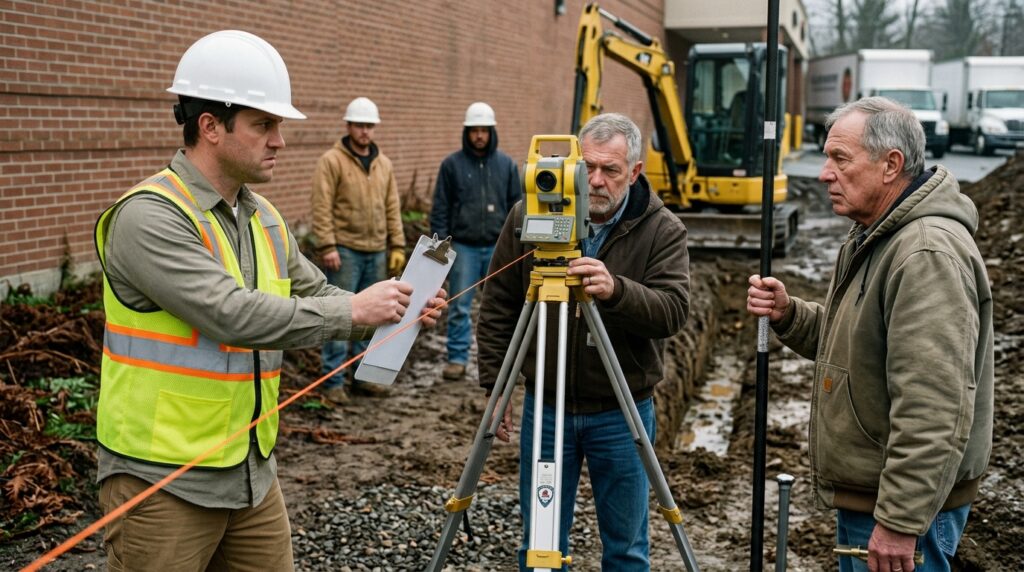
The orange poly-vinyl survey string snapped taut against my boot heel with a sharp, synthetic hum. I didn’t look back toward the supermarket parking lot, where the early morning delivery trucks were already idling against the concrete loading docks. Instead, I watched the steel tip of a four-foot boundary pin bite into the black earth of Martha’s timber lot.

“Hold the prism steady right there, Arthur,” Ray Okafor said from behind the tripod of his total station. His voice was low, gravelly, carried on a gust of cold valley air that smelled faintly of damp pine and unburned diesel fuel. “If their field crew moved the original northwest section corner, the laser’s going to catch the discrepancy within two millimeters. The county’s public database won’t be able to buffer the error line.”

I kept both hands flat on the cold carbon-fiber survey rod, my palm absorbing the low-frequency vibration of the automated leveling motor inside the housing. Twenty yards into the treeline, the low, wet thud of a mini-excavator’s track assembly rumbled through the floor of the valley. The regional development group hadn’t waited for Monday morning. A yellow machine with no corporate decals was already idling beside the pharmacy’s rear retaining wall, its bucket teeth dripping with fresh, grey clay from an un-permitted exploratory trench.

“They’re crossing the structural offset line by twelve feet, Ray,” I said, my eyes tracking the path of a fresh tire rut that had crushed a row of wild ferns near the old limestone boundary marker. “They aren’t just clearing brush. They’re dropping stone for a heavy vehicle access lane.”

“They can drop whatever they want,” Ray muttered, his thumb clicking the mechanical dial on the optical alignment lens. The red laser diode inside the device emitted a faint, high-pitched whistle as it locked onto the glass target above my fingers. “Until they produce a stamped cadastral map signed by a licensed state engineer, every yard of gravel they dump on this side of the ditch is legally classified as criminal trespass with environmental degradation factors. Hold…”

The terminal on Ray’s console beeped—a short, dual-tone confirmation that indicated a successful coordinate lock. But before he could record the data into his field book, the thick brush near the pharmacy wall parted with a heavy, cracking sound.

A man in a clean white hardhat and a high-visibility surveyor vest stepped over the string line, a aluminum clip-board held like a shield against his chest. Behind him, two laborers stopped mid-stride, their iron shovels resting against their steel-toed boots as they watched Ray’s crew align the equipment.

“This is an active commercial easement zone, gentlemen,” the man in the hardhat said, his voice carrying the rehearsed, bureaucratic flatset of a project manager accustomed to clearing private opposition before the legal filings hit the public record. He didn’t look at me; he looked directly at Ray’s state license emblem mounted on the tripod leg. “The regional distribution network has a logistics variance certificate for this section. You’re interfering with a critical infrastructure layout.”

“Show me the wet seal on the variance, son,” Ray said without taking his eye off the optical sight. He didn’t adjust his posture. His right hand remained loosely curled around the brass leveling screw on the base plate. “I’ve been running boundary lines in this county since before they poured the asphalt on the bypass. A regional logistics certificate doesn’t authorize an access corridor over a private estate title unless there’s a federal condemnation signature on page one.”

The project manager stepped closer, the heels of his clean boots digging into the wet grass, stopping exactly two inches from the bright orange poly-vinyl line. He turned his clipboard over, revealing a printed system screen with that same decimal suffix flashing in bold black text at the bottom of the ledger block: .047.

“The filing was synchronized through the county registry’s automated portal at six o’clock yesterday morning,” the manager said, his eyes narrowing into a sharp, transactional glare as he looked across the line at me. “The variance is locked, Mr. Pendelton. The corporate office doesn’t require your signature when the municipal infrastructure code classifies this parcel as an active logistics support node. If your surveyor doesn’t pack down this equipment within ten minutes, the local precinct is going to execute a civil obstruction removal.”

I let my right hand drift to my jacket pocket, my thumb rolling over the cool, small face of the brass leveling tool I’d carried away from the checkout register. The decoy secret—the simple store-level easement—was falling away, but the technical reality behind it was growing heavier by the second. The development crew wasn’t operating on a mistake. They were using a live administrative backdoor inside the county’s digital registry to rewrite the physical boundaries of the valley while the court offices were still locked for the weekend.

“Craig’s store terminal couldn’t validate that signature yesterday, manager,” I said, keeping my pitch perfectly level against the rising rumble of the excavator engine behind him. “And neither can you. If you look at the yellow plastic survey cap your crew drove into the corner stake by the pharmacy wall, you’ll see the serial number belongs to a water-district drainage profile from nineteen-eighty-four, not a commercial logistics expansion.”

The project manager’s thumb slipped against the aluminum edge of his clipboard, his face going entirely still under the white rim of his hardhat as Ray’s laser whined across the grass, cutting a straight red line through the gray morning fog.

CHAPTER 7: THE INTRANET AUDIT

The cooling fan inside Ray’s field terminal emitted a thin, high-frequency whine that vibrated through the metal chassis of the truck’s tailgate. Outside, the gray morning fog was thickening, turning the perimeter of the pharmacy wall into a desaturated haze, but inside the narrow radius of the screen, the data packet was bleeding bright white strings of system code.

“The gateway is heavily masked, Arthur,” Ray said, his hand keeping a tight grip on the interface cable connecting his total station to the ruggedized field laptop. His thumb was stained with graphite and dark timber grease, tapping the escape key twice as the network query timed out against a secondary wall. “This isn’t a localized loop check. Every time my mapping software tries to pull the raw cadastral file from the county server, an automated proxy redirection shifts the packet back to the supermarket’s internal logistics hub. They’ve built a digital loop.”

I leaned over his shoulder, my eye following the rapid scrolling of the transaction logs. The .047 suffix wasn’t a dead passive label anymore; it was actively pulsing at the end of every data exchange line, a microscopic digital anchor keeping the corporate easement flag live on the grid. “Look at the administrative routing stamp at the top of that packet, Ray. The one right above the terminal index.”

“I see it,” Ray muttered, his fingers shifting to the keyboard pad to execute an un-masked command string. “A remote login marker. A regional administration profile accessed the root directory at 05:43 AM, right before the field crew showed up with the excavator. But the terminal signature isn’t listed under the county surveyor’s office. It’s registered to a private network terminal inside the municipal building’s basement annex.”

The realization came down like a cold sheet of iron. The corporate development group hadn’t just used an internal loophole to bypass the local checkout registers; they had secured a live physical portal inside the building infrastructure itself. Evelyn Vance’s neighborhood association wasn’t acting alone—they were the public mechanism covering a deeper, structural corruption that went straight through the county clerk’s office. A localized field audit wouldn’t clear the title if the digital ledger itself was being rewritten at the core.

“They’re locking us out of the live registry, Arthur,” Ray said, his voice flattening into the tight, defensive register he used when a load-bearing calculation came back negative. “The proxy loop is dropping a permanent hold over the coordinates of Martha’s parcel. If my system can’t pull an authenticated county master file within forty minutes, the automated state server logs the project manager’s exploratory trench as a legally uncontested infrastructure commencement.”

“They won’t log it,” I said, my voice cutting through the mechanical hum of the field laptop. I reached into my jacket pocket, my calloused fingers curling around the brass leveling tool, using its precise weight to ground the rising pressure in my chest. “The proxy loop requires a continuous validation token from a local terminal to maintain its authority. That’s why Evelyn had that specific access card in her purse at Register 2. She wasn’t just checking my bags; she was carrying the physical hardware node that keeps this network loop synchronized.”

Behind us, through the gray curtain of the timberline, the muffled roar of the mini-excavator shifted gears, the heavy steel teeth of the bucket grinding against the limestone bedrock with a grating, metallic screech. They were accelerating the excavation, pushing the structural disruption past the offset line because they knew the digital clock was running down.

Ray’s screen suddenly flared into a solid amber block, the exact color of the restriction screen from Craig’s terminal yesterday morning. Across the center of the display, the text locked into place: ACCESS DENIED – HARDWARE AUTHENTICATION TRAILING ERR .047.

“That’s it,” Ray slammed his palm flat against the tailgate liner. “The proxy just sealed the firewall. Without the root terminal key from the municipal annex, my field software can’t verify the original 1987 survey stakes. We’re blind on the line.”

The setback was absolute, a total systemic failure that threatened to wipe out our entire physical defense before we could even file the emergency injunction. The decoy was gone, but the hidden truth behind it was guarded by a digital perimeter I couldn’t cross with a standard survey target. The protagonist had to shift the vector of pursuit, forcing the confrontation away from the dirt and into the very network terminal where the loop had been forged.

“Pack the tripod, Ray,” I said, sliding the brass tool back into my pocket until it hit the lining with a dull, heavy thud. “We’re done measuring the grass. We’re going to the municipal annex.”

CHAPTER 8: THE FINAL TITLE CLEAR

“Pull the master breaker on panel B, Craig,” I said, the words cutting through the humid, subterranean air of the municipal basement like a steel wedge dividing a timber beam.

The clerk behind the desk didn’t rise from his chair. His hand froze over the mechanical entry pad of the terminal console, his skin turning the dull, sickly color of unbaked dough beneath the flickering green glow of the server array. In the corner, the massive iron-framed distribution rack groaned—a heavy, low-frequency hum that vibrated through the cold concrete floor and traveled up through the rubber soles of my boots.

Evelyn Vance stood three feet back, her fingers still frantically clawing at the clasp of her leather handbag, her oversized sunglasses swinging wildly from her neck like a broken plumb bob. “Arthur, you have no authorization to step inside this quadrant. This is a municipal logistics utility center. The digital ledger is already certified by the state repository.”

“The repository doesn’t register proxy signatures that originate from a grocery store lane, Evelyn,” I said, stepping past the galvanized steel conduit that ran along the foundation wall. I drew the small brass leveling tool from my jacket pocket, its cold, perfectly machined corners catching the harsh white light of the bare ceiling tubes. I laid it directly on the plastic bezel of the master terminal monitor, the small glass bubble centering itself precisely between the etched black lines. “Ray, check the hardware ID on the routing card. Let’s see whose administrative security clearance matches that .047 suffix.”

Ray Okafor dropped his field terminal case onto the gray metal desk, the latch opening with a loud, ringing snap that echoed down the concrete corridor. He didn’t look at the clerk. He didn’t look at Evelyn. His thumb hammered the control key three times, executing a hard-wired audit sequence that bypassed the local system’s software encryption entirely.

The terminal monitor gave a single, loud, metallic click. The amber restriction screen that had haunted us from the self-checkout lane down to the timberline vanished, replaced by a cascading sequence of raw, raw database directory listings. The .047 wasn’t a standard corporate inventory classification code. It was a private administrative entry token registered directly to the senior county title registrar—Evelyn’s own brother-in-law.

“The loop is fully exposed, Arthur,” Ray said, his voice level, flat, carrying the unyielding assurance of an engineer verifying a core load-bearing failure. “They didn’t just route the easement flag through the market’s logistics framework to delay the court filing. They were using the store’s automated loss-prevention server as a digital blind to mask the physical deletion of Martha’s original 1987 survey stakes from the county master index. The developer’s clearing crew was logging the trenching coordinates through a falsified municipal port.”

“This is an operational overreach!” Evelyn hissed, her voice rising an octave as she lunged toward the terminal desk, her synthetic floral blouse catching the sharp edge of the metal rack. Her hand slapped against the console, trying to clear the screen, but Craig stepped into the gap, his corporate polo shirt creating a rigid physical barrier that sealed her out of the perimeter.

“Stand away from the deck, Ms. Vance,” Craig said, his hand extending to lock the main server cabinet door shut, the key turning with a heavy, final scrape of brass pins. “I’ve spent the last six hours reviewing the network logs from kiosk four. The store’s regional security office just initiated a global freeze on every transaction code linked to your developer profile. This isn’t an inventory dispute anymore. It’s a felony system manipulation of a public record.”

The silence that followed was absolute, heavy, the specific structural quiet that marks the definitive end of an unequal chess match. Evelyn looked at the green screen, then at the brass tool resting perfectly level on her paperwork, her posture deflating until she looked small, desaturated, and entirely spent beneath the unblinking glare of the basement lights. The decoy had been stripped away, and the final reality sat bare on the counter—a completely documented record of systematic fraud that no amount of public shouting or invented authority could reconstruct.

I picked up the small brass level, sliding it back into the deep pocket of my canvas jacket until it hit the lining with a familiar, solid thud. I looked at Craig, then at Ray, and walked toward the stairs.

The automatic doors at the top of the concrete stairwell opened into the bright, clean midday sun, the fresh air carrying the scent of rain and open earth. Across the asphalt lot, the tall timber on Martha’s land stood still, its heavy branches holding the quiet space of the valley exactly as it had for forty years, the perimeter cleared, the title ironclad, and the boundary lines finally settled in stone.

Similar Posts

Leave a Reply

Your email address will not be published. Required fields are marked *