The Weight of the Yellow Curb and the Cold Machinery of the Alley

CHAPTER 1: THE FIRST WINDOW

The manifest on Marcus’s clipboard was stained with old grease at the margin, the ink from his ballpoint pen running thin against the damp morning paper. Every shift was an exercise in shrinking numbers. The digital clock on the dash read 7:38 AM, leaving him precisely eleven minutes to clear the Market Alley junction before the medical clinic’s intake bay locked its automated security doors for the morning sorting cycle. If he missed the window, the premium supply crates remained in the hold until the afternoon shift, and the overtime allowance required for his sister’s home healthcare worker would dissolve into an administrative penalty. His hands, calloused at the knuckles from heavy crate handles, held the steering wheel with a loose, practiced grip that looked like patience but was actually paralysis.

He swung the van hard to the left, the heavy steel frame grooving into the mouth of the alleyway where the smell of burnt coffee grounds and wet brick always hung thick in the air. The tires hummed against the uneven granite pavers, bouncing the metal cargo shelves in the rear with a rhythmic, hollow clang. Everything was on schedule until the van cleared the blind corner by the boutique bakery.

The brake pedal went down hard under his boot. The ABS system pulsed once beneath his sole, a mechanical shudder that died out against the floorboards as the vehicle came to a dead stop.

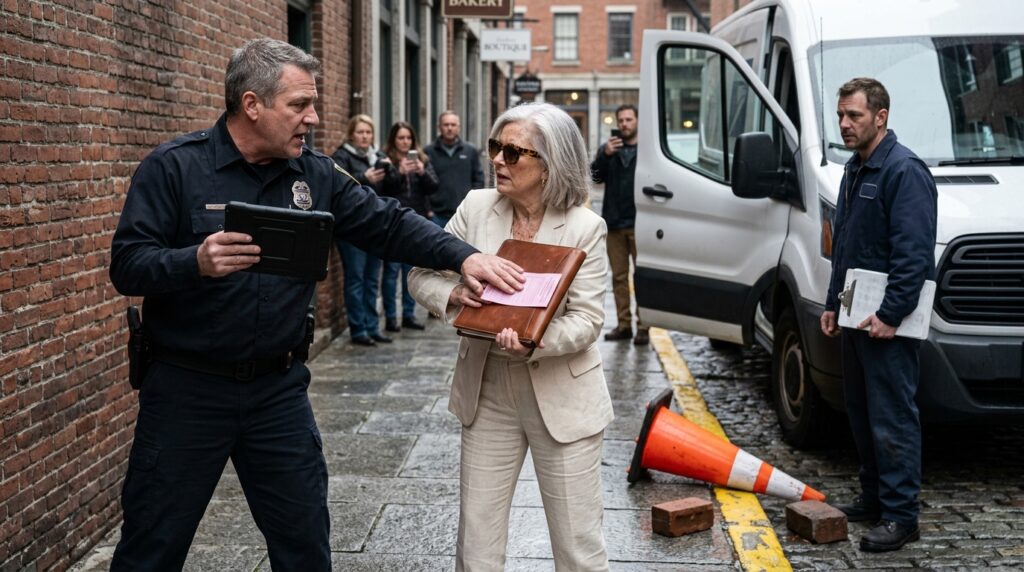
Directly in the center of the yellow-painted loading box stood an orange plastic cone, its reflective base weighted down by an old brick. Behind it stood Evelyn Thorne. She didn’t jump back from the approaching grille. She simply stood her ground, her arms crossed over the stiff linen of her pantsuit, her oversized tortoiseshell sunglasses catching the gray morning light like twin obsidian mirrors. Under her left arm, she cradled a thick leather binder with brass corners that glinted in the wash of Marcus’s headlights.

Marcus did not touch the horn. The silence inside the cabin was immediate, save for the heavy, rhythmic ticking of his father’s silver watch against his wrist. He watched her through the glass. Her jaw line was tight, the muscles moving beneath her skin as she muttered something to a boutique barista standing on a wooden loading platform to her right. The alley was too narrow to reverse without a spotter, and the concrete walls on either side were already close enough to scraping his side-view mirrors.

Evelyn uncrossed her arms and took three deliberate steps forward until her knees were nearly touching his front license plate. She pointed a finger toward the ground, then toward the brick archway at the mouth of the alley. She was speaking now, her voice muffled by the thick windshield glass, but the shape of the mouth was unmistakable: Out.

Marcus reached up with his left hand, his thumb catching the ridges of his commercial dashcam’s mounting bracket. A small blue LED light on the camera’s housing blinked steadily, recording the cobblestones, the cone, and the rigid posture of the woman holding his entire morning hostage. He didn’t turn off the engine. The diesel exhaust began to rise around her linen trousers, gray and heavy, but Evelyn Thorne did not move.


CHAPTER 2: THE SOUND OF THE HASP

The manual window crank resisted Marcus’s grip, the internal gears grinding against years of accumulated brick dust trapped inside the door panel. He rotated the plastic lever three full times until the glass pane dropped six inches, allowing the sour smell of idling diesel and damp masonry to fill the cabin.

“You’re tracking grease across a preservation walkway, driver,” Evelyn Thorne said. Her voice lacked the high register of panic; it was flat, metered, and heavy with the bureaucratic assurance of someone who spent her Tuesday evenings drafting municipal grievances. She didn’t look down at the van’s bumper, which remained less than two feet from her shins. Instead, she struck the edge of her leather binder against the side-view mirror housing. The heavy gold links of her watch made a sharp, metallic clink against the hard plastic. “The historical designation for this alleyway was updated during the spring council session. Heavy commercial freight is restricted to the northern arterial docks. You have sixty seconds to reverse out to the main boulevard before I log the license prefix.”

Marcus didn’t shift his feet on the pedals. His right boot remained braced against the brake, the mechanical vibration of the transmission pulsing through his heel. He picked up his steel clipboard from the passenger seat, the metal cold and pitted against his fingertips.

“The city code painted on this curb says otherwise, ma’am,” Marcus said, his delivery level, stripped of any defensive inflection. “Yellow curb, zone four. Dedicated medical logistics priority. I have a three-minute delivery allowance for the clinic’s rear intake box, and my clock started when I cleared the archway.”

“Your clock is irrelevant to the district council,” she snapped.

With a swift, practiced motion of her wrist, Evelyn popped the brass hasp of her binder. The heavy leather covers flared open like a small shield, revealing a stack of cream-colored documents secured under a triple-ring mechanism. She flipped through two indexed dividers until she reached a page covered in dense, small-print terminology. She held the binder high, angling the paper toward the dropped window so Marcus could see the thick black lettering at the top: Market Alley Historical Conservation and Restricted Logistics Directive.

Marcus didn’t lean toward the window, but his gaze narrowed, tracking the lines of text with the precise, scanning habit of a man who spent eight hours a day verifying serial numbers on pharmaceutical packing slips. His eyes stopped on the lower third of the page. Beneath a paragraph detailing private property line extensions, a circular municipal emblem was stamped into the paper.

The seal was wrong.

The three-tower crest of the city’s department of transit was visible, but the outer ring of text was slightly misaligned, the font using a serif layout that the county clerk’s office had phased out during the technological audit three winters ago. More telling was the ink itself; it lacked the slight indentation of a heavy mechanical pressure stamp, appearing flat, slightly blurred at the edges, like an inkjet reproduction forced onto heavy linen stock. He didn’t say a word about it. He recorded the anomaly in his mind, filing it alongside the sound of the ticking watch on his wrist.

“This document has been ratified by the seven primary storefront stakeholders on this block,” Evelyn said, her fingers clamping down on the margin of the page, nearly obscuring the blurred seal. “We control the easement access from the hours of seven to eleven to preserve the architectural integrity of the foundations. Your firm was notified by certified mail in April.”

“My firm handles emergency regional logistics, Mrs. Thorne,” Marcus replied, his voice dropping into a quieter, transactional register that made her defensive posture look theatrical. “We don’t sign neighborhood covenants. If you don’t move the orange cone, I’m required by company protocol to log a physical delivery obstruction with the city enforcement desk. That call goes out on a recorded state line.”

Evelyn’s face didn’t soften; the lines around her mouth tightened until her lips were a thin, bloodless seam. She took a step back, her expensive boots scraping against the grit of the cobblestones with a dry, harsh friction. She didn’t touch the cone. Instead, she reached into her linen jacket and pulled out a slim, silver smartphone, her thumb hammering against the screen with rhythmic, vengeful force.

“I am the block captain for this section of the historic registry,” she said, holding the phone out like a weapon, the camera lens catching the blue reflection of Marcus’s dashcam. “We don’t take orders from regional couriers who don’t know the bylaws of the ground they’re parking on. I am calling the private enforcement detail we retain for this block. Let’s see how long your logistics clock runs when the flatbed hooks your front axle.”

Behind her, the door to the boutique bakery creaked open on dry, rusted hinges. A man in an unbuttoned white apron stepped onto the wooden loading deck, a heavy iron tray balanced on his hip, his eyes fixed on the idling van and the woman holding her binder like a ledger of judgment. The stage was setting itself, the local shadows beginning to lengthen across the brickwork as the neighborhood woke up to a conflict that had been building since the first drop of yellow paint hit the curb. Marcus remained inside his steel box, his fingers tapping a slow, unhurried cadence against the rim of his steering wheel, waiting for the system to grind its gears.

CHAPTER 3: THE ASSEMBLY OF SHADOWS

The back door of the boutique bakery didn’t just open; it hit the exterior brick wall with a low, hollow thud that sent a small shower of dried mortar flakes onto the cobblestones. The man in the white apron stepped completely out onto the wooden deck, his arms resting over the iron baking tray like a barricade. Across the alleyway, the brass latch of a clothing boutique swung free, and two sales clerks emerged into the humid morning air, their eyes instantly fixing on the gray profile of Marcus’s transit van.

Marcus kept his hands flat against the wheel. Through the side-view mirror, he watched the gap behind his rear bumper shrink as a boutique coffee supplier’s box truck pulled into the mouth of Market Alley, saw the driver hit his brakes, and recognized the immediate, absolute bottleneck. The alley had become a closed box.

“Evelyn’s right, you know,” the baker called out, his voice bouncing flatly off the narrow brick walls. He didn’t raise his tone to shout; the architectural compression of the alley carried the sound straight through Marcus’s open window window frame. “We put thirty grand into resetting these pavers last October. Your transport axles are chewing the lime right out from between the joints. Take it out to the avenue.”

Evelyn Thorne didn’t lower her smartphone. She held it high, her thumb braced against the volume casing to steady the lens as she walked a slow, deliberate semicircle around the front perimeter of the van. The heavy gold links of her watch clicked rhythmically against the spine of her leather binder with every shift of her balance.

“The driver has been advised of the district restriction, Mr. Geller,” Evelyn reported into the phone’s active microphone, her voice carrying the clear, calculated cadence of a deposition. “He is actively obstructing an emergency historical preservation perimeter. I have already logged the carrier identification number and the operator’s description with municipal dispatch.”

Inside the cabin, the heavy ticking of Marcus’s silver watch seemed to sync with the steady pulse of the diesel engine. He didn’t look at Evelyn’s lens. He turned his head slightly toward the passenger seat, his eyes tracking the specific sequence of names handwritten along the margin of the document she had displayed moments before. Geller was there, scrawled in faded blue ink next to a structural easement index code. Below it were three others—the boutique owners who shared the narrow corridor’s footprint. The layout wasn’t an official city planning annex; it was a localized grid, a privately maintained map disguised by the heavy linen stock of a municipal filing jacket.

“You’re running behind, Vance,” Geller said, stepping down from the wooden deck until his boots met the stone. He walked with a slight limp, his apron strings dragging through the dry stone dust near the yellow curb line. “The clinic intake box locks at 7:49 AM. If you’re sitting here when the timer trips, those medical coolers go straight back to the sorting hub on the county line. Nobody wins that game.”

“The city maintains the easement for the clinic, Mr. Geller,” Marcus said. His voice was a flat, unyielding line that cut through the low murmur of the growing group of onlookers. “If the courier logs a failure due to a physical blockade, the municipal fine drops onto the property tax block for the entire quadrant. Code section nine, paragraph four. It doesn’t split between the storefronts; it hits the registry wholesale.”

A silence settled over the loading platform. One of the clothing clerks lowered her phone by an inch, her gaze shifting from Evelyn’s back toward the yellow paint beneath the van’s front tire. The collective certainty of the alleyway was beginning to develop its first structural fracture. They knew the bylaws Evelyn had drafted, but they also knew the cold arithmetic of city tax liens.

Evelyn stopped her pacing. Her sunglasses slid half an inch down the bridge of her nose, her eyes fixing Marcus with a sharp, defensive glare through the glass pane. Her fingers tightened around the edge of her binder until the leather buckled under the pressure.

“The city doesn’t enforce code in a historical sanctuary without an independent site audit, driver,” she said, her tone dropping into a hard, defensive whisper that barely cleared the window ledge. “We have the signature of the regional supervisor on the active directive. Your logistics company answers to the state board, and the state board recognizes our protective boundary.”

She turned back to the crowd, her arm gesturing toward the mouth of the lane where the coffee delivery truck was already beginning to sound its reverse alarm, the deep beep-beep-beep echoing off the brickwork like a ticking clock. She was rallying them again, her words designed to thicken the wall of human pressure around the van, but Marcus remained locked in his seat, his eyes fixed on the blue LED of his dashcam as it captured the exact position of her hand against the fake seal of her ledger. The trap was still closing, but he wasn’t the one inside it.

CHAPTER 4: THE ARRIVAL OF THE LAW

The sharp, high-pitched whine of a low-displacement engine ricocheted off the limestone brickwork before the vehicle even cleared the mouth of Market Alley. A three-wheeled city parking scooter, its fiberglass body panels faded to a chalky white by seasons of salt and exhaust, rattled over the granite headers. It came to a halt sideways, plugging the last six feet of open space between the coffee distributor’s rear tires and the stone entrance pillars.

Officer Dale Briggs killed the ignition. The scooter’s tailpipe let out a final, oily click of heat expansion as he swung his leg over the saddle. His uniform shirt was darkened with sweat across the shoulder blades, the utility belt clinking heavily with brass keys, handcuffs, and a ruggedized thermal ticket terminal that hung low near his hip. He pulled off his helmet, exposing graying hair plastered to his forehead, his face set in the heavy, unreadable lines of a city worker whose shift had begun four hours before sunrise.

“Nobody moves an inch,” Briggs said, his voice flat, raspy, and stripped of municipal courtesy. He didn’t look at Marcus. He didn’t look at Evelyn. His eyes tracked the physical bottleneck—the van, the orange cone, the idling box truck forty feet back. “Alley’s locked from the cobblestones to the gutter. Who owns the orange plastic?”

Evelyn Thorne stepped forward instantly, her boots striking the pavers with a rapid, defensive click. She held her leather binder before her like an administrative shield, the gold links of her watch sliding down her wrist until they pressed against the edge of the brass ring mechanism.

“Officer, I am Evelyn Thorne, block captain for the Historic District Registry,” she said, her voice dropping into the smooth, authoritative cadence she used for zoning board presentations. She adjusted her tortoiseshell sunglasses with one finger. “This vehicle is operating in direct violation of the restricted logistics directive passed during the spring session. The driver was given clear warning to reverse, but he has refused to clear the lane, threatening the foundation stability of these registered storefronts.”

Briggs didn’t take the binder she extended toward his chest. He reached down to his belt, unlatching a rugged black plastic tablet that woke up with a dull blue glow against his uniform.

“I don’t run historical registries, lady,” Briggs said, his thumb hammering a sequence into the glass panel. “I run the city traffic registry. This alley is a designated municipal transit utility lane. Yellow curb code means thirty minutes for commercial manifests. Unless you’ve got a city-stamped variance signed by the director of public works, the only thing operating in violation here is whatever is sitting in the middle of the easement.”

Marcus pulled the heavy metal latch of the van door, the mechanical hinge letting out a high, dry screech as he stepped down onto the stone. His work boots found the edge of the yellow paint line, his posture loose but balanced. He didn’t speak. He reached through the open driver-side window, his fingers clicking the release catch on his dual-lens dashcam. The unit came free with a short metallic snap, its internal cooling fan still spinning with a faint, high-frequency hum against his palm.

“Officer Briggs,” Marcus said, keeping his distance, his delivery level and even. “The manifest is for the clinic intake box. My arrival timestamp is logged on the system at 7:42 AM. At 7:43, this obstruction was placed manually in front of my radiator.”

“He’s falsifying his logs, Officer,” Evelyn broke in, her tone sharpening, the smooth veneer of her presentation starting to split at the margins. She stepped closer to Briggs, her finger pointing directly at the camera in Marcus’s hand. “That private recording device is a direct breach of the district’s privacy code. We have a signed covenant protecting these storefronts from commercial exploitation.”

“I told you once, lady, I don’t care about your covenants,” Briggs muttered without looking up from his tablet. He held out a blunt hand toward Marcus. “Give me the hardware.”

Marcus slid the device across the small gap between them. The metal housing was hot from the van’s windshield sun glare. Briggs plugged the camera’s auxiliary output straight into the side of his enforcement terminal, the screen splitting into two real-time video panels that reflected the narrow cobblestone passage from five minutes prior.

Evelyn’s jaw went rigid. She didn’t retreat, but her shoulders squared until her linen jacket went taut across her back. She reached down to the ring binder, her fingers turning the pages with a dry, rustling force, her thumb stopping against the blurred municipal seal she had used to hold the block hostage. Her eyes stayed fixed on the screen in Briggs’s hand, waiting for the system to make its next move while the ambient heat of the alleyway seemed to tighten like a vise around the entire assembly.

CHAPTER 5: THE SCRATCH OF THE CARBON PAPER

“The video matrix matches the live grid log,” Officer Briggs said. The words didn’t carry any anger; they fell into the heat of the alley like heavy bricks dropped onto dry dirt. He kept his thumb pinned to the edge of the rugged tablet, the unedited video loop running across the screen in crisp black-and-white pixels. On screen, the digital layout showed the unmistakable silhouette of Evelyn Thorne dragging a municipal-weight plastic cone across the easement line at exactly 7:43 AM, her gold watch links flashing under the alleyway’s high-pressure sodium lamp. “The obstruction marker was deployed by a private individual into a designated transit lane. That’s a code fourteen breach.”

Evelyn didn’t look down at the display. Her fingers shifted against the corners of her heavy leather ledger, her nails digging into the high-grade linen stock until the paper fibers flared gray. Her sunglasses caught the direct, blinding glare of the noon sun clearing the roofline of the clinic.

“The directive stands on the authority of the district council, Officer,” she said, her voice dropping into a hard, forced vibrato that was missing its previous administrative smoothness. She rattled the metal rings of the binder, thrusting the page with the misaligned seal toward the officer’s utility belt. “We adjusted these borders to protect the storefront values. The regional supervisor validated the signature on this registry index.”

Briggs didn’t glance at the paper. He reached down to his hip, pulling the rugged thermal terminal from its webbed holster with a dry, canvas rasp. The system hummed as it initialized, a small green indicator light pulsing against the desaturated grey casing.

“Your district council didn’t buy the ground under your boots, lady,” Briggs said, his voice level and cold as he pulled a digital land stylus from the side of the terminal. He brought up the city’s master geographic mapping framework, the public easement boundaries glowing bright green against the desaturated aerial background. “This coordinate line shows a clear twelve-foot arterial easement registered to the Department of Public Works since 1974. The historical district registry stops at the structural brick facade of your boutique storefront. The lane belongs to the city transport grid.”

Marcus stood perfectly still beside his open van door, his calloused thumb resting against the steel margin of his clipboard. He watched the crowd on the loading platforms. The baker, Geller, took a slow step backward, his boots grinding a trail through the white flour dust on the wood planks until his back cleared the platform line. He let his arms drop from the baking tray, his eyes fixed firmly on the ground near his own shop threshold. The two clothing store clerks had stopped their phones entirely, the screens going dark as they slipped the devices back into their aprons. The localized alliance Evelyn had cultivated over months of committee meetings was dissolving into silent isolation.

“Officer Briggs,” Evelyn said, her posture stiffening until her shoulders went completely square under her linen jacket. She took a single pace forward, her voice tightening into a desperate, transactional whisper. “This is an aesthetic zone. If we allow heavy regional distribution vehicles to tear up the lane during peak boutique hours, the foot traffic decreases by twelve percent across the quarter. I have a formal meeting with the municipal representative on Thursday. We can resolve the mapping discrepancies in chambers.”

“The city don’t negotiate code in chambers, Thorne,” Briggs said. His thumb clicked the print trigger on the handheld console.

The mechanical scratch of the thermal printer began, a high, continuous screech that cut through the low vibration of the van’s idling diesel engine. A long strip of gray, chemically treated paper spilled from the bottom of the casing, the font small and dense with statutory fines. Briggs ripped the paper clean against the metal serrations, the edge making a sharp, tearing pop. He didn’t drop it into her hand; he pinned it directly against the leather cover of her binder, right over the ink-printed seal.

“Four hundred dollars for the intentional block of a public courier easement,” Briggs stated, his voice ringing flat against the brick walls. “And if this plastic orange marker isn’t cleared from the path before my scooter engine cycles off, the department logs an administrative misdemeanor citation for falsifying municipal lane markings. That drops onto your retail license file within thirty minutes.”

Evelyn Thorne stayed frozen for three seconds, the paper citation fluttering slightly in the dry wind that funneled between the buildings. Her face had gone a mottled, dark red beneath the edge of her styled silver hair. She looked at Geller, but the baker had already turned his back, walking through his screen door until the iron latch clicked into the hasp. She looked at the boutique clerks, but they had vanished into the shadows of their showroom.

Her hand came down slowly, her expensive gold watch clinking against the plastic rim of the cone as she hoisted it by the center column. The brick she had used for weight dropped onto the granite pavers with a dull, heavy thud. She didn’t speak another word, her boots dragging across the stone dust as she hauled her properties back toward the rear threshold of her shop, her linen trousers trailing through the exhaust grease near the gutter.

The lane was clear. Marcus stepped toward the officer, taking his dashcam back with a firm, steady grip. He locked the camera into its magnetic windshield base, the blue light immediately resuming its quiet, unblinking cycle. Briggs gave him a brief, single nod, swung his leg over the saddle of the three-wheeled scooter, and kicked the starter. The small engine whined as the enforcement vehicle reversed out toward the mouth of the alley, clearing the bottleneck entirely.

Marcus walked to the rear of the van, popped the heavy double doors, and pulled the first aluminum logistics crate onto his hand truck. The air in Market Alley had returned to its normal, desaturated gray hum. He wheeled the load toward the clinic’s stainless-steel intake hatch, his boots striking the granite with the same methodical, unhurried rhythm that had brought him into the turn at dawn. The digital clock on the clinic wall read 7:48 AM. He pulled the manifest, stamped the barcode against the scanner, and watched the status indicator turn to green. The numbers had cleared.

Similar Posts

Leave a Reply

Your email address will not be published. Required fields are marked *