
CHAPTER 4: The Delivery Blockade and the Convergence of Municipal Code and Street Pressure
The dual rear wheels of the lumber carrier spun in the damp limestone gravel, throwing up white gray dust that clung to the wet cedar boards stacked in the open trailer. The diesel engine let out a low, concussive groan, its heavy exhaust pipe chuffing a cloud of blue-tinged smoke into the narrow corridor between the brick row houses.
Julian didn’t need to step outside to know what had happened. The vibration alone—that deep, shuddering hum of a heavy payload constrained against a dead stop—shook the hanging chisels on the workshop wall.
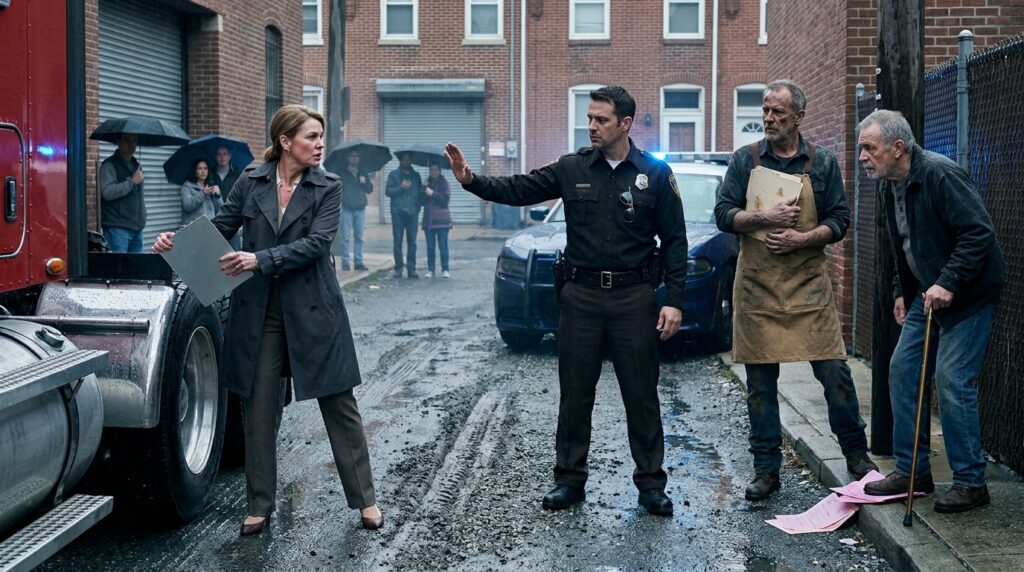
He threw open the side loading door, his boots hitting the ground just as the truck driver killed the ignition with a harsh pneumatic sigh. A massive red semi-tractor trailer, its chrome bumper polished to a mirror shine, was parked dead-center across the alley mouth. It wasn’t on the public street where it could draw a municipal parking ticket; it was wedged directly over the private apron of his property line, its rear trailer gate lowered just enough to block any foot or vehicle traffic from entering or leaving the lot.
On the far side of the blockade, standing near the edge of the neighbor’s curb with her arms crossed tightly over a charcoal trench coat, Brenda Sterling watched the scene with the cold satisfaction of a chess player executing a forced trap.
Julian wiped his palms down his jeans, his jaw tightening as he walked around the chassis of the massive truck. The driver’s door swung open, and a burly man in a reflective vest dropped down to the pavement, shaking his head and wiping grease from his thumb.
“Can’t drop your load here, pal,” the driver muttered, gesturing toward the rear trailer. “Management from the property association flagged the route. Said there’s an emergency utility restriction on this private lane. They told me to park it sideways and wait for site control.”
“That lane is private property,” Julian said, his voice dropping into that flat, dangerous register that left no room for argument. “And there is no utility restriction. That trailer is trespassing on a deeded right-of-way.”
“Hey, don’t look at me,” the driver threw his hands up, stepping back toward his cab. “They showed me a clipboard and a county-line permit copy. Paid in advance. I’m just following the manifest.”
Before Julian could answer, Brenda stepped past the edge of the trailer’s rear bumper, her metallic clipboard gleaming under the midday sun. Her face was flushed with a triumphant heat, her expression hard and unyielding.
“You’ve been given every opportunity to comply with neighborhood integration standards, Julian,” Brenda announced, her voice pitching to carry over the residual ticking of the cooling diesel engine. “When you refuse basic administrative cooperation, the community has a legal right to utilize commercial staging limitations to protect local infrastructure. That lumber isn’t reaching your basement today, and until you sign the zoning variance waiver, this blockage remains active under association authority.”
A small cluster of morning commuters, cafe patrons, and neighborhood residents had already slowed down along the public sidewalk outside, their footsteps halting as they took in the scale of the red semi blocking the narrow lane. Heads turned, whispers rippled through the concrete gap, and the faint, glowing rectangles of cellular phone screens began to rise from the crowd.
Julian did not shout. He did not lunge forward or reach for a tool. Instead, he reached into his jacket pocket and pulled out a heavy, water-stained document folder—the certified county plat map and the original 1973 property deed registered under his grandfather’s seal. He walked past the driver, past the massive chrome fuel tank of the semi, until he stood six feet from Brenda.
“You brought a commercial freight carrier onto a residential apron without a municipal permit, Brenda,” Julian said, his tone unnervingly calm against the backdrop of the idling engine. “And your association president credentials don’t grant immunity from state highway code violations, let alone unauthorized private impoundment.”
“I am protecting property values,” Brenda snapped, her composure slipping slightly as she noticed the crowd pressing closer against the curb. “You’re running an eyesore out of a historical zone, and the executive board is done waiting on the county to act.”
“The executive board doesn’t own this dirt,” Julian replied.
Just then, the familiar, sharp warop of a municipal patrol cruiser siren cut through the morning air. A standard county squad car pulled up alongside the curb, its blue lights sweeping a slow, rhythmic pattern across the brick facade. Officer Marcus Reed stepped out from behind the driver’s door, hooked his thumbs into his tactical belt, and looked past the crowd at the massive red semi straddling the private line.
Brenda’s expression shifted in an instant. Her posture straightened, her hand snapping up to thrust her metallic clipboard toward the approaching officer before he even cleared the cruiser’s rear fender.
“Officer Reed, thank goodness,” Brenda said, her voice instantly adopting a theatrical register of public distress. “We are executing an emergency neighborhood access containment. This unpermitted commercial property is violating association zoning mandates, and this resident is refusing to comply with public safety protocols.”
Officer Reed stopped midway between his cruiser and the truck. He looked at Brenda’s clipboard, then down at the deep tire ruts carved into Julian’s gravel drive, and finally at the red semi blocking a registered private entrance. He slowly took off his sunglasses, hooked them into his shirt pocket, and let out a long, weary sigh that smelled faintly of black coffee.
“Ma’am,” Officer Reed said, his voice flat and heavy. “This is a private property easement, not a community parking lot. And blocking an active delivery lane with a semi-tractor is a class-four civil obstruction.”
Brenda’s mouth parted, the triumphant certainty in her eyes wavering for the first time as the weight of the officer’s words settled over the quiet street.








