
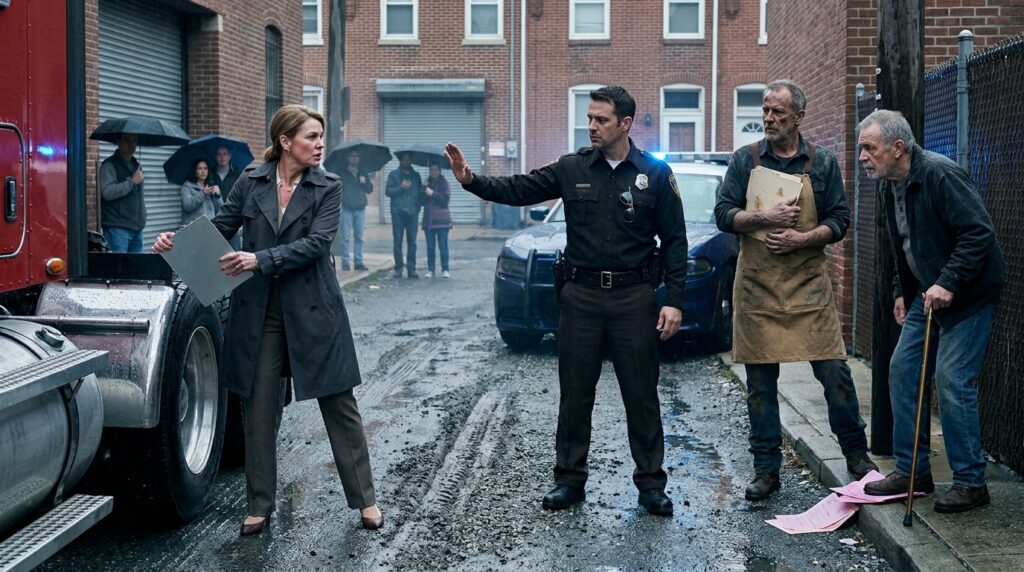
CHAPTER 3: The Unauthorized Towing Attempt Thwarted by a Neighbors Watchful Eye
The pneumatic hiss of a rollback truck’s hydraulic bed scraping downward cut through the quiet hum of Cedar Street before Julian could finish turning the blueprint fragment over in his fingers. The heavy iron chain of the winch clinked rhythmically against the chassis, striking the gravel drive with an aggressive, metallic chatter.
Julian didn’t hesitate. He dropped the paper onto the bench, vaulted the low workbench rail, and hit the side alley exit just as the rollback’s amber emergency lights began to pulse against the weathered red brick of the workshop’s exterior wall.
A tow truck bearing the emblem of a county-line impound service was already reversing into his private access lane, its rear tires crushing the low border stones his grandfather had laid down in seventy-six. Behind the wheel, a driver in a stained denim jacket leaned out the window, his arm hanging over the door frame as he checked his side mirror. Fifty feet away, half-hidden behind the corner of a neighbor’s box hedge, Brenda Sterling stood with her phone raised, her thumb hovering over the screen as she recorded the maneuver with clinical detachment.
“Hold it right there,” Julian said, his voice carrying the hard, flat edge of a timber axe striking dry ash. He didn’t run; he walked with deliberate, heavy-footed strides that matched the mechanical clank of the truck’s gears.
The driver glanced down, flicked a toothpick from his teeth, and shoved the transmission into park. ” Got a private impound authorization signed by the neighborhood oversight committee. Abandoned commercial staging on a shared access easement. Move out of the way or I hook the bumper and let the yard sort it out.”
“That easement is private property, and this vehicle is registered to a tax-paying resident,” Julian said, stepping directly into the path of the hydraulic bed, his boots planting firmly on the crushed limestone. “You pull that winch cable one inch further onto this concrete and you’re committing grand theft under color of a fraudulent tow order.”
The driver scoffed, reaching for the handbrake. “Lady in the yellow blazer said the title paperwork was cleared through the municipal board.”
“The municipal board doesn’t own this dirt,” Julian replied, his eyes locked on the driver’s window while his peripheral vision caught Brenda stepping out from behind the box hedge, her phone still angled toward them.
Before Brenda could open her mouth to deliver her rehearsed speech about neighborhood covenants, a weathered blue sedan roared around the corner from the main thoroughfare, tires spitting gravel as it slammed to a halt directly behind the tow truck, blocking its exit entirely. The driver’s door swung open with a rusty groan, and Arthur Pendelton—a retired postal worker who had lived across the street since the Reagan administration—stepped out onto the asphalt. He wasn’t wearing a blazer or holding a clipboard. He was wearing a faded flannel shirt, carrying a heavy brass-headed walking cane, and looking like a man who had survived forty years of postal route dogs and had no patience left for amateurs.
“Turn that rig around, boy,” Arthur rasped, pointing his cane straight at the tow driver’s chest. “I’ve lived on this corner longer than your daddy’s been driving trucks, and that lane has been deeded to the Vance family since the county had dirt roads. You touch that van, and I’ll have the state police impound your entire company fleet before lunch.”
The tow driver blinked, looking from Arthur’s fierce, unblinking glare to Julian’s motionless stance in front of the hydraulic bed. He looked back toward the hedge where Brenda was now lowering her phone, her expression tightening into a mask of pure fury as she realized her private asset seizure was dissolving into a public street argument.
“Look, I just take the calls,” the driver muttered, shifting the gear lever back into drive with a sharp clunk of resistance. “I don’t get paid enough for title disputes.”
He released the handbrake, feathered the throttle, and pulled the rig forward in a tight, awkward arc, kicking up a spray of limestone dust that settled over Brenda’s polished shoes as she marched toward the curb.
“This is an illegal obstruction of community remediation,” Brenda snapped, her voice pitching upward as she stopped three feet from Julian, her fingers clamped white around her metallic clipboard. “You are deliberately defying the administrative code of Cedar Estates, and every day you stall this transition will be added to your final municipal fine dossier.”
Julian didn’t shout back. He reached down to the asphalt where the tow driver had spat out a crumpled paper ticket during the scramble—a carbon copy of an expired municipal lien waiver bearing a signature that didn’t belong to any city official, but rather to a junior accountant at Vanguard Horizon Properties. He smoothed the corner against his thumb, folded it into his pocket, and looked down at Brenda with a steady, unyielding calm that made her take an involuntary half-step backward.
“Tell your private-equity friends down at the county line to send their own surveyors next time, Brenda,” Julian said quietly, the low rumble of his voice cutting through the morning air. “Because the next time someone steps foot on this property without a judge’s signature, I won’t be calling the tow company.”
He turned his back on her, walked back into the dim, familiar safety of the workshop, and slid the heavy oak bolt home into its iron socket.








