
CHAPTER 3: THE CALL ON THE ASPHALT
I didn’t reach the front door before her voice cut through the glass again.
Evelyn hadn’t moved back toward her porch. She was standing at the edge of my cul-de-sac apron, her cream utility jacket catching the bright midday glare, her phone pressed so hard against her cheek that her silver bob tilted awkwardly toward her left shoulder. Her heels were braced on the crumbling edge of the county asphalt, right where the public road gave way to my gravel driveway.
“I need a deputy dispatch to 412 Elm Ridge Court immediately,” she shouted into the receiver. She didn’t drop her tone. She amplified it, letting the words bounce off the metal siding of Miller’s garage across the way. “I have a non-compliant squatter blocking the doorway, defying a written legal notice to vacate, and threatening a member of the subdivision board.”
Across the street, Miller stopped wiping down the hood of his riding mower. He stood up straight, the greasy rag hanging limp in his fist, his eyes shifting from Evelyn’s rigid back to my front door. Down at the corner, Mrs. Gable unclasped her garden shears and stepped out from behind her hydrangeas, taking three slow steps toward the curb.
I opened the front door, stepping out onto the concrete porch just far enough for my boots to settle against the wooden sill. I kept my hands visible, resting lightly on the iron handrail Uncle Wesley had bolted into the porch foundation twenty years ago.
“You’re making a false report, Evelyn,” I called down the driveway. My voice was even, carrying across the hot gravel without strain. “There’s no squatter here. And you haven’t been on the subdivision board since ’24.”
She spun on her heel, her phone still pressed to her ear, her face flushing a deep, blotchy magenta beneath her pale makeup.
“He is belligerent, dispatch,” she spoke directly into the phone, her voice rising an octave, trembling with a sharp, rehearsed panic. “He is refusing to recognize civil jurisdiction. He’s making aggressive movements on the porch. Send someone before this escalates.”
She tapped the screen to end the call, but she didn’t put the phone in her pocket. She held it at waist height, the camera lens pointed directly at my face, her fingers tight around the casing.
“You think you’re clever, Arthur,” she said, taking two slow steps up the gravel path, stopping just short of the property marker pin Wesley had driven into the earth thirty years ago. “You think having a leather binder full of old receipts makes you immune to this town? That paper in my hand was drafted by the firm that wrote the original covenants for Elm Ridge.”
“That firm dissolved six years ago, Evelyn,” I said. “And your husband’s name was taken off the letterhead before the building was sold.”
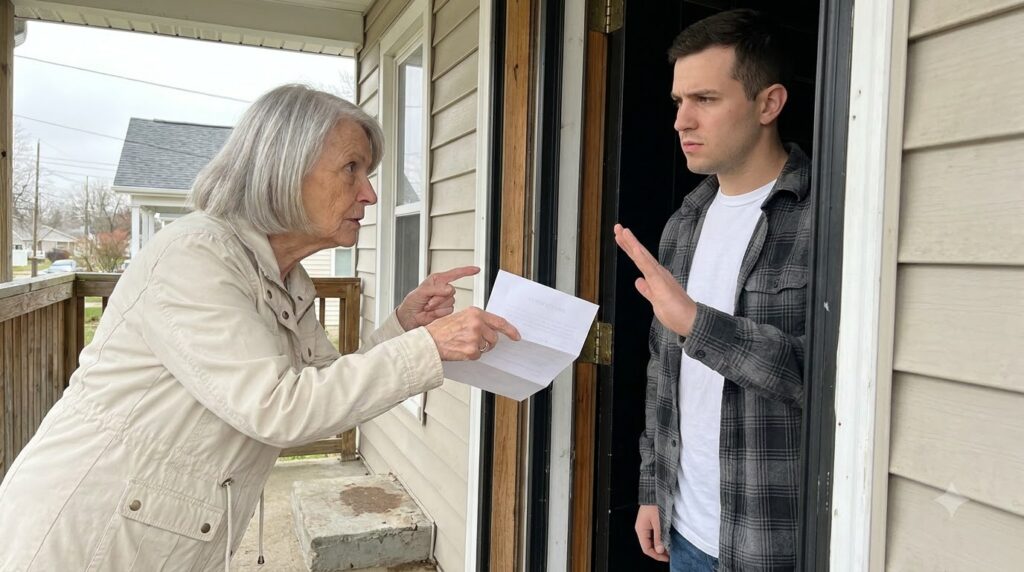
She flinched—a tiny, involuntary twitch of her jaw—but her eyes narrowed into something dark and calculated. She lifted the single sheet of white paper she still held in her left hand, flipping it over so the back faced the sunlight.
“Look at the filing mark on the margin, Arthur,” she said, her voice dropping into a razor-thin purr. “Look at the stamp.”
I leaned forward half an inch, my eyes scanning the lower corner of the page. Beneath the heavy red DEMAND FOR POSSESSION stamp, faint in faded blue ink, was a rectangular impression that had bled through from the back of the stock: ARCHIVED CIVIL RECORD – V.M.&A. DOCKET #418-B.
My throat tightened slightly. It wasn’t just a home-printed draft. It was a physical page pulled directly out of a closed civil case file—a real document that had once passed through the Lincoln County Courthouse, repurposed with fresh, laser-printed text over an old legal backing. To an officer pulling up in a patrol car looking for a quick civil resolution, that blue ink stamp carried the weight of a judge’s chamber.
“My husband left behind six filing cabinets of active dockets when he passed,” Evelyn said, stepping another inch closer, her eyes glittering with cold satisfaction. “The county clerk doesn’t purge those numbers. When Deputy Harlan gets here, he isn’t going to read your uncle’s lease. He’s going to look at that docket stamp, look at my name on the original development charter, and hand me the keys to clear this porch.”
In the distance, beyond the treeline where Elm Ridge Road met the state highway, the faint, rising warble of a siren broke the stillness of the afternoon.
Evelyn smiled, a slow, thin curve of her lips that didn’t reach her eyes. She reached into her utility jacket pocket, her fingers brushing against the tarnished brass key ring with the unnumbered tag, and pulled out a small, printed notice card.
“You have five minutes before the cruiser turns onto the court,” she whispered. “Take your truck and your binder, or I let them tow it off the grass.”
I didn’t answer her. I reached into my plaid shirt pocket, feeling the cold, pitted iron of the antique brass key against my thumb, and locked my gaze onto hers as the siren grew louder, turning the corner onto our street.








