CHAPTER 2: THE LEATHER BINDER AND THE Brass TAG
The deadbolt threw its heavy brass tongue into the strike plate with a dry, metallic thunk that vibrated through the oak frame.
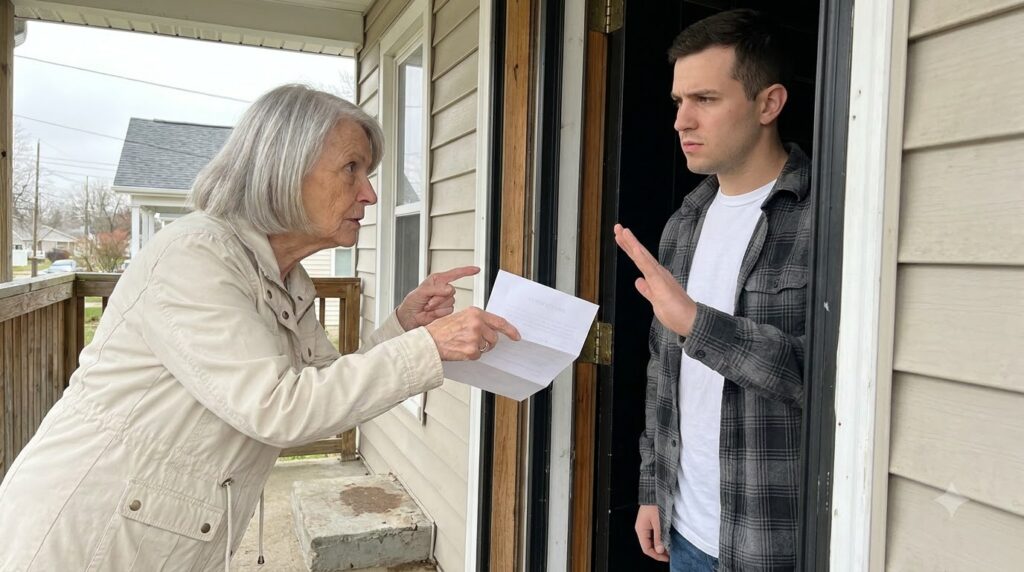
I didn’t let go of the thumb-turn right away. I held it, feeling the cold transfer of metal against my calloused palm, listening to the muffled retreat of Evelyn Vance’s heels clicking off the concrete steps. She didn’t hurry. Evelyn never hurried; she moved with the deliberate, heavy pace of someone who believed the ground beneath her feet owed her an apology for being uneven.
Outside, the idling hum of Miller’s riding mower surged back to life, its steel blades chewing through the high clover two lots down. The neighborhood was exhaling, resetting its rhythm after the morning’s disturbance. But the air inside the front hall felt thick, heavy with the dust her jacket had stirred up and the lingering, faint scent of cedar.
I turned away from the door and looked down at the threshold. A thin flake of white paint, dislodged when her cardstock slapped the casing, lay right where the worn Oak stain met the linoleum. I nudged it with the toe of my work boot, watching it crumble into fine gray powder against the floorboard.
“Eighteen months,” I muttered to the empty hallway.
My uncle Wesley had built the built-in coat rack by the front closet out of salvage heart-pine he’d hauled from the old rail depot in town. Every nail hole was plugged with dark walnut. He used to say that a man’s property line wasn’t drawn on a county surveyor’s map; it was drawn by where he was willing to stand when the rain started coming sideways.
I walked down the narrow corridor to the back room—the space Uncle Wesley had always called the study, though it was mostly filled with iron toolboxes, stacked canning jars, and two oak flat-file cabinets. The floorboards here had a slight, familiar sag near the window, a reminder of the soft joist he’d spent three weekends sistering with pressure-treated four-by-fours back in the spring of ’18.
The sunlight coming through the blinds hit the heavy steel safe in the corner. It wasn’t fancy—a two-hundred-pound, fire-rated Sentry box with a mechanical dial that smelled of graphite grease. I knelt on one knee, my jeans pulling tight across the scab on my shin where I’d scraped a joist on the porch repair last week, and spun the combination.
Three turns left. Two turns right. Stop on seven.
The heavy door swung open with a dull scrape against the carpet. Inside, resting on top of a stack of yellowed tax receipts and the original 1974 land grant plat, was the thick, dark-brown split-leather binder.
Uncle Wesley’s handwriting on the spine was written in faded white grease pencil: ELEM RIDGE – LEASE & IMPROVEMENTS.
I lifted the binder out, the cold leather stiff against my fingers, and carried it to the workbench under the window. When I unclasped the brass buckle, a small, loose object slid out from between the plastic sleeves and clattered against the iron vise base.
It was a key. Not a standard Schlage or Kwikset house key, but a heavy, antique mortise key made of tarnished brass, attached to an unnumbered oval tag. Etched into the soft metal of the tag were two crude letters: W.V.
I picked it up. The brass was cold, pitted along the shank as if it had sat in damp soil or at the bottom of a tackle box for a decade. It wasn’t a key to any door in this house. The keyholes here were all modern brass lever sets Wesley had installed during the ’92 renovation.
I set the brass key beside the vise and opened the binder to Section 3: Lease Assignment & Tenancy Continuation.
The notarized document sat behind a heavy sheet of archival plastic. The blue ink of the notary’s stamp—County of Lincoln, State of Illinois, Comm. Exp. 11/14/2028—was crisp, unsmudged. The signature beneath it belonged to Sarah Thorne, the estate executor, explicitly granting me full residential control and right of occupancy in exchange for property maintenance, tax escrow contributions, and structural upkeep following Wesley’s death. Every monthly wire transfer confirmation was stapled directly behind it, neat, chronological, incontrovertible.
Evelyn knew this binder existed. She had been in this room once, two weeks after the funeral, wearing that same cream jacket, offering to “take the administrative burden off the estate” by managing a private sale to an out-of-state investment group. Uncle Wesley had thrown her out before the coffee in her cup went cold.
I flipped to the back section—the neighborhood association covenant records Wesley had collected during his tenure on the drainage committee.
My fingers stopped on a document from four years ago. It was an official notice from the county circuit court regarding an injunction against the HOA board over contested easement access along the western creek bed. Attached to the back was a blank, sample template for civil possession demands—the exact same font, the exact same three-paragraph legal preamble, and the same heavy crest layout that Evelyn had held against my chest twenty minutes ago.
The header on the template listed the name of the firm that used to handle the association’s legal work: Vance, Miller & Associates.
Evelyn’s late husband had been the senior partner before the firm dissolved six years back. She hadn’t gone to the county clerk to get that paper. She had pulled a dead lawyer’s draft out of a filing cabinet in her basement, filled in my name on a typewriter or a laser printer, and walked it up my porch steps hoping the sheer weight of the legal jargon would make me pack a bag.
Through the blinds, a sudden metallic door slam echoed from the street.
I leaned closer to the glass, parting two slats with my thumb.
Evelyn was standing at the end of my asphalt driveway, right where the property line met the county shoulder. She wasn’t walking toward her house. She had her smartphone pressed hard against her ear, her cream utility jacket pulled tight around her waist, her free hand pacing small, agitated circles in the gravel.
She wasn’t calling a friend. Her jaw was moving fast, her face flushed red despite the morning shade. And in her left hand, held low against her thigh, she was gripping that unnumbered brass key ring—the twin to the old key sitting next to my iron vise.
I let the blinds snap shut, picked up the split-leather binder, and tucked the old brass key deep into the breast pocket of my plaid overshirt.
“Your move, Evelyn,” I said quietly, the weight of the binder heavy under my arm as I headed back toward the front hall.