
The Concrete Sill and the Unsigned Paper on the Threshold

CHAPTER 1: THE LINE ON THE PORCH

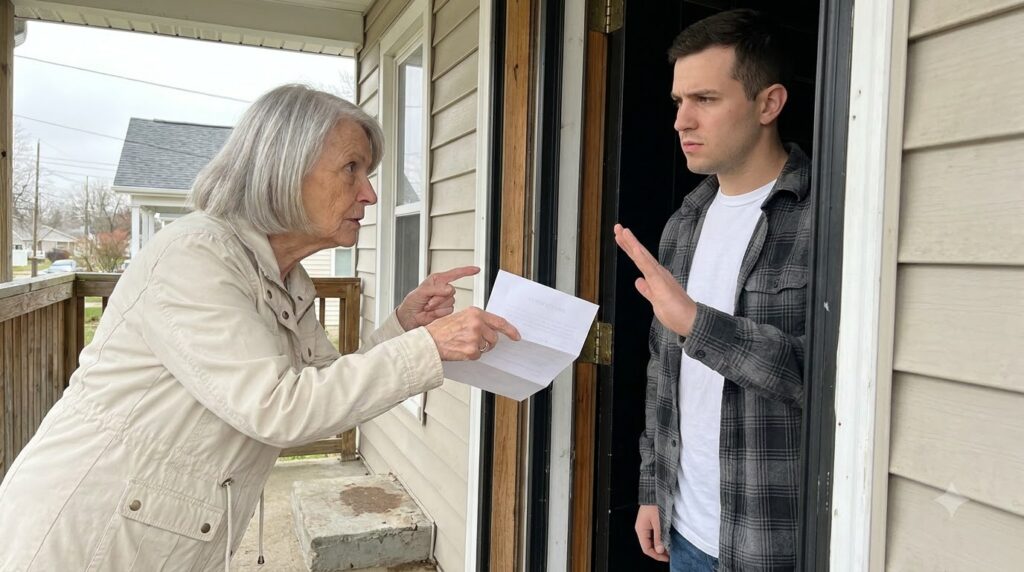
The sharp slap of heavy cardstock hitting the doorframe cut through the humid morning air before the voice even reached the porch steps.

“This is your eviction notice, you need to move.”

Evelyn Vance didn’t wait for the door to finish opening. Her fingers, age-spotted but rigid as steel wire, held the crisp white sheet inches from my chest. She stood on the second concrete step in a cream utility jacket that smelled faintly of cedar and old paper, her silver bob immaculately pinned against the light morning breeze. Her eyes—a pale, icy blue—were locked onto mine, searching for the flinch that usually came when she brought down her authority.

I didn’t move my feet. My boots remained planted behind the chipped wooden threshold sill, right where the worn Oak stain met the hallway linoleum. I raised my right hand, palm outward, suspended in the narrow three-inch gap of open air between us. I didn’t touch her. I didn’t touch the paper. I simply held the space.

“Arguing won’t change it,” she said, her voice dropping into that smooth, practiced register she used when chairing the association meetings three streets over. She pointed a sharp, manicured index finger toward the header on the page. “The notice says leave. Effective immediately.”

“I’m not leaving,” I said. The words came out low, raspy from my morning coffee, but flat enough to cut the air between us. “This is still my home.”

Behind her, across the sunlit asphalt of Elm Ridge Court, the quiet rustle of suburban routine was grinding to a slow halt. Miller had stopped his riding mower two houses down, the engine idling in a hollow, metallic hum. Mrs. Gable was leaning over her porch railing with a pair of hedge shears frozen in her grip. They knew that cream jacket. For twelve years, Evelyn Vance had ruled this subdivision with a clip-board and a filing cabinet full of technicalities, issuing fines for unclipped hedges, wrong-colored trash bins, and unauthorized driveway oil stains.

Evelyn’s jaw tightened, the deep lines around her mouth deepening like cracks in dry clay. She didn’t step back. Instead, she pushed the paper another half-inch forward, the edge brushing the cotton of my gray plaid overshirt.

“You think your uncle’s name on a deed protects you?” she whispered, so low the street couldn’t hear, though her eyes flared with a sudden, sharp heat. “He’s been in the ground eighteen months, Arthur. The estate has no standing here. This piece of paper is signed, sealed, and binding. You pack your truck, or the county clears this house for you.”

I looked down at the paper. The top bore a heavy, dark seal—a crest that looked official enough from three feet away—and three paragraphs of dense, single-spaced legalese ending in a bold red stamp that read DEMAND FOR POSSESSION. But right beneath the stamp, where the clerk of the circuit court’s blue-ink signature ought to sit, the line was dry and bare. Beside her wrist, clipped to her jacket pocket, hung a tarnished brass key ring—one that didn’t belong to any board member’s set.

“The notice stands,” she repeated, raising the sheet until it blocked the sight of her own chin. “You still have to leave.”

My hand stayed held in the doorway, my fingers steady against the morning heat. “Then call the deputy, Evelyn. Because I’m not crossing this sill.”


CHAPTER 2: THE LEATHER BINDER AND THE Brass TAG

The deadbolt threw its heavy brass tongue into the strike plate with a dry, metallic thunk that vibrated through the oak frame.

I didn’t let go of the thumb-turn right away. I held it, feeling the cold transfer of metal against my calloused palm, listening to the muffled retreat of Evelyn Vance’s heels clicking off the concrete steps. She didn’t hurry. Evelyn never hurried; she moved with the deliberate, heavy pace of someone who believed the ground beneath her feet owed her an apology for being uneven.

Outside, the idling hum of Miller’s riding mower surged back to life, its steel blades chewing through the high clover two lots down. The neighborhood was exhaling, resetting its rhythm after the morning’s disturbance. But the air inside the front hall felt thick, heavy with the dust her jacket had stirred up and the lingering, faint scent of cedar.

I turned away from the door and looked down at the threshold. A thin flake of white paint, dislodged when her cardstock slapped the casing, lay right where the worn Oak stain met the linoleum. I nudged it with the toe of my work boot, watching it crumble into fine gray powder against the floorboard.

“Eighteen months,” I muttered to the empty hallway.

My uncle Wesley had built the built-in coat rack by the front closet out of salvage heart-pine he’d hauled from the old rail depot in town. Every nail hole was plugged with dark walnut. He used to say that a man’s property line wasn’t drawn on a county surveyor’s map; it was drawn by where he was willing to stand when the rain started coming sideways.

I walked down the narrow corridor to the back room—the space Uncle Wesley had always called the study, though it was mostly filled with iron toolboxes, stacked canning jars, and two oak flat-file cabinets. The floorboards here had a slight, familiar sag near the window, a reminder of the soft joist he’d spent three weekends sistering with pressure-treated four-by-fours back in the spring of ’18.

The sunlight coming through the blinds hit the heavy steel safe in the corner. It wasn’t fancy—a two-hundred-pound, fire-rated Sentry box with a mechanical dial that smelled of graphite grease. I knelt on one knee, my jeans pulling tight across the scab on my shin where I’d scraped a joist on the porch repair last week, and spun the combination.

Three turns left. Two turns right. Stop on seven.

The heavy door swung open with a dull scrape against the carpet. Inside, resting on top of a stack of yellowed tax receipts and the original 1974 land grant plat, was the thick, dark-brown split-leather binder.

Uncle Wesley’s handwriting on the spine was written in faded white grease pencil: ELEM RIDGE – LEASE & IMPROVEMENTS.

I lifted the binder out, the cold leather stiff against my fingers, and carried it to the workbench under the window. When I unclasped the brass buckle, a small, loose object slid out from between the plastic sleeves and clattered against the iron vise base.

It was a key. Not a standard Schlage or Kwikset house key, but a heavy, antique mortise key made of tarnished brass, attached to an unnumbered oval tag. Etched into the soft metal of the tag were two crude letters: W.V.

I picked it up. The brass was cold, pitted along the shank as if it had sat in damp soil or at the bottom of a tackle box for a decade. It wasn’t a key to any door in this house. The keyholes here were all modern brass lever sets Wesley had installed during the ’92 renovation.

I set the brass key beside the vise and opened the binder to Section 3: Lease Assignment & Tenancy Continuation.

The notarized document sat behind a heavy sheet of archival plastic. The blue ink of the notary’s stamp—County of Lincoln, State of Illinois, Comm. Exp. 11/14/2028—was crisp, unsmudged. The signature beneath it belonged to Sarah Thorne, the estate executor, explicitly granting me full residential control and right of occupancy in exchange for property maintenance, tax escrow contributions, and structural upkeep following Wesley’s death. Every monthly wire transfer confirmation was stapled directly behind it, neat, chronological, incontrovertible.

Evelyn knew this binder existed. She had been in this room once, two weeks after the funeral, wearing that same cream jacket, offering to “take the administrative burden off the estate” by managing a private sale to an out-of-state investment group. Uncle Wesley had thrown her out before the coffee in her cup went cold.

I flipped to the back section—the neighborhood association covenant records Wesley had collected during his tenure on the drainage committee.

My fingers stopped on a document from four years ago. It was an official notice from the county circuit court regarding an injunction against the HOA board over contested easement access along the western creek bed. Attached to the back was a blank, sample template for civil possession demands—the exact same font, the exact same three-paragraph legal preamble, and the same heavy crest layout that Evelyn had held against my chest twenty minutes ago.

The header on the template listed the name of the firm that used to handle the association’s legal work: Vance, Miller & Associates.

Evelyn’s late husband had been the senior partner before the firm dissolved six years back. She hadn’t gone to the county clerk to get that paper. She had pulled a dead lawyer’s draft out of a filing cabinet in her basement, filled in my name on a typewriter or a laser printer, and walked it up my porch steps hoping the sheer weight of the legal jargon would make me pack a bag.

Through the blinds, a sudden metallic door slam echoed from the street.

I leaned closer to the glass, parting two slats with my thumb.

Evelyn was standing at the end of my asphalt driveway, right where the property line met the county shoulder. She wasn’t walking toward her house. She had her smartphone pressed hard against her ear, her cream utility jacket pulled tight around her waist, her free hand pacing small, agitated circles in the gravel.

She wasn’t calling a friend. Her jaw was moving fast, her face flushed red despite the morning shade. And in her left hand, held low against her thigh, she was gripping that unnumbered brass key ring—the twin to the old key sitting next to my iron vise.

I let the blinds snap shut, picked up the split-leather binder, and tucked the old brass key deep into the breast pocket of my plaid overshirt.

“Your move, Evelyn,” I said quietly, the weight of the binder heavy under my arm as I headed back toward the front hall.

CHAPTER 3: THE CALL ON THE ASPHALT

I didn’t reach the front door before her voice cut through the glass again.

Evelyn hadn’t moved back toward her porch. She was standing at the edge of my cul-de-sac apron, her cream utility jacket catching the bright midday glare, her phone pressed so hard against her cheek that her silver bob tilted awkwardly toward her left shoulder. Her heels were braced on the crumbling edge of the county asphalt, right where the public road gave way to my gravel driveway.

“I need a deputy dispatch to 412 Elm Ridge Court immediately,” she shouted into the receiver. She didn’t drop her tone. She amplified it, letting the words bounce off the metal siding of Miller’s garage across the way. “I have a non-compliant squatter blocking the doorway, defying a written legal notice to vacate, and threatening a member of the subdivision board.”

Across the street, Miller stopped wiping down the hood of his riding mower. He stood up straight, the greasy rag hanging limp in his fist, his eyes shifting from Evelyn’s rigid back to my front door. Down at the corner, Mrs. Gable unclasped her garden shears and stepped out from behind her hydrangeas, taking three slow steps toward the curb.

I opened the front door, stepping out onto the concrete porch just far enough for my boots to settle against the wooden sill. I kept my hands visible, resting lightly on the iron handrail Uncle Wesley had bolted into the porch foundation twenty years ago.

“You’re making a false report, Evelyn,” I called down the driveway. My voice was even, carrying across the hot gravel without strain. “There’s no squatter here. And you haven’t been on the subdivision board since ’24.”

She spun on her heel, her phone still pressed to her ear, her face flushing a deep, blotchy magenta beneath her pale makeup.

“He is belligerent, dispatch,” she spoke directly into the phone, her voice rising an octave, trembling with a sharp, rehearsed panic. “He is refusing to recognize civil jurisdiction. He’s making aggressive movements on the porch. Send someone before this escalates.”

She tapped the screen to end the call, but she didn’t put the phone in her pocket. She held it at waist height, the camera lens pointed directly at my face, her fingers tight around the casing.

“You think you’re clever, Arthur,” she said, taking two slow steps up the gravel path, stopping just short of the property marker pin Wesley had driven into the earth thirty years ago. “You think having a leather binder full of old receipts makes you immune to this town? That paper in my hand was drafted by the firm that wrote the original covenants for Elm Ridge.”

“That firm dissolved six years ago, Evelyn,” I said. “And your husband’s name was taken off the letterhead before the building was sold.”

She flinched—a tiny, involuntary twitch of her jaw—but her eyes narrowed into something dark and calculated. She lifted the single sheet of white paper she still held in her left hand, flipping it over so the back faced the sunlight.

“Look at the filing mark on the margin, Arthur,” she said, her voice dropping into a razor-thin purr. “Look at the stamp.”

I leaned forward half an inch, my eyes scanning the lower corner of the page. Beneath the heavy red DEMAND FOR POSSESSION stamp, faint in faded blue ink, was a rectangular impression that had bled through from the back of the stock: ARCHIVED CIVIL RECORD – V.M.&A. DOCKET #418-B.

My throat tightened slightly. It wasn’t just a home-printed draft. It was a physical page pulled directly out of a closed civil case file—a real document that had once passed through the Lincoln County Courthouse, repurposed with fresh, laser-printed text over an old legal backing. To an officer pulling up in a patrol car looking for a quick civil resolution, that blue ink stamp carried the weight of a judge’s chamber.

“My husband left behind six filing cabinets of active dockets when he passed,” Evelyn said, stepping another inch closer, her eyes glittering with cold satisfaction. “The county clerk doesn’t purge those numbers. When Deputy Harlan gets here, he isn’t going to read your uncle’s lease. He’s going to look at that docket stamp, look at my name on the original development charter, and hand me the keys to clear this porch.”

In the distance, beyond the treeline where Elm Ridge Road met the state highway, the faint, rising warble of a siren broke the stillness of the afternoon.

Evelyn smiled, a slow, thin curve of her lips that didn’t reach her eyes. She reached into her utility jacket pocket, her fingers brushing against the tarnished brass key ring with the unnumbered tag, and pulled out a small, printed notice card.

“You have five minutes before the cruiser turns onto the court,” she whispered. “Take your truck and your binder, or I let them tow it off the grass.”

I didn’t answer her. I reached into my plaid shirt pocket, feeling the cold, pitted iron of the antique brass key against my thumb, and locked my gaze onto hers as the siren grew louder, turning the corner onto our street.

CHAPTER 4: THE DEPUTY AND THE DOCKET

The white-and-gold Ford Explorer of the Lincoln County Sheriff’s Department hit the cul-de-sac apron with a heavy crunch of gravel. Its rooftop lightbar was dead, but the amber flashers along the grille cast rhythmic, flickering shadows across the front porch siding.

Deputy Harlan didn’t rush out. He let the engine idle for three long seconds, the warm exhaust shimmering against the asphalt, before swinging his door open. He was a broad-shouldered man in his mid-forties with a tanned neck, short-cropped brown hair, and a thick leather utility belt that creaked as he stepped onto the road. His eye immediately swept the line of neighbors gathered at the curbs—Miller leaning against his mower, Mrs. Gable hovering by her hedge—before locking onto Evelyn Vance standing halfway up my driveway.

“Evelyn,” Harlan said, keeping his voice low, gravelly, and unhurried. He didn’t take his hand off his belt. “We got a call about a trespasser refusing an eviction order.”

“He’s right there, Harlan,” Evelyn said instantly, turning her shoulder toward the porch and pointing her sharp, manicured finger at my chest. “Arthur Miller. He’s occupying 412 Elm Ridge without legal standing, defying a formal court demand for possession, and obstructing private property access.”

I stood my ground behind the oak sill, holding the heavy split-leather binder tucked under my arm. “Morning, Deputy,” I said calmly. “There’s no trespass. I have a valid, notarized lease assignment signed by the estate executor.”

Harlan turned his head toward me, his brow furrowing under the brim of his campaign hat. He took three slow, deliberate steps up the gravel, stopping at the base of the porch steps. “Let me see the paper, Evelyn.”

Evelyn stepped forward with absolute confidence, thrusting the white cardstock sheet into Harlan’s hand. “It’s an archived civil order, Docket 418-B. Drafted under the subdivision charter, endorsed under county civil code. He was served twenty minutes ago.”

Harlan lifted the paper toward the sunlight. His thumb ran across the heavy red DEMAND FOR POSSESSION stamp, then turned the page over to examine the faint blue rectangular impression at the bottom corner. His eyes lingered on the blue ink: ARCHIVED CIVIL RECORD – V.M.&A. DOCKET #418-B.

For a long, agonizing ten seconds, the only sound on the porch was the distant hum of the highway and the dry rustle of wind through the oak branches above.

“Docket 418-B,” Harlan murmured, his jaw tightening. He looked up from the paper to my face, his eyes suddenly hard, devoid of the neighborly tone he’d used at the driveway. “Arthur, this looks like an active civil filing out of the circuit court. If Vance, Miller & Associates filed this under the subdivision charter before the dissolution, it carries administrative weight until a judge stays it.”

A cold spike of adrenaline shot through my ribs. The decoy worked. The blue archival stamp from her late husband’s closed law firm had triggered exactly what Evelyn wanted: an officer defaulting to judicial protocol rather than challenging a decade-old docket number on a residential porch.

“Deputy, look at the signature line,” I said, my voice hardening as I stepped forward to the very edge of the threshold. “There is no clerk’s signature. There is no judicial seal. That stamp is from an archived box in her basement.”

“It has the docket number, son,” Harlan said, stepping one tread up the porch. “I’m not a circuit judge. I can’t invalidate a stamped civil record on a driveway. My job right now is to prevent a breach of the peace. If the board representative presents an archived court order, I have to advise you to vacate the dwelling pending a formal hearing at the county clerk’s office.”

Beside the porch rail, Evelyn let out a soft, sharp breath of victory. She didn’t say a word, but her posture straightened, her hand settling over her utility jacket pocket where the brass keys rested.

“He leaves today, Harlan,” she said, her voice dropping into a quiet, icy command. “Or you lock the door and post the county seal.”

I felt the ground shift under my feet. My preparation, my late uncle’s notarized binder, my digital receipts—none of it mattered in the immediate five minutes because Evelyn had weaponized a half-truth that paralyzed local enforcement.

Harlan turned toward me, reaching into his pocket for his official pad. “Arthur, I’m going to need you to step off the porch while we verify the file with dispatch.”

I took a breath, holding my temper behind my teeth. I opened the leather binder resting under my arm, pulled out a yellowed fold-out document from the back section, and laid it directly over the porch rail in front of Harlan’s face.

It wasn’t my lease. It was an old county surveyor’s map from 2022—and stamped across the bottom margin in purple ink was a municipal notice Evelyn hadn’t accounted for: SPECIAL TAX ASSESSMENT LIEN – UNPAID – SUBDIVISION BOARD AUTHORITY SUSPENDED.

Harlan froze, his pen hovering an inch above his notepad as his eyes caught the purple stamp.

CHAPTER 5: THE AUDIT ON THE PORCH

Deputy Harlan didn’t ask another question. He took the yellowed map out of my hands, held it against the cruiser’s hood under the midday sun, and stared at the purple ink for five long seconds.

“Hold on,” he said, turning back toward his patrol car. He leaned through the driver’s side door, unhooked the heavy radio microphone from his dashboard, and tapped his vehicle terminal screen. “Dispatch, run an administrative status check on Lincoln County Special Tax Assessment Lien 2022-09-C. Cross-reference Elm Ridge Subdivision Board authorization.”

Evelyn’s breath hitched. She took one step back down the driveway, her cream utility jacket rustling as her posture lost its sharp, rigid line. Her fingers darted to her pocket, clutching the brass key ring so tightly that the metal clinked against her belt buckle.

“Harlan, this is an unnecessary delay,” she insisted, her voice tight, cracking slightly around the edges. “The board charter gives us summary authority to enforce residential standards. You’re wasting county time over an old tax notation.”

The radio crackled, spraying static across the hot driveway before the dispatch operator’s voice came through the speaker, loud enough for Miller and Mrs. Gable to hear from the road.

“Unit Four, be advised. Special Lien 2022-09-C is active. Lincoln County Chancery Court suspended all corporate authority for Elm Ridge HOA in November 2024 following an ongoing forensic audit of unrecovered municipal drainage funds. Evelyn Vance was formally stripped of administrative signatory rights on November 14th of that year.”

The silence that fell over the porch was so heavy you could hear the grasshoppers in the dry lawn weeds.

Miller took three steps out into the road, his jaw open. Mrs. Gable lowered her hedge shears completely, her eyes fixed on Evelyn’s face.

Deputy Harlan slowly hung the radio mic back on its dash hook. He stepped out of the cruiser, closed the door with a firm, heavy thud, and walked back up the porch steps until he was standing three feet from Evelyn. His face wasn’t just stern anymore; it was cold.

“You don’t have administrative authority here, Evelyn,” Harlan said. “You haven’t had it in two years.”

“I was protecting the neighborhood,” she stammered, her gaze darting from Harlan to me, then down to the white cardstock sheet still resting in her hand. “The estate owes… the drainage account had outstanding liabilities—”

“The drainage account didn’t have liabilities, Evelyn,” I said, stepping off the wooden sill and taking two slow steps down the concrete stairs until I stood on the step right above her. I reached into my plaid shirt pocket and pulled out the old antique brass key with the unnumbered tag marked W.V. “My uncle Wesley wasn’t just keeping lease records in his safe. He was on the drainage committee when ninety thousand dollars went missing out of the regional escrow.”

Evelyn stared at the brass key in my palm, her face draining of all color until her skin matched the white paper in her hand.

“Wesley knew,” I said, my voice quiet, cutting through the stillness like a saw through pine. “He kept the duplicate key to the private safe-deposit box at First National—the one registered under your husband’s old law firm. You didn’t come up these steps today because I’m a bad tenant, or because my grass was too high. You came here because the county auditor is finalizing the embezzlement recovery list next month, and you needed this house cleared so your private debt collector could place a quiet lien on my uncle’s land before the sheriff’s office seized your own property.”

Evelyn backed up another step, her heel catching on the edge of the concrete walkway. The white eviction paper slipped from her numb fingers, fluttering down to land in the dry grass beside the driveway pin.

Deputy Harlan picked the paper up off the ground, looked at the fake court header, then looked at Evelyn.

“Ma’am,” Harlan said, his hand resting firmly on his duty belt, “you’re going to step away from this porch right now. And you’re going to come down to the station so we can talk about who gave you access to closed court files and why you’re serving fraudulent legal process on private residents.”

CHAPTER 6: THE SILL AND THE SECURED THRESHOLD

Deputy Harlan’s heavy leather glove didn’t squeeze, but the weight of his grip on Evelyn Vance’s elbow was absolute.

For a fraction of a second, she tried to pull back. Her shoulder hitched upward, her pale blue eyes flashing with the frantic, cornered instincts of someone who had spent thirty years giving orders rather than taking them. But Harlan didn’t yield an inch. His broad frame stood like an iron post between her and my front steps, blocking her sightline to the porch.

“Walk down to the car, Evelyn,” Harlan said. His tone wasn’t raised, but it carried across the manicured lawns with the dry, heavy finality of a gavel dropping on a wooden bench. “We’re going to sit in the back while dispatch logs the paperwork, and then we’re driving over to the Chancery Clerk’s office.”

Evelyn’s chin trembled. The rigid, practiced composure that had held her silver bob high for a decade seemed to collapse inward, leaving her face lined, hollowed out by the glare of the noon sun. She didn’t look at Miller, who was still standing by his mower with his hands pressed flat against his hips. She didn’t look at Mrs. Gable, who slowly turned her back and walked toward her front porch without saying a word.

Her gaze fell once, briefly, onto the dry grass beside my property pin. The brass key ring—the twin to the old key resting in my shirt pocket—lay glinting in the dirt, discarded when her hands had begun to shake. She didn’t reach down for it. She couldn’t.

Harlan guided her down the gravel incline, his boots crunching methodically against the stone. He opened the rear door of the patrol cruiser, held the doorframe so she wouldn’t strike her head as she sat, and clicked the door shut with a solid, airtight latch that cut off the quiet rasp of her breathing.

I stood on the concrete porch, feeling the heat radiate up through the soles of my work boots from the sun-baked steps. The heavy split-leather binder was still tucked under my arm, its brass buckle warm to the touch.

Harlan walked back up the walkway alone. He didn’t climb the steps. He stopped at the bottom riser, taking off his campaign hat to wipe his brow with the back of his forearm.

“I’m taking her in for processing, Arthur,” Harlan said, his voice returning to its normal, low gravelly drawl. “Filing false reports, attempting to execute fraudulent civil process, and harassing a resident on private land. The county prosecutor is going to want that binder and the key you’re holding.”

“It’ll be on your desk in an hour, Deputy,” I said. “Along with the digital doorbell footage from the top of the frame.”

Harlan looked up at the small black housing mounted beside the porch light, then gave a single, nod of respect. “Your uncle Wesley was a meticulous man. Turns out he raised you the same way.” He reached into his pocket, pulled out an official carbon incident receipt, and handed it across the iron railing. “Keep this on the counter. If anyone else from her old board shows up asking questions about easements or drainage, tell them to call my badge directly.”

“Appreciate it, Harlan.”

He turned, walked down to the Explorer, and pulled out into the cul-de-sac. The cruiser’s tires kicked up a thin cloud of dust that hovered in the air before settling back onto the hot asphalt.

Across the street, Miller caught my eye. He gave a short, quiet lift of his hand—a silent acknowledgment, an apology for watching from the sidelines—before turning back to his lawnmower. The engine roared back to life, its steady, rhythmic pulse filling the neighborhood once again, normal and unburdened.

I stepped backward across the threshold.

My boot heels settled against the linoleum inside the hallway. I reached down, took hold of the heavy brass knob, and pulled the front door shut. The deadbolt threw its heavy tongue into the strike plate with that same deep, metallic thunk—but this time, there was no vibration of conflict lingering in the frame.

I walked down the hall to Uncle Wesley’s study. I set the split-leather binder on the workbench beside the vise, laid the antique brass key on top of the lease agreement, and looked out the window at the sun-drenched yard.

The grass was high along the fence line, needing a trim before the weekend rain. The joist under the porch steps needed another coat of sealant. There was work to be done—real, physical labor that belonged to this dirt and this roof.

I locked the safe door, spun the dial until the tumblers clicked into place, and walked back to the kitchen to finish my coffee. The house was quiet, solid, and entirely mine.

Similar Posts

Leave a Reply

Your email address will not be published. Required fields are marked *






