CHAPTER 5: THE LIVE FEED AT THE PERIMETER
The heavy iron washer settled near Mr. Schmidt’s elbow with a final, flat click that sounded like a deadbolt falling into an ungreased channel. Nobody picked it up. The dark epoxy plug at its center seemed to swallow the light bouncing off the glass dining table, its rough matte surface contrasting with the cold, polished reflection of the acoustic panels above.
Louisa didn’t look at the hardware. Her white canvas shoes made a sharp scuffling sound as she retreated another six inches, her shoulders pinning themselves against the edge of a mahogany side table. Her smartphone remained raised, but the angle was erratic now, the lens tilting toward the floor tile every time her chest hitched.
“The winter settling report was executed under full civil engineering oversight, Arthur,” she said, her voice climbing an octave, losing its cold administrative cadence. “The board cleared the structural mitigation fund because the south retention berm was failing. If you begin unsealing old site housings based on an outside vendor’s guess, you create an uninsurable liability for the entire plat.”
“I’m not guessing, Louisa,” I said.
I picked up my smartphone, my finger pressing the side toggle to confirm the continuous record. The interface showed a steady, unbroken timer—forty-two minutes since the first standoff at the lockbox. At the top of the frame, the live metadata feed was updating in rapid, vertical jumps, the small digital digits reflecting off my thumb. “Everyone saw it online. Forty million views.”
She froze. The rigid, starched collar of her white V-neck shirt seemed to stiffen against her neck as her eyes darted to my screen. The reflection of the vertical data scroll caught the lens of her sunglasses, turning her gaze into two small, fractured clusters of white light.
“You haven’t cleared a data release with the association’s legal counsel,” she whispered, her thumb dropping from the plastic housing of her device for the first time since the driveway. “That’s a material distortion of the subdivision’s public profile. You called the contractor a thief, Arthur, and wasted our money on a fraudulent remediation order.”
“I didn’t call anyone anything,” Mr. Schmidt said. He reached down, his thick, calloused palm covering the iron washer. The dry skin of his fingers ground against the white zinc corrosion with a coarse, scraping sound. He looked up, his face entirely desaturated by the grey light filtering through the high windows. “The masonry firm that handled the foundation pour used these exact epoxy plugs to mask the sheared tie-backs during the second development phase. My son worked that crew before Vance went under, Louisa. He told me they buried twenty of these behind the door casings because the tension rigs failed.”
“Your son was dismissed for administrative neglect, Arthur,” she snapped back, though her squared posture was completely gone, her body leaning heavily against the mahogany wood behind her. “His logs aren’t canon. This is an extortion play to clear the holiday decorating invoice without an executive audit.”
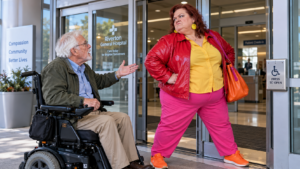
Outside the glass entrance, the shadow of the roadside resident witness lengthened across the concrete riser. The woman in the turquoise patterned top reached the door, her own phone held high against the glass panel to catch the interior geometry. The reflection of her screen showed the live streaming broadcast already mirrored on half a dozen regional subdivision forums, the comment tickers moving too fast to read through the tinting.
Schmidt didn’t answer her. He turned his back on the side table, his black long-sleeve shirt pulling tight across his shoulder blades as he walked toward the row of green storage totes I had stacked on the lounge floor. He reached down, pulled the top lid off a green bin, and dragged out a massive bundle of heavy, metallic pine garland. The wire core of the branch scraped against the tote’s plastic lip with a long, raw shriek.
“The work is staying on the floor,” Schmidt said to me, his voice low, vibrating through the hollow framing of the lounge tables. “Get the lanterns out. If the code inspector arrives before the public use permit is signed, we show him the invoices and the door housing.”
“Arthur, stop,” Louisa said, stepping forward as if to grab the wire garland out of his hand, but her foot caught on the torn metal transition strip again. The aluminum piece shifted, its raw, rusted underside scraping against her canvas shoe, leaving a dark streak of oxidized grease across the white fabric. She stopped mid-stride, her lips pressed into a thin, rigid line as she realized the camera on my hip was framing the entire unedited sequence.
The lounge door didn’t close, but the wind from the parking lot shifted, blowing a fine layer of dry suburban dust across the glass tables, settling over the paperwork and the corrosion-covered iron washer like salt on a fresh wound.