
CHAPTER 4: THE INTERVENTION LANE
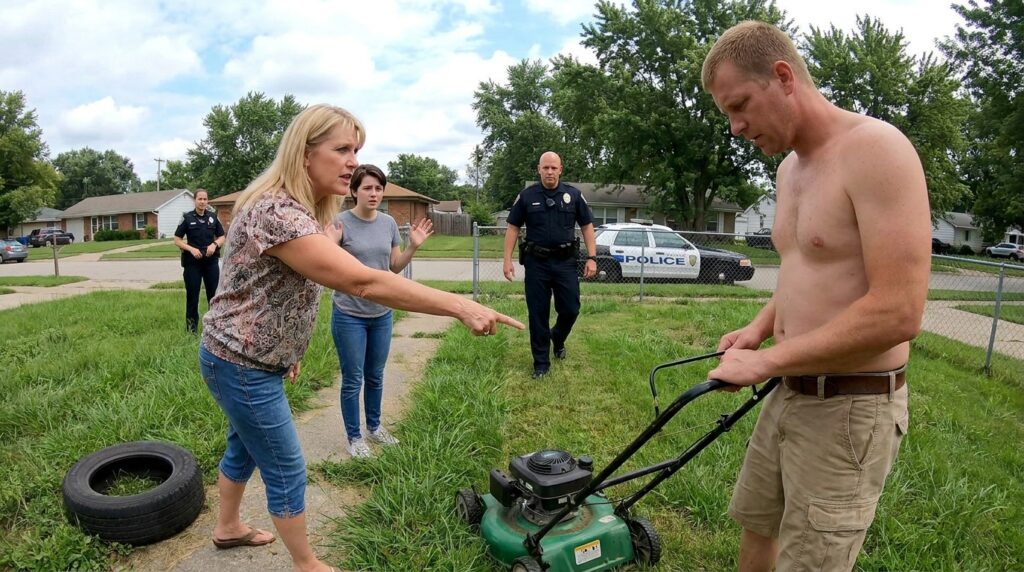
The primary officer’s boots were wide and solid on the grass line, his shadow falling across the engine shroud like a heavy shutter. His uniform was starched into stiff, knife-like creases that didn’t give under the midday heat, and his utility belt clicked with a dry, mechanical rattle as he adjusted his stance between Aaron’s left hand and Brenda’s outstretched phone.
“Everyone step back now, let me sort out what happened here,” the officer said. His voice was clipped, practiced, flat as a ledger page. He didn’t look at Brenda’s floral blouse or Aaron’s grease-stained chest. His eyes tracked the narrow space between the two properties, measuring the distance between the sagging chain-link fence and the green steel deck of the push mower.
Behind him, the second officer—the younger woman with her dark hair pinned tightly under her campaign cap—moved to the edge of the gravel driveway. Her hand rested loosely on her belt, her body angled to keep both Aaron’s work truck and the neighbor’s front porch in her line of sight.
Brenda didn’t retreat. She held her ground, her stocky frame shaking slightly with an angry, uneven breath. “Officer, he’s actively destroying my landscaping,” she said, her index finger pointing hard toward the thin line of cut weeds beneath the mower blades. “He’s been told repeatedly. This strip is an extension of Lot Four. My husband filed the boundary amendment with the county seat thirty-two years ago.”
The primary officer looked at the phone screen she was thrusting forward. He squinted against the flat, blinding reflection of the sun on the glass, his brow furrowing as he tracked the purple ink stamp labeled 76-EAS-09.
“Ma’am, keep the device still,” the officer muttered. He reached into his breast pocket, pulling out a small, ruggedized digital tablet that caught the light with a dull blue sheen. He didn’t touch her phone. He began tapping a sequence into his terminal, his thumb making a dry, tapping sound against the plastic casing. “What was the name on the original filing?”
“Gary Vance,” Brenda said, her jaw setting into a rigid line. She reached back, grabbing Chloe’s arm to pull her closer to the line, though the younger woman remained stiff, her eyes fixed on the rear bumper of the patrol car parked at the curb. “He was the senior county drafter. He knew these sections better than anyone in the municipal office. The code enforcement notice on his screen right now was generated under that exact file index.”
Aaron didn’t loosen his hands from the rubber grip of the mower handle, but he didn’t advance either. The machine kept up its low, sputtering rattle between them, the smell of scorched oil rising from the exhaust port in slow, greasy waves. He watched the primary officer’s face change as the tablet terminal connected to the county lot grid.
“Mr. Miller,” the officer said, looking up from the screen toward Aaron. “You have a copy of the deed for this property inside?”
“In the truck,” Aaron said. His voice was raw from the factory shift, short and transactional. “Glove box. Laminated survey map from ninety-one, before the subdivision was re-platted for the culvert expansion.”
The officer turned his head slightly, nodding toward his partner near the driveway. “Check the vehicle,” he commanded.
Brenda let out a sharp, ragged breath, her sunglasses slipping slightly down the bridge of her nose. “The ninety-one survey is obsolete, officer. The ninety-four amendment overrides any previous residential markers. It’s an official city ledger entry. If you look at that file on your tablet, you’ll see my husband’s signature at the bottom of the easement register.”
The primary officer didn’t answer her. He kept his eyes locked on his own terminal screen, his fingers tracking a sequence of dates that didn’t seem to match the paper Brenda was holding. The silence stretched between them, heavy and hot, broken only by the high, rhythmic buzz of the cicadas in the pin oaks and the steady, unyielding thrum of the push mower’s motor.
Aaron watched the officer’s thumb freeze on the tablet screen. A small, hard knot of tension tightened behind Aaron’s ribs. He knew what was on that ninety-four amendment because he had spent three months tracking the old municipal drainage records after his basement flooded. Gary Vance had indeed filed a boundary extension—but the signature line wasn’t stamped by the county clerk. It was stamped by the planning commission’s internal review board, a temporary designation that required an iron survey pin to be driven into the bedrock before the title could legally transfer.
The second officer came back from the truck, her boots crunching over the gravel. In her hand, she held the yellowed, laminated survey plat Aaron had kept inside the logbook. The plastic coating was cracked and scratched, grease-smudged at the edges where Aaron’s thumbs had held it against the steering wheel.
The primary officer took the document, laying it flat against the hood of the patrol car. He didn’t look up at Brenda, but his posture changed, his shoulders squaring into the fabric of his uniform as he cross-referenced the hand-drawn lines from thirty-five years ago with the live digital lot grid on his screen.
“Mrs. Vance,” the officer said, his voice dropping into a low, official register that made Chloe take another deliberate step back toward the sidewalk. “This ninety-four filing your husband submitted—it’s marked as an unverified conditional claim. The tracking index here shows it was suspended three months after entry because the physical survey pins were never verified by a state inspector.”
Brenda’s face went entirely white, the deep red flush on her neck freezing into splotches. “That’s an administrative error,” she whispered, her arm finally dropping down to her side, the phone screen going dark as her fingers slipped against the plastic edge. “The city accepted the notices. They’ve been sending code compliance out here for two years based on that ledger.”
“They sent them because the file was flagged for automatic review, not because the land belongs to you,” the officer said, his voice sharpening as he stepped directly onto the disputed strip of grass, his heavy boot pressing down the exact weeds Aaron had been trying to cut. “According to the county assessor’s plat, the legal boundary hasn’t moved since nineteen-seventy. And right now, you and your witness are standing three feet inside this man’s lot.”
Aaron let his thumbs slowly ease off the throttle bar. The green handle gave a short, metallic shudder as the engine finally gasped and died, leaving the front yard in a sudden, heavy silence that felt louder than the machine.








