CHAPTER 3: THE STRIP OF GRASS
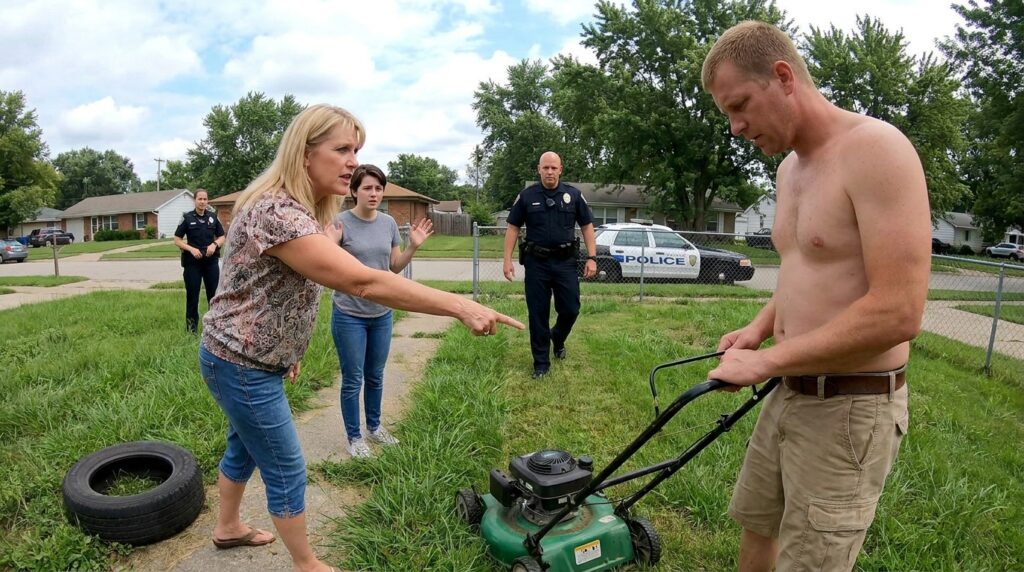
“You can back that machine up right now, Aaron, or the county’s going to make this very difficult for you,” Brenda said, her fingers tightening until the plastic edge of her phone case groaned. She didn’t blink against the dust coming off his deck. “The line was adjusted in ninety-four when the township widened the culvert. It’s on the master plat. My husband filed the copy himself.”
Aaron let the green rubber handles hum against his palms, the dead weight of the push mower vibrating down through his work boots into the dry fescue roots. The engine’s hot zinc smell was thick between them now, mixing with the sharp scent of wild onions being pulverized beneath the steel deck. He didn’t take his eyes off the ground where her white leather sandals sat firmly embedded in his patchy crabgrass.
“Ninety-four was an unrecorded easement review, Brenda,” Aaron said. His voice was raspy from the plant floor dust, low enough that the rattling mower deck nearly swallowed it. “The culvert stopped six lots down. It never touched this ditch.”
Brenda let out a short, thin laugh that didn’t reach her eyes. She shifted her stocky frame, blocking the narrow space between his old iron fence post and the edge of his gravel driveway. Her floral patterned blouse flared with the sudden mid-afternoon breeze, a bright splash of orange and lilac against the gray, unpainted siding of his porch. “You think you know how the county maps this block? You haven’t even seen the ledger folders in the basement at city hall. My husband spent twenty-six years drafting these coordinates. Every square inch of this frontage has his signature on it.”
She tilted the glass screen of her phone toward him again, her thumb stabbing at the digital layout. Underneath the main map, where the faded grid lines showed the original nineteen-seventy subdivision boundaries, a secondary stamp was visible in dark violet ink—an internal administrative amendment labeled 76-EAS-09: Lot 4 Boundary Extension.
Aaron stared at the numbers. The ink line on the scanned document looked too straight, too clean compared to the rough hand-drawn survey pins from the original builders. He knew every piece of rusted pipe and concrete marker along this ditch line because he had spent three weekends digging out the clogged drainage tiles by hand after the spring rains. He had never found a single iron survey pin three feet inside his grass.
Behind Brenda, the younger woman, Chloe, took two steps back toward the sidewalk, her sneakers squeaking against a patch of dry clay. Her eyes were fixed on the black asphalt street at the end of the block where the low, rising whine of the siren had suddenly dropped into a rhythmic, mechanical growl. “Brenda, the cruiser just turned onto the crescent,” she muttered, her fingers gripping the hem of her gray T-shirt until the cotton stretched tight. “Let them look at the papers inside. We don’t need to stay out here on the edge.”
“We stay right here,” Brenda said without looking back. She took another half-step forward, her capris brushing against the rusted muffler shroud of the idling mower. The heat radiating from the engine block made the air between them shimmer. “He’s been encroaching since he bought the place from old man Miller. Every time he runs these blades past my mailbox, he’s cutting away my property value. Not today.”
Aaron looked down at the cut line. The difference between his unmanaged, sun-bleached weeds and her perfectly level, dark green turf was exactly thirty-six inches of dry dirt. It was a strip of ground that barely grew enough fescue to fill a single collection bag, but it was the only buffer between his front porch and her constant, silent surveillance from the white vinyl blinds. Every citation he had received over the last eighteen months—the trash bin warnings, the vehicle maintenance notices, the lawn length citations—had traveled down this exact three-foot corridor.
The shadow of a large vehicle lengthened across the gravel driveway. The blue-and-white police cruiser didn’t rush; it rolled slowly along the curb, its tires crunching over the loose gravel scattered near the drainage ditch before it came to a halt right behind Aaron’s old work truck. The light bar on top remained dark, but the engine let out a low, heavy rumble that matched the vibration of the lawn mower.
Through the parched fescue, Aaron watched the driver’s side door swing open. A pair of heavy black leather patrol boots hit the asphalt with a solid, dry thud.
Aaron didn’t move his hands from the throttle bar. He kept his eyes on Brenda’s phone screen, watching the digital map lines jitter as her hand began to tremble slightly under the sudden weight of the official presence. He could feel the small, hard corners of the laminated surveyor’s plat he had tucked into the door panel of his truck weeks ago, waiting for this exact intersection of paper and dirt.
“Everything stays exactly where it is,” Aaron said, his voice dropping into the steady register of a man who spent his life monitoring the safety toggles on a multi-ton press. “Don’t move the screen.”
Brenda didn’t pull the phone back, but her jaw tightened, the red flush on her neck spreading toward her ears as the primary officer’s heavy utility belt clinked against the open door of the cruiser.