
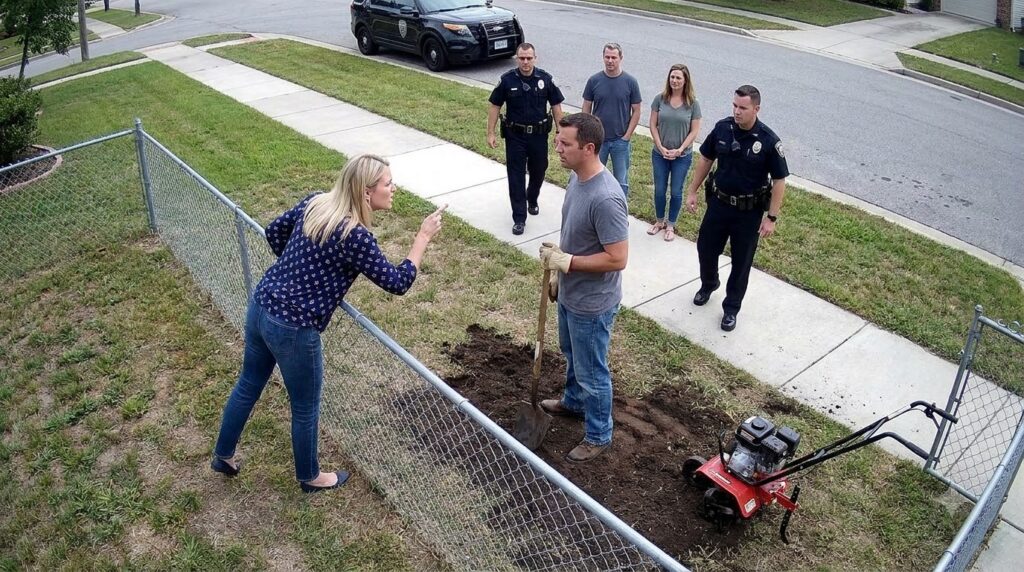
CHAPTER 8: THE SCRAPED BOUNDARY
“Open the briefcase, or I let the borough mechanic cut the hinges with an abrasive wheel.”
Vance didn’t unholster his Glock, but his right thumb hovered over the retention strap, his chest heaving against the dark poly-blend fabric of his uniform. The lawyer, pinned against the black quarter-panel of the Denali, held the aluminum case clamped against his stomach like a vestige of life itself. His immaculate charcoal wool was already dusted with yellow silt kicked up by the pumpers.
“That case is protected work product under attorney-client privilege,” David hissed, though his chin wobbled, betraying the raw terror of a cornered man.
Jesse didn’t wait for Garza or the officers to argue legal semantics. His boots hit the curb hard, spitting gravel into the storm drain. His fingers—calloused, grimy, stained in gray industrial sludge—clamped straight around the lawyer’s wrist. He didn’t wrench; he simply levered his weight down using the mechanical leverage he’d spent fifteen years honing on ditch-clearing breaker bars.
The lawyer’s fingers gave with a sharp gasp of air. The aluminum case tumbled onto the sun-baked asphalt, popping its spring catches with two sharp, metallic snaps.
A bundle of yellowed blueprints spilled across the blacktop, accompanied by a heavy iron register key stamped REC-92 and a fire-scorched leather ledger tied shut with rotting butcher’s twine.
Garza was on her knees instantly, ignoring the oily brine that was beginning to puddle near the street drain. She snapped the twine with a pocket blade and splayed the heavy vellum wide across the hot road.
Jesse stood over her shoulder, the sweet, cloying reek of trichloroethylene stinging the back of his throat. Down the block, the neighborhood stood completely frozen on their front porches—ordinary people with mortgages, garden hoses, and children, watching the yellow barrier tape flutter in the toxic drift.
Gloria Henderson stepped forward, dragging her sandals through the dry gravel. She didn’t scream anymore. She looked shrunken, stripped of the manic suburban pride that had driven her to the chain link an hour before.
“Look at the margin date, Gloria,” Garza said, her voice flat, devoid of mercy, slicing through the rumble of the diesel engines. She pointed a gloved finger at a hand-drawn elevation map dated August 14, 1992.
In the margins, etched in faded purple indelible ink, was a surveyor’s correction note initialed by the former borough engineer and countersigned by Thomas Henderson:
“Discharge conduit confirmed non-compliant under CWA Section 307. Boundary pin relocated 16 inches north into township right-of-way per easement indemnity deed #88-B. Subterranean bypass valve counter-weighted to street culvert. Maintenance transferred to Henderson Estate in perpetuity.”
Jesse looked from the crumbling parchment to the woman standing limp in the sun. “There was no dispute about grass,” he said softly, the weight of the realization pressing down like iron slag. “You weren’t trying to protect your property line. You were trying to stop anyone from finding out that your father bargained your entire neighborhood’s clean soil to save his machine shop from bankruptcy.”
Gloria’s breath came in ragged, brittle hitches. She didn’t look at Jesse; she looked down at the puddle of black, iridescent sludge bubbling through the cracked asphalt by her toes.
“If they knew,” she whispered, her voice hollow, lost beneath the thrum of the idling pumpers, “the house… the land… everything he left us was worthless. Worse than worthless. A debt we could never pay in three lifetimes. He told me before he died: Keep them off the fence. If they set a transit on the curb, the family name is finished.”
“Your family name was finished thirty years ago, ma’am,” Vance said, stepping forward. He produced a set of steel handcuffs from his belt, the chrome flashing blindingly in the noon glare. He didn’t reach for her wrists yet; he turned first to David, snapping the ratchets tight around the lawyer’s manicured wrists before shoving him against the cruiser’s hood. “And the people living downstream have been drinking your father’s settlement ever since.”
The technician in the Tyvek suit came running up from the ditch, his faceplate streaked with perspiration, holding up an emergency hydraulic shutoff clamp.
“Agent Garza! We tapped the bypass line at the bedrock line,” the tech panted through his respirator. “The counter-weight tripped, but the valve seated. The siphon is locked off from the main town culvert. No more volatile solvents entering the storm main.”
A strange, unnatural quiet settled over Mercer Way. The sudden stop of the hydraulic shriek made the constant drone of the fire truck engines sound distant, almost negligible.
Jesse stepped away from the crowd, walking slowly back toward the tailgate of his battered Ford. He took off his cowhide gloves, dropping them onto the rusted steel bed. His hands were shaking slightly—not from fear, but from the sudden, jarring release of adrenaline that comes when a working man realizes he’s stepped over the edge of a pit he wasn’t meant to see.
He picked up his transfer shovel. The blade was still coated in the sour yellow subsoil of the Mercer ditch, the edge dulled where it had rung against the forged pin.
Across the property line, the chain-link fence still stood, tilted two degrees into the yard, rusted amber along the lower wire. But it didn’t divide neighbors anymore. It stood as a naked, rusted memorial to a lie that had finally run out of dirt to hide in.
Jesse slid the shovel into the rack behind his cab, cinched down the rubber tie-downs, and leaned his elbows on the hot rim of his truck bed, watching the county investigators pound steel survey stakes into the true earth.








