
CHAPTER 5: THE SIEGE OF MERCER WAY
“Hands on the tailgate. Keep your palms flat against the steel.”
Jesse didn’t look back over his shoulder. He pressed his palms into the sun-scalded sheet metal of the Ford’s drop-gate, the grit of dried river silt grinding into the calluses of his thumbs. Behind him, the street had ceased to be a quiet suburban lane. It was an extraction corridor.
Two heavy lime-yellow pumpers from the borough department were angled across both lanes of Mercer Way, their air brakes releasing with ear-splitting, pneumatic sneezes that rattled the windowpanes of the split-level across the street. Beyond them, a white cab-over response unit bearing the state department of environmental protection crest idle-rumbled in the center line, its roof strobes flashing a rhythmic, nausea-inducing magenta against the yellow tape fluttering in the hot breeze.
“I didn’t pour the slab,” Jesse said. His voice was raspy from the chemical draft rising off the trench fifty yards back. “I was hired for grading. The paperwork is on the passenger seat.”
A heavy hand, clad in textured nitrile over leather work gloves, patted down the hips of his canvas trousers, checking the empty tool loops before pulling his wallet from his back pocket.
“Paperwork says whatever the broker pays forty dollars to have printed at an office supply shop, son,” said a woman’s voice, dry, clipped, and devoid of regional accent.
She stepped around to his flank. She wore steel-toed tactical boots, charcoal field fatigues, and a heavy windbreaker despite the ninety-degree sun, with REGIONAL ENFORCEMENT – EPA REGION II stenciled in reflective gold across the shoulder blades. Her face was weathered, sun-spotted around the temples, with graying hair pulled back into a severe knot. Her badge was clipped to her collar alongside a personal air monitor that ticked with a slow, erratic click every four seconds.
She tossed his wallet onto the tailgate between his hands, followed by the folded cardstock permit Jesse had shown Vance twenty minutes earlier.
“My name is Special Agent Garza,” she said, tapping the cardstock with a stubby yellow pencil. “And this ticket lists an LLC registered out of a strip-mall mail drop in Dover that dissolved eighteen hours ago.”
Jesse’s jaw tightened until his molars ground together. He looked down at the paper. The blue seal on the bottom corner—the one the yard dispatcher had sworn was a clerk-stamped municipal variance—looked thin and oily under the direct glare of the sun.
“Apex Coastal,” Jesse muttered. “They paid half down by cashier’s check. They said the bank needed the north ditch cleared before the appraiser arrived on Tuesday.”
“Apex Coastal isn’t a bank asset firm,” Garza said, leaning her hip against the Ford’s tail light. She drew a stiff manila folder from under her arm and flipped it open against the truck bed. “It’s a shell entity owned by Mercer Remediation Trust. A cleanup syndicate formed by three former shareholders of Henderson Tool & Die back in nineteen ninety-six.”
Jesse raised his chin, his eyes darting toward the chain link run.
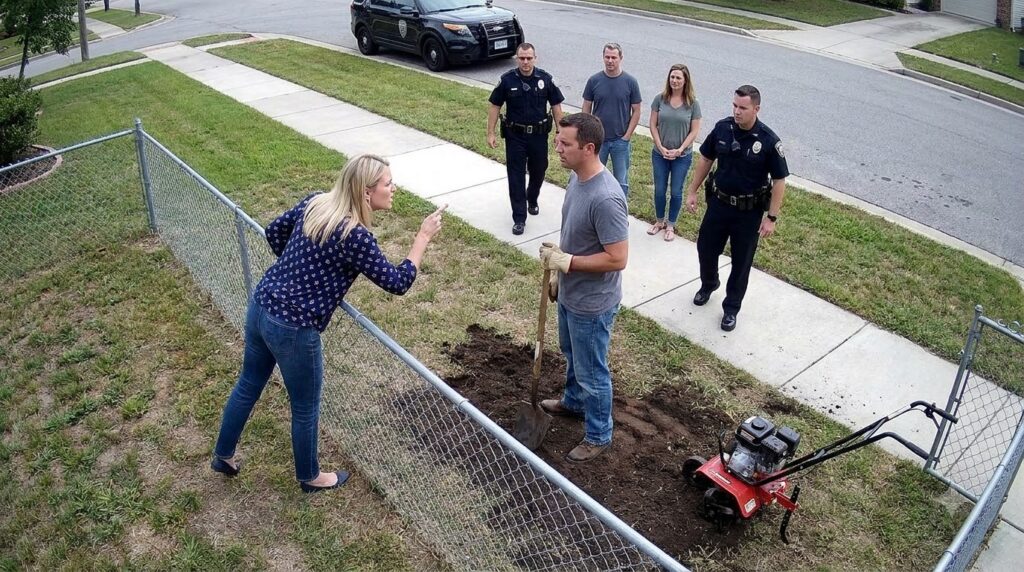
Down by the curb, two technicians in hooded white Tyvek suits and dual-cartridge respirators were kneeling over the furrow, guiding a long fiber-optic inspection wand down through the slit beside the iron plate. A portable gas chromatograph rested on a rubber mat between them, its digital readout spiking in jagged red bars as it sampled the vapor.
Beyond them, Henderson sat on the rear bumper of Miller’s cruiser. She had been wrapped in a yellow shock blanket that looked ridiculous draped over her navy patterned blouse. She wasn’t looking at the officers or the white suits. Her hollow, sunken eyes were fixed directly on Jesse’s tailgate, her mouth slightly agape, watching Garza’s hand rest on the manila file.
“Her father didn’t just dump trichloroethylene in an unlined ditch,” Jesse said, the logic coming together with the brutal clarity of an autopsy. “He piped it. The whole property line is a leach field.”
“It’s not a leach field,” Garza corrected, her voice dropping so low the idling diesel engines almost drowned it out. “It’s an active siphon line. He tied the plant’s degreasing vat overflow into the township’s storm run thirty years ago, right before the federal clean water amendments forced mandatory soil core audits.”
She turned a page in the file, revealing an aerial survey photograph taken from an aircraft in the early eighties. A bold red grease-pencil line tracked the boundary, cutting right through where Henderson’s manicured boxwood hedge now stood.
“If the line was ever surveyed by the borough, the liability triggered an immediate Superfund seizure of every residential lot on this side of the block,” Garza continued, her sharp eyes boring into Jesse’s skull. “The trust was set up to buy the foreclosed houses one by one as the owners died or went broke, secretly dig up the junctions, and pour concrete down the sleeves before the county could link the cancer cluster to the old plant.”
She pointed the blunt eraser of her pencil straight at Jesse’s chest.
“And they hired an uninsured, off-the-books equipment operator with a gas tiller to break the seal so that when the vapors tripped the neighborhood monitors, the local boy with the shovel took the statutory fall for unlawful hazardous disturbance.”
The air went dead in Jesse’s lungs. The heat seemed to thicken, smelling of baking asphalt, sulfur, and the cold, metallic sweat breaking across his forearms.
He looked past Garza toward the street corner where the roadblock ended.
Parked just outside the perimeter tape, behind the idling pumpers, sat a clean, unmarked black Denali with tinted windows, its engine running silently, exhaust shimmering over the pavement. The driver’s window was cracked two inches, the glint of a dark-suited elbow resting on the sill, watching the white suits drill into the earth.
“They’re not waiting for an appraisal,” Jesse whispered.
“No,” Garza said, closing the manila folder with a sharp, dry snap. “They’re waiting to see if you survive the inspection so they know whether to burn the rest of the paper.”








