
CHAPTER 9: THE VERDICT ON CRACKED CONCRETE
Arthur didn’t use the ladder. He drove the square tip of his hex bar deep into a fissure between the exposed caliche layers, hauled his boots out of the green-stained sludge, and pulled himself up through the jagged hole in Slab Nine.
His knees hit the court surface hard, bone jarring against acrylic. White lime dust puffed in a cloud around his forearms, mixing with the sweat running down his temples.
Brenda stood three paces back, her athletic visor crooked, the plastic air horn trembling in her right fist. She looked at him not with anger, but with the hollow, desperate gaze of someone who had watched a controlled burn jump the firebreak.
“Miller is in the banquet hall,” she said, her voice raw over the distant hum of the pumper truck’s generator. “The county deputy commissioner is already at the table. If Kyle signs that blanket easement conveyance, the county assumes emergency receiver jurisdiction over the whole parcel. The state takes the title, Arthur. Every home on this street gets wiped into an uninsurable toxic hazard buffer.”
Arthur didn’t answer. He stood, wiped the gypsum paste from his palms onto his khaki trousers, and unclipped the heavy fiberglass surveyor’s tape. In his other hand, he carried the extracted brass injector manifold, its severed clear tube still weeping bright green phosphorescent tracer onto his boots.
He walked across the buckling court, through the collapsed perimeter fence, and pushed past the yellow emergency tape.
He didn’t take the golf cart. He marched down the center of the asphalt road, leaving a double track of grey caliche footprints in the midday sun.
At the clubhouse, the heavy oak doors of the banquet room stood propped open with folded cardboard coasters. Inside, the air conditioning was dead. The heat of ninety people packed shoulder-to-shoulder was suffocating, smelling of wet wool, stale coffee, and panic.
At the raised dais at the front sat Kyle Miller, beside a middle-aged bureaucrat with silver hair wearing a Clark County badge. A thick document with three blue notary ribbons lay between them, open to the signature page. Miller held a silver fountain pen poised an inch above the line.
“Under Section 10-A of the Emergency Soil Remediation Act,” Miller was reciting into the microphone, his hand visibly shaking, “the Juniper Crest Master Association hereby cedes regulatory easement authority to the district—”
CLANG.
The heavy brass manifold hit the center of the folding table, slamming into the wood with the force of an iron sledge. The green tracer fluid splattered across the white linen cloth, soaking straight into the blue notary ribbon.
Miller dropped the pen. The silver barrel rolled off the table and clicked against the parquet floor.
Arthur stood at the edge of the dais, his clothes caked in mud, the red mark of the inspection light still pressed into his lower lip.
“Don’t sign that, Kyle,” Arthur said. His voice was gravel in an empty drum, low, steady, and carrying to every corner of the silent hall.
“Arthur Vance!” Miller shouted, his face flushing purple. “You’re trespassing on an emergency executive session! Officer, remove this man!”
The county deputy commissioner didn’t move. He leaned forward, squinting through gold-rimmed glasses at the green liquid pooling across the legal document. His fingers tapped the edge of the brass manifold.
“What is this?” the commissioner asked, his voice sharp and bureaucratic.
“That’s industrial fluorometric dye, Commissioner,” Arthur said, reaching into his pocket and tossing the grease pencil beside the valve. “Connected directly to the twelve-inch municipal main under court four. It wasn’t an accidental leak. It was plumbed with a backflow regulator to pump eighty gallons a minute directly into the soluble gypsum shelf beneath the court.”
The room remained dead quiet. An old man in the third row let out a ragged cough that echoed against the cedar beams.
“Arthur, you’re delusional,” Miller stammered, grabbing a paper napkin to wipe the green fluid away from the signature line. “The court subsided naturally! We have geotechnical reports from three licensed firms—”
“You have reports from Donald Vance’s shell companies,” Arthur interrupted, his finger coming down on the blue document. “Brenda’s brother. The same man who initiated a sixteen-million-dollar wire transfer to a Cayman escrow account fifty minutes ago. The reserve fund didn’t vanish into maintenance. They used it to purchase short positions on their own development’s bond debt.”
Arthur turned to the crowd of retirees, his neighbors, people he had nodded to across mailbox clusters for twenty years.
“They didn’t just want an insurance payout for a broken pickleball court,” Arthur said, his eyes scanning the pale, bewildered faces. “The entire development was built over an uncompacted caliche sinkhole mapped out in 1978. The developer’s original bonds were maturing this November. If the foundation held, they were liable for eighty million dollars in infrastructure deficits. But if the ground washed out into an uninsurable natural catastrophe? The county pays the bondholders, the insurance clears the mortgages at distressed prices, and the developer’s entity walks away clean with the master reserve.”
Miller stood up, his chair tipping backward and hitting the wall. “That’s slander! You can’t prove a single syllable of that without—”
“The original 1978 county rejection plat is in my truck bed, Kyle,” Arthur said calmly. “Dry-stamped with the red wax seal by the head of the civil drainage division. My name is on the surveyor’s rejection box. I rejected this parcel forty-eight years ago because the bedrock was water-soluble. Your father bribed the zoning board to override the plat, and you spent the last six months drilling bypass holes to make sure the earth finally swallowed the evidence.”
The silence in the room broke.
It wasn’t a roar of shouting; it was a cold, sickening gasp from three score people realizing that the homes they had poured their life savings into had never been meant to survive them.
Brenda Vance walked through the rear double doors. She didn’t look at Miller, and she didn’t look at the crowd. She walked down the center aisle, her athletic visor held in her limp hand, and placed her master key ring—the brass key to the pump shed lock swinging on the ring—directly on top of the county commissioner’s papers.
“It’s true,” Brenda whispered. Her voice was barely audible over the hum of the emergency lights, but in the hush, it carried like an axe striking dry pine. “Donald has the account keys. Miller authorized the bypass valves.”
Miller’s face went completely grey. His hands dropped to his sides, the fingers slack.
The county commissioner stared at the brass manifold, then at the keys, and finally pushed the blue-ribboned document away from himself. He reached into his suit coat, pulled out a heavy black radio, and keyed the mic.
“Dispatch, this is Unit One at Juniper Crest,” the commissioner said, his eyes locked on Miller. “Cancel the emergency easement transfer. Notify the district attorney’s civil fraud division and dispatch two patrol units to the clubhouse administration office. We have a felony infrastructure tampering incident in progress.”
The crowd rose, an overwhelming tide of voices, questions, and weeping spilling down the aisle toward the stage.
Arthur didn’t stay to watch the deputies arrive.
He stepped off the dais, walked past the shouting neighbors, past Brenda Vance standing motionless beside the ruined table, and walked out the rear double doors into the dry, unyielding heat.
He walked past the cracked swimming pool, past the sunken remains of Slab Nine where the yellow water truck was setting up steel containment barriers, and reached his old Ford pickup parked under the shade of a dusty mesquite tree.
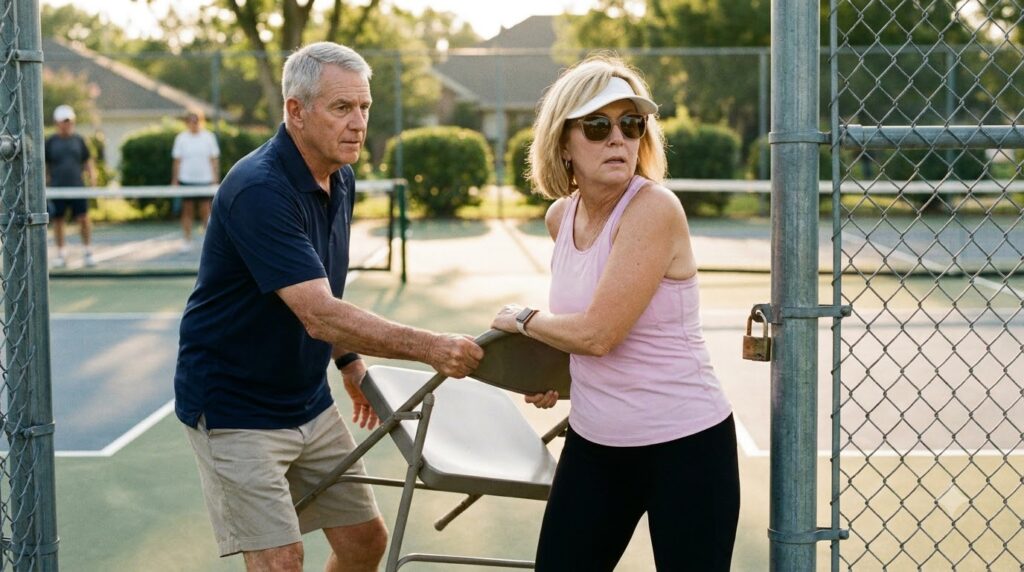
He picked up his folding aluminum chair from the side of the court path—the same chair Brenda had yanked from his hands three hours ago—opened the legs, and planted it firmly on the hard, uncracked bedrock of the main road.
He sat down, rested his elbows on his knees, and pulled the knurled brass micrometer from his pocket. The desert wind blew hot and dry across his face, carrying the distant wail of sirens from the highway. The ground beneath his feet was hard, silent, and finally still.








