
CHAPTER 2: SPLICE AND TORSION
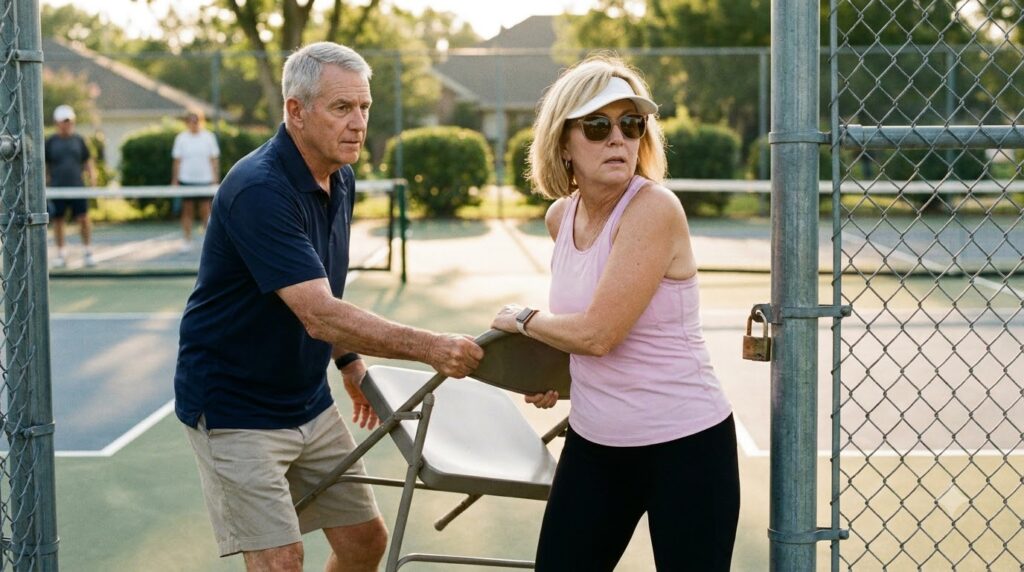
The sweat on Brenda Vance’s temple didn’t dry; it settled into the creased makeup around her eye sockets like grout drying in cracked tile. She didn’t speak another word. She hauled Arthur’s aluminum chair behind her, its nylon strap dragging across the court surface with a dry, hiss-slap rhythm that died only when she passed through the perimeter turnstile and let the heavy latch drop.
Arthur stayed by the court apron until the taillights of her electric golf cart dissolved into the oleander hedge by the south gate.
He didn’t touch the brass lock. Not yet. A man who spent thirty-four years reading municipal easements knew that tampering with a seal was giving the other side a cause of action. You didn’t touch; you measured.
He drew his right hand from his khaki pocket, slipping the small steel gauge between his forefinger and thumb. He knelt down beside the corrugated door of the pump house. The heat rising from the green acrylic court was thick, carrying the smell of cooked plastic and stale chlorine. At court level, the hum inside the corrugated steel wasn’t just audible; it traveled through the ball of his left foot.
A 60-cycle vibration. But layered underneath it was the distinct, uneven flutter of an auxiliary cooling fan—the kind mounted in high-density server racks or heavy-duty transformer enclosures, not the simple open-air armature of an intermittent five-horsepower centrifugal pump.
Arthur ran the flat edge of his fingernail along the black zip-tie poking through the gap. It wasn’t the brittle, paper-thin nylon sold in fifty-packs at the hardware store down on Route 4. It was carbon-stabilized, weather-rated, ten-millimeter strap-banding with an aircraft-grade pawl. And trailing behind it, half-concealed in the shadow of the door flange, was the matte rubber sheath of an RG-6 quad-shield coaxial cable alongside an unsheathed four-gauge ground wire that had been newly crimped into the building’s cold-water riser.
Someone had tied into the main distribution feed, bypassing the utility meter behind the tennis storage shed altogether.
Arthur took a grease pencil from his chest pocket, made a single horizontal tick against the seam of the jamb to gauge any door displacement over the night, and walked out.
At twenty minutes past twelve, the desert wind had turned the suburban development into a valley of dry reeds and ticking sheet metal.
The Juniper Crest community courts were dark. The high-pressure sodium floodlights, governed by a communal astronomical timer, had shut down at ten o’clock sharp. Arthur stepped through the unlatched pedestrian gate near the culvert, his rubber-soled work boots soundless against the expansion joints of the walkway. He carried no flashlight. In a subdivision engineered with uniform setback lines and zero lot clearances, an artificial beam drew security patrols faster than a broken window. The ambient glow from the arterial highway three miles west was enough to throw the perimeter chain-link into sharp, charcoal relief.
He reached the pump shed.
The air out here was cool now, seventy degrees, but the brick face of the utility station felt feverish. Arthur stepped off the concrete apron into the crushed granite swale that drained the court’s outer apron.
His boot sank.
Not an inch. Four inches. The gravel gave way with a sickening, silent liquefaction, the porous crushed stone collapsing under his heel into an unseen void beneath the turf.
Arthur shifted his center of gravity instantly, dropping his left knee to the solid curbing to catch himself. His spine stiffened. He pulled his right foot free. The sole came away coated not in damp topsoil, but in dry, floury silt—pulverized road base, washed clean of any binder.
He stayed crouched, his pulse thumping behind his ears like a trip-hammer.
He reached into the swale, sliding his fingers through the pea gravel down into the breach. Five inches down, the earth simply ceased to exist. There was an empty pocket, a subterranean shelf three feet wide running directly under the reinforced edge of Slab Nine.
The court wasn’t just cracking from the August sun. The subsurface had vacated.
Arthur withdrew his hand, wiped the dust against his trousers, and turned to the corrugated door.
In the dark, the Master Lock No. 5 had an oily sheen under the distant highway reflection. Arthur didn’t reach for a shim or a pry bar. Instead, he pulled a compact inspection mirror on a telescoping antenna from his jacket along with a shielded red-lens penlight. He slipped the mirror flat through the half-inch gap between the door and the channel-iron jamb, angling it upward toward the interior locking bar, then pressed the momentary switch of the red torch between his teeth.
The narrow beam bounced through the mirror’s angled glass, painting the inside of the unlit enclosure in blood-red monochrome.
There were no chemical aeration barrels. There were no pallets of winter rye seed or five-gallon jugs of muriatic acid.
Bolted straight to the interior cinderblock, on unistrut channels that had been drilled with fresh carbide bits, sat an eight-port industrial multiplexer and a commercial power distribution unit. The status LEDs were steady green, flashing rhythmically like pulses along a nervous system. Spliced into the bottom of the unit were three heavy trunklines that didn’t terminate in the pump switchgear.
They ran downward through a freshly cored four-inch hole in the concrete floor, swallowed by corrugated flexible conduit that dived straight into the earth beneath the court.
Beside the rack hung a clip-board with a yellow manifest. Arthur twisted the antenna, rotating the mirror three degrees to catch the header on the printed maintenance log.
It wasn’t stamped with the insignia of the county water authority or the local municipal utility district.
The bold, block lettering at the top read: GEO-SEISMIC TELEMETRY GROUP — BASIN DISPLACEMENT MONITORING.
Beneath it, scrawled in Brenda Vance’s sharp, erratic script, was an entry dated seventy-two hours ago:
Sensor array 04 failure. Void migration accelerating toward residential curb line. Core sample #3 collapsed at sixteen feet. Do not allow foot traffic or structural load on Slab Nine under any circumstances.
Arthur extinguished the light. The mirror slid back into his pocket with a muted metallic click.
The hum behind the metal skin of the door wasn’t an irrigation pump. It was a high-draw vacuum compressor keeping the borehole from venting gas, or keeping the ground from breathing out the rot beneath it.
A twig snapped behind the fence line near the clubhouse parking pad.
A pair of high beams swept across the chain-link, the light catching the galvanized wire in a blinding, diamond grid. The engine was low, idling without the standard rattle of an electric cart—a heavy, four-wheel-drive municipal utility truck, parking diagonally across the driveway to block the only path out to the road.
The door of the truck clicked open, and the heavy thud of steel-toed boots hit the asphalt.








