CHAPTER 7: THE COLLECTION OF EVIDENCE
The plastic evidence bag didn’t seal silently; its heavy, industrial-grade adhesive zip tore across the night air with a loud, serrated crack that matched the rhythmic pulsing of the cruiser’s secondary blue strobes.
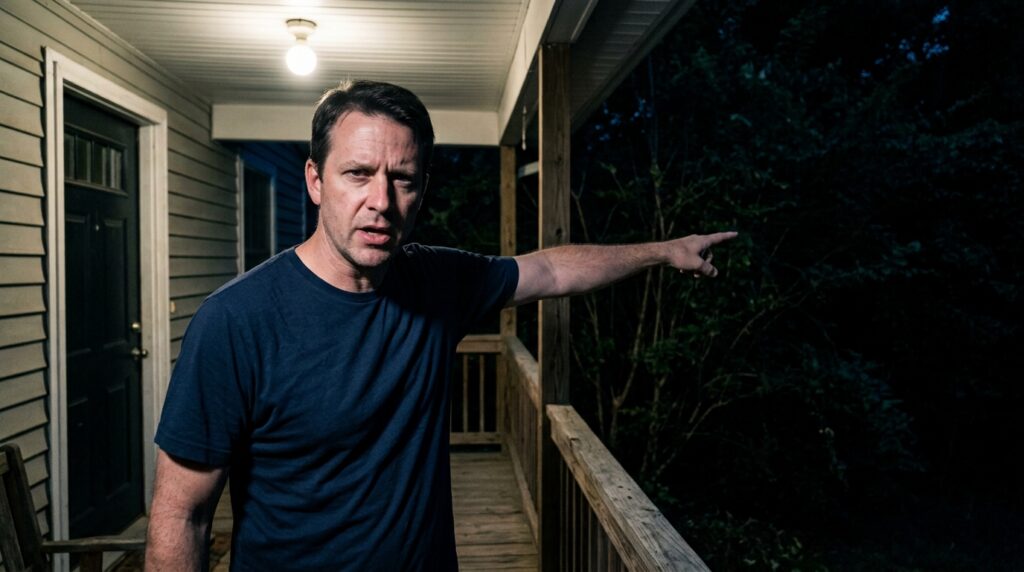
Mark stepped down off the wooden porch, his boots sinking precisely three centimeters into the saturated turf before he cleared the light wedge of his house. The physical reality of the scene had converted from a standoff into an inventory. Two yards away, the deputy’s long flashlight beam was focused on the hood of the patrol car, illuminating the tactical night-vision visor, the heavy digital camera, and the green-bordered HOA file folder Brenda had clutched like a shield.
Brenda stood by the rear quarter panel, her broad frame locked in a rigid, tight state of exhaustion. Her floral blouse was completely ruined, the bright red hibiscus patterns smeared with long streaks of gray clay from the drainage ditch. Her chin remained lifted, but her eyes, small and hyper-focused behind her thin glasses, tracked the movement of the neighborhood spectators who had gathered along the cul-de-sac line.
The Millers were there, their phones raised to chest level, the small blue indicator lights of their video applications casting an unnatural, flickering tint across the asphalt. Three houses down, the porch light of another board member clicked off, a silent, institutional retreat that Mark noted with absolute clarity. The support network was dissolving in real time.
“This equipment is private property registered to the Oakridge Heights Administrative District,” Brenda said, her voice dropping its administrative rattle, replaced by a sharp, transactional rasp. She didn’t look at Mark. She kept her gaze fixed on the deputy’s citation book. “The data collected within that file is protected by a standard municipal non-disclosure agreement. It cannot be entered into a standard county sheriff’s log without a civil court order.”
The deputy didn’t answer with a speech. He lifted the heavy SLR zoom camera, using a specialized evidence pen to pull back the rubber weather sealing along the base plate. Underneath the matte black coating, a clean, laser-etched inventory matrix code was revealed.
PROPERTY OF COUNTY CODE ENFORCEMENT – LOGISTICAL DIVISION – ID: 0442-FL.
Mark stopped at the edge of the light wedge, his hands staying deep in his pockets, his fingers tracing the sharp, cold edge of his thumb drive. “The inventory tag matches the cryptographic certificate that authorized the network bridge,” he said, his tone flat, entirely level. “The same ID number is logged forty-eight times on my internal router over the last forty-eight hours.”
Brenda’s jaw tightened, the skin along her throat going entirely pale under the white LED glare. She turned her head by a fraction of a millimeter, her gaze locking onto Mark’s face with an intensity that calculated every risk, noticed his posture, and suppressed whatever panic was rising in her throat. She didn’t monologue. She didn’t explain her plan. She recognized that the physical evidence on the hood of the car was an absolute barrier to her current position.
“A safety audit requires technical monitoring, Mark,” she said, her voice dropping into a guarded, narrow frequency. “You can audit the files all you want, but a hazard remains a hazard until the county clears the tract.”
“The county isn’t clearing a fire lane, Brenda,” Mark replied, his voice maintaining its unhurried, strategic cadence. He didn’t look at her; he looked at the green folder beneath the deputy’s palm. “The county code enforcement network doesn’t pipe live raw data streams to a private developer’s acquisition office unless the tract is being processed for a mandatory municipal tax lien sale.”
The silence that followed was heavy, compressed by the steady, hot hum of the cruiser’s radiator fan. The deputy paused, his pen hovering over the citation sheet, his eyes flicking from the laser-etched matrix code on the camera back to the business card floating face up in the wet mud at Brenda’s feet—the silver crane logo of Vanguard Core Holdings catching the blue flash of the emergency lights.
The tactical logic had fully inverted. The discovery of the trail camera in Chapter 2 had been the decoy, the physical bait meant to draw Mark out into a loud, litigious property-line dispute that would justify an emergency environmental intervention. But the actual asset—the legal mechanism she was using to force the sale—was now categorized on the hood of a police cruiser under a state criminal statute.
“Ma’am,” the deputy said, his voice a flat, non-negotiable baritone as he unlatched a pair of steel restraints from his utility belt with a sharp, double-metallic clack. “Turn around and place your hands behind your back. We’re going to secure the hardware at the station while the county prosecutor verifies the network certificate.”
Mark didn’t watch her hands go into the steel. He didn’t smile, and he didn’t offer a final verbal vindication. He turned his back to the road, his boots leaving clean, precise chevrons in the soft grass as he walked back toward the illuminated steps of his porch. Behind him, the low, wet murmur of the onlookers grew louder as the cell phones continued to log the absolute collapse of her authority. The perimeter was secure, the physical threat was being escorted past his surveyor stakes, but as he reached the screen door, his mind was already calculating the next layer of the network. Brenda was off the board, but the corporate file at Vanguard Core Holdings remained open, and the true horizon of the dispute was still unspooling in the dark.