CHAPTER 2: THE COLD PERIMETER
“If you’re looking for the line, Mark, you’re standing three inches short of it.”
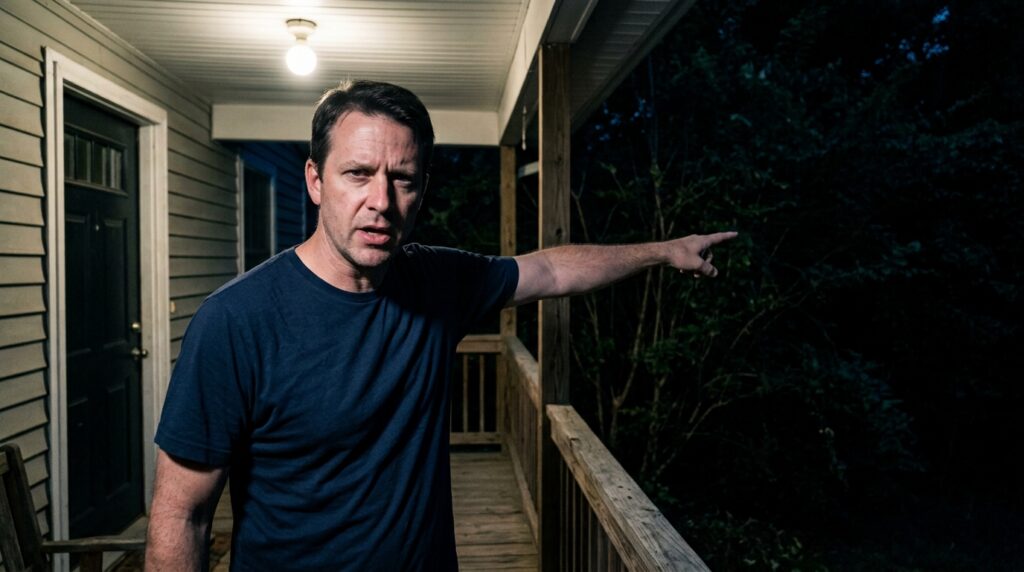
The voice didn’t come from the trees. It lived in the memory of the morning before, a dry, administrative rattle that had followed him into the dew-soaked grass. Mark kept his weight balanced on the balls of his boots, his upper body low as he stepped off the lowest pressure-treated wooden step of the back porch. The ground here was transitional—creeping wood-sorrel giving way to the damp, acidic mast of the pine woods.
He didn’t use a flashlight. The unshielded 100-watt bulb from the kitchen window behind him cast a long, geometric wedge of amber light across the lawn, but its efficacy died exactly twelve yards out, shearing into a sharp, vertical cliff of shadow where the sweetgums began. His eyes had adjusted to the gray-scale reality of the perimeter. To his left, the chain-link fence of the Miller property glinted like a silver wire; to his right, nothing but the dense, unmanaged blackness of the easement.
He knelt, the fabric of his jeans straining against his kneecaps. The humidity was an active weight, pressing the smell of rotting bark and old iron into his throat. He reached down, his fingers hovering over the exact spot where he had heard the fracture minutes earlier.
The dirt didn’t lie. It couldn’t calculate or misdirect.
In the soft, wet clay just beneath a cluster of discarded pine needles, a clean, mechanical edge had been pressed into the earth. It wasn’t the irregular, rounded heel of an old running shoe or the wide, flat print of a standard work boot. The tread was technical—sharp, multi-directional chevrons with a distinct, reinforced steel-shank indentation in the arch. The edges of the print were still sharp, the tiny ridges of displaced mud uncollapsed by the night air. Someone had stood here within the hour, their weight shifted heavily toward the house, their posture stabilized for a long, static duration.
Mark’s thumb measured the width of the heel-strike. Nine centimeters. A small foot, but heavy enough to sink four millimeters into compressed red clay. Brenda didn’t wear work boots; she patrolled the cul-de-sac in rubber-soled orthotics that left wide, featureless smears in the dust. This was a different asset. Someone had been deployed into the gray zone with specific instructions to observe, not to fine.
He leaned forward, his palm resting on the rough, scaling bark of a mature slash pine. The wood was cold despite the ambient heat, its resin tacky against his skin. His tactical logic, refined by years of corporate asset management where every loss was a statistical footprint, began to map the angles. If a person stood in this specific indentation, their line of sight cut directly through the gray condensation of his kitchen window, bypassing the refrigerator obstruction, straight to the counter where the plat map was currently pinned under his fist.
They weren’t looking for overgrown weeds. They were looking for his reaction.
His fingers slid upward along the trunk of the pine, tracing the natural ridges of the bark until they hit a discrepancy. The gray lichen wasn’t native to this side of the tree—it was too dry, its texture resembling cast silicone rather than organic growth. Mark’s fingernail pried at the edge. A small, square section of the trunk shifted, the artificial bark pivoting on a tiny, greased stainless steel hinge.
Behind it, the dark, unreflective circle of a wide-angle lens stared back at him.
It was an industrial-grade, low-light trail camera, its housing anodized black and recessed deep into the heartwood of the living tree. A tiny, dual-lens infrared emitter sat just above the aperture, completely invisible to the naked eye but humming with a microscopic heat that Mark could feel on the pad of his index finger. No branding. No commercial serial numbers. A single, heavy-duty coaxial wire ran from the base of the battery compartment, plunging down into the core of the tree through a drilled channel that had been sealed with black silicone.
The camera wasn’t storing data to an internal card; the slot was empty, its spring-loaded gold pins exposed. It was broadcasting.
Mark didn’t pull the unit. To destroy the asset was to notify the operator that the perimeter had been compromised, resetting the board before he could identify the pieces. He carefully closed the silicone flap, aligning the artificial lichen with the natural grain of the pine until the seam disappeared back into the geometric shadows.
The weight under his ribs shifted from a knot to a cold, calculation-driven calm. Brenda’s $4,500 citation wasn’t the opening move of an HOA dispute; it was the smoke screen designed to keep him looking at paper while the real infrastructure was drilled into his wood.
He stood up slowly, his joints clicking in the midnight silence. He turned his back to the woods, walking back toward the harsh, yellow light of his kitchen with a measured, unhurried stride. He knew the camera was tracking the center of his shoulder blades. He knew that somewhere within three hundred yards, an IP address was logging the exact timestamp of his retreat.
He climbed the porch steps, his boots leaving faint, red clay chevrons on the weathered cedar planks. As he reached for the screen door, a small, rhythmic sound vibrated through the floorboards—the low, distinct ping of his kitchen computer receiving a high-priority network notification.