
CHAPTER 3: THE DUST AND THE ANCHOR
The high-pitched wail of the approaching cruiser died down into a low, metallic growl as the second patrol car cut its wheels hard toward the gravel shoulder. Tires grated over the sun-baked shale, kicking up a rooster-tail of dry silt that drifted over the weeds where Miller stood. The driver’s side door swung open before the suspension had even settled, the heavy hydraulic hinge giving a sharp, rhythmic squeak in the stagnant heat.
Deputy Vance stepped out, his tall, lean frame hunched slightly under the glare of the four-o’clock sun. Unlike Miller’s sweat-soaked navy cotton, Vance’s uniform shirt was crisp, stiffened with starch, though a thin coat of white road dust was already clinging to his shins. His eyes narrowed behind dark, silver-rimmed aviators as he took in the geometry of the road: Miller standing hip-deep in a dry drainage ditch with his cap crooked and his chest heaving, Eleanor planted like an iron post forty yards down beside the galvanized mailbox, and the red pickup idling on the opposite crown with its exhaust pipe puffing black diesel rings into the sky.
“Miller,” Vance said. His voice was flat, carrying the gravelly dryness of a man who spent his shifts listening to county radio chatter through an earbud. He didn’t rush his stride. He walked to the edge of the ditch, his boots crunching methodically over the gravel. “What do we have here?”
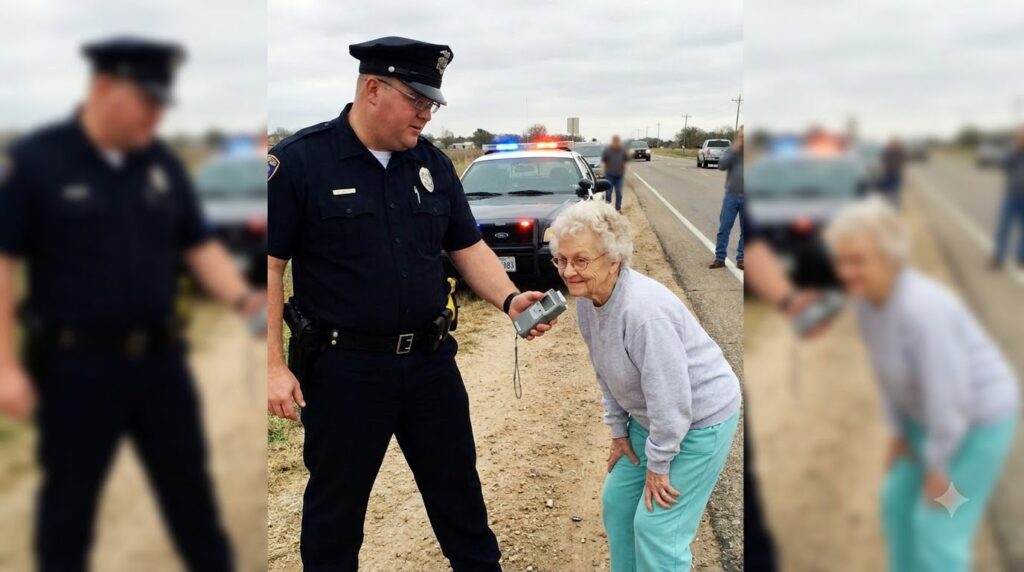
Miller hauled his right foot out of the ditch dirt, the heavy rubber sole coming up with a dull thump. He didn’t look at Vance directly; he kept his eyes locked on Eleanor, his fingers wrapping so tightly around the small gray breathalyzer that the plastic casing groaned under his knuckles.
“Subject refused a lawful roadside evaluation,” Miller grunted, his voice ragged from the dust in his throat. He climbed onto the shoulder, his shoulder patches dark with sweat where the strap of his duty belt pressed against his collarbone. “Exhibited severe disorientation while operating a motor vehicle. When ordered to perform the breath analysis, she initiated a tactical retreat on foot down the public right-of-way.”
Eleanor didn’t shift her feet. She kept her right hand resting casually on the rusted steel mailbox, her body angled just enough to keep both officers in her direct line of sight. Through her wire-rimmed lenses, she noticed the small, square camera mounted to Miller’s center chest seam. The tiny status LED on its side wasn’t solid green—it was flickering a dull, irregular amber, the rhythmic pulse of a unit running on standby rather than actively writing to a memory drive.
“Tactical retreat,” Eleanor repeated softly, her voice cutting through the idling rumble of Vance’s cruiser. “Is that what they call an eighty-year-old walking to her neighbor’s lane these days, Deputy?”
Vance didn’t answer immediately. He looked at the tire marks Miller’s cruiser had left when pulling over the Buick—sharp, jagged skid marks where the patrol car had cut off the sedan’s front bumper—then looked at the Buick itself, sitting straight and squarely between the painted fog lines fifty yards back.
“Mrs. Vance,” Vance said, nodding once toward the mailbox. “You’re a long way from town.”
“I live two miles up the ridge, Arthur,” Eleanor replied calmly. “I’ve lived there since before your father took over the grain elevator. And I was driving thirty-two miles an hour until Officer Miller decided my bumper needed a close inspection.”
Miller took two heavy steps forward, his boots grinding the roadside grit into powder. “She was weaving, Vance. Speech was thick when I made first contact at the window. I had articulate, reasonable suspicion of physical impairment before I ever asked her to clear the door.”
“You asked me to blow into a tube because I wasn’t going fast enough to satisfy your ego, son,” Eleanor said. She stepped away from the mailbox, her movement deliberate and unhurried. Her beige slip-on shoes moved over the broken pavement without making a sound. She stopped ten feet from Vance, well outside Miller’s reach, her hands clasped lightly over her light gray sweatshirt. “And when I gave you a demonstration of my coordination, you fell into a ditch.”
Miller’s face flushed a deep, mottled red, the color spreading down his thick neck into the open collar of his shirt. “You fled an active traffic stop!”
“I walked away from an unlawful demand,” she corrected him, her eyes locking onto Vance’s dark glasses. “Deputy, your partner’s chest camera has been flashing amber since he stepped out of his car. If he recorded thick speech at my window, I suggest you pull the audio log right now and let us all listen to it.”
Vance’s hand moved instinctively to the small control head mounted on his own lapel, but his eyes shifted to Miller’s chest. The amber light flickered twice and died, the dark lens of the housing reflecting nothing but the heat-distorted line of the empty road.
Miller’s jaw tightened, a muscle jumping along the edge of his clean-shaven cheekbone. “The unit had a power fault during the initial pursuit,” he said quickly, his thumb flicking the side of the device with a hard, metallic click. “The cabin microphone on my cruiser caught the baseline verbal interaction. It’s all on the hard drive.”
“Then let’s go look at the hard drive,” Eleanor said quietly. She didn’t wait for Miller’s permission; she turned on her heel and began walking back toward her Buick, her gait perfectly straight, her balance unbroken on the heat-cracked asphalt.
Miller made a sudden, aggressive move to cut her off, but Vance stepped smoothly into his path, his long arm extending just far enough to place a flat palm against the center of Miller’s chest rig.
“Hold on, Miller,” Vance said softly, the tone carrying no heat, only the cold, pragmatic weight of a man who knew how much paperwork a bad arrest generated on a Saturday afternoon. “Let’s review the cabin reel first.”








