
CHAPTER 2: THE FRICTION OF RUNNING
Her beige slip-on shoes struck the sun-baked asphalt with the dry, rhythmic slap of leather hitting oak. There was no hesitation in the stride, no wide-legged stumble of a body fighting its own balance. Eleanor kept her shoulders low, her arms swinging in short, metronomic arcs that cut through the shimmering heat waves rising off Old County Road 4.
Behind her, the sudden rupture of motion exploded into heavy, chaotic violence.
“What the—Stop! Stop right there, get back here now!”
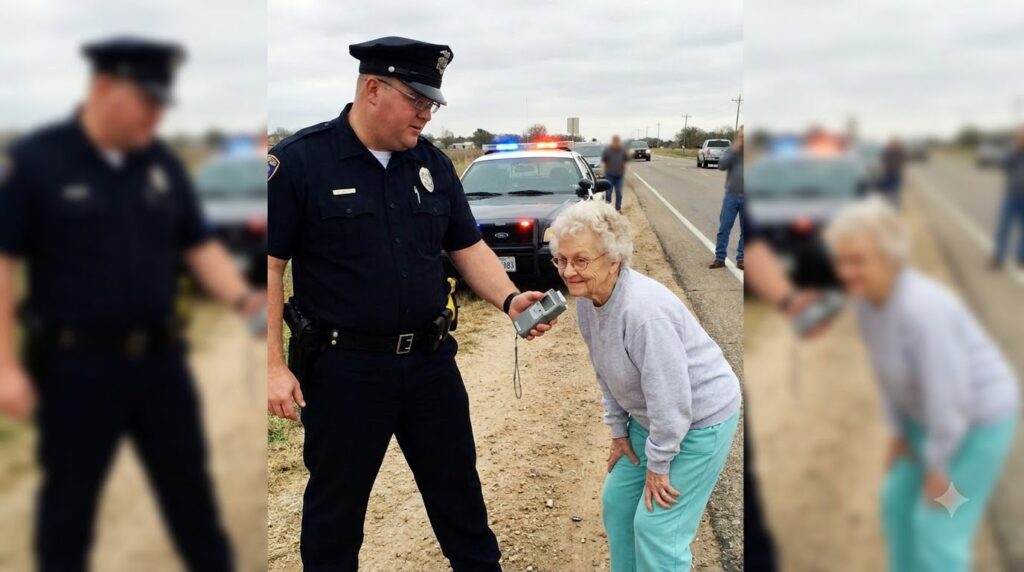
Officer Miller’s yell was choked off midway by the sheer weight of his own momentum. His boot heels bit into the loose limestone grit of the shoulder, throwing up a cloud of gray dust as he tried to haul his two hundred and fifty pounds around the open edge of the Buick’s door. The metal hinge screamed as his forearm slammed against the frame, the heavy navy cloth of his uniform sleeve catching on the latch before snapping free.
Eleanor didn’t look back. She knew the geography of this road the way an old farmer knew the depth of his well. Three hundred yards ahead, the asphalt crested over a shallow culvert where the drainage ditch dipped beneath the entrance of the Miller farmstead—no relation to the officer, just sixty acres of neglected sorghum and rusted equipment. The white fog line along the edge of the pavement was cracked, spalled by decades of frost and heavy grain trucks, but it ran straight as a surveyor’s string. She kept her left shoe planted squarely on that white line.
Miller’s footsteps sounded like sacks of wet flour being dropped onto dry dirt. Thump. Thump. Thump.
“You’re making this worse!” his voice boomed, already ragged, the harsh rasp of a heavy smoker trying to push a heavy frame past its natural limit. “Add… evading… to the charges! Pull over!”
The leather of his duty belt clanked rhythmically—the heavy radio bouncing against his hip, the steel cuffs knocking against the small of his back, the holster slapping hard against his right thigh. He was breathing through his mouth now, deep, desperate gulps of hot air that smelled of fried grease and road dust.
Eleanor adjusted her pace by a fraction of an inch, taking the shallow incline toward the culvert without shortening her stride. Through the thin wire frames resting on her nose, the world was a study in friction and wear. The dry grass in the ditch was bleached white by August; the telephone poles stood like gray, splintered teeth against the pale sky.
A red pickup truck coming from the opposite direction slowed to a crawl, its chrome grille dipping as the driver hit the brakes. The man behind the wheel—a farmer in a faded blue mesh hat—stared through his dusty windshield, his mouth slacking open as he watched an eighty-year-old woman in aqua pants draw away from a heavily uniformed police officer who was rapidly turning the color of a bruised plum.
Miller saw the truck. The presence of a witness acted like a cattle prod to his pride.
“Get on the ground!” he roared, trying to force a burst of speed out of his thick legs. His broad face was slick with sweat, his clear glasses slipping down the bridge of his nose as he lunged forward, reaching out a thick, hair-knuckled hand toward the tail of Eleanor’s light gray sweatshirt.
His fingers brushed the fleece. Just the tip of his glove, catching the hem.
Eleanor felt the slight tug at her spine. She didn’t panic. She didn’t reach back. She simply shifted her weight two inches to the right, stepping off the cracked fog line and onto the hard-packed gravel of the shoulder.
The change in surface was instant. Miller, expecting her to hold the smooth asphalt, overcommitted his weight to the left. His lead boot caught the soft edge where the pavement crumbled into the ditch. The heavy rubber sole twisted, digging a three-inch furrow into the dirt.
“Woah—!”
Miller didn’t go all the way down, but his center of gravity shattered. His arms pinwheeled in the air, the small gray breathalyzer still clutched uselessly in his right hand like a piece of plastic driftwood. He stumbled five long, agonizing paces into the dry weeds of the ditch, his duty boots crushing the brittle goldenrod, before he managed to plant his feet and arrest his fall.
He stood there in the ditch, his chest heaving like a blacksmith’s bellows, his navy shirt soaked through with dark patches of sweat at the armpits and sternum. The black peaked cap had slipped sideways on his head, exposing a patch of pale, damp scalp.
Forty yards further down the road, Eleanor brought herself to a smooth, controlled halt right beside the galvanized mailbox of the old farmstead. Her breathing was quick, but deep and even, the steady rise and fall of a diaphragm accustomed to morning walks up the ridge.
She turned around slowly, resting one hand on the rusted steel post of the mailbox. The sun caught the clean, unmarked soles of her beige slip-ons. There was no dust on the canvas, no scuff marks on the toes.
Miller leaned forward, his hands pressed hard against his knees, his broad back bowed as he tried to drag oxygen into his burning lungs. He looked up through his fogged glasses, his face dark with a mixture of heat stroke and pure, unadulterated fury.
“You’re… under… arrest,” he wheezed, pointing a thick, trembling finger at her.
“Officer,” Eleanor called back, her voice carrying clearly over the hot, still air of the road, “the only thing lacking balance on this road is your judgment.”
Before Miller could haul himself out of the ditch, the sharp, warbling yelp of a secondary siren cut through the distance. Down Old County Road 4, a second marked patrol cruiser was approaching fast, its roof lights painting the dry cornfields in flashes of silent red and blue.








