
The Slow Lane Standoff and the Asphalt Line That Wouldn’t Bend

CHAPTER 1: THE WEIGHT OF THE ASPHALT

“Blow into the tube, ma’am, or we skip the courtesy and go straight to the county lockup.”

Officer Miller didn’t wait for an answer. He leaned his two hundred and fifty pounds deeper into the driver’s side window frame of the beige Buick, the worn leather of his duty belt creaking like dry timber against the sun-heated door panel. The smell of hot radial rubber and baked weed-growth rose off the shoulder of Old County Road 4, mixing with the sharp, artificial lemon scent hanging off the cruiser’s dashboard fifty feet back.

Inside the quiet cabin, Eleanor didn’t flinch. Her hands—veined, thin, but steady as iron rebar—remained planted at ten and two on the cracked vinyl steering wheel. Through the thin wire frames resting on the bridge of her nose, her pale blue eyes didn’t track the heavy, clean-shaven jawline hovering six inches from her face; they stayed fixed on the red-and-blue strobes reflecting off her rearview mirror.

“Thirty-two in a forty-five, Officer,” she said. Her voice carried no tremble, only the dry, rasping cadence of someone who had lived on this stretch of asphalt long before the county paved the ditch lines. “The speed limit is a ceiling, not a requirement. Particularly when the sun hits the crest at four in the afternoon.”

Miller let out a short, wet breath that fogged the top edge of her window glass. He adjusted his black peaked cap with a thick thumb, letting the gold badge on his chest catch the direct glare of the sun.

“Slurred cadence,” Miller muttered, speaking less to her and more to the wire mic pinned to his left shoulder epaulet. “Delayed motor response. Subject demonstrates disorientation regarding basic traffic flow.” He slapped a heavy, palm-flat blow against the roof of the Buick. The sound echoed down the quiet line of suburban drainage ditches. “Step out of the vehicle, ma’am. We’re going to run a quick baseline balance check right here on the shoulder.”

Eleanor didn’t move immediately. She reached down, switched off the ignition, and pulled the key from the tumbler with a deliberate, metallic click. The small brass key ring held a single house key and a faded plastic tab from a local hardware store that had closed in ninety-eight.

“You’re making a mistake, son,” she said quietly, her voice dropping into the low, flat register of a schoolteacher who had watched thirty generations of boys try to lie their way out of detention.

“Out of the car,” Miller repeated, his hand dropping to rest heavy on the top of his holster flap. “Now.”

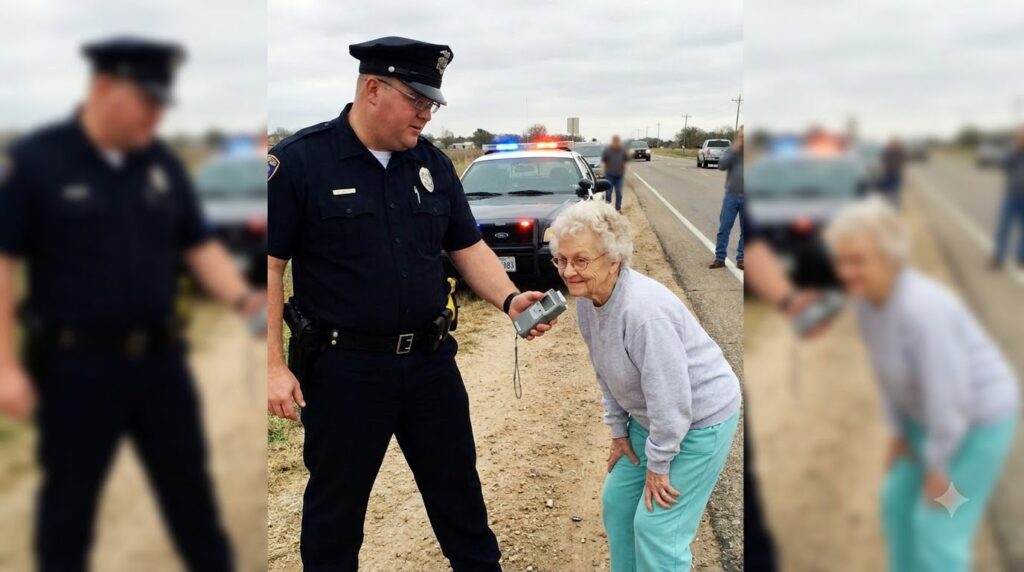
She opened the door. The hinge groaned under the weight of the heat. As her beige slip-on shoes touched the loose limestone grit of the road edge, Miller stepped back just enough to corner her against the quarter panel, his broad navy shoulders cutting off the view of the quiet residential lawns across the ditch.

He unclipped a gray, boxy handheld unit from his belt loop, flicking the digital toggle with his thumb until the small LED screen lit up green in the harsh sunlight. He held the clear plastic mouthpiece three inches from her lips.

“Blow steadily until the tone stops,” Miller commanded, his voice booming over the rumble of an approaching pickup truck that was already slowing down to watch the spectacle. “Let’s see just how much of that lunch wine is still in your system.”

Eleanor looked at the tiny gray nozzle. Then she looked up, past the thick rim of Miller’s clear glasses, straight into the red, sweat-slicked folds of his forehead. A tiny, dry crease formed at the corner of her mouth—not a smile, but the cold, quiet recognition of a man who had built his whole life out of leverage he didn’t actually own.

She leaned in close, as if to comply.

Then she let out a short, clear chuckle that cut straight through the idling hum of the patrol car behind them.

Before Miller’s heavy hand could tighten around the device, her body shifted. The hunched, frail posture melted away in a fraction of a second. Eleanor pivoted on the ball of her right foot, cleared the edge of the open car door with a sharp, fluid movement, and launched herself straight down the center line of the sun-baked road.


CHAPTER 2: THE FRICTION OF RUNNING

Her beige slip-on shoes struck the sun-baked asphalt with the dry, rhythmic slap of leather hitting oak. There was no hesitation in the stride, no wide-legged stumble of a body fighting its own balance. Eleanor kept her shoulders low, her arms swinging in short, metronomic arcs that cut through the shimmering heat waves rising off Old County Road 4.

Behind her, the sudden rupture of motion exploded into heavy, chaotic violence.

“What the—Stop! Stop right there, get back here now!”

Officer Miller’s yell was choked off midway by the sheer weight of his own momentum. His boot heels bit into the loose limestone grit of the shoulder, throwing up a cloud of gray dust as he tried to haul his two hundred and fifty pounds around the open edge of the Buick’s door. The metal hinge screamed as his forearm slammed against the frame, the heavy navy cloth of his uniform sleeve catching on the latch before snapping free.

Eleanor didn’t look back. She knew the geography of this road the way an old farmer knew the depth of his well. Three hundred yards ahead, the asphalt crested over a shallow culvert where the drainage ditch dipped beneath the entrance of the Miller farmstead—no relation to the officer, just sixty acres of neglected sorghum and rusted equipment. The white fog line along the edge of the pavement was cracked, spalled by decades of frost and heavy grain trucks, but it ran straight as a surveyor’s string. She kept her left shoe planted squarely on that white line.

Miller’s footsteps sounded like sacks of wet flour being dropped onto dry dirt. Thump. Thump. Thump.

“You’re making this worse!” his voice boomed, already ragged, the harsh rasp of a heavy smoker trying to push a heavy frame past its natural limit. “Add… evading… to the charges! Pull over!”

The leather of his duty belt clanked rhythmically—the heavy radio bouncing against his hip, the steel cuffs knocking against the small of his back, the holster slapping hard against his right thigh. He was breathing through his mouth now, deep, desperate gulps of hot air that smelled of fried grease and road dust.

Eleanor adjusted her pace by a fraction of an inch, taking the shallow incline toward the culvert without shortening her stride. Through the thin wire frames resting on her nose, the world was a study in friction and wear. The dry grass in the ditch was bleached white by August; the telephone poles stood like gray, splintered teeth against the pale sky.

A red pickup truck coming from the opposite direction slowed to a crawl, its chrome grille dipping as the driver hit the brakes. The man behind the wheel—a farmer in a faded blue mesh hat—stared through his dusty windshield, his mouth slacking open as he watched an eighty-year-old woman in aqua pants draw away from a heavily uniformed police officer who was rapidly turning the color of a bruised plum.

Miller saw the truck. The presence of a witness acted like a cattle prod to his pride.

“Get on the ground!” he roared, trying to force a burst of speed out of his thick legs. His broad face was slick with sweat, his clear glasses slipping down the bridge of his nose as he lunged forward, reaching out a thick, hair-knuckled hand toward the tail of Eleanor’s light gray sweatshirt.

His fingers brushed the fleece. Just the tip of his glove, catching the hem.

Eleanor felt the slight tug at her spine. She didn’t panic. She didn’t reach back. She simply shifted her weight two inches to the right, stepping off the cracked fog line and onto the hard-packed gravel of the shoulder.

The change in surface was instant. Miller, expecting her to hold the smooth asphalt, overcommitted his weight to the left. His lead boot caught the soft edge where the pavement crumbled into the ditch. The heavy rubber sole twisted, digging a three-inch furrow into the dirt.

“Woah—!”

Miller didn’t go all the way down, but his center of gravity shattered. His arms pinwheeled in the air, the small gray breathalyzer still clutched uselessly in his right hand like a piece of plastic driftwood. He stumbled five long, agonizing paces into the dry weeds of the ditch, his duty boots crushing the brittle goldenrod, before he managed to plant his feet and arrest his fall.

He stood there in the ditch, his chest heaving like a blacksmith’s bellows, his navy shirt soaked through with dark patches of sweat at the armpits and sternum. The black peaked cap had slipped sideways on his head, exposing a patch of pale, damp scalp.

Forty yards further down the road, Eleanor brought herself to a smooth, controlled halt right beside the galvanized mailbox of the old farmstead. Her breathing was quick, but deep and even, the steady rise and fall of a diaphragm accustomed to morning walks up the ridge.

She turned around slowly, resting one hand on the rusted steel post of the mailbox. The sun caught the clean, unmarked soles of her beige slip-ons. There was no dust on the canvas, no scuff marks on the toes.

Miller leaned forward, his hands pressed hard against his knees, his broad back bowed as he tried to drag oxygen into his burning lungs. He looked up through his fogged glasses, his face dark with a mixture of heat stroke and pure, unadulterated fury.

“You’re… under… arrest,” he wheezed, pointing a thick, trembling finger at her.

“Officer,” Eleanor called back, her voice carrying clearly over the hot, still air of the road, “the only thing lacking balance on this road is your judgment.”

Before Miller could haul himself out of the ditch, the sharp, warbling yelp of a secondary siren cut through the distance. Down Old County Road 4, a second marked patrol cruiser was approaching fast, its roof lights painting the dry cornfields in flashes of silent red and blue.

CHAPTER 3: THE DUST AND THE ANCHOR

The high-pitched wail of the approaching cruiser died down into a low, metallic growl as the second patrol car cut its wheels hard toward the gravel shoulder. Tires grated over the sun-baked shale, kicking up a rooster-tail of dry silt that drifted over the weeds where Miller stood. The driver’s side door swung open before the suspension had even settled, the heavy hydraulic hinge giving a sharp, rhythmic squeak in the stagnant heat.

Deputy Vance stepped out, his tall, lean frame hunched slightly under the glare of the four-o’clock sun. Unlike Miller’s sweat-soaked navy cotton, Vance’s uniform shirt was crisp, stiffened with starch, though a thin coat of white road dust was already clinging to his shins. His eyes narrowed behind dark, silver-rimmed aviators as he took in the geometry of the road: Miller standing hip-deep in a dry drainage ditch with his cap crooked and his chest heaving, Eleanor planted like an iron post forty yards down beside the galvanized mailbox, and the red pickup idling on the opposite crown with its exhaust pipe puffing black diesel rings into the sky.

“Miller,” Vance said. His voice was flat, carrying the gravelly dryness of a man who spent his shifts listening to county radio chatter through an earbud. He didn’t rush his stride. He walked to the edge of the ditch, his boots crunching methodically over the gravel. “What do we have here?”

Miller hauled his right foot out of the ditch dirt, the heavy rubber sole coming up with a dull thump. He didn’t look at Vance directly; he kept his eyes locked on Eleanor, his fingers wrapping so tightly around the small gray breathalyzer that the plastic casing groaned under his knuckles.

“Subject refused a lawful roadside evaluation,” Miller grunted, his voice ragged from the dust in his throat. He climbed onto the shoulder, his shoulder patches dark with sweat where the strap of his duty belt pressed against his collarbone. “Exhibited severe disorientation while operating a motor vehicle. When ordered to perform the breath analysis, she initiated a tactical retreat on foot down the public right-of-way.”

Eleanor didn’t shift her feet. She kept her right hand resting casually on the rusted steel mailbox, her body angled just enough to keep both officers in her direct line of sight. Through her wire-rimmed lenses, she noticed the small, square camera mounted to Miller’s center chest seam. The tiny status LED on its side wasn’t solid green—it was flickering a dull, irregular amber, the rhythmic pulse of a unit running on standby rather than actively writing to a memory drive.

“Tactical retreat,” Eleanor repeated softly, her voice cutting through the idling rumble of Vance’s cruiser. “Is that what they call an eighty-year-old walking to her neighbor’s lane these days, Deputy?”

Vance didn’t answer immediately. He looked at the tire marks Miller’s cruiser had left when pulling over the Buick—sharp, jagged skid marks where the patrol car had cut off the sedan’s front bumper—then looked at the Buick itself, sitting straight and squarely between the painted fog lines fifty yards back.

“Mrs. Vance,” Vance said, nodding once toward the mailbox. “You’re a long way from town.”

“I live two miles up the ridge, Arthur,” Eleanor replied calmly. “I’ve lived there since before your father took over the grain elevator. And I was driving thirty-two miles an hour until Officer Miller decided my bumper needed a close inspection.”

Miller took two heavy steps forward, his boots grinding the roadside grit into powder. “She was weaving, Vance. Speech was thick when I made first contact at the window. I had articulate, reasonable suspicion of physical impairment before I ever asked her to clear the door.”

“You asked me to blow into a tube because I wasn’t going fast enough to satisfy your ego, son,” Eleanor said. She stepped away from the mailbox, her movement deliberate and unhurried. Her beige slip-on shoes moved over the broken pavement without making a sound. She stopped ten feet from Vance, well outside Miller’s reach, her hands clasped lightly over her light gray sweatshirt. “And when I gave you a demonstration of my coordination, you fell into a ditch.”

Miller’s face flushed a deep, mottled red, the color spreading down his thick neck into the open collar of his shirt. “You fled an active traffic stop!”

“I walked away from an unlawful demand,” she corrected him, her eyes locking onto Vance’s dark glasses. “Deputy, your partner’s chest camera has been flashing amber since he stepped out of his car. If he recorded thick speech at my window, I suggest you pull the audio log right now and let us all listen to it.”

Vance’s hand moved instinctively to the small control head mounted on his own lapel, but his eyes shifted to Miller’s chest. The amber light flickered twice and died, the dark lens of the housing reflecting nothing but the heat-distorted line of the empty road.

Miller’s jaw tightened, a muscle jumping along the edge of his clean-shaven cheekbone. “The unit had a power fault during the initial pursuit,” he said quickly, his thumb flicking the side of the device with a hard, metallic click. “The cabin microphone on my cruiser caught the baseline verbal interaction. It’s all on the hard drive.”

“Then let’s go look at the hard drive,” Eleanor said quietly. She didn’t wait for Miller’s permission; she turned on her heel and began walking back toward her Buick, her gait perfectly straight, her balance unbroken on the heat-cracked asphalt.

Miller made a sudden, aggressive move to cut her off, but Vance stepped smoothly into his path, his long arm extending just far enough to place a flat palm against the center of Miller’s chest rig.

“Hold on, Miller,” Vance said softly, the tone carrying no heat, only the cold, pragmatic weight of a man who knew how much paperwork a bad arrest generated on a Saturday afternoon. “Let’s review the cabin reel first.”

CHAPTER 4: THE DECOY TAPE

The hood of Miller’s cruiser was so hot the navy paint seemed to hum under the sun. Eleanor stood three feet back, watching Deputy Vance lean through the open driver’s door of the lead patrol unit. His long fingers tapped against the ruggedized laptop bracket mounted beside the shotgun rack, the keys clicking with the heavy, dry snap of old plastic.

Miller hovered at Vance’s elbow like a storm cloud, his shadow blocking the light off the side mirror. His chest was still moving in deep, forced hitches, sweat dripping off the point of his jaw and soaking directly into the collar of his uniform.

“File 08-08-B,” Miller growled, leaning past Vance to point a thick, grime-stained forefinger at the screen. “Right there. Time stamp shows 15:52. That’s the moment I initiated the stop.”

Vance didn’t hit play immediately. He tilted his silver-rimmed aviators up onto his forehead, his gray eyes narrowing as he scanned the file metadata scrolling across the bottom of the black screen.

“Audio track shows a secondary channel active, Miller,” Vance said quietly. “Where’s the bodycam link?”

“I told you, the wireless receiver dropped the sync when I cleared the door frame,” Miller snapped, his voice tight, edge-strained. “The cabin microphone captured everything. Just play the external channel.”

Eleanor didn’t move toward the door, but her eyes tracked the thick bundle of wires running beneath the cruiser’s center console. Right beside the siren control box, a tiny, handmade orange bypass pin was jammed into the secondary audio harness—a crude manual kill-switch designed to cut bodycam feeds before they ever hit the hard drive.

“Play it, Arthur,” Eleanor said, her tone level as a carpenter’s rule.

Vance struck the spacebar.

The small speaker on the dashboard hissed with loud, crackling static—the sound of hot wind rushing past a front grille—followed by the heavy, muffled thud of a vehicle door closing. Then came Miller’s voice, loud, booming, and slightly distorted by the digital gain:

“…32 in a 45, Officer… ceiling, not a requirement…”

The recording paused. A sharp, warbling tone cut across the static, followed by Miller’s voice again, but this time his tone was oddly layered, accompanied by a faint, slurred echo that didn’t match the crisp clarity of Eleanor’s original words:

“…Subject exhibits severe motor delay… speech thick, slurred… unintelligible response regarding basic spatial orientation…”

Miller straightened his back immediately, a triumph born of desperation flashing across his dark, sweat-streaked face. He looked over the top of the cruiser’s roof straight at Eleanor.

“There it is,” Miller declared, his voice echoing off the dry gravel. “Official audio record. Recorded slurred speech, verbal confusion, and clear signs of cognitive disorientation prior to the field sobriety request. Departmental policy 402 permits an immediate roadside breath test when verbal indicators of impairment are logged on the primary cruiser audio.”

Vance stared at the wave-form jumping across the screen. The secondary channel was clean—or at least clean enough on paper to satisfy a quick departmental review. The digital signature showed a verified time stamp, locking the audio to the exact minute Miller had stepped up to the Buick. To anyone looking at the surface file, Miller had done everything by the book: he had logged verbal impairment on the cabin mic, justifying the physical check under standard road safety protocol.

Eleanor looked at Miller’s triumphant grin, then down at her own pale hands. The decoy secret sat right there on the dashboard monitor—a neatly packaged layer of digital proof that seemed to seal her guilt under county policy, making it look like her sudden sprint was nothing more than an intoxicated senior fleeing a legal DUI evaluation.

“You think that’s my voice on that tape, Miller?” Eleanor asked quietly, stepping closer to the car frame.

“It’s what the machine recorded, ma’am,” Miller replied, his voice dropping into a smooth, practiced cadence that reeked of bureaucratic safety. “And the machine doesn’t lie.”

Vance reached out to close the laptop screen, his expression troubled, ready to wrap up the scene under the weight of the apparent audio evidence. “Mrs. Vance, based on this file—”

“Keep it open, Arthur,” Eleanor interrupted sharply. She pointed a thin, steady finger toward the bottom right corner of the telemetry monitor. “Look at the engine RPM log running below the audio track.”

Vance stopped his hand mid-air, his eyes dropping back to the green digital line crawling across the bottom of the screen.

CHAPTER 5: THE FRICTION ON THE GRAVEL

Vance’s hand froze two inches above the trackpad. The sun, beating down relentlessly onto the black hood of the cruiser, radiated a wall of dry, shimmering heat that made the laptop screen flicker with faint horizontal lines.

“What about the telemetry line, Mrs. Vance?” Vance asked, his eyes squinting as he leaned closer to the glare on the glass.

Eleanor didn’t back down. She leaned toward the open window frame, her light gray sweatshirt dusting against the hot painted steel. “That audio track you just listened to has an engine noise frequency layered behind it. But look at the green bar running underneath the time code. The patrol car’s transmission wasn’t in park when that voice line was logged. The drive-shaft sensor reads zero output, but the throttle position sensor is sitting at twenty-two percent.”

Miller slammed his heavy, sweat-slicked palm down onto the roof of the cruiser with a crack that sounded like a small caliber gunshot.

“That’s enough!” Miller roared, his face darkening into a deep, purplish crimson. His broad shoulder shoved between Eleanor and the door frame, throwing his two hundred and fifty pounds forward to block her view of the screen. “You don’t get to audit police department telemetry on the side of a public highway, lady! You’re an unauthorized civilian standing inside an active enforcement perimeter!”

The sudden movement sent a spray of loose roadside shale skittering into the ditch. Miller’s hand dropped hard onto his heavy duty belt, his fingers curling over the plastic handle of his sidearm holster. The sheer physical bulk of the man seemed to expand in the sun, blocking out the light, using every ounce of his authority to crush the space between them.

“Deputy,” Miller barked, his voice dropping into a raspy, dangerous vibration, “this subject is actively interfering with an ongoing traffic investigation. She was ordered to remain at her vehicle. She fled. She is now attempting to tamper with official evidence on my terminal. Secure her.”

Vance hesitated, his boots shifting in the gravel. His silver-rimmed aviators caught the harsh glint of the sky. He looked at Eleanor, then at Miller’s white-knuckled grip on his belt. The system was closing ranks—the institutional inertia of two uniformed officers standing on a county shoulder, where a written log and an official mic file carried more weight than the dry logic of an old woman in aqua pants.

“Mrs. Vance,” Vance said quietly, his voice tight, stripped of its earlier neighborly warmth. “I need you to step back to the shoulder. Right now. If there’s an issue with the telemetry integration, that’s something the county prosecutor reviews during discovery. It’s not something we adjudicate on the asphalt.”

The trap was pulling shut. The decoy secret—the manipulated audio file that Miller had logged into the system—had done its job. Even if the track was fishy, the procedure dictated that Eleanor had to be processed, booked, and charged for fleeing an officer, leaving her to fight a falsified record from inside a jail cell thirty miles away in the county seat.

Eleanor looked at Vance’s impassive face, then at Miller’s gloating, sweat-dripping jaw. She realized with chilling clarity that logic alone wouldn’t break the procedural wall. The system was designed to protect its own paper trail first and ask questions months later, after the bail was paid and the impound fees had stacked up.

“You’re going to put me in the back of that car based on a tape that was recorded while your engine was idling in the station parking lot before your shift even started, aren’t you?” Eleanor said softly.

Miller took a heavy, crowding step toward her, his chest almost touching her shoulder. “You’re going to turn around, put your hands behind your back, and let me do my job, ma’am. Or we do this the hard way.”

He reached out his thick, hair-knuckled hand, his fingers spreading wide to clamp down on her wrist. The heavy metal rattle of his handcuffs clinked against his duty belt—a cold, final sound echoing over the hot pavement.

Eleanor didn’t flinch. She didn’t retreat. Instead, her eyes dropped to the sun visor inside Miller’s cab, where a yellowing piece of paper—the manual shift log—was tucked under the plastic strap, its corner fluttering in the hot updraft off the road.

“Arthur,” Eleanor said, her voice dropping to a knife-sharp whisper, “ask him why his shift log lists a mechanical governor fault at two o’clock today.”

Miller’s hand snapped back as if he’d touched a live wire.

CHAPTER 6: THE SHADOW ON THE VISOR

The silence on Old County Road 4 hit with the force of a slammed vault door.

Miller didn’t take another step forward. His thick hand stayed frozen in mid-air, four inches from Eleanor’s left shoulder, his fingers twitching slightly against the heavy leather of his utility belt. The heat radiating off the cruiser’s hood seemed to double, thick with the smell of scorched oil and the metallic twang of the idling radiator fan.

Deputy Vance shifted his weight, his tall frame blocking the glare of the low afternoon sun. He didn’t ask Miller a question. He simply reached through the open driver’s window of the lead cruiser, his long fingers stretching past the steering wheel to pinch the yellow corner of the carbon-copy log sheet sticking out from the plastic visor band.

“Don’t touch that, Vance,” Miller rasped, his voice dropping an octave into a low, guttural warning. “That’s personal equipment notes.”

Vance didn’t pause. The paper slid free with a crisp, dry rustle that sounded like dry corn leaves brushing together in a autumn breeze. He pulled the sheet out into the sunlight, unfolding the three-ply NCR paper against the flat top of the patrol car’s door frame.

Eleanor stood her ground, her heels planted firmly on the sun-baked asphalt. She didn’t look at Miller’s darkening face; her eyes stayed glued to Vance’s expression as the younger officer scanned the hand-written blue ink columns.

“Two o’clock logging,” Vance read aloud, his gravelly tone unnaturally steady. “Unit 104. Mechanical governor engagement fault on Old County 4 corridor. Radar calibration bypass noted due to alternator spike.” He stopped, his thumb resting over a line of bold red stamps at the bottom of the form. “You logged a governor fault before you ever turned your strobes on behind Mrs. Vance’s Buick.”

“The radar was throwing false doppler returns on the open ridge,” Miller said quickly, the words tumbling over each other as he tried to fill the widening gap in the air. “The alternator was surging. That’s why I initiated a physical visual assessment instead of relying on the speed gun. It’s standard departmental protocol when equipment telemetry drops below ninety percent reliability.”

“A visual assessment?” Eleanor’s voice was soft, but it cut through Miller’s explanation like an axe through wet pine. “Or a quota check on a quiet road where you thought no one would read the telemetry?”

Vance turned the laptop screen toward himself, his knuckles white against the heavy casing. His eyes flicked back and forth between the yellow paper in his left hand and the scrolling green data lines on the terminal monitor.

“The audio file wasn’t recorded at fifteen-fifty-two,” Vance said quietly, the realization settling into his voice like frost on a windshield. “The engine RPM log matches the alternator spike at two o’clock. You took an audio file from a DUI arrest three weeks ago—the one down at the river bottom—and spliced the ambient track over the cabin line when you pulled her over.”

Miller’s face went from dark crimson to a sickly, pale gray. The sweat on his forehead seemed to freeze in the heat, standing out in beaded rows along his hairline. He looked around the empty road—at the red pickup truck still idling silently on the opposite shoulder, at the dry cornfields stretching out toward the horizon, and at Eleanor, who hadn’t taken a single backward step since she brought herself to a stop beside the farmstead mailbox.

“It was a preliminary field check,” Miller muttered, his posture deflating as his heavy shoulders sagged beneath the weight of his duty rig. “She was driving thirty-two miles an hour. It was an obstruction risk.”

“The speed limit is a ceiling, Miller,” Vance said, his voice flat, devoid of any camaraderie. He reached into the cab, struck the function keys on the laptop console, and initiated a hard system override. The green data lines vanished, replaced by the bright red lettering of a administrative lockout screen. “And this stop is over.”

Miller stared at the locked screen, his thick hands dropping uselessly to his sides. The small gray breathalyzer was still clutched in his right hand—a useless piece of grey plastic that had failed to deliver the leverage he had counted on.

Eleanor adjusted her wire-rimmed glasses with a calm, deliberate touch of her thumb. “I believe my Buick is still idling on the shoulder, Deputy,” she said.

Vance nodded once, his eyes meeting hers behind his dark lenses. “It is, Mrs. Vance. And the road is clear all the way to the ridge.”

CHAPTER 7: THE RECKONING ON OLD COUNTY 4

The silence that stretched across Old County Road 4 wasn’t the heavy, suffocating stillness of an ongoing threat. It was the sudden, cool release of a pressure valve.

Miller’s heavy, sweat-slicked fingers uncurled slowly, dropping the small gray breathalyzer onto the hot hood of his patrol car. The plastic unit slid three inches across the navy paint, leaving a dull smudge in the dust before coming to rest against the base of the windshield wiper. It sat there—a harmless, hollow block of cheap gray casing—devoid of any authority, its digital screen dead and unlit.

Deputy Vance didn’t raise his voice as he stepped between Miller and the driver’s side door. His tall, starch-stiffened frame blocked the laptop monitor entirely, his hand coming down with a quiet, deliberate click to snap the ruggedized computer shut. The green and red diagnostic lights vanished behind the black plastic lid.

“I’m clearing the stop log on Unit 104, Miller,” Vance said, his voice flat, carrying the cold, unyielding weight of an administrative sentence passed on the shoulder of a two-lane county road. “And I’m tagging your cabin drive for a mandatory department audit when we turn in the keys tonight. You’ll sit in the passenger seat of my car while I tow the 104 back to the yard.”

Miller didn’t argue. The aggressive, broad-shouldered posture that had dominated the window frame twenty minutes ago had completely dissolved, replaced by the heavy, slumped defeat of a man who knew every single byte of his own telemetry had turned against him. He stepped back into the gravel ditch, his heavy boots making a dull, grinding sound against the shale as he reached up to pull the black peaked cap from his damp head. Without the hat, his pale, sweat-beaded scalp looked vulnerable, aged, and thoroughly human under the harsh glare of the August sun.

Eleanor didn’t gloat. She turned her back on the two officers and walked toward her beige Buick sitting idling fifty yards down the white fog line.

Her beige slip-on shoes moved over the sun-baked asphalt with a light, rhythmic cadence. The soles were still clean, untouched by the ditch dirt, taking each step with the unhurried grace of someone who had spent eighty years learning how to keep her balance on unsteady ground. The hot air rising off the road smelled of baked earth, wild mustard grass, and the faint, familiar exhaust of her own four-door engine.

When she reached the Buick, she opened the driver’s door. The metal hinge gave its familiar, dry squeak—a sharp, mechanical note that sounded almost welcoming against the vast, open hum of the surrounding cornfields. She slid onto the sun-warmed vinyl bench seat, adjusted her thin wire-framed glasses with a flick of her index finger, and wrapped her steady hands around the cracked wheel at ten and two.

In her rearview mirror, she watched Vance unclip the ignition keys from Miller’s belt while the red pickup truck across the crown finally shifted into gear, its diesel engine puffing a single pale cloud of exhaust before pulling smoothly away down the lane.

Eleanor clicked the transmission into drive, released the parking brake, and tapped the accelerator. The Buick moved forward smoothly, its tires humming softly as it took to the center of the lane, leaving the flashing strobes, the gray plastic breathalyzer, and the heat-warped asphalt of Old County Road 4 far behind in the dust.

Similar Posts

Leave a Reply

Your email address will not be published. Required fields are marked *






