CHAPTER 4: THE FROZEN RUNG
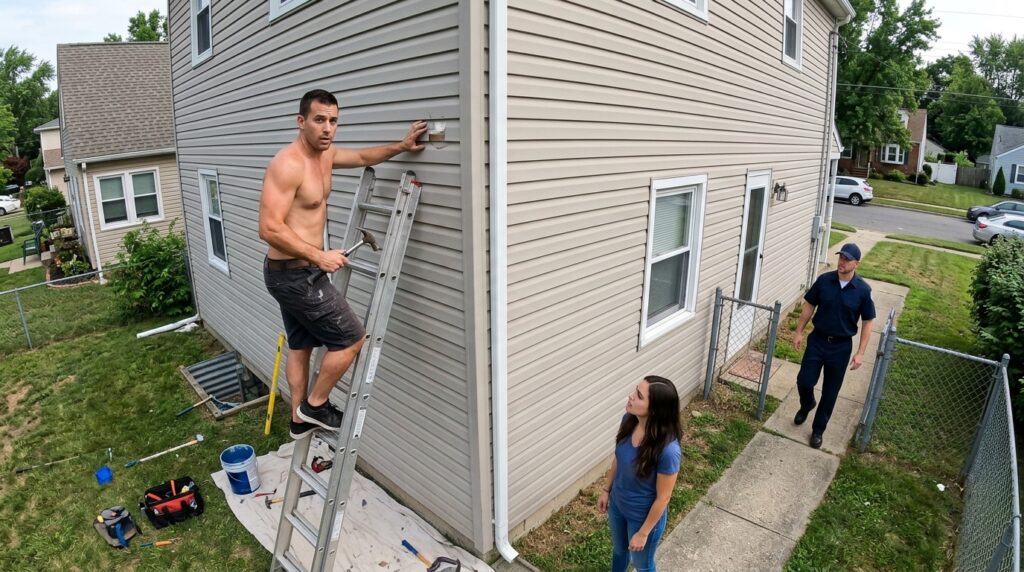
Officer Vance took three measured paces into the side yard, his heavy leather utility belt letting out a dry, transactional creak that matched the heat radiating off the foundation. He didn’t look up at Mark yet. His eyes remained fixed on the lower skirt of the vinyl planking where the new starter channel met the rough concrete footer. With the blunt toe of his regulatory boot, he kicked at a small mound of excavated dirt, exposing the rusted, pitted neck of an old three-quarter-inch galvanized pipe.
“That’s a dead feeder line,” Mark said from the middle of the ladder. He didn’t drop his hammer. His fingers stayed locked around the weathered hickory handle, his knuckles white under the thin film of dry caulking paste. “We cut it out three inches below the frost line when we cleared the ledger board. It’s out of commission.”
“The caller didn’t specify utility type,” Vance said, his voice flat, carry-on dullness that usually preceded a county infraction notice. He stopped his boot precisely an inch from the aluminum base rail of the ladder. His grey eyes finally traveled up the metal rungs, stopping on Mark’s bare chest. “She said you were running an unpermitted tie-in over a public right-of-way. She said you were building a permanent footer extension.”
“Look at the pins,” Sarah said. She was at the base now, her breathing shallow but her stance anchored. She thrust the bright neon-orange sleeve toward the officer’s chest, the thick plastic crackling like dry brushwood under the noon sun. “The city structural stamp is right on the header page. Look at the date. June ninth.”
Vance reached out a gloved thumb, hooking the corner of the orange vinyl pouch without taking it from her hand. He tilted his head down, the wide brim of his cap casting a dark, sharp shadow over the papers. He didn’t read the text; his eyes went straight to the lower right corner, searching for the raised, circular indentation of the municipal seal.
His thumb stopped. He rubbed the plastic over the signature line.
“This is a digital pre-file printout,” Vance murmured, his voice dropping into a lower register that made Mark’s jaw lock. The officer let go of the pouch, leaving it dangling from Sarah’s fingers. He reached back for the leather tab of his notebook, his pen popping from its clip with a dry, mechanical click. “The clerk’s office hasn’t counter-sealed this document. On a Saturday, a pre-file without a field signature is a conditional hold. It means the work hasn’t been verified by the district surveyor.”
From the curb, the heavy crunch of Mrs. Gable’s shoes against the shoulder gravel accelerated. Her floral blouse seemed to expand as she stepped across the dry lawn ditch, her oversized sunglasses catching the full glare of the white sedan’s chrome bumper. She was holding her phone high now, the screen bright with an active recording line.
“I told you!” she cried, her voice cracking under the heat. “They don’t have the final registration. They’re overriding the 1984 easement line before the surveyor can plot the drainage channel. Officer, look at the concrete—they’ve already covered the original iron stake!”
Mark felt the ladder vibrate beneath his arches as Vance took another step forward, his hand resting directly on the third aluminum rung. The metal gave a short, high-pitched ring under the officer’s weight.
“Son,” Vance said, looking up with a face completely devoid of empathy. “Step down off the ladder. Hang the belt on the hook.”
“The work is code-compliant,” Mark said, his voice dropping into the low, dangerous stillness he’d learned in the transport units. He didn’t budge. “The setback from the fence is thirty inches. The old covenant she’s talking about isn’t on the deed registry at the county courthouse. It’s a private agreement between two owners who died before the road was paved.”
“It doesn’t matter if it’s dead or alive if the pre-file is unverified,” Vance said, his pen touching the yellow carbon paper of the ticket book. He began to draw a thick, black line across the header—the universal sign for an immediate stop-work injunction. “If there’s an unsealed easement dispute on the property line, the county protocol says the work ceases until Monday morning. You lay another plank, and I’ll call the sheriff’s unit to impound the compressor.”
The physical reality of the setback hit Mark in the chest. If he came down now, the exposed tarpaper on the upper eave would be bare to the thunderstorms rolling in from the valley by five o’clock. The water would get behind the old flashing, rotting out the remaining cedar joists within forty-eight hours. Sarah couldn’t afford a structural remediation. They were out of money, out of time, and the system was closing around them exactly the way Mrs. Gable had engineered it from her porch.
Sarah stepped between Vance and the ladder, her phone held flat in her right hand, her thumb hovering over an old video file. Her face was pale, the sweat tracking lines through the white dust on her cheeks.
“Officer,” she said, her voice dropping into a razor-sharp whisper that caught the inspector’s attention before the pen could finish the stroke. “You might want to see what she did to the original survey stake before you write that line.”
Vance paused, the tip of his ballpoint sinking into the yellow sheet, leaving a small, dark ink blot that bled through the copy paper. He looked from Sarah’s screen to the dark, narrow space behind the ladder where the old cedar fence met the foundation, his jaw hardening into a tight knot of bureaucratic suspicion.