
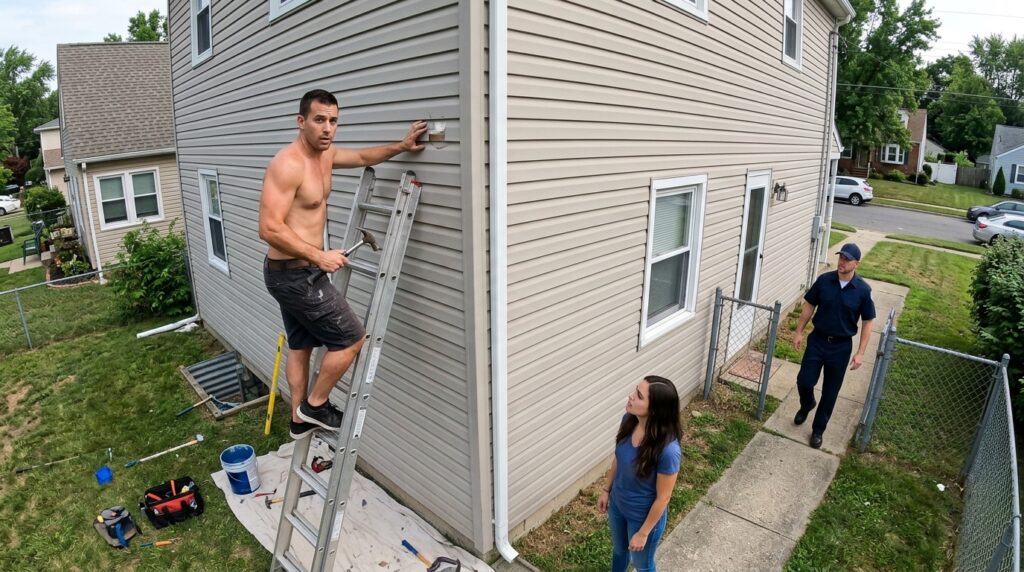
CHAPTER 3: THE CRUNCH OF BOOTS
“He’s here about the structural load, young man,” Mrs. Gable called out across the lane, her voice cutting through the dry midday air like a blunt saw through pine. “Don’t pretend you didn’t hear the siren.”
Mark didn’t look at her. He didn’t look at the small black square of her phone, which was still aimed directly at his belt line. Instead, his boots stopped at the perimeter of the gravel, his weight settling into the low, worn heels of his leather work boots. The white sedan from the city had come to a dead stop against the mailbox post. The front tire had rolled up on the dry, parched turf of the easement strip, leaving a shallow, dusty rut that smelled faintly of scorched earth and old rubber.
The driver’s side door swung open, its rusty bottom hinge catching on a tuft of crabgrass with a dull metallic click.
Officer Vance stepped out into the glare. He was a compact man with a thick, clean-shaven jaw that looked like it had been carved from cedar block. His dark uniform was crisp, despite the ninety-degree heat, but the yellow nylon lanyard of his inspection ticket-book was frayed at the clip. His high-crowned cap sat low over his brow, casting a dark wedge of shadow across gray eyes that looked completely unimpressed by the neat suburban lawns stretching down the block.
He didn’t pull a weapon, and he didn’t reach for a badge. His right hand simply dropped into the pocket of his trousers, his heavy leather duty belt groaning with a slow, administrative screech as he adjusted his stance against the incline of the lane.
“The work order says lot thirteen,” Vance said. His voice was low, rhythmic, carrying the dry flat gravel of the northern part of the county. He didn’t look at the house, and he didn’t look at the open ladder leaning against the cedar siding. He looked at the toolbelt resting on Mark’s hips, his eyes tracking the dark, oily sheen of the framing hammer handle. “Complaint came in twenty minutes ago. Unpermitted structural alteration on an exterior retaining line.”
“It’s not structural,” Mark said. His hand stayed loose by his flank, just three inches above the yellow card tucked under his belt. “It’s three-eighths vinyl planking over five-ply backing. The insulation beneath was rotted out by the spring storms. We’re replacing like with like.”
Vance let out a slow, dry breath through his nose. He took two steps forward, his heavy rubber soles crunching into the loose stones of the driveway, stopping exactly where the shadow of the silver maple met the sunline. “The caller says you’re cutting into the setback. Says there’s an active easement under the gravel.”
From the curb, Mrs. Gable took three quick, mincing steps forward, her floral blouse rustling like dry butcher paper. “It’s the eighty-four covenant, Officer! I told the dispatcher. The drainage lane runs six feet from my fence line. They’re pinning the scaffolding directly into the right-of-way.”
Vance didn’t look back at her. He kept his face tilted toward Mark, his gray eyes sliding down to the gray caulking smudge on Mark’s shoulder. “You got a permit sleeve on the property, son?”
“Inside,” Mark said. “Sarah’s bringing it down.”
“She better be,” Vance said. He reached down, unbuttoning the small leather tab of his notebook pouch with a sharp, dry pop. The paper inside was yellowed at the margins, the standard multi-copy carbon sheet used for civil warnings. “Because if I have to pull a stop-work notice on a Saturday, the county fee doubles before the ink is dry. And if you’re standing on an active easement without a utility waiver, the city doesn’t just fine you—they bring the backhoe.”
Mark felt the hard edge of the yellow cardboard voucher pressing against his ribs. The temptation to pull it out—to show the officer the old purple stamp from 1984—was a heavy, physical ache in his arm. But his training wasn’t in civil law; it was in structural stability. You don’t clear a line until you know what’s buried underneath the grass. If he gave Vance the stub now, the officer would have to log it into the county logbook, and once an old covenant was logged on an active ticket, the whole lot would be frozen for ninety days while the clerks in the basement turned over the old leather ledgers.
“The fence line is thirty inches clear of the structural foundation,” Mark said, his voice dropping into the flat, low register he used when a joist didn’t line up with the plumb bob. “The landscape pins from ninety-eight are still in the grass behind the shed. You want to walk the line, or you want to wait for the folder?”
Vance paused, his pen hovering over the blank carbon sheet. He looked down at the gravel between his boots, then looked up at the high, unfinished corner where the house siding lay bare to the tarpaper. A single blue-tailed wasp was hovering near the open eave, its wings making a tiny, dry rattle in the silence.
“I don’t walk lines on a Saturday unless the markers are missing,” Vance said, his voice tightening slightly. He turned his head then, just enough to catch the reflection of the sun in Mrs. Gable’s oversized sunglasses. “But the neighbor seems mighty sure about the dirt.”
“The neighbor doesn’t have the current plat map,” Sarah’s voice came from the porch screen, sharp and clear as a brass bell. She stepped out onto the top concrete step, her boots making a sharp click against the gray sealer. In her left hand, she held the bright neon-orange plastic sleeve, the corporate municipal seal of the county clerk showing crisp and black through the clear film. “Everything is right here in the folder, Officer. We pulled the permits three weeks ago.”
Vance watched her descend the steps, his pen remaining stationary. The shadow of his cap hid his eyes, but Mark could see the way the officer’s jaw tightened—the look of a man who had spent ten years realizing that every neighborhood fence was just a trap waiting for an inspector to trip the wire.








