
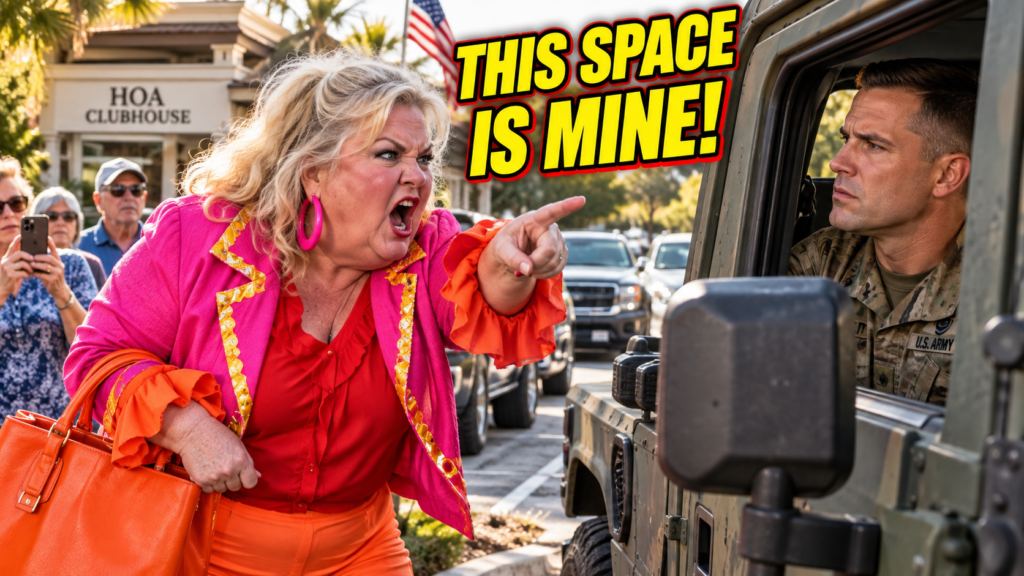
Chapter 7: Leaving Room
Over the following weeks, the change wasn’t dramatic.
Karen didn’t become a different person overnight.
She still noticed crooked trash bins.
She still disliked loud music.
She still cared deeply about how the neighborhood looked.
But when she saw something she believed violated a rule, she stopped herself from confronting the person immediately.
She emailed management.
Sometimes the HOA agreed with her.
Sometimes it didn’t.
Either way, the decision no longer depended on how loudly she argued.
The veterans’ outreach program became an annual event at the clubhouse.
Karen attended the following year.
She arrived early.
This time, she parked in an ordinary resident space.
When a military vehicle approached the clubhouse, Karen watched it pass without saying a word.
The same retired couple were there.
The husband smiled at her.
She smiled back.
Later, Martha found Karen near the entrance.
“You coming inside?”
“In a minute.”
Karen was watching an elderly veteran struggle with a box.
She walked over and helped him carry it.
There was no audience.
No camera.
No argument.
No opportunity to prove she was right.
Just a small act of usefulness.
The veteran thanked her.
Karen nodded.
Then she looked toward the parking lot.
The space where everything had started was empty.
That empty space meant something different to her now.
It wasn’t hers.
It wasn’t the military’s.
It wasn’t the HOA’s in any personal sense.
It belonged to the community because the community needed it.
And Karen finally understood the distinction between having rights and having authority over everyone else.
She had wanted respect.
What she had actually needed was trust.
Trust could not be demanded with a rulebook, a raised voice, or a handbag placed across a hood.
It had to be earned by leaving room for other people.
Months later, the HOA newsletter included a photograph from the veterans’ event.
Karen was standing near the entrance, helping an older couple find their way inside.
She barely noticed the camera.
She wasn’t posing.
She wasn’t making a point.
She was simply there.
And for the first time in a long time, the people around her weren’t giving her space because they were afraid of an argument.
They were giving her space because they trusted her to use it well.








