
Chapter 5: The Pattern Nobody Wanted to Discuss
Karen expected the HOA board to defend her.
Instead, she found three board members already sitting around the conference table.
Martha placed the parking incident report in front of them.
No one called Karen rude.
No one called her a bully.
They simply reviewed what had happened.
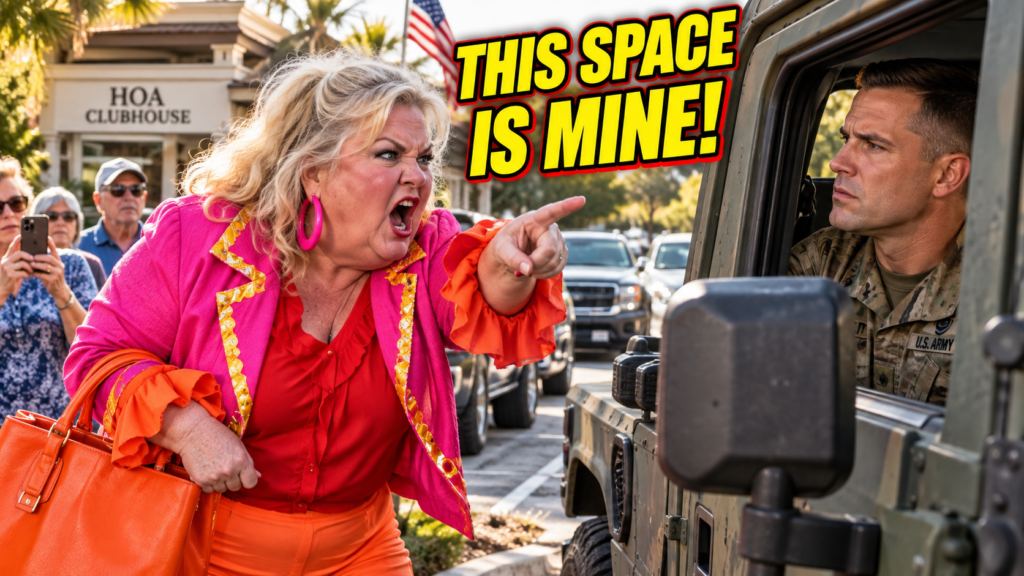
The security footage showed Karen entering the space before the military vehicle arrived.
It showed her placing the cone there.
It showed her standing in front of the vehicle.
And it showed her refusing multiple requests to move.
Karen watched the footage in silence.
Then came something she hadn’t expected.
Martha opened another folder.
It contained complaints from residents.
Not about parking.
About repeated attempts to control shared spaces.
A neighbor whose guests had been confronted.
A couple who had been accused of violating a landscaping rule that did not apply to their property.
A delivery driver who had been told he wasn’t allowed to use a loading area.
An elderly resident who had stopped attending clubhouse activities because she didn’t want another confrontation.
Karen’s face tightened.
“These people are exaggerating.”
One board member shook his head.
“The issue isn’t whether every complaint was justified. The issue is that there are enough of them that we have to address the pattern.”
Karen looked toward Martha.
“You’ve been collecting complaints against me?”
“No,” Martha said. “Residents have been submitting them.”
That distinction hurt more than Karen expected.
She had always believed the problem was one person misunderstanding the rules.
Now she was seeing a community that had quietly adapted around her behavior.
People took different entrances.
They avoided certain parking areas.
They chose different times to use the clubhouse.
They had learned when not to argue with Karen.
And Karen suddenly understood something uncomfortable:
People weren’t respecting her authority.
They were avoiding conflict with her.
The board decided she would receive a formal notice requiring her to stop personally enforcing HOA rules and to direct disputes through management.
No suspension.
No dramatic punishment.
Just a boundary.
Karen signed the acknowledgment reluctantly.
But as she left, she noticed the military vehicle outside.
The service member was unloading supplies.
A group of older veterans had begun arriving.
One of them recognized the driver and shook his hand.
Karen stopped.
She had expected a confrontation.
Instead, she saw ordinary people helping one another.
For the first time that afternoon, she wondered whether she had been arguing about the wrong thing.
Then she heard her phone vibrate.
It was a message from her adult daughter.
Mom, I saw the video. Can we talk?
Karen stared at the screen.
She hadn’t realized anyone in her family had seen it.








