
Chapter 6: What Stayed Behind
Three months later, the house sold.
The buyer accepted the disclosed easement issue after the drainage plan was revised and documented.
Daniel and Linda moved closer to their daughter.
The transition was harder than either expected.
On moving day, Daniel walked through every room one last time.
He remembered birthday dinners.
Arguments.
Christmas mornings.
His father’s workshop.
Linda’s first garden.
The years had accumulated in the walls.
But the house was ready for someone else’s story.
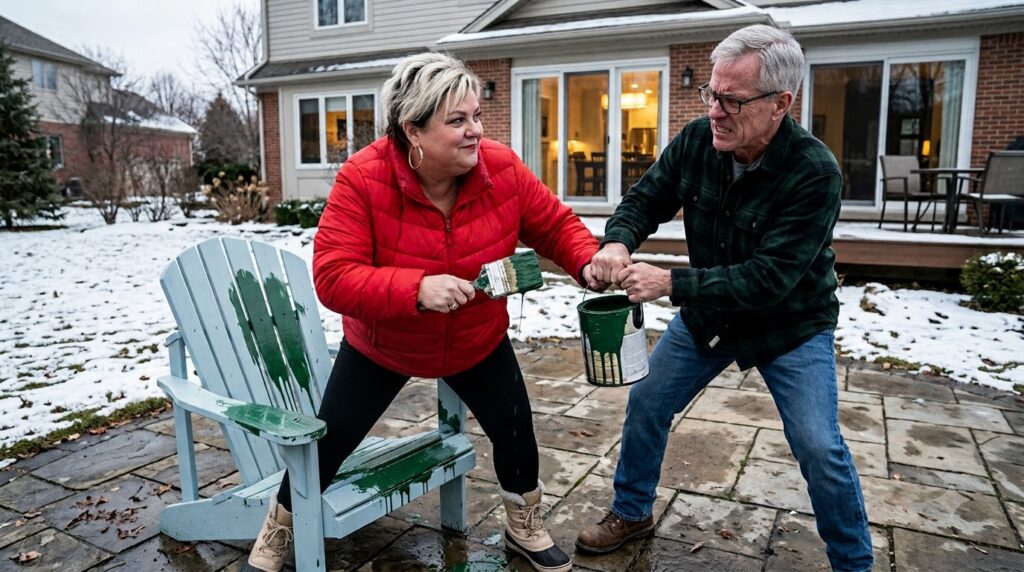
Outside, the restored chair sat beside the moving truck.
The woodworker had managed to save most of it.
There were faint marks beneath the new finish where the green paint had penetrated too deeply to disappear completely.
Daniel decided to leave them.
Linda came outside.
“Ready?”
He looked at the chair.
“Almost.”
He picked it up.
They carried it together.
They didn’t leave it behind.
Karen watched from across the street.
She didn’t approach.
Before Daniel got into the truck, she called out.
He turned.
“I was wrong,” she said.
Daniel waited.
Karen glanced at the chair.
“I thought if I made enough noise, nobody could change anything.”
Daniel nodded once.
“Sometimes things have to change.”
Karen looked down.
“Even when you don’t want them to.”
“Especially then.”
She nodded.
That was all.
No dramatic reconciliation.
No sudden friendship.
Just an acknowledgment that a line had been crossed and, eventually, recognized.
Months later, Daniel placed the chair on the back porch of their new home.
Their grandchildren loved it.
They climbed onto it, argued over who got to sit there first, and left fingerprints on the freshly cleaned arms.
Daniel pretended to complain.
Linda laughed.
One evening, after everyone had gone inside, Daniel sat alone in the chair.
The faint green stains were still visible beneath the restored finish.
He ran his fingers across one of them.
He had once wanted the marks completely erased.
Now he wasn’t so sure.
They reminded him that homes were never really about wood, walls, paint, or property lines.
They were about the things people believed they had a right to protect.
Their privacy.
Their memories.
Their families.
Their dignity.
And sometimes, even their mistakes.
Daniel looked through the window at Linda preparing tea.
For months, he had believed the biggest problem was a neighbor who had crossed a property line.
He finally understood that the more important boundary had been inside his own marriage—the line between what two people assume the other understands and what they actually take the time to say.
Karen had damaged a chair.
The green paint had stained the wood.
But the confrontation had forced Daniel and Linda to confront something neither had wanted to see.
They had been standing in the same house while quietly imagining two different futures.
Now they were finally building one together.
The chair remained on the porch.
Blue beneath the restoration.
Green beneath the blue.
A permanent reminder that some damage cannot be completely erased.
But with enough honesty, patience, and care, it doesn’t have to define what comes next.








